
A Dog Person
A Reflection On Life
I grew up watching as our family dog, Dusty, a small golden retriever, was isolated to a small, fenced-off area of the backyard. As kids, we played with her as often as we could, but being a caged animal, she didn’t know how to act when she had a visitor in her otherwise solitary confinement.
She’d buck around, jump all over you, scratch you, and get mud all over your clothes in her excitement. Eventually, we avoided her, like some dirty secret kept locked up, which only made her behavior worse.
Watching the neighbors interact with their obedient Doberman looked like fun. I knew we were doing it wrong but had no idea how to fix this.
As kids do, one of us would leave the gate open from time to time and she’d bolt from the yard as fast as her legs could carry her. For hours, we’d chase her through the neighborhoods — into busy streets. She was a fugitive on the run, and I remember hoping that this was the time she’d get away.
Dusty never made it out alive. I swore that I’d never keep a dog cooped up like that when I was an adult. I was going to be a real dog person. Maybe I’d have a Doberman too.
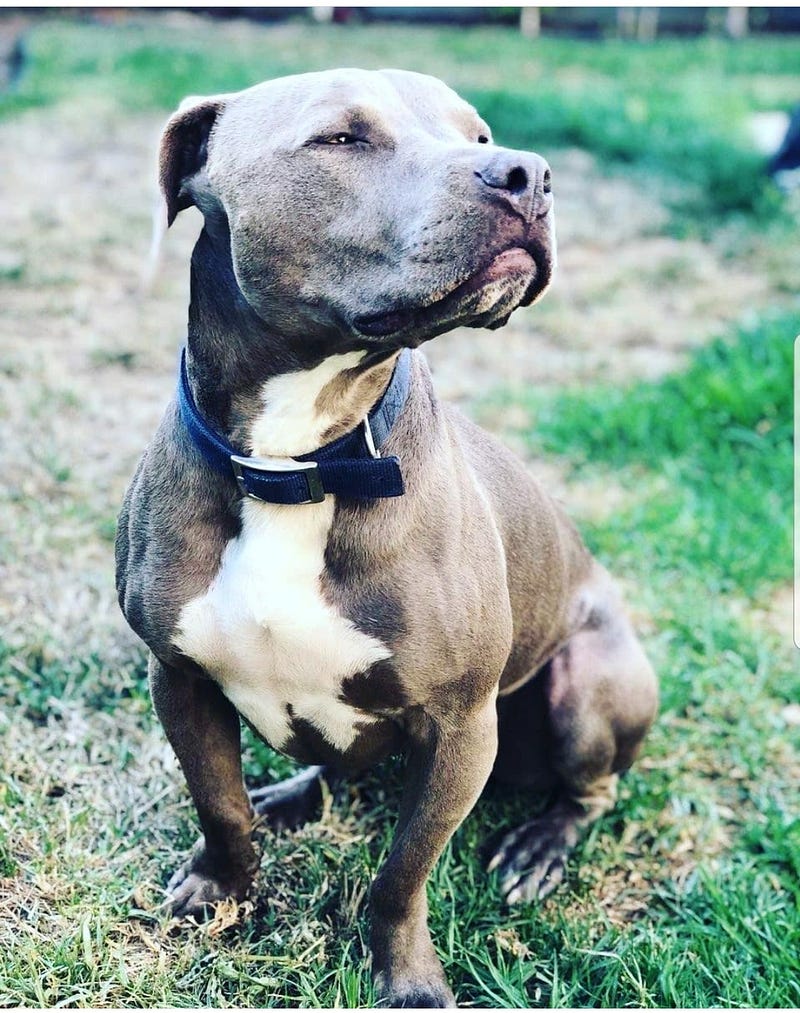
Roscoe came to live with my now ex-wife and me in 2014, at 8 weeks old. A blue-nosed American Pitbull Terrier, he was a land shark, tearing into anything and everything he could.
Shoes and clothes were shredded daily. A wrought iron hose reel was ripped right out of the concrete. What he didn’t eat, he pooped on.
He was just over six months old when the last thread of my marriage unraveled — in my alcoholic dysfunction, my wife had decided to leave me. Though the divorce had nothing to do with Roscoe, I recall with clarity that the destructive antics of a puppy seemed to pour gasoline on the fire. It was just one more thing that she needed to get away from in a hurry.
That divorce rocked me. A few weeks into it found me at one of the lowest points of my life — working a job I hated, living in a house that I couldn't afford, with the guilt and lament of my inability to cope with my own bullshit stacking up around me like a runaway Tetris game.
I barely had the mental energy to function, let alone give Roscoe the attention he deserved. He’d sleep in his crate next to my bed when I got home from a night shift, but while I was at work, Roscoe was kept in the backyard.
After one especially grueling 12-hour shift, I returned home to find hundreds of pieces of yellow fluff strewn all over the yard. Roscoe had somehow managed to tear the door from the wooden shack that housed the water heater and had systematically ripped the insulation off of it, piece by piece.
Absolutely exhausted, I made up my mind. I would have to re-house Roscoe over the next week. I was in no shape to take care of this dog — to give him what he needed. It was for the best. I really wasn’t a dog person anyhow.
But as the week dragged on, I realized I couldn’t do it. He was all I had. I’d get home and the sound of the front door closing echoed through that empty, quiet house. Roscoe was there, elated to greet me every time — whipping his thick, crazy wagging tail on everything — my only friend in the world it seemed.
Time heals all wounds, as they say. The acceptance of my failed marriage settled in, and though I was still far from a dog person, Roscoe and I eventually found our rhythm.
A couple of years after the divorce, I met the woman who would later become my wife. The first time she met Roscoe, he jumped into her lap like the 65lb clown that he was. Embarrassed, I yelled at him to get down off of our guest. To my surprise, she waved me off. He was her boy from the get-go.
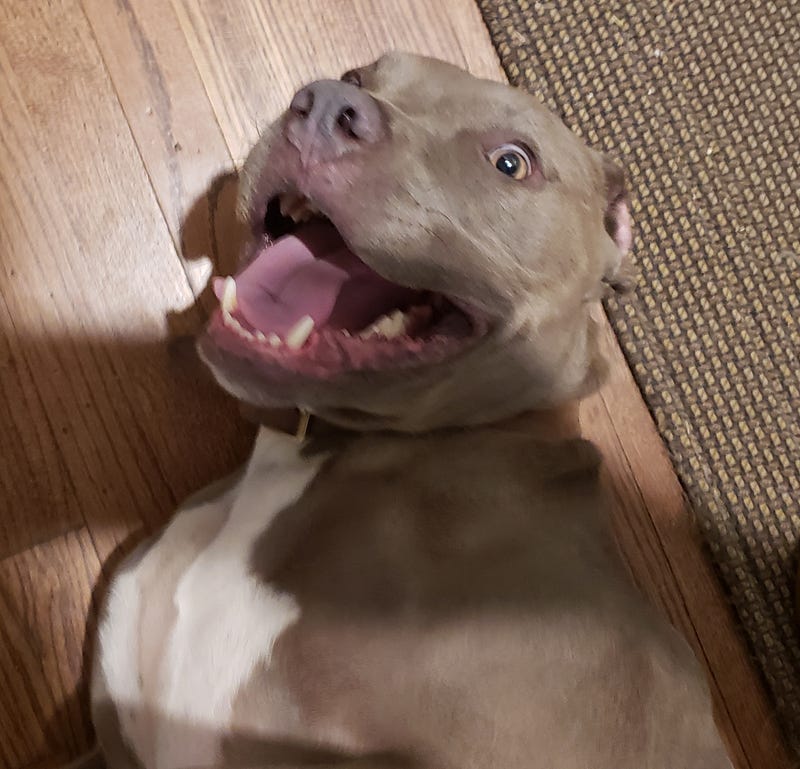
Her love for dogs was undeniable, and I followed her dog person lead as we took Roscoe (along with her dog Roxy, a female shepherd mix) nearly everywhere we went for the next couple of years: dog parks, the dog beach, hiking, the lake. Our relationship was fresh and open, and Roscoe was in heaven.
But two years later brought the demands of a new baby, alongside the navigation of a pandemic, and dog-centered trips became much less of a priority. We found a house with an enormous, hilly backyard where Roscoe was able to run, play, and chase squirrels, but my heart ached when I’d see him get excited for a car ride, only to realize he wasn't going anywhere with us.
Roscoe began to look depressed — even seemed to actively avoid our toddler. The weight of my shortcomings began to weigh on me again. He deserved better.
As fate would have it, grace smiled on Roscoe, giving him a blessing in the form of an 18-year-old boy who was trying desperately to find his place in the world — my eldest son.
As the silver lining of another failed relationship, Bradley had been living with his mother a few cities away for most of his life, though he’d come to see me once or twice a month.
He and Roscoe quickly became inseparable — best friends doesn’t describe it. There was an undeniably deep connection between these two hams. On weekdays, I’d open the door to his room to find the two of them hiding from the rigors of the workweek, spooning in bed.
On workdays, Roscoe waited for his boy with a sadness that comes only as a product of real love. And really love him, he did. It was like they completely understood each other. Brad was a dog person.
About a week ago, Brad called me over to see Roscoe after getting him out of bed in the morning. I could hear the fear in his voice. Roscoe was standing in the living room, as rigid as a sawhorse. “Come on Roscoe, let's go outside,” I called. He was frozen, his gaze looked panicked.
I gently picked him up and placed him on the grass, thinking that he may have just slept in the wrong position — now seven years old, he had been subject to some stiffness in his joints. But I was terrified as watched his back legs give out from under him.
The prognosis at the vet’s office wasn’t good. A neurological issue in Roscoe’s spine had led to a sudden and nearly complete paralysis from the waist down. With surgery, there was a chance he could recover — but that surgery would cost anywhere from 15–20 thousand dollars, and there was no guarantee that he’d be pain-free, able to walk again, or even control his bladder or bowel movements.
It was one of the heaviest decisions I’ve ever had to make. The doctor made Roscoe comfortable with a sedative and we lay with him and each said our goodbyes before the final shot was given.
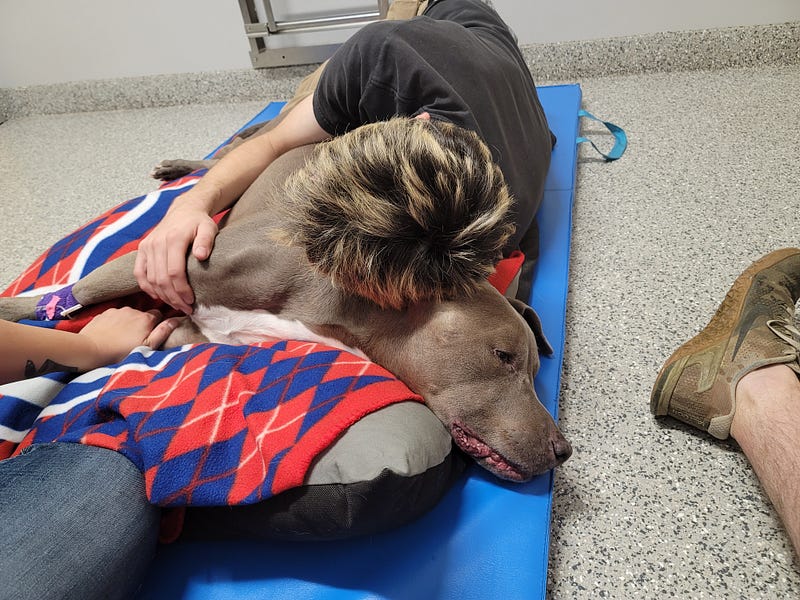
As he faded away, the pain and suddenness of the situation were almost too much to bear, and rivers of emotion poured out of me. That wasn’t just our dog lying there. It was our family — forever changed, forever short of the whole that it had once been.
The ache was deep — deeper than I ever imagined. Was this what being a dog person was? Because I didn’t want it anymore. I wasn’t ready to feel this.
But with nowhere to run, I was forced to surrender to the situation. Suddenly clarity and peace washed over me as I saw my wife and son and I, united in the intimacy of this scene — closer than I’d ever witnessed — embracing our beloved boy in his last moments.
That’s when it dawned on me. Being a dog person was about going for the ride along the full spectrum of where that love takes you, not just the good times. It was frustration. It was exhaustion. It was joy. It was pain. It was family. It was death.
It was life.


