
A Different Perspective on the Top 3 Medium Advice
Focus on adding value, not take it

I joined the Medium Partner Program last June. I didn’t have high expectations in terms of earnings. My idea back then was to use it as another channel of distribution for the articles I already post on my website.
But after publishing some posts, I saw a few cents here and there. Then I realized that Medium isn’t just another distribution channel. I can use it as another income stream.
After researching and reading a ton of posts on how to succeed on Medium, I learned three important points:
- Publish frequently (yes, not just write — there’s a huge difference)
- Submit to publications
- Engage with other writers’ stories
But instead of thinking about how doing these things can help you earn more, use it to learn and improve instead.
In July, I did all those things. And it paid off. I earned enough to pay for an annual Medium membership.
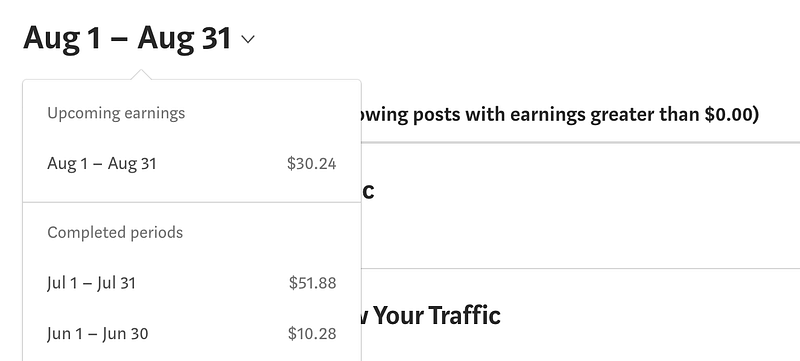
I know I’m still far from replacing my freelancing income with writing on Medium. And that’s okay. I’m enjoying my journey and continuously improving. My current goal is to break the $100/mo barrier.
#1: Instead of Writing, Publish Frequently
Writing daily is the advice you’d often read about if you want to improve your writing. I say that’s terrible advice.
The goal of writing is to get your stories read. Writing doesn’t do anything.
Instead of writing daily (or frequently), your goal should shift to publishing.
When you publish, that’s the only time other people can actually read your articles. That’s the only time you’d know if your stories are good or bad. You can’t improve if you just put words on your screen (or paper). You need feedback from other people.
In Medium, feedback comes in the form of views, reads, claps, and responses or comments.
If your published stories have neither of those, that’s an indication of bad writing. Or, it could also be you’re on the wrong platform. Either way, at least you know for sure.
Writing doesn’t get you to that conclusion.
Key take away: Don’t focus on writing. Focus on publishing. Learn from it.
#2: Submit to Publications, But…
Medium Publications have a bigger reach and captive audience. That’s why this is the go-to advice for new writers. But instead of looking at it to earn more money on Medium, use it as a way to improve your writing. They have editors who can give you feedback on your posts — which is another way to verify if your writing is good or bad.
Continuing from above, when you submit to a publication, there are only two possible outcomes:
- They publish your article
- They reject your article
That’s pretty much it.
If they accept your post, you know it’s good. If they don’t, then it’s either terrible or just not a good fit. Submit to other publications making sure you read the submission guidelines and the topics they publish.
If after all those submissions and your articles still aren’t accepted in publications, don’t whine and complain about not getting accepted in the publication. That just means the editors deem your post not good enough. Yet.
Breathe in.
Breathe out.
Move on.
Publish it yourself. Determine for yourself whether it’s a high-quality post or not. If people are reading and commenting on your work, then it’s a great article. All the publications didn’t see the value of your work and that’s their loss. But you can only know for sure when you submit to different publications.
I’ve read many stories on how an article was rejected by big publications, then, after the author self-published, got asked by the same publication to add it to theirs.
Key take away: Make a list of all the topics you write about. Find 3–5 publications that publish those topics. When you have an article ready, submit to publication 1. Make your way down that list if they get rejected. If it still doesn’t get accepted, publish on your own. Breathe in. Breathe out. Move on.
#3: Engage with Other Writers
I see Medium as a niche social media site. It’s a community of writers from different industries. And what do you do on social media?
Be social. Engage.
That means reading other people’s stories, learning from them, showing your appreciation and support through claps and comments.
I don’t have any concrete data on whether Medium rewards you when you read other people’s work or respond to their stories. But whatever your motivations are for writing on Medium, use the platform to learn as well. Don’t be in it solely for earning.
When I was researching publications, most wrote in their submission guidelines something along the lines of reading other published stories so you know how the published works look like (style guide and formatting) and the topics the publication covers.
The easiest way to develop a great gut feeling for what you should submit to Better Marketing is to read Better Marketing. It might sound obvious, but a lot of our submissions show people don’t do it.
— Better Marketing Submission Guidelines
Apparently, there are many writers who don’t do that.
Key take away: Read other writers’ stories. Follow them. Give a comment if you can spark a meaningful conversation. Take advantage of Medium’s highlights feature. If something resonates with you, highlight it then use it as a quote or an idea for your next story later on.
Over to You
There are tons of advice for earning more on Medium. But if you truly want to succeed, go beyond the earnings. Make sure you’re providing real value to other people’s lives.
Use Medium to learn and improve. The only way you can do that is by publishing your stories, getting feedback, and adjusting your work accordingly. And as with any business, earnings are only a byproduct of the value you create for other people.