
a DeFi stream of consciousness and the opportunity for “trustless games”
I’m going to walk you through a stream of consciousness of my DeFi journey over the last 3 weeks (it feels like 3 months). My hope is to dive into the market and user psychology of what is happening right now, and let you draw your own conclusions on where the opportunities are. As I remark at the end of this long ramble, I think the real opportunity is the blue ocean of trustless game design — and not just “money games”, hopefully.
I’ve been following DeFi from an “intellectual” standpoint since late 2018, talking to the leading players in the space, including 0x, Uniswap, Compound, MakerDAO, Set Protocol, Loopring, Melon, Nomisma, etc. I thought several of these projects were very interesting, although I was concerned that some projects would concentrate systemic risks in a way that reminded me of what I dealt with at Cleary as a derivatives/bankruptcy lawyer in 2008, when everyone thought central clearinghouses for OTC derivatives like CME/ICE/LCH would solve all of the world’s problems, but you ended up just replacing one TBTF with another. Some of these projects had collateralization and liquidation triggers established in a rote waythat would be very damaging in the case of a “flash crash”. Indeed, this is what we ultimately saw with the ETH flash crash that led to a massive undercollateralization of the MakerDAO ecosystem in Spring 2020.
Despite these risks, I saw and believed early on in the exponential potential of composable financial primitives that anyone could participate in. It was never about “banking the unbanked” (at a DeFi panel in 2019, I think I called much of the movement “leveraged crack”), but much more about utilizing trustlessness as a primitive that could cut away all the fat that has accumulated in our financial pipes over the last few decades. Indeed, what has been constantly surprising to me has been the speed and magnitude of resilience the DeFi ecosystem has demonstrated in bouncing back from what should have been multiple cataclysmic DAO 2.0 events.
In January 2019, I had hours of discussions and debates on this with smart institutional folks, and while I could appreciate their perspective, I was quickly reminded of the saying, “To a man with a hammer, everything looks like a nail.” To understand what was happening, you had to step out of the bounds of conventional thinking. As just one example, I was a big fan of Carbo Clan’s project CoinCow, which was the first real play on crypto meme culture (“milking cows” to collect your coins) and “yield farming” before that even became a term, all instantiated in fungible, decentralized smart contracts (not centralized mining output contracts) designed to interoperate with leading DeFi protocols. Yet, in the course of trying to convince others of the investment case behind memes and viral narratives, I became a meme myself.
In Q1 2019, my partner Sam and I decided to focus full time on gaming/interactive investments, and I largely stopped paying attention to DeFi until May 2020, when I was starting to see some genuinely interesting innovations as the cumulative innovations of Compound (governance token yield mining), Maker (leveraged money creation through collateralized debt pools), Synthetix (MINTR), UMA (decentralized investment bank), Uniswap (AMM), and others started to stack at scale. From May to August 2020, I kept up with the developments from an “analytical” standpoint, but by mid-August I concluded that I had become a DeFi dinosaur, as reading was no substitute for “doing”. So I decided to buy 10 ETH as my “DeFi learning fund” on August 13, viewing it not as an investment or trading pool but as a way for me to understand what in the world was going on.
The first day I started, DeFi was hitting its YAM frenzy with $500m locked up in YAM yield farming contracts. YAM itself was an incredible drama where there was a bug that rendered it worthless on Day 1, and they needed a certain % of the community to vote to fix it, but to vote cost a crazy amount of gas, so it was a classic collective action problem. Ultimately they got the necessary votes but failed to fix it anyway — although the project has resurfaced in v2 form. In DeFi, nothing ever dies, it only gets iterated and improved.
Without getting into the detail of what YAM is, the relevant point was that the frenzy sent Ethereum gas prices skyrocketing to about 5–10x normal levels so that by day 1 I had spent about 2.5 ETH in gas alone for trying out various DeFi transactions, such as:
- Opening a Maker CDP vault to get leverage on my ETH
- Getting sUSD leverage on my ETH by borrowing synthetic ETH against my actual ETH on Synthetix, then selling the synthetic ETH for sUSD to get leverage against my ETH
- Trying DeFi management tools through Instadapp
- Borrowing/lending on Compound
- Staking stablecoins for y tokens on Curve
I highly encourage everyone to do the same. There is no other way to learn what this is all about. Minimum 10 ETH given gas fees, ideally 20.
For the 75% or so I had left, I decided I would try to actually “play the game” and turn a profit. I missed YAM, but quickly stumbled on the next one that felt instantly appealing: $BASED (based.money). Amidst the sea of leveraged DeFi crack, the artistic wonder that is counter-culture, equity-like upside to magic internet money, created by anonymous ghouls, with mindshare and marketing fueled by sick retro memes , well what can I say other than $BASED stood out:
“Welcome to game theory for degenerates. The BASED protocol is a DeFi game of chicken designed to shake out weak hands and yield the highest gains or those who understand the rules.”


… And amazing videos:
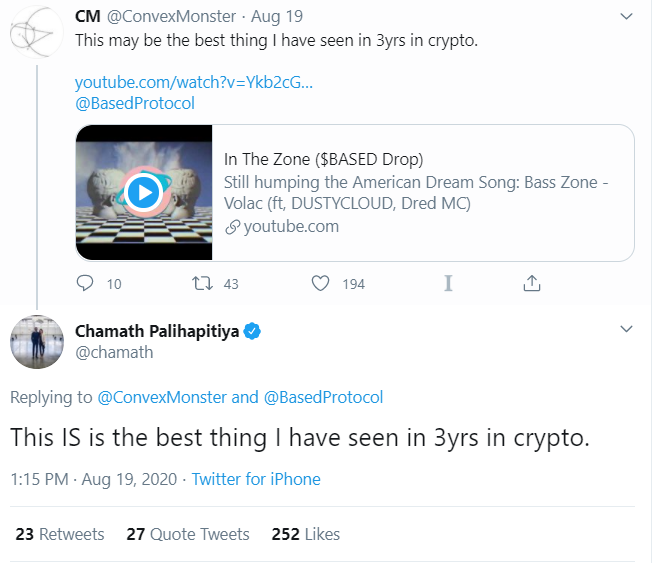
Lex had an interesting culturally take on the project as a whole here.
Simplistically, $BASED is like having an equity stake in the expansion of its money supply. After 97% of $BASED has been issued, it will “rebase” to a price of $1 (like a stock split, or reverse stock split, as applicable) and adjust quantity accordingly. This should obviously be market neutral, but if you subscribe to the TSLA theory of retail FOMO, it’s obviously market positive! I think there is market demand for a stablecoin that you own because it’s supposed to be around $1, but get an equity kicker every so often as more people come into the game (i.e., the number of “dollars” you own expands as more people use it). Imagine having an equity interest in the expansion of USD….
So how do you go from nonexistent currency to fair distribution with zero VC, zero premine, and anonymous founders? That’s the genius of the $BASED distribution game: only 100k would ever be issued prior to rebase, 25k through a Pool 0, and 75k through a Pool 1. In Pool 0, you would earn $BASED by staking sUSD (Synthetix USD) and earning your pro rata share of all sUSD staked in $BASED. So basically, free money as long as there was no smart contract risk (or some other “rug pull” like keys not being burned) … which in the case of a project overtly sponsored by anonymous ghouls proclaiming “degenerate finance” should be crazy high, but counterintuitively felt like a low risk despite the fact that the contracts were not audited prior to launch (precisely because it was so “unpresentable”). The supply for Pool 0 would decline exponentially every 24 hours (so 12.5k day 0, 6.25k day 1, etc.).
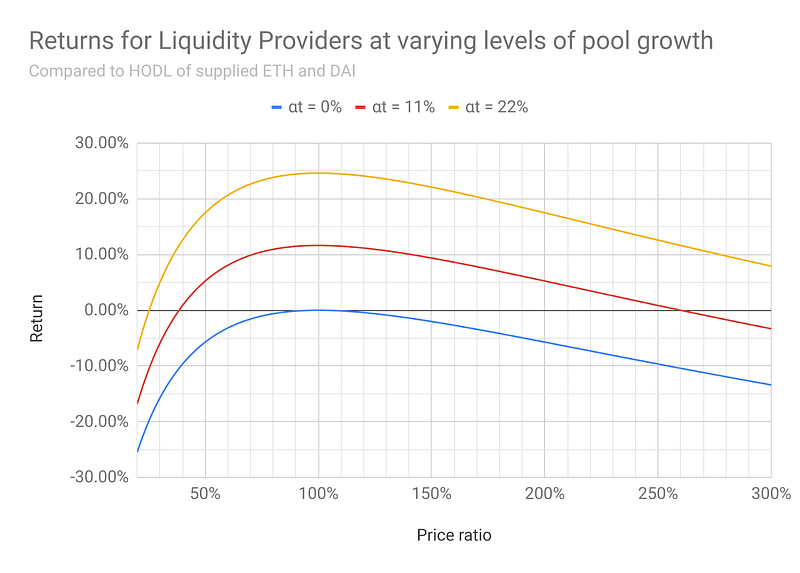
Pool 1 started after Pool 0, and was where the real innovation happened: to earn your pro rata share of the 75k tokens (37.5k on day 0, exponentially declining every 3 days), you had to stake Uniswap LP tokens in the $BASED-sUSD pair. So the game was this: sell vol against a hypervolatile asset, and in exchange get your share of a 10000% APY token … see this article for a good overview of what Uniswap LP returns look like.
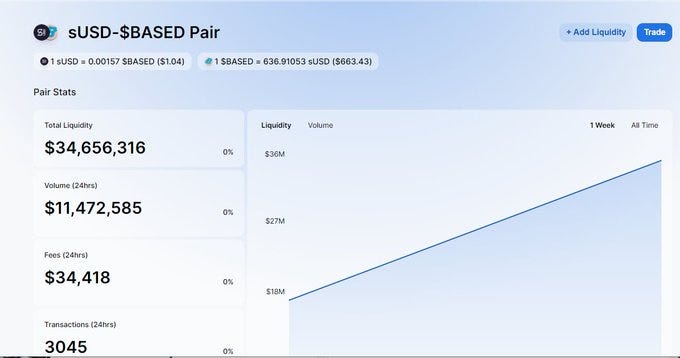
Overnight, the sUSD-$BASED pair became one of the top 3 liquidity pairs on Uniswap (from not even existing a few days prior).
I myself chickened out a bit too early. I didn’t want to be last off the boat, so I pulled out of farming Pool 1 once about 2/3 of the $BASED supply had been issued. Big mistake that probably cost me at least 10bps maybe closer to 20bps of the protocol ownership. The right strategy would have been to wait until 90% issuance, close out the Uniswap LP pool, and then market buy $BASED at the lows around $50. Oh well, hindsight is 20–20.
I think there’s a lot more that should be explored on the incentives side for zero VC, zero founder reward, zero pre-mine projects. The lack of a “community grant” fund makes it harder to bootstrap partnerships to accelerate adoption, but because the only way the project can reach escape velocity is through the code and the infection rate of mindshare, it’s actually a fascinating alignment of founders and the community as a whole — the only “inside info” that the founders have relates to the knowledge of what’s coming next. And actions certainly speak louder than words — I like it a lot.
It’s worth dwelling here on how GOOD it feels to earn free money. Or for pool 1, even it’s not free (because you’re short vol by being an LP), the feeling that you are EARNING your stake in a community feels very good. The fact that there’s risk makes it feel even better — that’s why when people joke on Twitter about how it’s hard work to tend your “crops”, it’s not actually really a joke. There is real proof of work happening here, and for communities that are long term sustainable like I think $BASED will be, that’s as equitable a distribution mechanism as I can come up with.
This is why from a regulatory standpoint, the claim that DeFi is a regulatory disaster is somewhat misplaced. Often there is no Howey issue with what is going on at all: this is not an expectation of profit for some undeveloped project in reliance on the efforts of others — these are projects IN PROD where the efforts are 100% driven by you, and your willingness or not to interact with these smart contracts. From a distributional standpoint, projects like $BASED are a huge improvement versus the traditional venture model you see in predecessors like AMPL. The bigger issue is market manipulation and wirefraud. For years, everyone thought FX was “unregulated” and folks could do whatever they wanted. That all changed billions of dollars of fines later as the self-style “Cartel” allegedly colluded to drive the WMR fix, and it resulted in years of headache for the entire industry. Of course, FX is not a “security” but the DOJ’s jurisdiction under wire fraud rules is incredibly broad, reaching any “deceptive or manipulative device using interstate commerce”. If it becomes relevant, the regulators can come pull the rug. That is, unless you’re a bunch of anonymous ghouls. (Who after all would in their right mind trust a bunch of non-existent skeleton developers?)
If all of crypto is about narrative economics, then the projects with the best memes and strongest organic communities should win because the R0 is higher than anything else out there. But herein lies the rub. Imagine if I presented this to a corporate Investment Committee. And my investment thesis were the power of the memes. And we had no idea who the founding team was. And of course the contracts were unaudited. Oh, and the culture of the project was explicitly anti-VC in nature. I would literally get laughed out of the room, assuming I made it to the room to begin with.
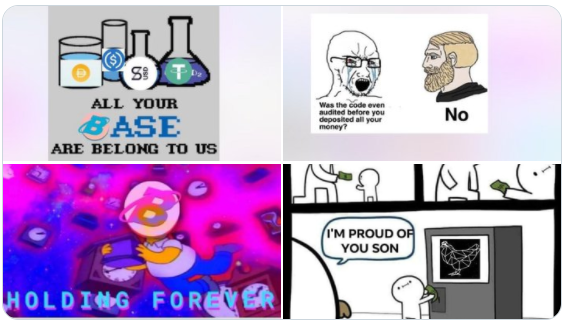
Incidentally, I’m also long “memecoins” like Tendies (the dogecoin of DeFi). Just look at these fried chicken memes: Here is an imgur gallery. The point of all of this is, to make money in DeFi, you must not take yourself too seriously.
Funny enough, Tendies now also have real utility, and I started using my Tendies to farm Kimchi last night. Kimchi is a fork of Sushiswap/Juno with fixed inflation per block (hyperinflation initially but asymptotic over time) and therefore CRAZY yields (like hundreds of thousands of percent APY). You earn Kimchi by staking the Kimchi-Tendies pair on Uniswap, and staking those Uniswap LP tokens. Obviously none of this is audited either. Oh and the founders didn’t burn the keys so they could pull the rug out. Oh well, I had to do it, it was my nationalistic duty. The Kimchi game has none of the “heat” that $BASED does, and I wouldn’t be surprised at all if it suffers a “hot dog” style death. Yet, it’s actually a fascinating economic experiment, in terms of whether a project can go from literally a ponzi scheme (unsustainably high yields propped up by the sole fact that new money is coming in to buy Kimchi to stake in Uniswap LP pairs to earn more Kimchi) to something more lasting. In this particular case, I’m highly skeptical, but I’ve already withdrawn 5x my original principal in <2 days so I’m chillin.
There are definitely some interesting long term ‘buy and hold’ types of opportunities on the liquid macro side that should be explored. Like xDai STAKE for L2 scaling (IMO, most likely to win the Reddit scaling challenge for ETH) or DXDAO for DAO governance. But I have no edge in figuring this out given my day job, so no real point in talking about it.
In any event, all this talk about money games is ultimately making me bored. I do think there is a large sample space of “trustless game design” that can/should be explored (the NFT hypothesis is a bit boring), whether it involves monetary incentives or not. A lot of this yield farming stuff is not new at all (I would start with Raph Koster’s blog as a starting point). Given the psychology at work here I think this “bubble” can actually last for a while because it’s just individual incentives playing out at a potential scale we haven’t seen before, yet with limited mass retail participation to date (given the gas fees, all this is being led by whales and followed by the “mass bourgeoise” who’ve been experimenting with DeFi in the last 3 months … it’s too complicated for everyone else).
I’m much more interested in how all of these primitives can be used to bootstrap UGC communities (user-generated content) at scale. I wish the novel experimentation around DAOs, incentive models and community formation we are seeing in DeFi were applied less to farming and fermentation (http://kimchi.finance) and more to the generation of positive-sum creative collectives like this idea from Peter Rojas: https://twitter.com/peterrojas/status/1300822317807804416.
I think the next generation of “trustless games” are not going to be about just money (like most DeFi yield farming projects), nor are they going to be AAA creations with NFTs promoting open economies. I think they are going to exhibit stupidly simple yet compelling core mechanics that tap into the unknown, emergent behavior of the herd for delightfully unexpected experiences. What Mr. Beast is doing with things like his “finger on the app” challenge are good indicators of where we’re heading. So what’s the next Reddit Place?
That’s where the real long term opportunity lies here, and I’m pretty sure we are going to be at the center of it. Who is building in this space? Reach out to me at [email protected] and let’s chat. I want to organize a community, hackathon, incubation lab of sorts for formative projects in this ecosystem, and would love to learn more about ways this might be productively accomplished.
So long story short, the only way to learn is to experiment by doing. Go get your feet wet, and then you can think about what to do next.


