
A Deep Idea About Reality that Can Make You Incredibly Open-Minded
It’s also ultra-liberating
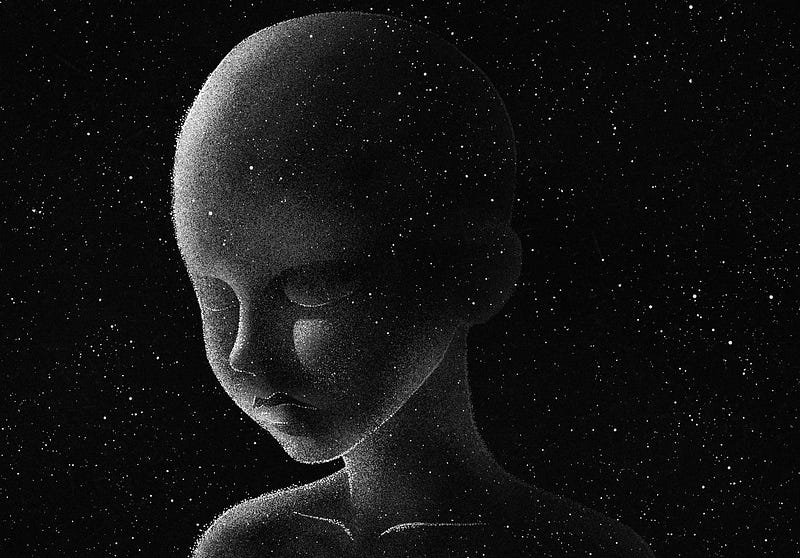
Back in my philosophical rabbit-hole diving days, I had the (mis)fortune of stumbling across Solipsism.
At its core is the idea that you can’t be sure if reality exists—it could be an illusion conjured by your mind.
When you’re dreaming, it seems 100% real. Only when you wake up do you stub it away with, “Bah! That was just a dream” and go out to conquer your “real” day.
But how do you know it’s real? Couldn’t reality be us all sleeping in some unknown dimension and “dreaming” our entire lives?
Even worse, how do you know anyone apart from you exists? Or if even you exist?
Reality could be a lone brain floating in an ocean of nothingness, “dreaming” it all.
Thankfully, Descartes’s “I think therefore I am” gives us certainty of the latter. But your mother, dog, wife, and pesky neighbor?
They might not exist after all — even me and this article you’re reading could be a projection of your dreaming “real” mind.
Nobody Is Really Insane (or Sane)
Sanity is subjective — we brand anyone that deviates from what the majority collectively believes as “insane”.
“Perhaps a lunatic was simply a minority of one”
— George Orwell
The line between wisdom and insanity is excruciatingly thin.
One day, you could be a celebrated genius with a stack of Nobel prizes. But the moment one stray idea germinates enough, you could be thrown into a mental asylum.
History tells us legends like Nikola Tesla, Friedrich Nietzsche, Leo Tolstoy, and Abraham Lincoln went insane in the last part of their lives.
But did they actually go insane?
Or did they reach such intellectual depths that regular human beings couldn’t comprehend?
It’s a slow spectrum — first, they call you different, then strange, then weird, then outright mad.
The farther you stray from “normal”, the farther you traverse along this spectrum.
This Is the Pulsating Core of Open-Mindedness
When you realize we can’t even be certain of reality, anything and everything becomes possible.
Levitating Indian babas? Haunted houses? Mysterious cases of rebirth? The unexplainable pyramids of Giza? The weirdest of cults? Alien sightings? Black magic? Speaking mountain goats?
You might not agree they exist, but neither can you rule them out.
In a potentially infinite universe of more than infinite possibilities, an open mind makes you a magnet to wonder.
You’ll go through mind-bending experiences, meet the most diverse of people, and witness a menagerie of worldviews.
All you have to admit is that “reality” is painfully uncertain.
Even worse, “our” reality is only a tiny figment of “actual” reality — the output of our petty brains based on our 5 meager senses.
At First, This Idea Made Me Lose Sleep
“What’s reality?”, “Is there even a reality?”, “If there were multiple, which is the real one?”, “Maybe we wake up the moment we go to sleep?”
But none of these questions have definite answers — pick even the most structured of thought towers and you’ll still find loopholes.
This is what religions (try to) solve — We cannot and need not know. God takes up the burden of the rational mind.
We can only strive to get closer and closer to the truth — by walking the path of God.
I’m not religious, but I believe in God — not because I’m certain he exists but because I’m certain there’s no way he doesn’t exist.
It’d be too pretentious of a tiny human on a tiny planet orbiting a tiny star in a tiny solar system in a tiny galaxy — which is again one invisible speck in the universe.
Before you atheists and agnostics come yelling at me, let me clarify, God needn’t mean a smiling crucified man or a serpent-wrapped bluish man with a man-bun.
God signifies the finite end of our knowledge — basically everything “unknown”
We may never know what our reality is, all we can do is continue to ponder and wonder at the sheer magic we take for granted every single day.
But to retain our sanity, we can offload the burden of our ignorance to a higher entity — god, the universe, energy, whatever you want to call it.
“You can never know everything, and part of what you know is always wrong. Perhaps even the most important part. A portion of wisdom lies in knowing that. A portion of courage lies in going on, anyway.”
If you found this valuable, consider joining Medium. You’ll get unlimited access to all my articles and a gazillion other writers. If you sign up using my link, I’ll earn a tiny commission. I appreciate your support!


