
A Dead Cat on the Edge of Delusion
On the need to be seen
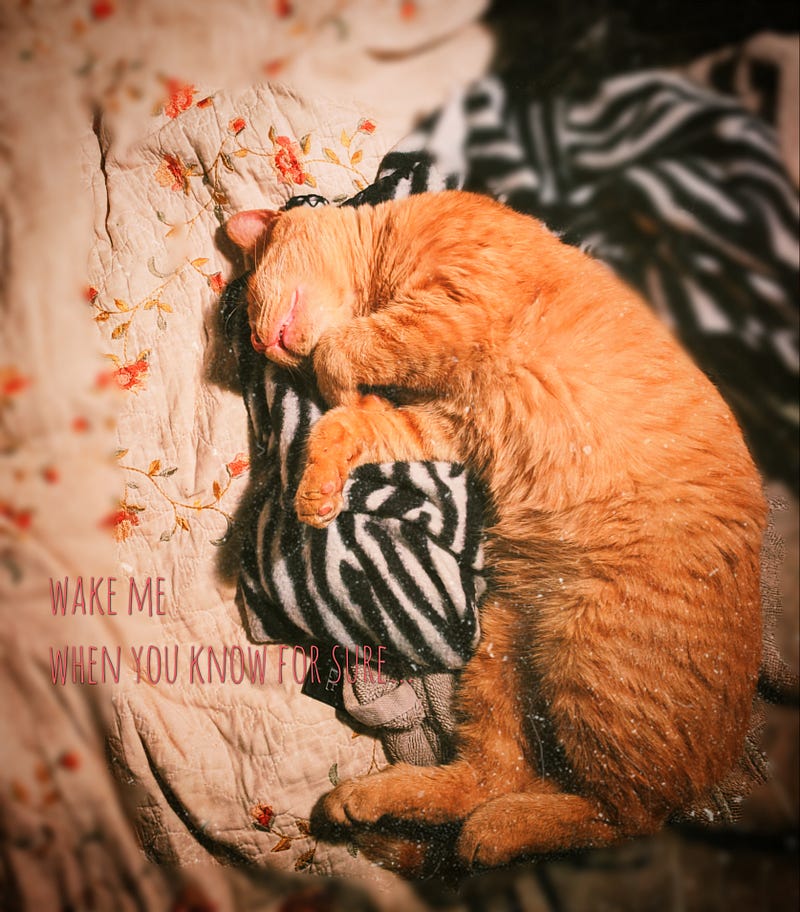
In quantum physics, there is a basic idea known as the concept of Schrodinger’s cat. An extremely oversimplified explanation of the thought experiment goes like this: Inside a box, there is a cat. Until you look in the box, you don’t know if the cat is dead or alive — it’s a quantum uncertainty. When you open the box, there is a 50% chance that it will be alive and a 50% chance of its being dead.
Common sense might tell you that if the cat is dead when you open the box, it was dead before you opened it — but with Schrodinger’s cat, that’s not exactly the case. For quantum reasons that don’t really matter right now, Schrodinger’s cat was both fully dead and fully alive while the lid was on the box. Every possibility that could have been coexisted until you, the observer, opened the box and caused all the possibilities to collapse into just one actuality.
You could say that the cat existed in a state of potential — potential life and potential death — until you interfered with that potential by looking.
What does this have to do with delusion? you may wonder. I’m getting to that. The idea of Schrodinger’s cat always places emphasis on the observer, making the point that the mere act of observing something is enough to influence it. (If you’ve ever left your kids to play happily for an hour, only to watch them spiral into bitch-smacking the minute you peek around the door to check on them, you know what I’m talking about.)
Delusional people believe whole-heartedly in something that simply isn’t true. Like the stalker who is convinced that a celebrity is in love with him, they are just so sure that the cat is alive when the box has already been opened and the cat is laying dead in front of them. In other words, they are trying to threaten, coerce, scare, force life into a cat that will only ever be dead, because they can’t accept that their perception of a live cat simply doesn’t line up with reality. They can’t stuff the cat back in the box, either —it has been observed to be dead, and dead it will stay.
The mere act of observing something is enough to influence it.
My question is, what if you’re the cat?
There is a chance that I could be wrong about so much. So many of the things that I believe, based on a few conversations, a stack of psychology books, and the memories that linger from ten or fifteen years ago, could be just wrong. That would make me, by definition, delusional. Except that the box hasn’t been opened, and I’m not the observer standing outside to open it. I am the cat.
I need an observer to open the box for me so that I can know if I am dead or alive.

(I should add that questioning my own perceptions is nothing new to me at this point. After having discovered that almost everything I had based my teenage life on was a sick and twisted lie, I have grown very wary of making any decision based on one perspective alone. Assuming I might be insane until there is concrete evidence to the contrary seems to be the safest option.)
Maybe that’s why some people seem to be so uncomfortable around me — they can sense that I am stuck inside Schrodinger’s cat box, a box that looks an awful lot like Misty’s four white walls, and they are not going to be the observer brave enough to open it.
I think the box can be opened — hell, maybe I can open it from the inside if I can call off my defenses long enough to let an outside observer drop in the key — and if I’m right, then I might be able to get outside of my head someday after all.
If my perceptions are delusional, though, then I am nothing but a dead cat in a locked box.