
A Curious Tale of Soil Augmentation
Sometimes, because of the crops we grow, the soil needs help. Even a small townhouse garden.
A natural, climax biome does not need people adding anything. Forests and meadows were doing just fine before humans showed up. But those are complex ecosystems above and below the soil’s surface. Organic material in the soil is broken down and recycled into nutrients plants use to grow.
On farms, and to some extent our gardens, we extract the organic material (in the form of our food) before it gets recycled by the life in the soil.
Soil Augmentation by Crop Rotation and Cover Crops
We are a canny lot as my Glaswegian grandmother liked to say. Over the millennia humans have learned to rotate crops with legumes which adds vital nitrogen ions to the soil. Crop rotation has been part of farming for thousands of years. It is prescribed in the bible, in both Exodus and Leviticus, the land is given a “rest” or Sabbath every 7 years to revitalize the land.
Soil Augmentation with Manure
Another method we humans have used to enrich the soil is with animal manure. We will get to animal manure in a moment, but before we do, let's discuss a really icky subject: Human manure
Human manure is discouraged in some societies and cultures, but not everywhere. It may even be used close to your home.
The use of human manure for soil augmentation is problematic. If it is not aged and properly treated, it can spread disease.
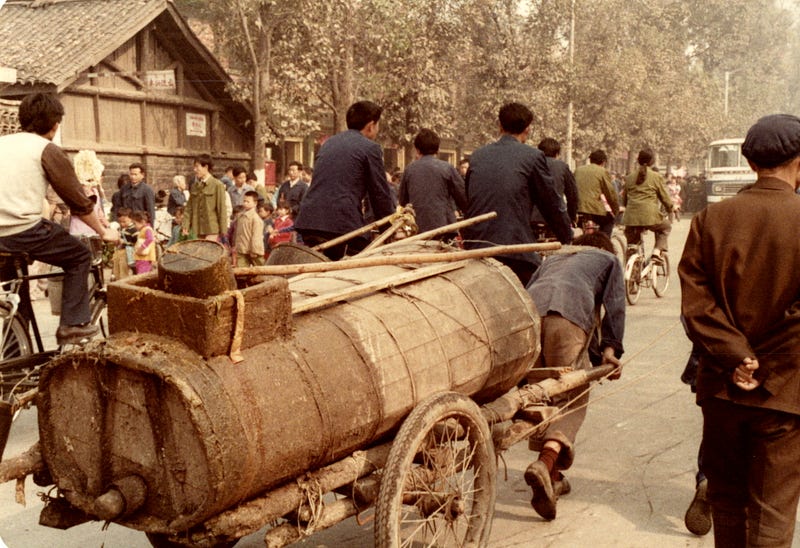
All animal manure takes time to mature. Sometimes the manure is rushed into soil augmentation due to economic necessity. It is one of the reasons to avoid leafy vegetables in developing countries.
Amoebic dysentery is one such problem. It was a common ailment for the expat community in Beijing in the early ’80s. Our friend Joan had two jobs: Working at the International School of Beijing and examining stool samples with her microscope. I’m not sure what her medical qualifications were, but if you were sick, she would invite you to look through the microscope at the amoebas and then hand you the protozoa poison pills.
I watched my brother suffer from dysentery near the green fields of Bali. It was not a nice way to end a wonderful vacation.
Sewage Treatment Lest you think human manure on crops is a third-world “thing,” consider your local sewage treatment plant. Where does your toilet waste go? It has to go somewhere.
My home town has a great web page explaining what happens to human waste from our home. It turns out that after the sewage treatment, the water portion is extracted and flows into the Santa Ana River toward the communities of Anaheim (Disneyland) and Huntington Beach. The other portion is politely called biosolids. Here is what happens to our biosolids:
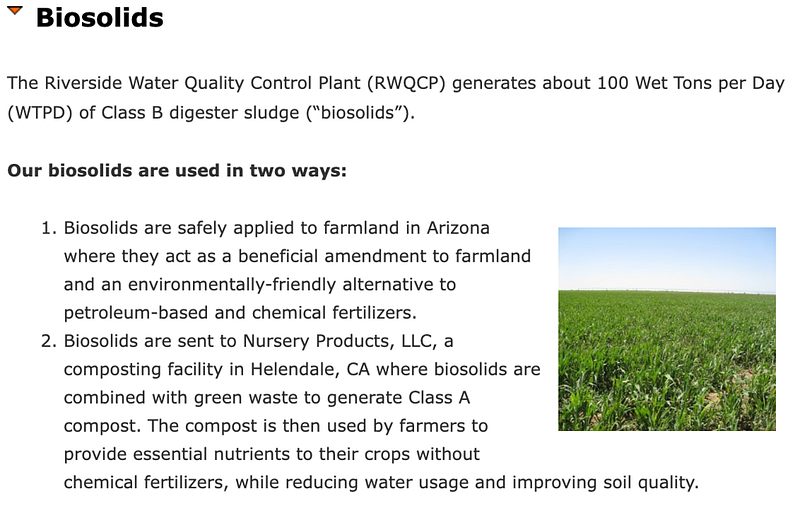
Thank you, Arizona for using my waste for soil augmentation! I’m not sure if there is a direct correlation, but I am reminded of episode 1 of Chef’s Table Pizza with Chris Bianco on Netflix. In it, he says that a great pizza starts with great dough and that the best wheat for making dough is only found in Arizona.
So the waste is not wasted. It was not wasted on the scientists of the nineteenth century that there was something important in animal manure. There was concern in that century that the soil of farms in Europe and America would no longer be able to support their growing populations. They needed even better soil augmentation.
The Guano Age and Soil Augmentation
Don’t know about this age? It was real. The story starts with the Incas. They realized that adding bird droppings enriched the soil of their farms. As it turned out, they had mountains of it just off their shore.
For tens of thousands of years, birds had been nesting on the islands off the coast. Over the years, the ground literally became mountains of guano. Incan farmers were given islands where they could collect the guano with the enlightened rule: No harvesting during nesting season. Guano is the Quechua word for dung. See here for more information. Harvesting the guano during the breeding season was a capital offense. This practice continued through the conquest of the Inca and Peruvian independence.
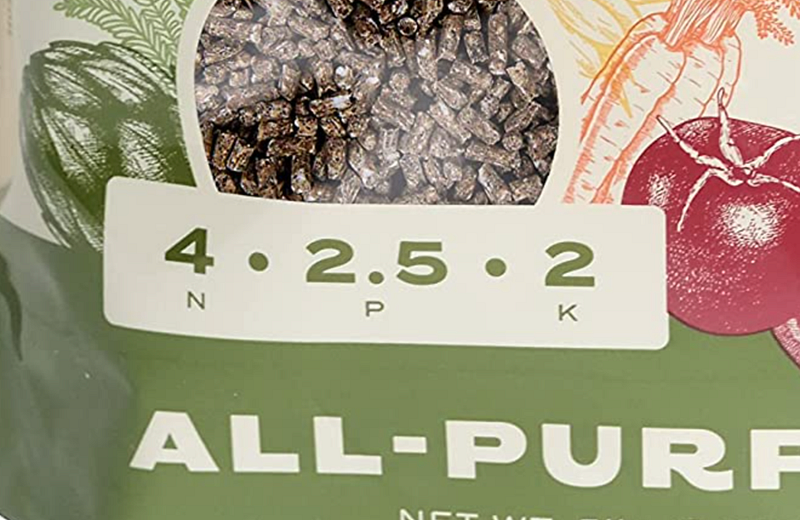
The Prussian geographer, Alexander von Humboldt, became curious about this powder and brought back a sample to German chemists. It was extremely rich in the nutrients the European and American farmers needed: nitrogen, phosphate, and potassium compounds. Look on the label of a modern fertilizer package. Those are the main ingredients.
The Guano Age had Begun
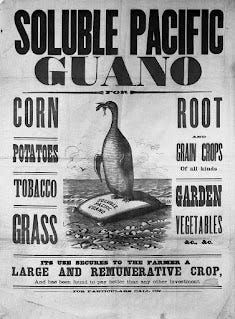
There was a lot of money to be made from the trade. This caused a scramble to get rich by getting as much as possible.
Scammers were there, cutting the shipments of guano with sawdust and selling it to farmers. Importers demanded tests of the product.
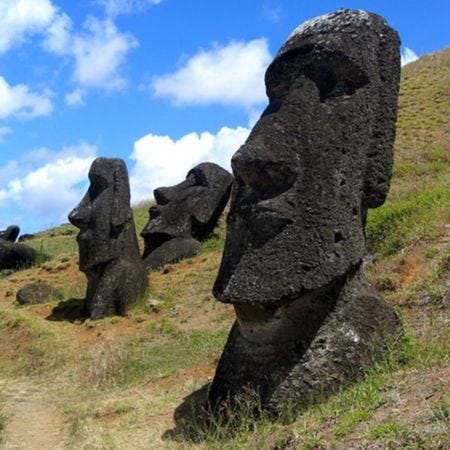
Digging guano on islands went commercial. Islands around the world lost elevation. Labor was a problem. Long exposure to bird droppings can cause diseases such as histoplasmosis. The Peruvians kidnapped over a thousand men from Rapa Nui to work on the guano islands. Only 15 returned, with smallpox, and within a few years, the native population was reduced to 111. The culture that had created the giant heads of Easter Island had disappeared.
President Millard Fillmore guaranteed American farmers a fair price for guano in his State of the Union Address of 1850. “Peruvian guano has become so desirable an article to the agricultural interest of the United States that it is the duty of the Government to employ all the means properly in its power for the purpose of causing that article to be imported into the country at a reasonable price.”
Ultimately the United States created the Guano Act in 1856. It was introduced to the Senate by William Seward, the same person who a decade later bought the state of Alaska. The act declared any American who found a deserted Guano Island could claim it in the name of the United States.
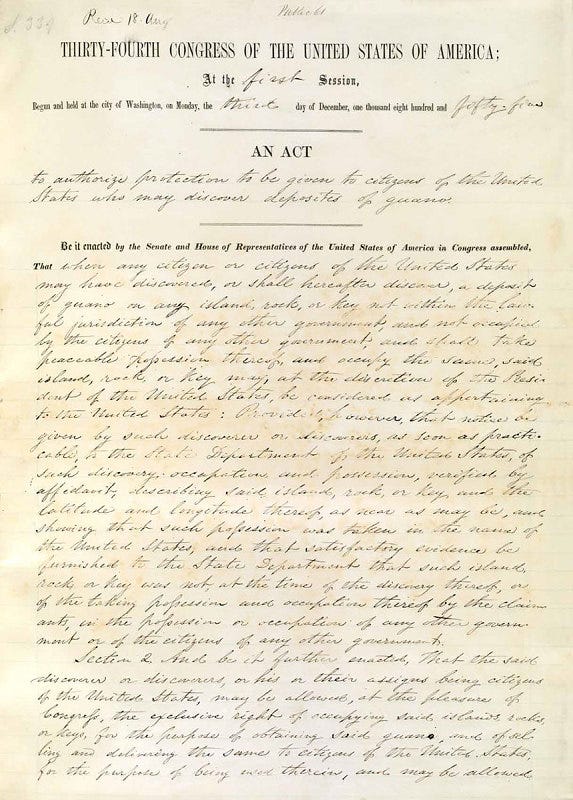
The United States is still in possession of many of these “guano islands”. Here’s a list of islands that were claimed for the United States using this law.
Besides making fertilizer, the guano was very effective in the manufacture of explosives.
The guano trade was an important source of fertilizer until 1909 when a German chemist, Fritz Haber, created a method for combing hydrogen and nitrogen into ammonia. A few years later, fellow German Carl Bosch created an industrial method for this process. They both received the Nobel Prize. It created a “green” revolution that greatly increased the amount of food in the world with the creation of cheap fertilizers.
Currently, the overuse of fertilizer has downstream effects such as algal blooms, see this article from the CDC: https://www.cdc.gov/habs/environment.html. The largest producer of fertilizer is Russia. It has suspended exports during the war with Ukraine (the second biggest producer).
The Haber-Bosch process is considered one of the most important inventions of the 20th Century. The soil of most of the food you eat was probably augmented by material created by this process.
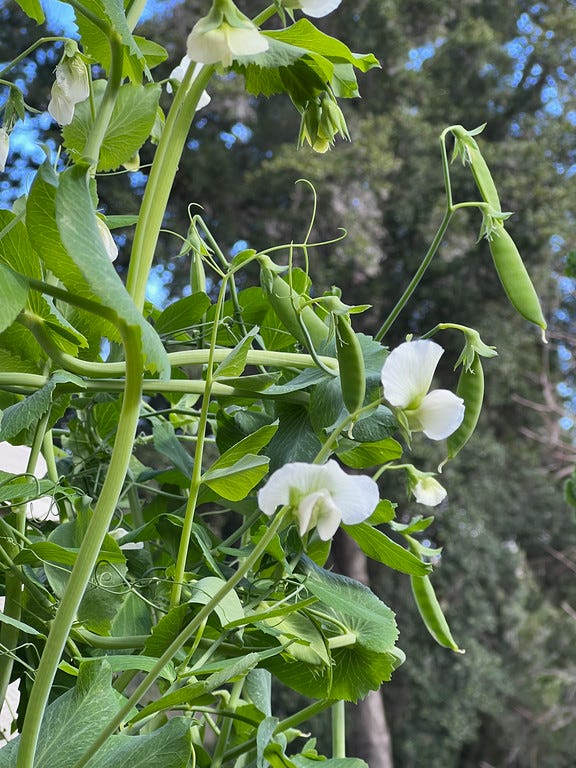
At the Townhouse Gardens, I prefer crop rotation with legumes such as sugar snap peas, plus augmentation from my compost bin.
Further Reading:
Article from Audubon regarding efforts to protect the guano islands off their coast. Guano is still an important export. It is a resource used in organic farming. https://www.audubon.org/news/holy-crap-trip-worlds-largest-guano-producing-islands
BBC podcast on Fritz Haber, father of chemical warfare. https://www.bbc.co.uk/programmes/b08jb6sb
Many of the islands claimed and mined by the US for guano are now supervised as wildlife refuges by the U.S. Pacific Islands Fish and Wildlife Office.