
A Crypto Skeptic Plays the Market for 2.5 years
Lessons learned on the long walk from mania to crash.

As I’m writing this, the entire cryptocurrency market is crashing yet again. Bitcoin proper is down to a six-month low, with its price off half from its peak; Etherium is doing even worse.
Normally, this is where I would take a moment to enjoy a satisfyingly smug laugh at the expense of everyone who staked their fortunes to nothing and tried to fight the bull head-on. But given that I’m down about 17% in the latest dip, I really can’t laugh but so much.
In the long-term — the only term that counts in investing, even speculation — I am still up. I’ve made money, at least enough for a few trinkets. What I haven’t figured out is how much of that is luck. Perhaps I’m just a fortunate gambler. Beginner’s luck, I suppose.
Toward the end of 2018, I started a little personal experiment. I went over to the Coinbase account — the one that I’ve had for years and never use — and made a few investments. Nothing big, and indeed the sums were trivial — not tens of thousands or even thousands of dollars, but just enough to buy a tiny stake in Etherium and a few other interesting coins.
Why on Earth would I do this? I’ve been on record telling people Bitcoin is a scam and they should steer clear. Beyond that, I am not the investing type — not speculative investments like crypto, of course, but not even the safer things that many people dabble in. So why start here?
This was a personal trial of sorts. It might be better to say that I wasn’t the investing type. It’s easy to forego future returns when you’re moving from one tenuous job to another, cutting every expense but rent and trying to save up a backstop. But at a certain point, I realized this backstop had grown unexpectedly large. By not indulging in the consumer electronics treadmill or traveling to far-off places to take pictures of myself, I’d built up enough money that it seemed sound to put it to work.
Trouble was, I was scared to death to do that. It’s a mindset that comes from being broke.
After years of being afraid to spend money, I needed to prove that I had the nerve to lose money. And what better way to do that than with a high-risk investment that might vanish at any moment? So I took a few bucks, wrote them off as a loss, and threw them into Coinbase. Here’s what I learned from my time as an outsider in a world of zealots.
I don’t have the nerve for speculation
I am not a gambler by nature. As someone who doesn’t enjoy watching my bank balance dwindle, I am not a fan of any activity where one expects to lose money. Because of this, I assumed I wouldn’t find much joy in investment that is, at the very least, gambling adjacent.
It turns out I was mostly right.
Look, I fully understand the rush that investors get when they’re riding high. Even with the pocket money I had in the market, I got the same feeling several times. When you jump on a particular coin, just hours before it goes up 15%, it makes you feel downright powerful. Mostly, it makes you want to do it again — to chase the high, to find that next big score that’s going to dwarf what you’ve just done.
But this is a pleasure that comes from playing pretend. I don’t have my life savings or someone else’s money riding on this — when I lose big, when I’m off by 20%, I’m ultimately out of nothing. With the sum I have in the market, it’s almost like a video game — something like the investment simulators we played on the old Apple IIe computers in the gifted classroom.
I know full well that if I’d put real money on this, I would have jumped out the first time I lost a nickel. Incidentally, that wasn’t a long wait.
It takes more time than people think
The people who jumped in on the crypto bandwagon at the height of the mania did so with the promises of fast money. After all, this has been the image in the press — people jumping in and jumping out at just the right time and making a fortune. The newbies came in expecting 100%, 1,000%, even 10,000% returns — and in weeks or days, not months.
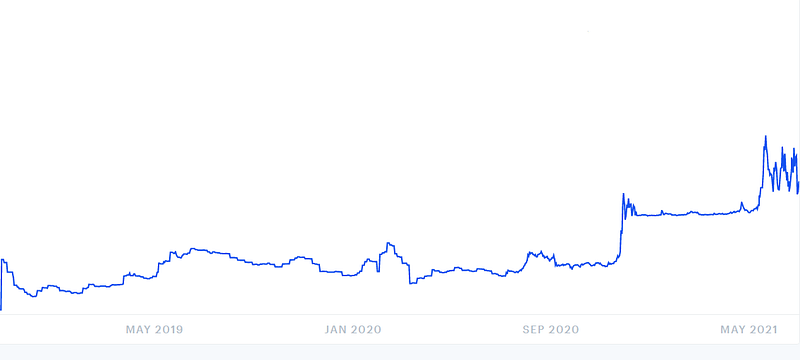
Look at the value of my portfolio again. It didn’t quite work out that way for me, did it?
Within days of the start of my experiment, the entire crypto market went into long-term decline. This wasn’t a crash, a deep one- or two-day dip like we’ve seen over the past few months, but a steady, week-to-week erosion that lasted for months. There would not be a chance to jump out on the crest with a bag of money.
Eventually, I quit logging into Coinbase. A recovery — if it was ever going to come — was far off in the distance. Since I’d already written the money off as a loss, I left it where it was and went about my life, thinking little about it.
It would be two years before my conservative Etherium-heavy portfolio paid off. The start of the second big crypto mania sent prices into low Earth orbit, increasing the value of my coins by several orders of magnitude. I could get out with a healthy profit, and I could have made even more if I’d stayed in for a few more weeks.
What would have happened if I’d put in serious money? True, I could have doubled or tripled it — but knowing my own ways and neuroses, it’s more likely that I would have hopped out at the first sign of a dip and lost a few thousand dollars. This is bound to be the same fate of anyone who goes all-in on the advice of some dodgy “expert” promising a big score.
If you want that big score, you’d better be ready to lose
That second big boost came after I reentered the market. I didn’t have any intent to reinvest — I’d made my money, and I’d made an important point to myself, and I didn’t need to have anything more to do with crypto madness.
But at some point, I said “What the hell,” and I bought some RLC.
It’s not important (and possibly not interesting) to know what, exactly, iExec RLC is. What’s important is that I was lucky enough to buy into it within hours of its official introduction to Coinbase and watch its value increase by 50% in less than 36 hours. That right there is the big win that people long for, the kind where you can easily make five figures literally overnight.
But the wins are only half the story. The losses are often sidelined — they’re inconvenient, especially when you’re selling someone on a dream and a strategy. The above is absolutely true; I made 50% on my first RLC flip, but I promptly lost 20% on the next one. Indeed, my dealings in this coin have been about 50/50 in terms of whether I made or lost money.
So was RLC worth it? For me, yes — in the grand scheme of things, I made more money than I lost, so it was a worthy investment. There’s the rub though — you need to look at this in the grand scheme of things, in the long-term. Professional investors, much like professional gamblers, make their living on the overall numbers. It’s an amateur that plays for the big one-off wins.
Actually, you’d better be ready to lose, regardless
If I were forced to throw away money on a game of chance, I’d have to pick blackjack. Mainly it’s the strategy involved, and the math — blackjack is nearly a pure numbers game. The catch to that is that, occasionally, you’ll get a sequence of cards that’s just a loser for you. There is a ceiling on your odds of victory that even the best advantage players in the world can’t pass.
Sometimes, despite yourself, you lose. Such is cards; such is crypto.
The recent market crashes prove that, in this space, there really isn’t such a thing as a “safe investment.” Coins move together, with the smaller ones chasing the bigger ones. When one of those big coins (especially Etherium, which underpins a lot of other coins) goes down, everything follows it. You can only hope that you got out before the worst of it.
I haven’t always been lucky enough to avoid these chasms. Maybe if I was glued to a screen more than I already am, and I was more obsessed with this space, and I slept half as much as I do… maybe I could save myself. But who am I kidding? When the first crash came in, I had my money parked in Etherium — widely considered a sure thing in the community. By the time I realized it wasn’t business as usual, it was too late — everything was falling off a cliff.
This is where I should say something trite like “Only invest what you can afford to lose.” It’s sound advice, but it’s obvious that no one’s listening. Easy money has a way of negating good sense and making even the most skeptical person vulnerable to the allure of charlatans and con men.
I can’t exactly tell you that winning is impossible. In two-and-a-half years, I’m up 150% on my initial investment — and that’s despite the crash and a few mistakes that cost me plenty. Clearly, one can make money here, but there are always things to know before jumping in. Have a strategy (other than “put all your money into a coin a celebrity mentioned on Twitter”) and stick with it. Be prepared to wait for a few years if the market turns upside down. And be prepared to lose some money, because you will.