
A Crude Look at the Whole
Complexity Drives the World, You Should Understand It
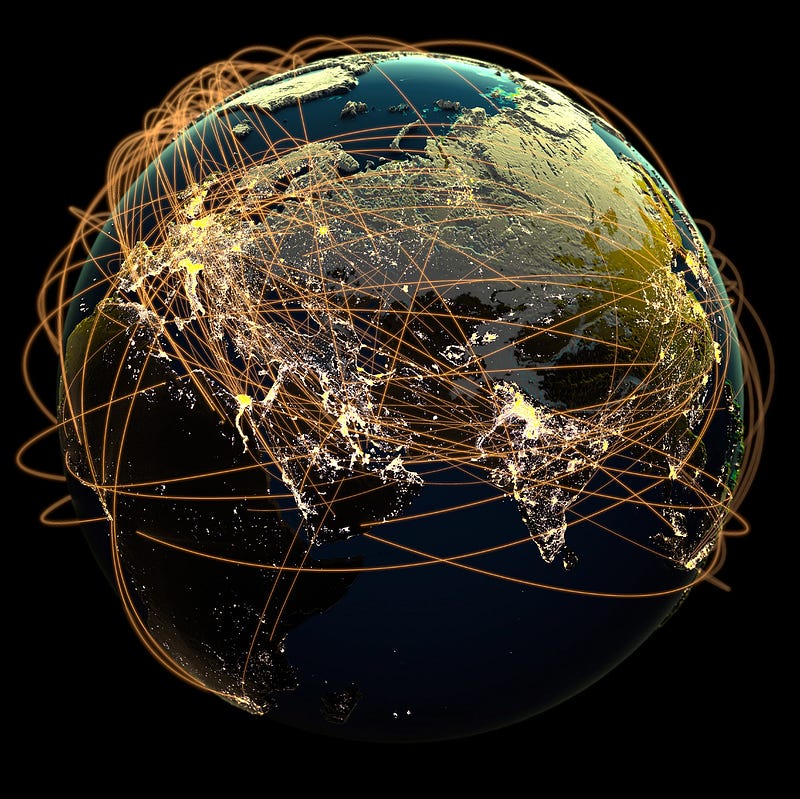
“Ideas thus made up of several simple ones put together, I call Complex; such as are: Beauty, Gratitude, a Man, an Army, the Universe.”
— John Locke, An Essay Concerning Human Understanding
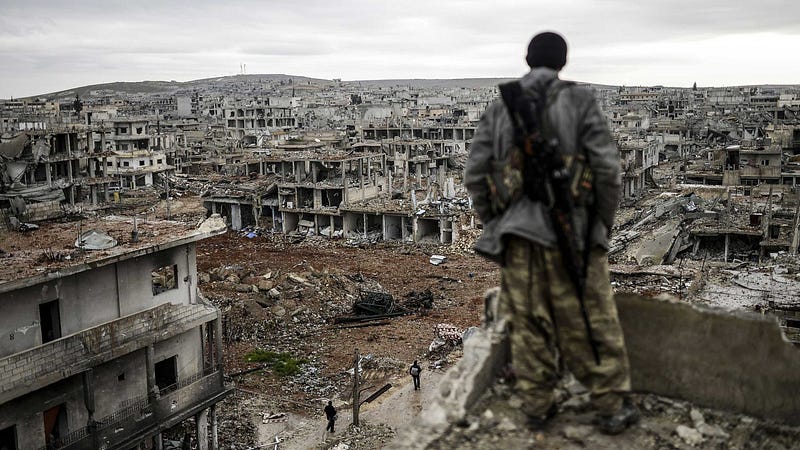
In the late summer of 2010, clouds of yellow-brown smoke wafted across the grim Muscovite sky, obscuring the Kremlin in a haze that was so thick eyewitnesses said it could be worn like a coat. During particularly hot Russian summers, peat bogs sometimes catch fire and billow turbid fumes across the East European plain. That year, the heat was particularly severe. 56,000 people died from it, and several hundred fires were burning at once.
But that was just the beginning.
Crop failures slashed the Russian wheat harvest by more than a third, forcing the government to implement severe export controls on grain. The market shortage that this caused rippled first through the region, then the world.
Countries that relied upon Russian imports to feed themselves — notably the fragile states of North Africa — were squeezed hardest. Egypt, for example, normally imported more than half of its wheat from Russia, but that year received 1.2 million tons less — a serious shortfall for a country whose 83 million people got a third of their daily caloric intake from bread. Food prices in Egypt doubled between June 2010 and February 2011.
In Tunisia, a twenty-six-year-old food vendor named Mohamed Bouazizi made became a literal match igniting the proverbial powderkeg, sparking a movement that swept the region and plunging more than a dozen brittle states into revolution and war. Soaring inflation forced Bouazizi — who was already destitute before the food shortage — to take out a loan to acquire the products he sold on the streets. After a callous police officer instead confiscated these wares, Bouazizi saw no other recourse — he set himself on fire in front of the town’s police station on December 17th, 2010.
Tunisian protesters were outraged. They had already been angry after revelations of high-level government corruption by Wikileaks, but Bouazizi’s example mobilized them even further. A mere 28 days later, Zine el Abidine Ben Ali, who had ruled that country for nearly a quarter-century, was overthrown. Dictators in neighboring states followed.
The Tipping Point
“The number of such causes is infinitely great, the causes themselves infinitely small; historians select an absurdly small portion of them and attribute everything to this arbitrarily chosen tiny section.”
— Isaiah Berlin
The question to ask ourselves is not what “caused” the Arab Spring. While it's comforting to think in terms of simple cause and effect, it’s a mistake known as the fallacy of the single cause or causal reductionism. Causal reductionism attempts to simplify events by drawing linear relationships from cause to effect. The siren call of certainty often seduces us into believing that the future unfolds inexorably from the present and that if we could just understand the pieces, we could act proactively to prevent the outcomes we dislike and achieve the outcomes we prefer.
Sadly, this just isn’t the way the human world works. In the case of the Arab Spring, the pieces had been in place for decades, the population primed for revolution. Food prices had fluctuated before, the oppression of the region’s regimes continual. If it were possible to rearrange the pieces and replay the scenario, the results would very likely be different.
There was no single, proximate cause for the Arab Spring; it emerged through a complex causality. A combination of many interdependent variables pushed this particular system past the point of criticality at that particular time and place.
In other words, it reached a tipping point.
How Complexity Works

Complexity is a loaded word. It is often — incorrectly — thought of as a synonym for complicated. Both derive from Latin but are subtly distinct. The Latin verb plicare means to fold. Complicare is to fold together. The Latin past participle plexus can mean to weave, braid, or entwine. The difference is one between layering and weaving. Complication denotes layers, one atop another. Complexity takes this further, merging individual strands into a single, braided whole. In short, complexity is the level of interconnectedness of elements within a system.
OK, the etymology is nice to know. But what does it mean?
Complex systems are co-evolving multiplex networks. That sounds tricky, but really it simply means that complex systems can change as a result of the interactions of elements within them; but also that the interactions of the elements within them can change as a result of the state of the system.
But we’re getting ahead of ourselves. Here are what I call the four building blocks you need to grasp complexity: systems, agents, interdependence, and feedback. Together, they create the conditions for a fifth concept, emergence.
Systems and Agents
“The aim of science is not things in themselves, as the dogmatists in their simplicity imagine, but the relations between things; outside those relations there is no reality knowable.”
— Henri Poincaré
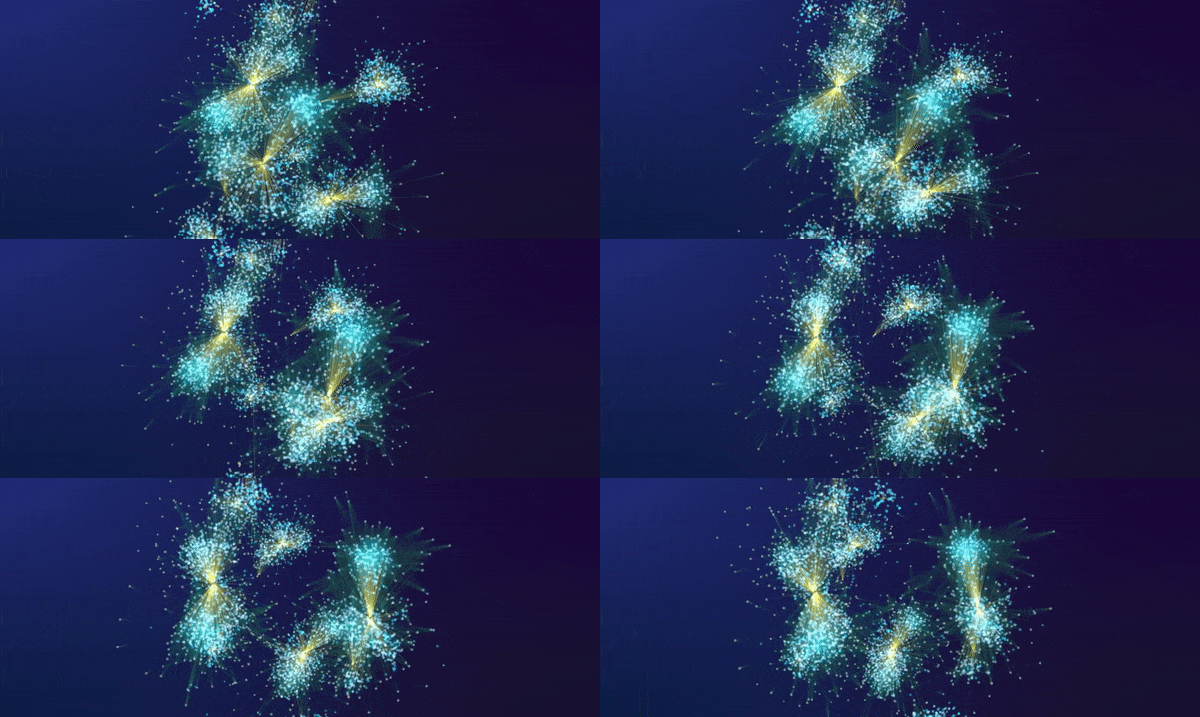
A system is a collection of actors that form a network in which the whole exhibits properties that are different than those of its constituent parts. Agents are the irreducible actors within a given system. Systems are composed of agents, and agents act within a given system. Agents can be almost anything: cells, insects, people, terrorist organizations, or nation-states.
Systems can be either open — vulnerable to influence from other systems — or closed — like an experiment in a laboratory. The boundaries of systems can also expand and contract over time. In the example of the Arab Spring, the open system of the Middle East and North Africa had grown so that it was influenced by actions from actors as far away as Russia and by the actions of non-geographic entities like Wikileaks.
As systems expand and the number and diversity of agents increases, they become more complex. The more complex a system grows, the more sensitive it becomes to minor disturbances that can propagate rapidly throughout the network, changing the interactions of its agents and thus changing the structure of the system itself. Just as in North Africa, things may look stable for a long time until a tipping point is reached, prompting a sudden collapse.
Interdependence
“Everything is connected. Some things are more connected than others.”
– Herbert Simon, The Organization of Complex Systems
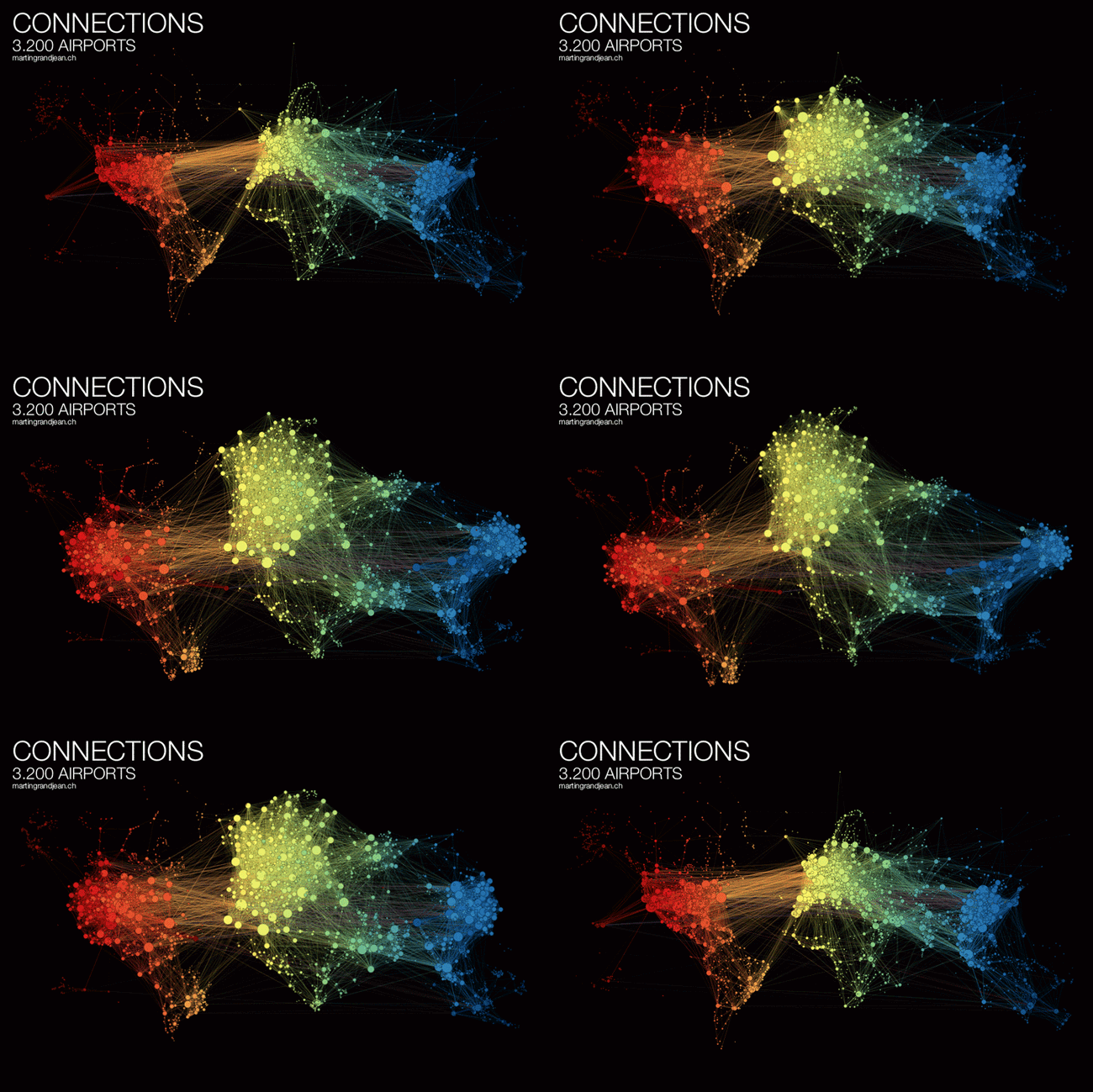
Interdependence is the degree of interaction between agents within a system. This is why complexity science is so closely related to network dynamics. The more connections that exist, the more interdependent a system becomes. Consider every new internet user, connected device, gas pipeline, and direct flight as increasing global interdependence. In the Arab Spring, countries like Tunisia were dependent upon normally reliable food imports from places like Russia. The Russian wheat harvest was in turn dependent upon favorable weather conditions that were negatively influenced by climate change, and so on, ad infinitum.
Feedback
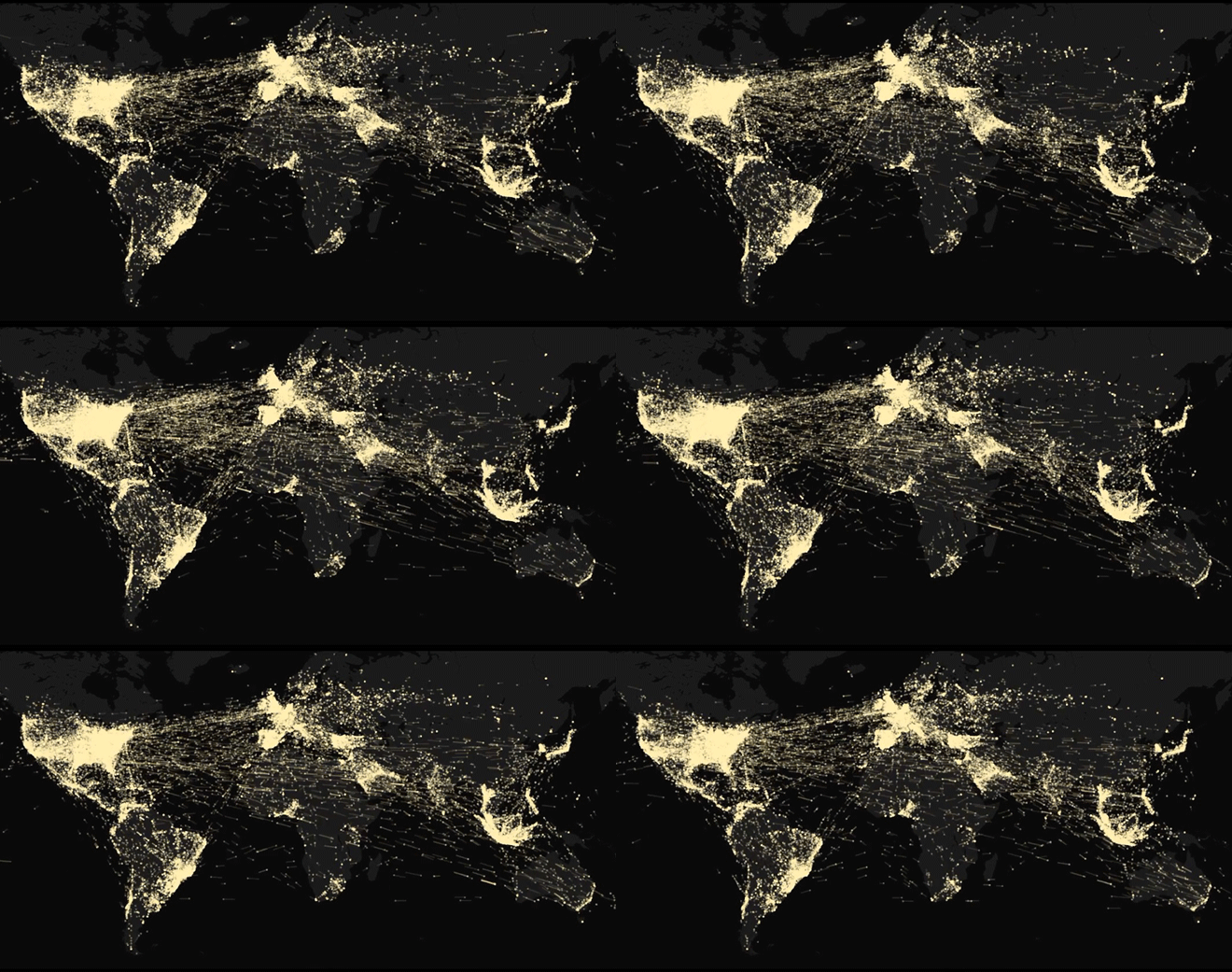
“But in war, as in life generally, all parts of a whole are interconnected and thus the effects produced, however small their cause, must influence all subsequent military operations and modify their outcome to some degree, however slight.”
— Carl von Clausewitz, On War
Think of feedback as the exchange between agents. If interdependence is the number of channels available, feedback is the signal that rides those channels. Feedback prompts agents to take action or otherwise change their behavior. Just as individual ants respond to stimuli on the ground by releasing pheromones to signal other ants to change their order of march, humans respond to a video of wanton police brutality on YouTube.
The concept of feedback was popularized by mathemetician Edward Lorenz’s discovery of the butterfly effect. Working as a meteorologist at the Massachusetts Institute of Technology in 1962, Lorenz ran equations on his computer to determine patterns in weather formation. Though he expected to replicate the same results every time that he input the same pattern, he was shocked to find the computer consistently generated wildly divergent predictions.
Lorenz realized that infinitesimally small differences in measurements were causing profound differences in the weather forecast. Standard models didn’t expect differences so tiny to matter, but here was the evidence they mattered a great deal. It turns out that the effects of tiny perturbances feeding back upon themselves cascade through the system, amplifying as they expand. Before long, the effects compound, making even marginally accurate prediction of the outcome impossible.
People, the agents who comprise nations, are inherently unpredictable because the feedback that affects them takes the form of information, which is intangible. So the more information — that is, feedback — that flows through a system, the likelier it is a tipping point will be reached and emergent behavior will occur. So while we might be able to forecast the immediate future with some success, what looks like clear skies can turn dark quite suddenly — and sometimes storms emerge with unexpected force and intensity, such as happened with the Arab Spring.
Emergence
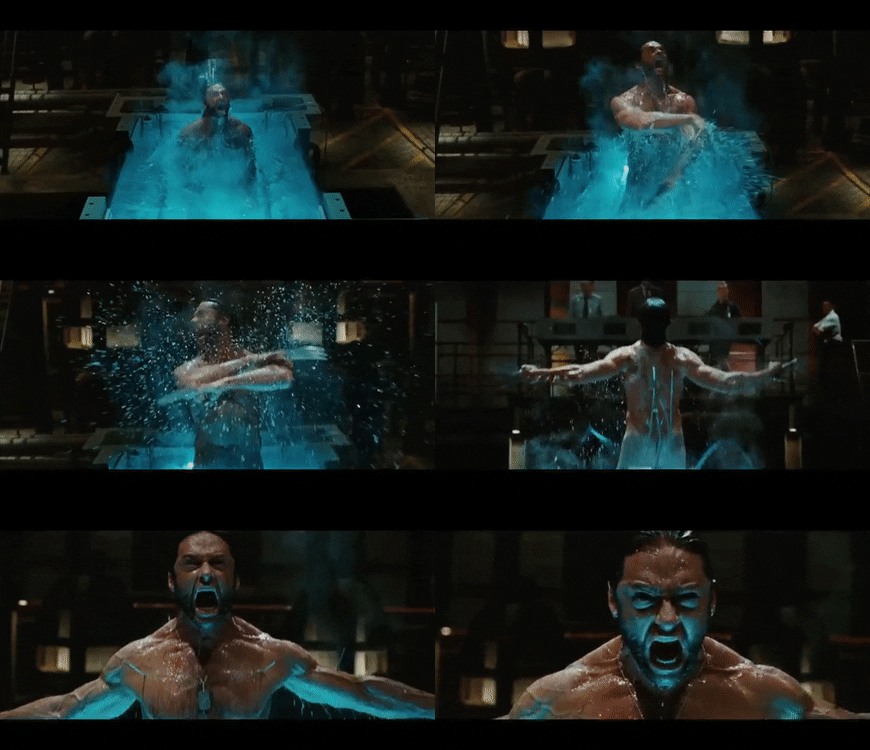
Emergence is the spontaneous result of the interaction of agents through feedback. Emergence produces new, unforeseen characteristics or behaviors. Typical examples of emergence include phenomena like the fractal patterns in snowflakes or the spark of human consciousness that emerges from the interaction of billions of neurons. In Tunisia, Mohamed Bouazizi’s self-immolation was the feedback that pushed the system he was a part of to a critical state, prompting the emergent new behavior that took removed a dictator and spawned wars that go on to this day.
Complexity as a Worldview
“The man who believes that the secrets of this world are forever hidden lives in mystery and fear. Superstition will drag him down…But the man who sets himself the task of singling out the thread of order from the tapestry will by the decision alone have taken charge of the world.”
- Cormac McCarthy, Blood Meridian
The world has grown more complex and less linear, which in practical terms means more unpredictable and potentially more dangerous. Cause and effect are no longer easily discernable or proportional.
In a simpler world, prediction was facilitated by analysis — the reduction of systems into their composing pieces to examine how they worked. The fatal flaw of reductive analyses, however, is that they ignore the fact that systems are connected to other systems out there in the real world. Put simply, the complex open systems of the world we live in today are not so reducible, and output isn’t always equal to the input.
Complexity isn't an ideology or mantra — it’s an ontology, a worldview that allows us to better understand the nature of the interconnected, uncertain, and contingent world we live in. It’s a realization that events are neither random nor entirely predictable; that though constrained by relatively stable existing features, outcomes aren’t written in stone and might vary greatly from what a reductive analysis predicts.
It is not an excuse for indecisiveness. Those who use it as such and throw their hands up in surrender don’t understand it. Yes, the world is messy and convoluted, but complexity tells us is that even the smallest of our choices can have dramatically outsized effects as they reverberate through the systems we are a part of. We should pause to recall all of the systems we are a part of and how all the feedback we are subject to influences us. We should take care to consider whether our actions are likely to tend towards good or bad outcomes throughout those systems as their effects cascade.