
A Couple of 1940s Women PIs in Spotswood’s ‘Fortune Favors the Dead’
Boy, it’s fun to watch women fight crime and win
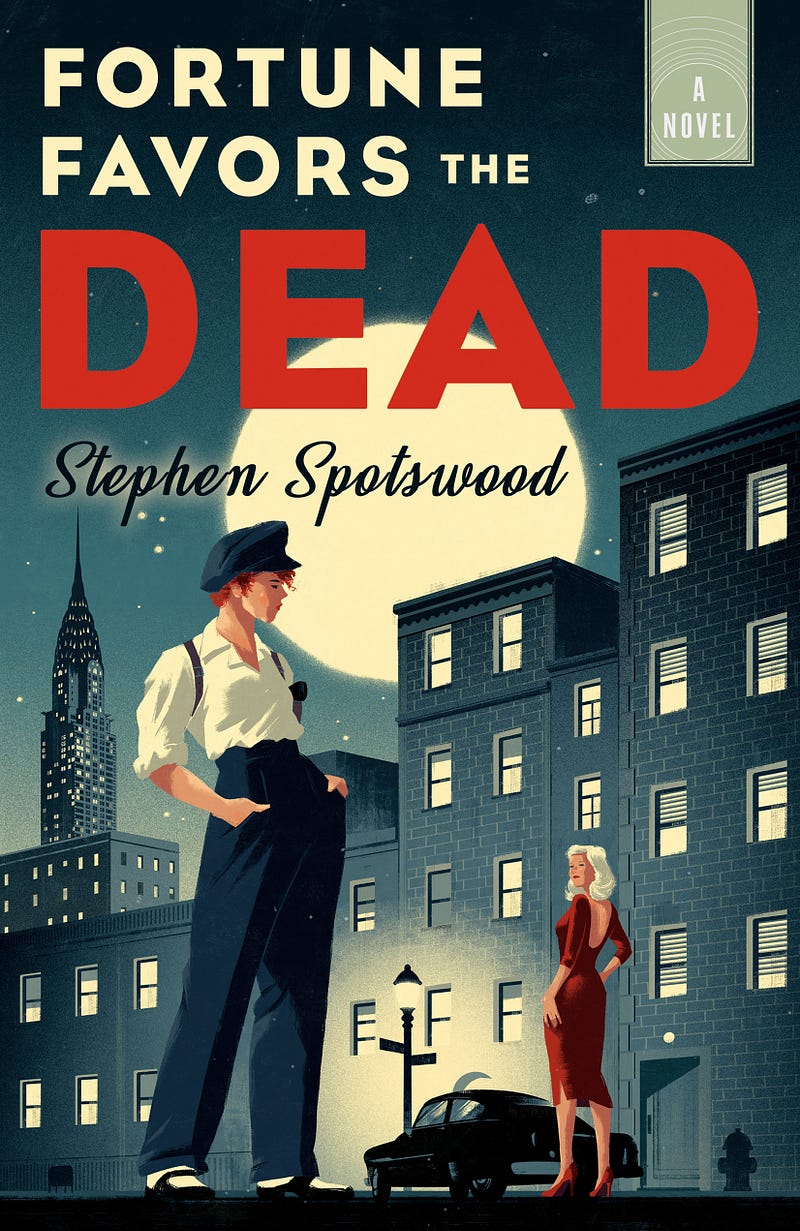
Review of Stephen Spotswood, Fortune Favors the Dead. Doubleday, 2020. Also Random House Audio, 2020. Narrator: Kirsten Potter.
Stephen Spotswood, you have joined my greatest hits list!
Fortune Favors the Dead is the first in the Pentecost and Parker mystery series set in the 1940s. Willowjean Parker (Will for short and by preference) is a circus roustabout and performer who does a security detail one night as part of her many duties. As she prowls the grounds, she stumbles into a situation that requires her to use her world class knife-throwing skills. She also stumbles into a heartstopping acquaintance with Lillian Pentecost, the greatest and strangest detective in wartime New York City.
Pentecost’s life is saved by Parker’s handy way with a knife. Pentecost is not the kind of gal who lingers over sentimental debts of gratitude. She does send for Parker a few days later and, not-too-long story shorter, Parker accepts an offer of employment that includes room and board, special training and a salary. And just like that, the crime stopping duo of Pentecost and Parker is born.
I started this series partway through, as I am wont to do when a fun-sounding audiobook becomes available. Secrets Typed in Blood is the third installment of the Pentecost and Parker mysteries, and in hindsight, after reading the first, I can say that Spotswood really gets these characters, as well as the challenge of satisfying plotting (not easy, let me say), and I can’t wait to read numbers two and four. Yowza.
OK, back to Fortune Favors the Dead (number one)…..with a few general comments that apply to the whole series.
I’m gonna make a few people mad, maybe, when I say that Spotswood, as a male person, is damn good at writing females: complicated, unorthodox, interesting females with difficult, self-directed lives.
Wait, you say — leaving aside your sexism, Ms. Reviewer, how can these females exist in the forties, in wartime?
Well, listen, they did. Not just fictionally, but really. World War II on the home front was a life-changing era for many women, who not only worked in the factories but also in crowded offices, sleeping in shifts in hastily rented apartments and rooming houses, keeping the stoves busy with rationed food, somehow caring for their children, crying for male relatives overseas, and so on: the things women do without getting credit for their multitasking.
So the detective team of Pentecost and Parker is not really that much of a stretch in historical terms — although their personalities are brilliantly original and a joy to watch unfold chapter to chapter.
Spotswood is careful with the historical setting. As a journalist (as well as a playwright), he has experience getting things ‘right.’ I have to say that as both a historian and a reader I love this period (AND Manhattan), and I think he captures the city at war: the grittiness, the modernity, the necessary improvisation, the shapeshifting, as men went to war or didn’t, as women volunteered for military service (in ancillary positions, of course) or took new jobs, and as crime and crime fighting went on as ever, only with new twists and opportunities.
Lillian Pentecost, the brilliant detective with a wonderful name, is from the start a mysterious character. She holds back; doesn’t show her hand; is rarely caught out; is generally one or two steps ahead in her case handling strategies. She is one of Nature’s aristocrats.
But she is also struggling with multiple sclerosis, which severely impedes her physical capabilities in the tight situations that might arise in private detective work. This is where Will Parker comes in — and this is also where Spotswood makes the wonderful decision to make Parker the first person narrator. We see Pentecost through her eyes. Parker is as unsentimental as her boss, and knows how to avoid the gushiness that Pentecost deplores. She also — usually — respects her boss’s side-eye warnings to hold back or change tacks, in interviews or hazardous encounters.
But Parker is also impulsive and occasionally overestimates her ability to escape a dangerous situation. I mean, these are thrillers, for heaven’s sake. There’s some fighting, some fleeing down alleys, in addition to the knife-throwing. There are mysterious bad guys who attack in the dark.
Speaking of mysterious bad guys: Spotswood is a great plotter, as I suggested above. The reader might be able to guess who done it, but it’s not straightforward, and Spotswood takes us from a locked-room situation to a stage on which lots of the players have motives. A matriarch, Abigail Collins, dies horribly and mysteriously in her own home. Her husband had committed suicide a year earlier. Collins’s grown children and their godfather are aloof — clearly hiding things even though they have hired Pentecost to get to the bottom of the woman’s murder.
There is also a mysterious and maybe shady medium involved (a seer, a mystic, a soothsayer, whatever): a figure with some kind of strange power over Pentecost that Parker divines, so to speak, but cannot parse.
Things get complicated when the daughter, Rebecca Collins, starts courting Parker. Parker is interested. She makes the judicious decision to ask Pentecost whether going dancing with a client/suspect is a good idea. Her boss gives her the go-ahead, framing the date as an information gathering opportunity.
The date is a useful device for learning more about both Becca, the daughter of the murdered woman, and Parker herself.
The date is also a useful device to let us know that Parker likes women. Not exclusively, but happily. Not to mention letting us see Pentecost’s unconcern with her employee’s romantic life.
Kissing ensues.
OK, I love that Spotswood can write women-loving women. I love that, in my reading, he gets this right. I love that Parker’s love life is acknowledged — Parker talks about the parts of her life that she keeps in the shadows — but not made a big deal of.
In real-life America, it is not really until after the war, in the 1950s, that being gay became a Red Flag Big Deal. Not that homosexual lives and behaviors were a ho-hum earlier than that — just that the postwar McCarthy era, as we call it, brought in brutal layers of “security risk” investigations, outings, shamings, firings, and of course the concomitant suicides. Nice. Not.
Ironically, wartime also brought lots of gay men and lesbians to self-awareness and then into community because of the churning mobility of the population, both abroad in the war zones and back home in the United States.
At any rate, Spotswood’s first novel — the one under review — actually earned him a Lambda Literary Award nomination for LGBTQ mysteries. Whoa! And well deserved.
The ending? Not going to tell you, of course. But the unrolling is sufficiently believable, even though there are big pieces of the story that the author reveals quite late in the game. He doesn’t “cheat,” and frankly, I don’t care that much about those rules concerning the reader needing to have all the elements in hand at a subconscious level. Sheesh. I do care to know, at the end, all the little connections and revelations that brought the detectives to their conclusions. Spotswood satisfies my requirement.
Spotswood’s series satisfies me at all levels. Write on!
Oh — the Pentecost/Parker series audiobook narrator, Kirsten Potter, does a wonderful job distinguishing the characters without caricature.
Two more mystery/thriller BAOS reviews: