
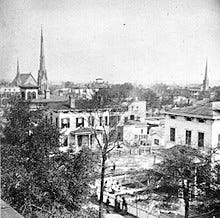
A Coup d’é tat On American Soil
White Supremacists staged a coup on Wilmington, North Carolina, in 1898
33 years after the end of the Civil War, Wilmington, North Carolina, was a city where black Americans were elected in the city government and were prosperous business owners. There were 4 black republicans in the US Senate from 1875 and 1899 and eleven black state house representatives in 1898. The elected officials tried to erase it in the history books.
During the Reconstruction Era
The 1860s
North Carolina ratified the 14th amendment in 1868. The state legislature had a Republican majority and a Republican governor. Democrats consisted of former Confederates and Whigs. The Democrats blamed blacks, Union carpetbaggers, and “race traitors.” Freed slaves were eager to vote, supporting the Republican Party. Temporarily, Confederate veterans were not allowed to hold office or vote. Already angry about losing the Civil War, many of the Democrats joined the Ku Klux Klan (KKK). The KKK tried to suppress the black vote by organizing violence during elections.
Taking Back the State (Making North Carolina Great Again)
The 1870s
The Democrats opposed “radical” reconstruction policies of the U.S. Congress and took control of the North Carolina General Assembly in 1870. They began to reverse some of the changes made by Republicans. They regained control of the state legislature even though the Force Act of 1870 suppressed the KKK. (The Act made it illegal for state officials to discriminate against in voter registration and made election fraud, bribery or intimidation of voters, and conspiracies to prevent citizens from voting illegal).
The Democratic Party began to change the laws of North Carolina. One of those laws was that local officials would no longer be elected, but appointed by the state. They took over the state’s judiciary and adopted 30 amendments. These included lessening the number of judges on the state supreme court, putting all local governments under the control of the state legislature, not allowing “certain types of criminals” to vote, mandating the segregation of schools, making interracial relationships illegal, etc..
In 1876, a governor during the Civil War, Zebulon Vance, won the governor’s race once again. The Democrats felt North Carolina had been “redeemed” and, after his election, wanted to take back the rest of the state, including Wilmington.
The Populist Party
The 1890s
Some eastern counties and specifically Wilmington, the largest city in the state, had a majority of black residents. That part of the state also had a third political party, The Populist Party. The Party consisted of white middle-class commercial farmers that were frustrated with the Republicans.
The Republicans were white Mountain anti-Confederates, blacks, and some manufacturers and urban professionals.
The Populist party only obtained 17 percent of the vote but caused Democrats to lose votes. Even though Republicans and Populists had policy differences, they agreed to join forces in the Fusionist Party, to accomplish their shared goal of defeating the Democrats and their control of fraudulent elections.
“Sometimes, the two parties chose candidates jointly; sometimes, they agreed to support the candidate nominated by one of the parties.” (Hunt) Their efforts were rewarded with winning control of the North Carolina Supreme Court, the General Assembly, and most of the state’s seats in Congress.
The Republican-Populist General Assembly of 1895 gave back blacks access to vote. A Populist, Marion Butler, and a Republican, Jeter Pritchard, was sent to the U.S. Senate.
Republican Daniel L. Russell Jr. elected North Carolina’s governor in 1896. Many black North Carolinians in Wilmington appointed to government positions. Three city aldermen were black. One of the five members on the constituent board of audit and finance was black. Black people were in positions of justice of the peace, deputy clerk of court, street superintendent, coroners, police officers, mail clerks, and mail carriers.
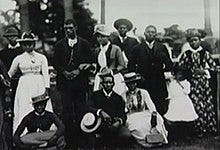
Black citizens of Wilmington worked as mechanics, carpenters, jewelers, watchmakers, painters, blacksmiths, masons, etc. They owned ten of the city’s eleven restaurants, 90 percent of the city’s twenty-two barbers, 1/4 of the fish and oysters dealerships, there were more black shoemakers than white ones, they were one-third of the city’s butchers and half of the city’s tailors. Frederick C Sadgar was a black architect and financier. Thomas C. Miller was one of the three real estate agents and auctioneers and was a pawnbroker, many whites in debt to him. “John C. Dancy replaced a prominent white Democrat as the appointed collector of customs at the Port of Wilmington, in 1897, at a salary of nearly $4,000 (about $113,000 in 2017). (The editor of the Wilmington Messenger often disparaged him by referring to Dancy as “Sambo of the Customs House”).” Black professionals supported each other. Alexander and Frank Manly owned Wilmington Daily Record. It was one of the few black newspapers in the state at the time and the only black daily newspaper in the country. While it looked like progress was being made in the gilded age, it angered white supremacist democrats and was an issue that energized them. They wanted their state back.
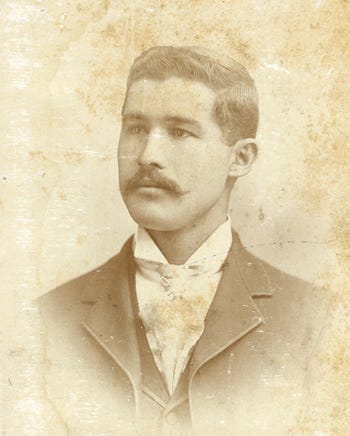
Despite their success, blacks had no inherited wealth. With the collapse of the Freedman’s Bank (out of 37, one was in Wilmington), some Wilmington blacks lost much of their savings. Credit or loans hiked interest rates for blacks (nearly 15 percent, and under 7.5 percent for poor whites); lenders refused to let blacks pay off their mortgages in installments. Blacks were 60 percent of the county’s population but only owned 8 percent of the property in Wilmington.
Affluent whites believed that they were paying too much in taxes (on property) compared to blacks.
While thus numerically strong, the Negro is not a factor in the development of the city or section. With thirty years of freedom behind him and with an absolute equality of educational advantages with the whites, there is not today in Wilmington a single Negro savings bank or any other distinctively Negro educational or charitable institution; while the race has not produced a physician or lawyer of note. In other words, the Negro in Wilmington has progressed in very slight degree from the time when he was a slave. His condition can be summed up in a line. Of the taxes in the city of Wilmington and the county of New Hanover the whites pay 96 2/3rds per cent; while the Negroes pay the remainder — 3 1/3rds per cent. The Negro in North Carolina, as these figures show, is thriftless, improvident, does not accumulate money, and is not accounted a desirable citizen.
— Henry L. West, journalist for The Washington Post, November 1898
An impression prevails that these colored people have grown greatly in wealth, that they have acquired homesteads, have become tax-payers and given great promise along these lines. It is not true. In North Carolina they had as fair a chance as in any other Southern State — perhaps better than any other. And here it is sad to hear their frequent boast that they own eight millions of property. This is about three percent, according to the tax list, the total of which shows an amount much less than the actual total values of the State, but this fact does not disturb the proportion between the races. They are thirty percent of the population. After thirty years of opportunity, they have three percent of the property. True, they may claim that this is all net gain as they started with no property. But they did not start with nothing. They started with enormous advantages over whites. They were accustomed to labor. The whites were not. They had been for generations the producers of the State and the whites the consumers. They were accustomed to hardship and privation and patient industry. They had the muscle. If in this thirty years they have only acquired this pittance, where will they be in another thirty years considering that the advantages of their start are largely, if not entirely lost?
— Daniel L. Russell, Governor of North Carolina, 1900
The Election of 1898
In late 1897, Democrats were angry with the “Negro Rule.” They were upset with Fusion government reforms that would not allow them to manage, and “game” the city’s affairs. Under the Fusionists rule, they lowered interest rates decreasing banking revenue. New tax laws affected stockholders and property owners. Railroad regulations made it more difficult for those with railroad holdings to capitalize on them. Many Wilmington Democrats, the city’s economic leaders, felt these new laws directed at them.
The Democratic State Party Chairman’s, Furnifold Simmons, strategy for the 1898 campaign was to inflame racial resentment and make the campaign’s main issue white supremacy. Simmons recruited men who could “Write, Speak, and Ride.” Riders rode horses to be intimidating. Writers created propaganda in the media. He created a speaker bureau to deliver the message of the party across the state where racist propaganda was distributed before speeches, and the speakers appealed to white men to join their cause.
Simmons also worked with Raleigh News & Observer, and The Charlotte Observer, cartoonist Norman Jennett (aka “Sampson Huckleberry”), and Charles Aycock were on staff to execute the campaign strategy. Simmons also worked with The Caucasian and The Progressive Farmer, which was already a mouthpiece for white supremacy. They portrayed blacks as corrupt and unjust, and alleged black men were after white women claimed and accused white Fusionists of supporting “negro domination.”
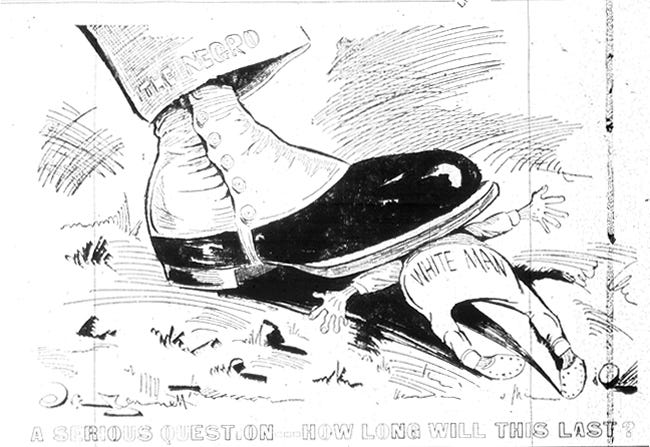
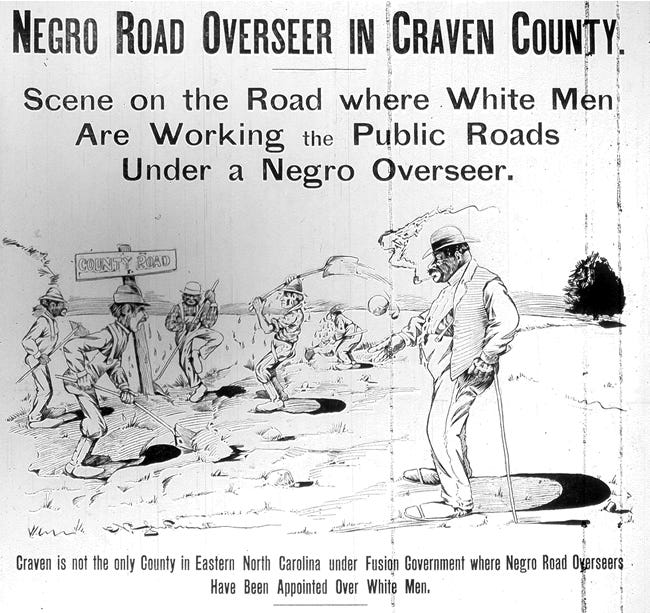
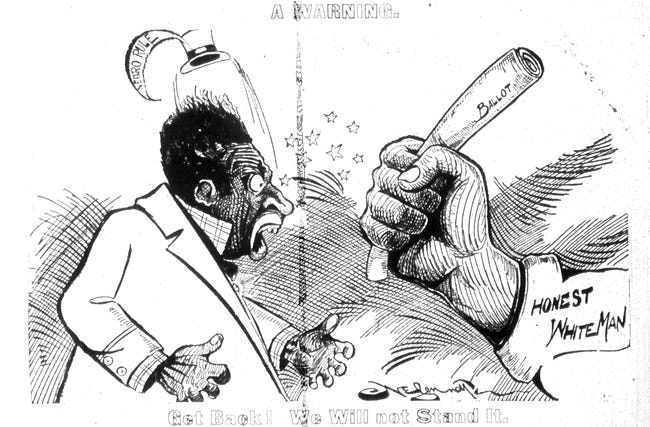
On November 20, 1897, Francis D. Winston, wrote that whites needed to unite and “re-establish Anglo-Saxon rule and honest government in North Carolina.” He said that Republican and Populist rule was anarchy, evil, and the Democrats would save the state from “tyranny.”
There is but one chance and but one hope for the railroads to capture the netnext? legislature, and that is for the nigger to be made the issue. — The Caucasian
North Carolina is a WHITE MAN’S STATE and WHITE MEN will rule it, and they will crush the party of Negro domination beneath a majority so overwhelming that no other party will ever dare to attempt to establish negro rule here. — Simmons
Another party leader Daniel Schenck added:
It will be the meanest, vilest, dirtiest campaign since 1876. The slogan of the Democratic party from the mountains to the sea will be but one word … ‘Nigger’!
Alex Manly wrote an editorial in the Wilmington Daily Record on August 18, 1898, to reply to a speech given by Rebecca Felton. Felton was in support of lynching all African American men to protect white women. “The Daily Record suggested that consensual relationships between African American men and white women were common and that often the man was accused of rape only after the relationship was discovered. Once the Democratic papers got hold of the editorial, there was an uproar. Under headings such as “Vile and Villainous” and “A Horrid Slander,” the editorial was reprinted throughout the state. Some Democratic papers continued to run it in almost every single issue up to election day.” (Graham)
Toward the end of the campaign, to ensure victory, the Democrats increasingly resorted to violence. After Democratic rallies in North Carolina, “The Red Shirts,” groups of men in red shirts with weapons, rode through black neighborhoods to scare them away from voting. “The Red Shirts began holding a series of marches and rallies around Wilmington. Just days before the election, a parade of 1,000 men mounted on horses, marched through Black Wilmington neighborhoods. The next day, after a “White Man’s Rally,” they repeated their march through Black neighborhoods — this time firing into Black homes and a Black school. The event ended at a park with a picnic and a free barbecue. These types of marches were held daily, leading up to the election.
Alfred Waddell delivered speeches across the state. The day before the election he spoke to a crowd saying:
“You are Anglo-Saxons. You are armed and prepared and you will do your duty … Go to the polls tomorrow, and if you find the negro out voting, tell him to leave the polls and if he refuses, kill him, shoot him down in his tracks. We shall win tomorrow if we have to do it with guns.”
Many Republicans and blacks did not vote in the election. Red Shirts blocked every road leading in and out of the city and drove potential Black voters away with gunfire.” (Gooch)
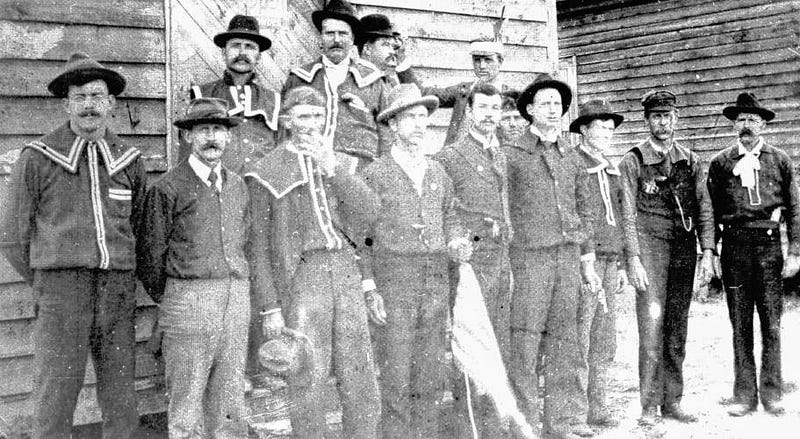
The Democratic Party won the legislature from the Fusionists after four years out of power.
The Coup and The White Declaration of Independence
They called for the end of “negro rule,” the Democrats had a document of demands they called The White Declaration of Independence. The demands included the overthrow of the newly elected interracial government.
They demanded that The Record stop publishing and that Alexander Manly be banished from the city and leave town within 24 hours. They required that he notify the Waddell within 12 hours of the notice of their acceptance or rejection of the demand.
They summoned the community’s Black leaders and told them their ultimatum. They drafted a response to the warning, and one of the members agreed to take it to Waddell’s home, but he left it in the mailbox because he was afraid.
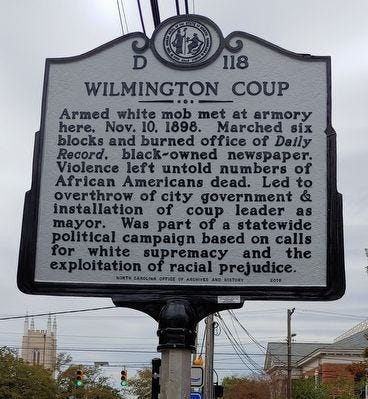
Thursday, November 10, 1898, when they didn’t receive the response by the deadline, Waddell gathered about 500 white businessmen and veterans. They armed themselves and went to the offices of the Daily Record, vandalized the office, and set the building on fire.
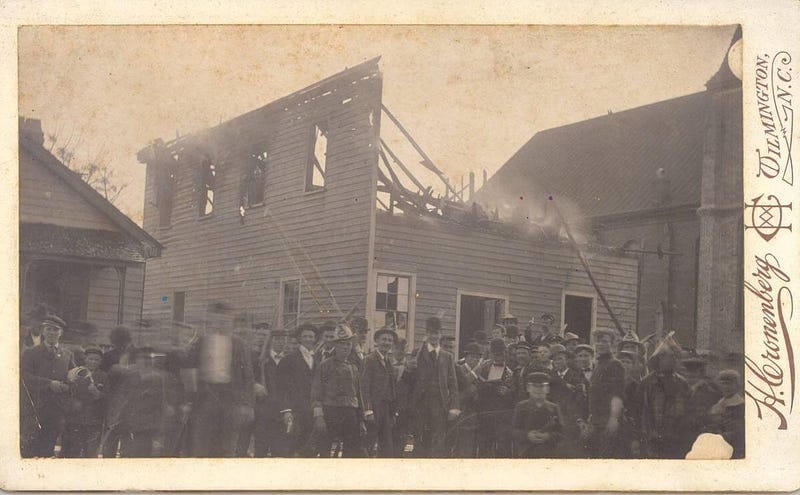
Black newspapers all over the state were destroyed simultaneously. Blacks and white Republicans were denied entrance to city centers throughout the state.
Waddell led a group of 200 men to city hall and forced elected officials to resign at gunpoint. This included the city’s Republican governor, the board of aldermen, and the police chief. Democrats put a new city council in place. They elected Waddell to take over as mayor by 4 p.m. that day. Waddell was given a list of prominent Republicans to banish from the city. The next morning Waddell had six prominent Black leaders marched out of the town.
Simultaneously the white mob rioted. The crowd of white vigilantes grew to about 2,000. They went into black Wilmington neighborhoods, destroying black businesses and property and assaulting black inhabitants. Small groups were spread out over the city and continued until nightfall.
It is estimated that 50 to 300 black people killed. Some black lives were spared by hiding in the swamps and nearby cemeteries for days. Over 2,000 black residents left Wilmington permanently. They were forced to abandon their businesses and properties.
On Thursday, November 10, 1898, more than 2,000 armed white men, backed by a white-supremacist state militia, effected the only successful coup d’etat in American history. They swarmed the city of Wilmington, murdered at least 60 African Americans, forced more than 2,100 black residents to flee, ordered the city’s multiracial government and other public officials to resign, more or less at gunpoint, then replaced them with white rulers. No one tried to stop them, and no one was ever held responsible.
The Jim Crow South and the History of the Grandfather Clause
When the black newspapers were destroyed, a way to organize and keep informed was also destroyed.
Then the new laws from the White Declaration of Independence were enacted. They adopted a series of Jim Crow laws that continued for decades. These included a law where new voters needed to pay a poll tax and an amendment that you had to pass a literacy test. They also used a “grandfather clause,” to bypass the literacy requirement for white voters. The clause stated that if their ancestor was eligible to vote in the state before Jan. 1, 1867, then they were eligible to vote. This excluded practically any black man from voting.
The Democrats also passed laws prohibiting blacks and whites from sitting together on trains, steamboats, and in courtrooms. They also required blacks and whites to use separate Bibles.
Through 1908, Democrats in other southern states followed suit in creating Jim Crow laws.
The effects of the election were lasting. After Daniel Russell left office in 1900, North Carolina would not elect another Republican governor until 1972.
George White, an African American who was elected to Congress from a predominantly African American district in 1898 was the last African American elected to that body until 1928. North Carolina would not send another African American to Washington until 1992.
Rewriting History
During most of the 20th century, the coup in 1898 was taught as a “race riot” — blacks rioted, and whites restored order. There were no black papers there anymore to report on the coup. The white newspapers reported on it as a riot that the black residents instigated. Democrats printed books of a victory and showed blacks as instigators. Some of the men that were responsible for the coup have their names on schools and state parks.
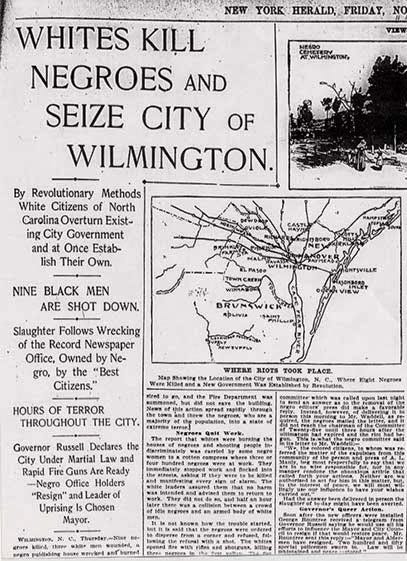
A riot is something that happens spontaneously. This was not a riot started by white supremacists; it was a coup planned for months in advance.
In 1951, Helen Edwards, a black scholar at N.C. Central, wrote a thesis challenging the records. She was called a “negress,” and Wilmington officials said her research was “distorted and sensational.”
In 1998, there were some asking if the revisionist history was accurate. Two years later, the General Assembly appointed a commission to look into what happened. “In 2006, the commission published its 480-page report, showing that the coup was not a “race riot” but a “documented conspiracy” to overthrow a legitimate government. On November 8, 2008, Wilmington installed a memorial a block from where the coup’s first victims were killed.”
Sources
“YouTube.” When White Supremacists Overthrew a Government, uploaded by Vox, 20 June 2019, www.youtube.com/watch?v=LVQomlXMeek&feature=youtu.be.
Gooch, Bonita. “Wilmington Coup of 1898: Goodbye Reconstruction, Hello Jim Crow.” The Community Voice, 28 Feb. 2020, www.communityvoiceks.com/wilmington-coup-of-1898-goodbye-reconstruction-hello-jim-crow/article_774cce8a-5a65-11ea-95e9-b39cc532786b.html.
Graham, Nicholas. “The Election of 1898 in North Carolina: An Introduction · The North Carolina Election of 1898 · UNC Libraries.” Exhibits.Lib.Unc.Edu, June 2005, exhibits.lib.unc.edu/exhibits/show/1898/history.
Hunt, James. “Fusion of Republicans and Populists | NCpedia.” NCoedia, 2006, www.ncpedia.org/fusion-republicans-and-populists.
Lafrance, Adrienne, and Vann Newkirk. “The Lost History of an American Coup D’État.” The Atlantic, 12 Aug. 2017, www.theatlantic.com/politics/archive/2017/08/wilmington-massacre/536457.


