
A Conversation in a Dark Tower Between the Creator of Frankenstein, Genghis Khan, and Will Rogers, with a Surprise Visit from Bede
It must be noted this is the first of other such conversations to be transcribed
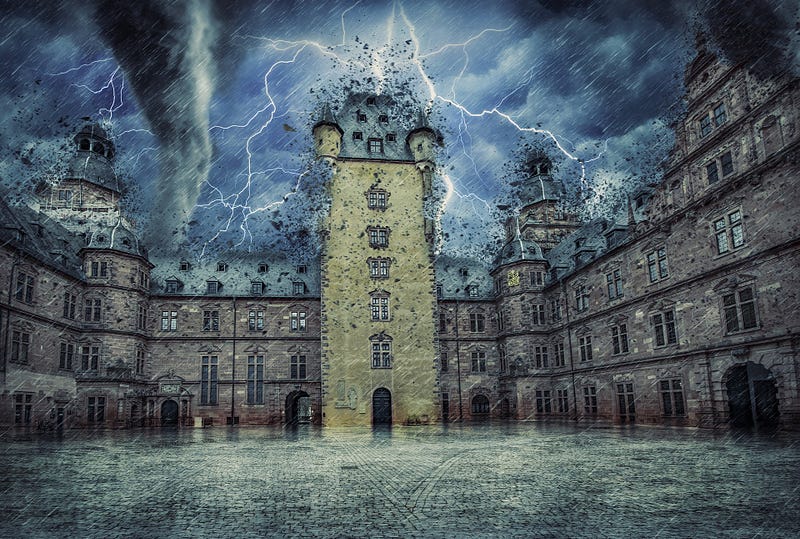
Setting: Castle somewhere outside Geneva. Storm raging above.
(Enter, somehow, Mary Wollstonecraft Shelley, Genghis Khan, and Will Rogers. The off-stage narrator (watcher) offers a running commentary.)
NARRATOR: The setting of this story, if you must know, is actually a point of convergence of three personages caused by a cosmic ripple in space. I see it as both a cosmic and comic manipulation, for some unknown entity (or entities) is surely behind it and our reactions are in service to its amusement.
“Moments Out of Time,” as these convergences have come to be known, involve rather famous figures from our past who could never have met in reality. ALAS, such events appear frequently and at random. My people and I are a captive audience, since we can never be prepared for their sudden arrival in real time before us. Not to mention, once a “moment” has begun, we are unable to interrupt it in any way whatsoever, thus forcing us to yield an hour or more of our sense of time to its non-sense of time!
Wishing no desire to complicate this explanation, one more element must be noted. The cause of this sudden point of convergence is a torus, something our scientists have said is only hypothetical. Yet while they continue to insist the universe is governed by the five senses, they are also always changing the script, declaring with absolute faith there is dark matter, for instance, and suddenly determining, quite recently, there may be no such thing. Interestingly, none of them have ever experienced a “moment.” Since enlightening nay-sayers, who always dig their heels in, is a very tedious task, I assume and well understand why the torus and its makers would not want to be bothered arguing the point. But it must be kept in mind that a torus is inherently a transmission of light and we, humans that we are, are made of star stuff, aka, light. It is vital to remember this whenever any confusion may arise.
The last “moment” I experienced was five days ago. It was in the late afternoon, and I had set up a hologram to enable my long-awaited visit to the Benedictine monastery of St. Peter and its companion monastery of St. Paul in Northumbria in 731 AD. (A hologram is a photographic recording of a three-dimensional light field, remember. This matters.) I wanted to see how the twinned monasteries had looked before the ravages and destruction by the vicious Vikings and then the damnable Danes and then the folly of King Henry VIII wanting a new bedmate and an heir at any cost. I sought dearly to meet the Venerable Bede, but I didn’t have the chance, since the “moment” upstaged the buildings and landscape, its cosmic interference apparently undeterred by the software I was running.
This recent experience involved a journey into a strange matrix and a lengthy conversation heralded by three strong-minded influencers in the course of Earth’s history (for better or worse). Mary Wollstonecraft Shelley showed up first, a writer who I have to admit offered some of the most exquisite observations about the failures of human nature and science run amok in her novel Frankenstein. I have read the book seventeen times after finding it in old time-lapse cylinders that had once been our primary form of archiving. Emerging next out of the torus and going over to join her was Will Rogers, an all-round entertainer whose wit made him a rock star on the radio, in films, and on Broadway in the early twentieth century, and who offered a most accurate assessment of the egregious nature of the average member of Congress in his time. (Happily, we have long since disbanded that gallery of sociopaths.)
The third one irritated me profoundly, though I knew Genghis Khan’s outlook was an instructive model to reveal the dark side of our species. I felt a distinct letdown at seeing him. My own feeling was that I had had quite enough instruction in that area in my life. My father had been a corporate executive who made a killing, so to speak, in the arms trade and my mother had followed a cult devoted to ceremonies in graveyards at night to find and destroy witches and all manner of innocent creatures and almost trapped me in there with her. They have both gone into the ether now and it is not impossible to imagine another torus has already presented them to an audience somewhere on Earth in some other “moment” as evidence of human folly.
Khan immediately ordered Mary and Will to stand before him and vow unending allegiance. When they refused, a curious glint appeared in his eyes.
GENGHIS: “You defy me?”
NARRATOR: It was obvious he hoped they would say yes and give him a reason to crush them. Will laughed. For a moment I froze. Granted no visitation had ever harmed us, the audience, but such was the threat emanating from this Mongol emperor that I feared Will would be replaced by a different visitor. I admit that thought was not only incorrect, given the usual time limit of the convergence, but also not so worrisome. Almost anyone replacing Will would automatically share his mockery and repulsion for the dictator. Almost anyone. At least four major figures in the twentieth and twenty-first centuries came into my mind who had matched his ruthless greed for power and his savage bloodlust, people who were even more successful in their exterminations and oppressions (mainly, it must be said, because they had larger populations to work with).
WILL: “Here’s the way it is, Genghis, my friend. We will never have true civilization until we have learned to recognize the rights of others.”
MARY: “So true!” She broke off as a strange ribbon of light wove itself among the three, its intensity blinding all of us, players and watcher. “What is that?” she asked, but the next instant it had vanished and she waved her hand in dismissal and went on. “My mother spoke of that exact idea in her book called A Vindication of the Rights of Woman, declaring that ‘All the sacred rights of humanity are violated by insisting on blind obedience… Strengthen the female mind by enlarging it, and there will be an end to blind obedience.’ How blessed I was with such a mother, though I never knew her, for she left us when I was but a month old.”
GENGHIS: The glint in his eyes had become a hardened look of fury and rage. “I have six Mongolian wives and over 500 concubines! Women are for my indulgence.”
WILL: “You ain’t the first man to say that. Sad to say, you ain’t the last, either.”
NARRATOR: An aside: Geneticists have determined over 16,000,000 humans currently alive on our planet right now are genetic descendants of good old Khan because of his “indulgence.” Lucky us. But I digress.
MARY: “Have you never considered your evil work, killing millions upon millions, instilling terror and grief and panic in all whose territories you swept underfoot in waves of blood?” Mary spoke in outrage, raising her voice. “Your invasions displaced people on a scale unknown before you were born. Have you no remorse? You are a monster!”
WILL: “Mary, you sure know monsters, but you ain’t preaching to the choir here telling him all that stuff.” Will shook his head. “Why, he’s that proud of himself, like. Genghis here’s pretty certain he’s the greatest person who’s ever lived. Even though we all know he’s a born criminal and fool.”
GENGHIS: “You bait me,” he said to Will, with a smile that was far worse than any sneer would have been. “Others have tried. Many. Dead men, all. Words are useless. I became Emperor because I deserved to be. You have paltry leaders who hesitate to follow in my footsteps. They are the reason I triumphed, why I couldn’t be stopped. My law is the law, and I am — ”
NARRATOR: It was his turn to stop as the ribbon of light appeared again, expanded now to curving waves winding around the three of them, this time its color altering between white-gold and blue.
GENGHIS: “Which of you is doing this? How dare you interrupt me? I am the ruler of the world. You say I killed millions? It was far more! I rid the world of all who were in my way!”
WILL: “I regret to say that part of things hasn’t changed much.” Will swung his lasso a few times in contemplation. “Yep, true it is. Our politicians have single-handedly ensured we will always be at war somewhere or other. They have three playgrounds — Wall Street, the offices they redecorate every year at taxpayer expense, and the circus tours where they tell their constituents what they want to hear. I fear to say how gullible people are believing their perpetual lies. A fourth playground might have been the two grand chambers where they are elected to legislate, but since they spend very little time legislating, being on vacation so often, also at taxpayer expense, it doesn’t really count. The one thing they don’t do is try to make things better. I don’t think they understand the principle, nope, not at all. They invented the word self-interest. Like Genghis here, same thing.”
NARRATOR: The light wound around Will in spirals as he swung the lasso and then it faded away. Genghis stared for a moment at where it had been and looked around and behind him and then at Will and Mary.
GENGHIS: “If you stop that light, I will let you live.”
NARRATOR: His companions both broke out in laughter, enraging him again. He tried to draw his sword.
WILL: “Right generous of you, but you see, Genghis, from my view of things, anybody whose pleasure is watching somebody else die is about as little use to humanity as a person being electrocuted. Even though I used to think I’d never meet a man I didn’t like, have to say you’re testing me mightily.”
MARY: “Will is absolutely right.” She turned and faced Khan. “Just as my mother before him. We can depend on men in power to vindicate their own self-interest at the expense of anyone else!” she declared. “Were they more enlightened, why, women would already have the vote and be treated as the strong and powerful people they are. And all those less fortunate from any walk of life and territory and livelihood and origin would live in freedom. My mother noted many times the entitlement of men would destroy more than it would ever create.” She paused. “But our time will come,” she added softly.
WILL: “Is that why you wrote that book of yours? I read it. Have to say, that monster Frankenstein kept me awake a few winter nights.”
MARY: “You mistake the creature. Frankenstein was the doctor. He created the monster out of the hubris of entitlement residing in his maniacal attending to his own will. He saw humans as an array of parts, a wretched conveyor of chemicals by which he could embed a spiritless spark of life. He worshipped what he believed was the absolute power of science. It is a male obsession, this desire to insist on cause and effect, an outmoded and irresponsible and lethal approach to life, to Nature especially. Did you not understand my intent was to condemn the attempt? The doctor thought he was God!”
NARRATOR: Before Will could answer, the light returned. It was blindingly bright this time and the three before me all put up their hands to shade their eyes. It raced among them before exiting with a loud, crackling sound.
WILL: “This light thing that keeps showing up has got me wondering. That crackling sound it makes, why, it’s just like the movie they made of your book, Mary! Millions saw it, d’ya know? They used a real coil in it that was sparking all over, had this massive power when the monster came alive, scaring everybody. That was Tesla’s coil, a man with a brilliant mind who would have loved to meet you, especially. I know it was his coil in the movie because I knew the special effects man — Strickfaden, he was. Their studio was right next to mine when I was making A Connecticut Yankee.”
MARY: “Movie? Tesla? What on earth? What manner of thing are you describing?” She stared at him.
WILL: “You have no idea how famous your monster became — the whole world knows about it. Because of the movie. Now, what a movie was will take a little time to explain. They came into Hollywood with the speed of a locomotive— ”
MARY: “I do know the power of a locomotive, having actually been on one with my son. So what is this movie object?”
GENGHIS: “You both ANNOY me with your useless chatter!” Genghis interrupted, fingering the thin strands of his graying beard. “Nothing you say makes sense. There is only power. MY power.”
WILL: “Not much of a listener, are you, Genghis. That’s sorta what this doctor of Mary’s felt. Not a whole lot of difference between the two of you, tell the truth. Since you haven’t read that there book, of course, and no way you could have, things being the way they are, that isn’t something you’d figure out.”
MARY: “Unfortunately, civilization is equally flawed in its praise of those like you, Genghis Khan! Our literature rains plaudits on far too many violent men. Why, in the ‘Squires Tale’ of Chaucer’s Canterbury Tales he sets his characters in the Mongol empire and is remarkably glib about death and destruction, for the leader in his story is, he claims, a paean among men.”
WILL: “Most likely this Chaucer just plain didn’t know, since ol’ Genghis here never made it to the shores of England so you all were safe and could settle for hearing the stories from travelers, I reckon. If Genghis had crossed your English Channel, well, we wouldn’t be chatting here and now, you and I. My wager is we wouldn’t exist. Since all his massacres tended to stop helpless humans from rebellion, their being dead and all. We know all about that where I come from. Why, in my country they were very religious people that come over the Atlantic from the old Europe and bringing their ways with them. They were made in the image of Genghis, though they’d never admit it, no sir. Yep, real religious people. They would shoot a couple of Indians on their way to every prayer meeting.” Will gazed at Genghis a moment before going on.
WILL: “Why, they managed to wipe out most of the native population in America by the time they were all done,” he continued. “Being born Cherokee, you see, I know what it was like from the stories passed down. You could say my people weren’t on the Mayflower. Instead, we met the boat, and we’ve regretted our manners that day ever since.”
MARY: “How grim and painful a travesty. Would you had known!”
WILL: “Well, Mary, you have a great heart and a wonderful imagination and you know how to explain what’s wrong. But you see, seems to me our humanity’s just not ready for real truth or real harmony.”
GENGHIS: “The only truth lies in the power of a man to step on the backs of all who oppose him. I am a god of gods!” Khan reached again for his sword, but it would not leave its scabbard, much to my relief.
NARRATOR: Will smiled, but for once it didn’t reach his eyes.
WILL: “I’d say you and our politicians are not so different in a lot of ways. The thing is, you do it yourself and they send others to do it for them. I am a peace man. I haven’t got any use for wars and there is no more humor in ’em than there is reason for ‘em.”
NARRATOR: As he uttered those words the light came again, but this time it circled around the three, its rays reflecting on their faces and forms.
MYSTERIOUS VOICE: “Oh, God, have mercy! What demons have come to us!”
NARRATOR: I could hear the piercing dread in the disembodied voice and it brought a chill to me even though I knew all was well. The visitations were always benign to the audience, as I have mentioned.
But still, what happened next was very perplexing. To my amazement and that of the three standing before me, the figure of the Venerable Bede appeared, his pale face above his black habit showing the terror he was feeling. I knew it was him. In his hands he carried smooth pieces of vellum with writing on them. I could see one was titled Historia Ecclesiastica. I was in awe, knowing I was looking at the original manuscript for that extraordinary work from 731 AD. The others did not seem to know who he was, but were dazzled by the light emanating from him, so pious and educated a man. I sensed he was the source of the light we had been seeing all along.
I saw then the stone walls of the chapel around us, and through an open arched window the fields beyond the monastery lay in golden sunlight, just what I had come to see in the first place. Nothing like this had ever happened before.
WILL: “What, by all that’s God’s earth, is happening here?”
MARY: “Who are you?”
NARRATOR: I sensed the tremor in Mary and the wonderment in her words, her voice hardly above a whisper.
GENGHIS: “How dare you invade my presence! You are a Christian, a devil before me!”
NARRATOR: Suddenly, watching the light flickering madly around us, I knew instantly what must have happened. The three had overstayed their appointed hour and may even have missed the event horizon occasioned by those who controlled their departure via the torus. My software had sensed the assigned time had run out and begun to overwrite them. I had no idea what this might cause to take place and felt a growing anxiety.
BEDE: “You are the demons I have spoken of here!” he called out, holding the manuscript to his heart and the gold cross before him. “I know of you just as Saint Fursey knew you, I know your evil. I know that the God of us all is the truth and the true power. You are but fabrications of Falsehood, Covetousness, Discord, and Injustice. Begone!”
NARRATOR: Bede held the large cross up before him and its light shone out and covered the three visitors who had been conjoined.
The next moment the Venerable Bede was gone, and so were Will and Mary and Khan. I have no idea of the why and how, though I suspect someone somewhere far, far away was made aware the whole situation was getting out of control and fixed it just in time.
For me, it was a fascinating experience that altered my previous unwillingness to witness “Moments Out of Time,” though I regretted deeply having no chance of conversation with the inspired monk of Jarrow.
I find myself actually looking forward to the next “moment,” for patience and anticipation prevail now in my heart, as Mary was wont to say.
(Exeunt)