
Course Overview
A Comprehensive Overview of the World’s Most Popular Online Course: ‘Learning How to Learn’
It’s the one skill which underpins every other, so why not learn how to learn?

I recently completed all four weeks of Dr Barbara Oakley and Dr Terrence Sejnowski’s illuminating (and very meta) online course with the full title of ‘Learning How to Learn: Powerful mental tools to help you master tough subjects’. For further details on its structure and purpose, or if you’d simply prefer to embark on this course yourself (free of charge), see here.
However, if you don’t want to invest the 10 or so hours necessary to progress through the course and instead want to read all of the key information in one place, look no further. By painstakingly converting my course notes into this long-form piece, in theory you should be able to benefit from all of the contextual and practical teachings within this course — in less than an hour!
True to the teachings of the course, I deemed it to be an effective personal revision method for myself to go over my fragmented notes again and present them in this complete and finalised manner. If you decide to follow along, I sincerely hope that you can benefit from my efforts here too!
Without further ado — and of course with plentiful thanks to the engaging course instructors — here is everything I gathered from my journey through this goldmine of a course.
Part 1 of 4: What is Learning?
Introduction to the Focused and Diffuse Modes of Learning
A basic understanding of how your brain works can help you to learn more easily and with significantly reduced frustration. Prevailing neurological research indicates that humans have two distinct fundamental modes of thinking, and that we can only be in one of these modes at a time. Both of them are needed to help us learn and assimilate information, but in different ways. There is the ‘focused mode’ — the one we’re familiar with — which is used when intently and directly concentrating on something you’re attempting to learn or understand. Secondly, there is the ‘diffuse mode’, which allows for more creative thinking and broad-ranging perspectives. This far more free-flowing and creative mode is related to the brain’s many so-called neural resting states.
The diffuse mode of thinking is best applied when the problem you’re working on requires new ideas or approaches, i.e. concepts you haven’t even thought of before. In the absence of actually having thought a particular thought before, you can’t know how the neural pattern associated with the target thought ‘feels’, or which neural connections give rise to it (and indeed where these connections need to take place in the brain). The big question is then — how can we develop a novel thought in the first place?
To sharpen our understanding of these two fundamental modes, we’re going to draw a pictorial analogy between the neural framework of the brain and a pinball machine. Incidentally, both metaphor and analogy are powerful learning tools.
The focused mode of thinking can be visualised as a densely packed array of pinball machine bumpers, making it difficult for a specific thought (the pinball in this analogy) to travel around and explore different regions. Similarly, the diffuse mode has far wider spaces between bumpers, facilitating access to new neural connections and therefore thought patterns. In other words, this much more relaxed diffuse mode offers a valuable big picture perspective. It’s true that you can’t focus in as strongly — e.g. to finalise problem-solving or understand the finest aspects of a concept — yet the diffuse mode enables you to ‘get to’ the initial place you need to be in order to go about finding a solution.
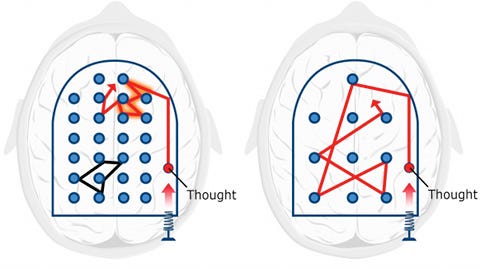
The landslide consensus is that when learning something new — especially something difficult — your mind needs to smoothly transition back and forth between the two fundamental learning modes to best assimilate the desired material. Let’s drop in one more analogy to conclude this section… the most effective way to build neural structures (and thus knowledge) is to do a little work each day (or every other day) over an extended period, as opposed to resorting to frenzied last-minute cramming. In the same way muscular structure can only be developed little by little, through sustained commitment over a prolonged period of time, neural structures also have to be built up steadily over time so as to ensure robust and reliable foundations of knowledge.
What is Learning?
The brain is a very expensive organ! What is meant by this is that our brains consume around ten times more energy by weight compared to the rest of the body. Furthermore, although computers can comfortably outperform us in analytical areas such as chess or mathematics, there are many bodily processes which we take for granted — our senses for instance — that are incredibly complex and far beyond the capability of the world’s fastest computers. In summary, despite the blatant intrinsic power and capabilities of the human brain, we are not consciously aware of how they work!
To address this dilemma, neuroscientists utilise brain imaging techniques to guide us in our study of the brain and its activity. This is naturally of great importance to the field of psychology too, given the clear influence of the unconscious mind on our motivations, thought processes, memory and emotions. Such imaging has ascertained that there are correlated regions of the brain which are most active when the subject is in the resting state, and others which ‘switch off’ in the resting state and are most active when the subject is interacting with the world.
A synapse is a single connection between neurons and can be imaged. Indeed, memories are stored in the multitude (thought to be of the order of 10¹⁴) of synapses in the brain. The latest research has established that (contrary to popular assumption) brain connectivity is dynamic and continues to be so even after it matures. There is thus a continual turnover of synapses forming and disappearing in what is an ever-changing neural environment. It begs the question (which will be discussed later) — how do memories remain stable over the years?
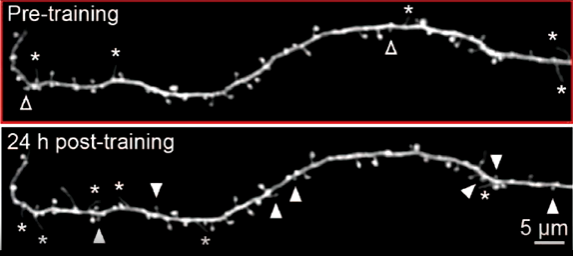
Here’s an interesting thought… you’re technically not the same person you were after a night’s sleep or even a nap, due to this upgrading process of the brain through the formation of new synapses. Later we will discuss how to take advantage of sleep and your unconscious mind, priming yourself to more easily assimilate information and solve problems.
Procrastination, and Our First Productivity Hack!
When you think about doing something you’d rather not, the areas of your brain associated with pain are activated. Your brain naturally tries to shut off this negative stimulation by redirecting your attention towards other — more pleasant — things. This is the insidious driving force behind procrastination: you feel unease after observing or thinking about something that you don’t want to do, you try to counteract the negative sensation by shifting your attention, and you feel happier because of this. However — crucially — this procrastination-based happiness is temporary. Research tells us that the ‘neuro-discomfort’ associated with something you’d rather not do actually starts to fade away not long after you start working on what you initially were averse to.
A popular productivity tool used to help counter procrastination is the ‘Pomodoro Technique’, which was developed in the late 1980s. The technique involves using a timer to set out an interval over which you really concentrate on what you’re working on without interruption (usually lasting 25 minutes, a duration over which virtually anyone can maintain focus).
Importantly, once the timer ends on a particular cycle you should give yourself a small reward in the form of a few minutes’ break to, for example: browse the web, take a walk, grab a coffee or snack, do some stretching. This technique effectively amounts to doing an intense, undistracted 25-minute mental workout, followed by a brief respite period of mental relaxation.
This process can then be repeated as much as desired! It sounds like such a simple system — because it is — but you’ll be surprised by how powerful it can be in keeping you focused on what’s most important. Next time you’re struggling to will yourself to stay on task, try to complete a 25-minute Pomodoro instead. Hopefully by then you’ll have gained some momentum, and will impress yourself with how much you go on to achieve in that sitting!

The Importance of Practice
We generally regard mathematics and the sciences as more conceptually challenging than other fields, a perceived complexity which is thought to be related to the abstract nature of the ideas they encompass. For example, mathematical ideas tend to come without an analogous ‘thing’ or object based in reality which one can anchor the concept to in order to better understand it. You might say that words such as ‘love’ and ‘hope’ are abstract too, but at least linguistic concepts like this can be directly related to emotions we can feel.
This highlights the importance of practicing with the ideas and concepts you’re learning — particularly in regards to more abstract areas of learning — in order to enhance and strengthen the neural connections you’re making throughout the learning process. Even if the ideas themselves are abstract, the neural thought patterns you’re constructing are real and concrete!
A thought pattern can be helpfully thought of as a series of neurons, which have become linked together (and therefore ‘fire’ together) through repeated use. Equipped with this picture, we can visualise three separate stages of understanding:
- When you’re first beginning to understand something, the neural pattern is present but is very weak (blurred lines).
- When you cover the material again or start a related problem, you deepen the same neural pattern (less blurred lines).
- Once you have a full and lucid understanding of the problem or concept, the neural pattern is well and truly ingrained in your neural structure (dark and firm lines). In other words, practice makes permanent.

Therefore when learning, start by studying something with intent focus (i.e. the focused mode). It will then serve you well to take a break or set your mind elsewhere for a while, giving your brain’s diffuse mode an opportunity to operate in the background and assist in your conceptual understanding. In this way, your ‘neural mortar’ (to use yet another analogy) has a chance to solidify, and you can start to avoid the jumbled knowledge base and poor foundations brought about by cramming.
Memory
One way to model and understand memory is to split it into two major memory systems known as long-term memory and working memory (also known as short-term memory). These two systems are actually related, as you’ll often bring something from your long-term memory into your working memory so that you can actively think about it, especially in tandem with other (perhaps newer) ideas.
Your long-term memory is akin to a vast storage warehouse which is distributed all across the brain, with different sorts of long-term memories being stored in different regions. This warehouse can store billions of items! Research shows that to increase the chance of storing and securing an item of information in your long-term memory, you need to revisit it at least a few times. This practicing and revisiting of information is doubly important due to the fact that so many items can be stored here that they can start to bury or obscure one another.
On the other hand, your working memory is akin to a (not very good) blackboard, necessitating repetition of what you’re trying to work with so that it stays in place on the blackboard. You’ll perhaps recognise this feeling from the times you’ve repeated a phone number to yourself until getting the chance to write it down. We repeat information in this way to help counteract natural bodily dissipative processes which cause memories to fade or disappear. The working memory is centred in the prefrontal cortex (located at the very front of the brain, immediately behind the forehead), and has connections to other regions of the brain to access long-term memories.
We use the working memory system when attempting to hold a few distinct ideas in mind so that a concept can be understood or a problem can be solved. It’s the system involved in what you are immediately and consciously processing in your mind. Note however that the latest research suggests that our working memory can only hold about four items (or more accurately ‘chunks’ ) of information. Our automatic tendency to group ideas and memories into so-called chunks (more on these later) makes our working memory feel larger than it actually is.
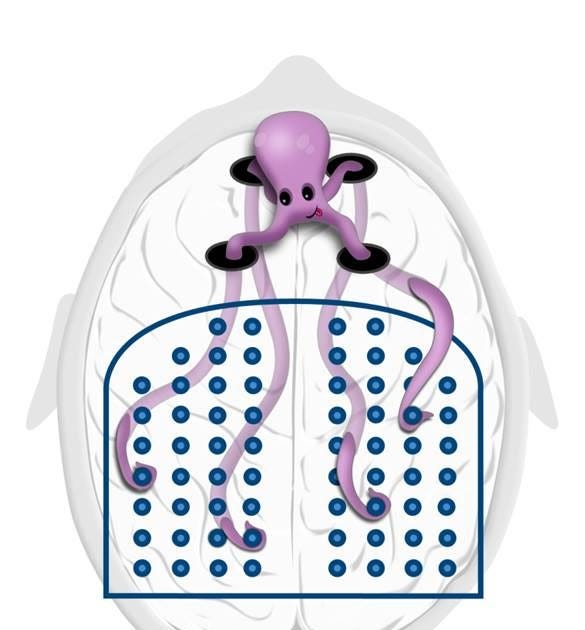
In summary, long-term memory is used to store fundamental concepts and techniques that are involved in whatever it is you are learning about, whereas working memory is deployed when you’re dealing with something new. Transitioning new information from your working memory to your long-term memory takes both time and repeated practice. One way to assist this process is through a very useful technique called ‘spaced repetition’.
Spaced repetition relies upon repeating something you want to retain (in your long-term memory) over a spaced out series of days. We now know that repeating something multiple times in one evening is significantly less effective than repeating that same something over the course of several days (tying into the pitfalls of cramming mentioned earlier). This technique allows time for the requisite neural and synaptic connections to form and strengthen, facilitating a solid knowledge structure.
The Importance of Sleep
This may surprise you: the mere act of being awake leads to the creation of toxic products (or metabolic toxins) in your brain, which are flushed out when you sleep! When you’re asleep your brain cells shrink slightly, creating additional space between them which allows fluid to flow through and wash the aforementioned toxins out. Therefore in a sense, sleep is your brain’s way of keeping itself clean and healthy.
This explains why you may struggle to think clearly after insufficient sleep, as you’re working with a brain that still has metabolic toxins floating around. Other than the well-established negative short-term effects of sleep deprivation such as doing worse on tests, having too little sleep over too long a period of time is linked to headaches, depression, heart disease, diabetes and a shorter lifespan.
Sleep is a crucial part of the memory and learning process. During your slumber your brain actually tidies up ideas and concepts you were thinking about and learning, erases the less important parts of memories and in turn consolidates areas that you need or want to remember. Your brain can use this downtime to repeatedly go over certain neural patterns in order to strengthen them, rehearsing some of the tougher parts of what you’re trying to understand and learn.
Sleep has been demonstrated to significantly enhance your ability to understand and solve difficult problems. The deactivation of the conscious ‘you’ in the prefrontal cortex helps other areas of your brain to start communicating with each other more easily. If you hadn’t guessed it already, this is actually a prime example of your diffuse mode in action! It tasks itself with forming the neural solutions to your learning tasks while you’re resting. Even dreaming about what you’re learning or studying can majorly enhance your ability to understand it by condensing your memories into easier to grasp ‘chunks’.
DISCLAIMER — nothing comes from nothing! Of course, you must plant the seed for your diffuse mode by first doing focused mode work when awake. You can increase the chance of dreaming about a particular topic you covered by going over it shortly before sleeping or napping. You can also improve this chance further by simply willing your mind to dream about something!
Thoughts from Dr Terrence Sejnowski
Week 1 of this course concludes on an insightful interview with Dr Sejnowski, a pioneer in computational neuroscience and one of a handful of scientists to be elected to all three US national academies: engineering, science and medicine. Here is a bullet point list of the major takeaways:
- There is a general principle that you can learn more through active engagement (independently solving problems, practical experimentation or participation in a discussion, for instance) compared to passive listening. This is the notion of learning by doing, and can sometimes be more effective than simply reading a bunch of books.
- Learning by osmosis from more knowledgeable people is another good way to assimilate information. Also, being in a creative environment around other creative people is a potential way to enhance your own creativity and productivity. The quality and clarity of your ideas can be improved if you have other people to bounce them off of, or to try explaining them to.
- Passion and persistence can beat pure intelligence in the pursuit of success.
- Exercise such as running can provide an effective means of disengaging the mind from normal trains of thought and coming up with new ideas through the diffuse mode. In essence, it can allow your subconscious thoughts to bubble to the surface.
- It is of great difficult — if not impossible — to consciously do or focus on two or more things at once, as they’re likely to become mixed up. Practical multitasking is more a case of ‘context switching’ between topics.
- In a test environment, try not to get hung up on a question you can’t answer. Instead move on to the next one, as often the answer to the problem that was holding you back can mysteriously pop into your brain later on in the test — once again courtesy of the diffuse mode. It’s good to understand that our brains can operate like this, with disparate things working on ‘parallel tracks’.
- Recall the dynamic picture of the brain’s neural structure introduced earlier. Neurological discoveries have revealed that the hippocampus (a seahorse-shaped part which of the brain which is paramount in learning and memory, located in the middle) continually generates new neurons, even well into your adulthood. Studies of rats tell us that having an ‘enriched environment’ (e.g. freedom to move around and interact with things/people) encourages the formation of much stronger neural connections. To summarise, you ideally want to be surrounded by other people who are stimulating you, and to have access to events which you can actively participate in.
- However, independent of such an enriched environment, exercise can also serve to boost the number of new neurons which are born and survive in your hippocampus, aiding you in remembering things.
Part 2 of 4: Chunking
Introduction to Chunking
The succinct neuroscientific definition of a ‘chunk’ is a group of information which is bound together through meaning or use. Underpinning each individual chunk is a network of neurons which have learned to communicate and coordinate with each other, firing together and allowing you to think a thought or perform an action smoothly and efficiently. One of the first steps towards acquiring expertise in academic topics is to form neural chunks like this.
However this process of forming chunks is in fact more general, it being the mental leap which helps you to unite scattered pieces of information through meaning, whether it’s applied to sport, music or academia. The creation of a new logical whole renders the chunk easier to remember, and also makes it easier to fit the chunk into the bigger picture of what you’re learning. It actually helps your brain to run more efficiently! This is because once an idea, concept or action is ‘chunked’, you no longer need to remember all of the fine underlying details. The main idea — the simple chunk of thought — gives rise to a complex swirl of underlying activities and information. Chunking differs depending on the context, so chunking in chemistry would differ to that of history or karate, say.
Chunks are best formed through focused practice and repetition, this is the most effective way to create strong memory traces that can be called upon when required. It’s good to bear in mind the following when going about forming solid chunks: if you only memorise a fact without understanding or context, you’ll not be able to see how the concept links with other concepts you’re learning. The path to expertise is built upon little by little, with small chunks steadily becoming larger. Eventually, this expertise can be leveraged to provide more creative interpretations of the material.
Recall the ‘octopus of attention’ analogy shown previously, depicting the four slots of working memory based in the prefrontal cortex. Focusing your attention on something involves filling those slots by selecting and making connections to information you have in various parts of your brain, a process that often helps you begin to create a chunk. When you’re stressed, however, your ability to make such focussed mode connections can be diminished, explaining why your brain doesn’t tend to work as effectively in moments of anger, stress or fear.
Remember that this is a very different matter to the random connections made in the diffuse mode! Some of the best learning programmes will combine structured practice (i.e. repetition and rote focus mode learning of facts and concepts) with more diffuse learning. For example, diffuse learning in the context of language study could mean conversing with native speakers.
How to Form a Chunk
Regardless of the subject matter or skill, learning involves getting an initial sense of the pattern you want to master, and working on small pieces (or neural ‘mini-chunks’) of what you want to learn until you’ve grasped them. You can then join them together into larger and more complex neural chunks, which can be summoned in an instant when needed. The best chunks are so well ingrained that you don’t even need to consciously think about connecting the corresponding neural pattern together i.e. the set of ideas or actions becomes second nature. This is the point of condensing complex ideas, movements or reactions into a singular chunk, but how are they formed?
- Start by focusing your undivided attention on the information you want to chunk, with as few distractions (watching TV or checking your phone, say) as possible. These peripheral thoughts will use up some of the limited slots in your working memory!
- Grasp the basic idea(s) that you’re attempting to chunk by allowing the focused and diffuse modes of thinking to alternate in helping you figure out what’s happening. Understanding is the glue that holds the underlying memory traces together, which can then broaden and link to yet more memory traces. Remember that a chunk created in the absence of understanding is often of no use, as it can’t be connected or related to other material that you’re learning.
- Gain context by going beyond the initial problem, taking the time to evaluate the information more broadly. This requires repetition and practice with both related and unrelated problems such that you can develop an appreciation for both when and when not to use a chunk. This process will assist you in seeing how your newly formed chunk fits into the bigger picture of what you’re learning. The overriding principle is as follows: you need both the tool itself, and an understanding of when to use said tool, otherwise it will be of scant use to you!
In mathematics and science, a worked through example can be a major help in first trying to understand how to address a problem. This is analogous to first listening to a song before attempting to play it yourself. In this way you lighten the initial cognitive load, and give yourself an opportunity to work out the key features and underlying principles of a given problem. However, it’s critical to not purely focus on why each individual step of a solution works, but also the overriding connections between steps. Comprehending the complete rationale behind a method empowers you to be able to tackle related problems on your own, or even discover brand new methods of doing them!
This touches upon an important point: simply understanding how a problem was solved does not necessarily create a chunk that you can call to mind later on. You need to ensure that you are regularly reviewing the concept and applying it to problems on your own. Only the act of doing something (rather than just observing, even when accompanied with understanding) helps to create the neural patterns which underlie true expertise. Finally, practice helps you to broaden the network of neurons which are associated with your chunk, serving to strengthen the network itself, but also making it accessible for many different paths.
Learning takes place in two main ways, with both processes being vital in your goal of mastering the material:
- Bottom-up learning (i.e. chunking) in which practice and repetition help you to build and strengthen each chunk so that you are able to easily access a certain chunk whenever you need to.
- Top-down learning (i.e. big picture process) which allows you to see what you’re learning and where it fits in. For example, the knowledge of when to use a certain problem-solving technique as opposed to any other.
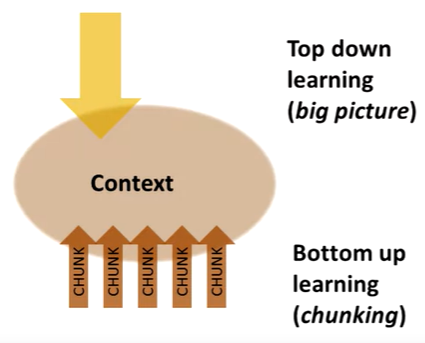
To end this section with a quick tip: prior to actual study you could try a rapid ‘picture walk’ of the pictures and section headings in the chapter of a book to give you a sense of the big picture. It will also give you the knowledge of where to place the chunks you’re constructing and how they relate to each other.
Illusions of Competence
It’s time to discuss methods of study and traps you can fall into. Re-reading material from your notes or a book is much less productive than using the technique of ‘recall’. This means simply looking away and recalling the material you’ve just read, in essence engaging in a loop of reviewing the material and recalling or explaining it out loud to yourself. This mental retrieval process itself fosters deep learning and helps to begin forming chunks. However, re-reading of material can be effective if used in conjunction with spaced repetition, letting some time pass between separate readings.
Interestingly, recalling material when you’re outside your usual place of work or study can actually somewhat strengthen your grasp of the material, as it can help to make you independent of the subliminal cues associated with any one given learning location. This is of particular importance when preparing to tackle problems in an examination venue.
Once a concept has been chunked, it then only takes up a single slot in your working memory which is easy to follow-up and can be used to make new connections. This leaves the rest of your working memory clear, and in a sense you will have increased the amount of information available to your working memory. A good metaphor for this scenario is to view this slot containing a chunk as a hyperlink that’s connected to a large webpage.
As previously discussed, it’s vital to work through problems yourself as opposed to simply looking at the solutions and assuming you understand them. This is so that you can ensure the information has persisted in your memory, and that the requisite concepts have been well incorporated into your underlying neural circuitry. It’s an illusion of competence to blithely assume that observation of a solution method is equivalent to true understanding and mastery that you can independently apply.
Too much underlining or highlighting of your study material can be counterproductive sometimes. This is because you can fool yourself into thinking that you’ve lodged a concept in your mind purely because you’ve highlighted it! You should therefore keep this to a minimum (try for a sentence or less per paragraph). However, words or notes in a margin that condense key concepts are a great idea.
You should regularly test yourself on whatever it is you’re learning, taking advantage of mistakes to help correct your thinking such that you can learn and do better next time around.
What Motivates You?
It’s an obvious truth that learning is far easier when you’re learning about something that you’re interested in. However, what motivates you? What compels you to do things or make certain decisions? In this section we’ll briefly summarise the three chief neuromodulators in the brain, and the effects they have.
Neuromodulators are chemicals which affect (or modulate) how neurons respond to other neurons. They carry information not only about the content of an experience, but its importance and value to your future. They also have a profound impact on your unconscious mind. Here are some quick-fire facts about the big three: acetylcholine, dopamine and serotonin.
Acetylcholine
- Plays an important role in focused learning and paying close attention.
- Acetylcholine neurons project widely throughout the brain and help to form new long-term memories.
Dopamine
- Research has found that motivation is largely controlled by the chemical dopamine, which is present in a small set of neurons in our brain stem (a posterior part of the brain, continuous with the spinal cord).
- Dopamine neurons are part of a system in that brain which controls ‘reward learning’. This chemical is released from these neurons when we receive an unexpected reward (but not just immediate rewards, it is produced in response to delayed rewards also). These neurons feature in the unconscious part of your brain. Promising to treat yourself after a study session (for example) is effectively tapping into your dopamine system.
- Addictive drugs act to artificially increase dopamine activity in the brain, tricking it (and you) into thinking that something wonderful has just happened. One could argue that the reality is the opposite however, as they often create a craving and dependence which hijacks your free will and encourages harmful actions.
- A loss of dopamine neurons has been shown to lead to a lack of motivation, a phenomenon — linked to many mental health issues — known as ‘anhedonia’, the inability to feel pleasure.
Serotonin
- A diffuse neuromodulatory system that affects your social life. The alpha male in a group of monkeys has been found to often possess the highest level of serotonin activity, and inmates in jail for violent crimes have some of the lowest levels of activity relative to the rest of society!
- Serotonin is linked to risk-taking behaviour in that the less of it you have, the more likely you are to take risks.
- Drugs prescribed for depression usually act to raise the level of serotonin activity.
Emotions and cognition are linked such that the former can affect your learning and memory. This is exemplified by the amygdala (an almond-shaped structure in the base of the brain, part of the limbic system), which is a major centre where cognition and emotion are integrated. The amygdala and hippocampus are together involved in processing memory, making decisions and regulating emotional reactions. You’ll be most effective as a learner if you ‘keep your amygdala happy’! Emotions and your neuromodulatory systems are indeed slower than perception and action, but are no less important for successful learning.
Chunking Continued
Chunks are built in the mind in order to enhance knowledge and acquire expertise. They’re valuable pieces of information which can be pieced together in new and ever creative ways. The bigger and more well-practiced your mental library of chunks, the more efficiently and easily you’ll be able to figure out solutions to problems.
A good library of chunked material — or in other words a library of strong neural patterns — can allow the diffuse mode to more easily help you connect two or more chunks together in innovative ways to solve novel problems. You’re effectively teaching your brain to recognise different types and categories of concepts so that you can automatically know how to solve or handle whatever it is you encounter, with both speed and confidence.
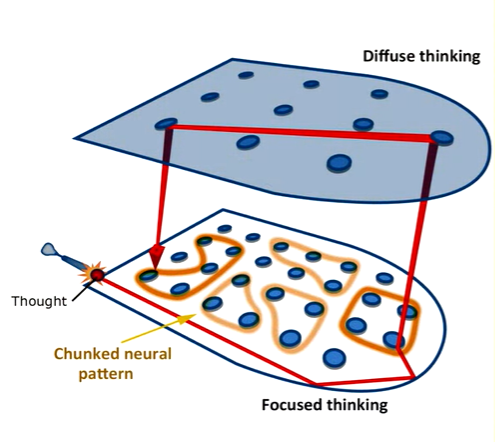
Chunking is a way to compress information and organise it more compactly, and as you gain further experience with it in any particular subject, bigger chunks can be created with stronger neural patterns behind them. Individual chunks can reinforce each other as you can be assisted in your understanding of new concepts through their relation to chunks you already have. This applies not only within a particular field but occasionally across them, an idea known as ‘transfer’. However, if you don’t repeatedly practice with your growing chunks, the neural patterns associated with them can remain ‘faint’, making it more difficult to piece together the big picture of what you’re trying to learn.
There are two ways to solve a problem:
- Sequential (or step-by-step) reasoning — involves the focused mode, and is a situation where each small step moves deliberately towards a solution.
- Holistic intuition — often requires the (more creative) diffuse mode to link several seemingly unrelated focused mode thoughts. Most difficult problems or concepts are grasped through intuition, as these complex and new ideas tend to lead away from what you’re familiar with.
Be cautious with 2. however! Solutions brought about through the diffuse mode should still be carefully verified using the focused mode, due to the semi-random way in which it makes connections. In other words, intuitive insights aren’t always correct.
Dr Oakley makes reference at this point to her (I believe) self-coined ‘Law of Serendipity’, which states that “Lady Luck favours the one who tries”. The important point here is to try not to be overwhelmed by a seemingly large number of problems or concepts to cover and understand. Once the first piece of information is logged in your mental library, later concepts are likely to go in with increasing ease!
Overlearning, Einstellung and Interleaving
There is such a thing as overlearning i.e. continuing to study or practice what you’ve already mastered. It’s useful in specific situations where there is an advantage to developing ‘automaticity’, for example to combat nerves involved in preparing for public speaking, perfecting a piano piece or executing a serve in tennis.
However, such repetitive overlearning during a single study session has its downsides, as research has shown that it can be a waste of valuable learning time. Once you’re comfortable with a basic idea during a session, continuing to go over it during the very same session doesn’t really help strengthen the desired long-term memory patterns. The key here is to instead use subsequent study sessions for repetition in order to strengthen and deepen your chunked neural patterns.
This is clearly related to the previously mentioned idea of spaced repetition! The best use of your study time (and what often distinguishes the top-performing students) is to deliberately focus on the topics you find more difficult, a system referred to as ‘deliberate practice’.
The next concept you should know is that of ‘Einstellung’ (meaning something similar to ‘mindset’ in German). This is a phenomenon whereby a neural pattern you’ve already developed and strengthened may actually prevent you from finding a solution or idea! The crowded ‘bumpers’ in the focused mode, together with the previous neural patterns you built can create a mental rut which prevents you from springing to a new place where the desired solution might be found. This is equivalent to installing a mental roadblock because of a failure to escape the way you were initially looking at something.
Thus, you’ll often have to unlearn your erroneous older ideas or approaches, even while learning new, more appropriate ones. It’s a well-known fact that most paradigm shifts in science are instigated by either young people, or those who originally trained in a different discipline. What these two groups have in common is that they are not so easily trapped by Einstellung.
However, specialising in one area or being more of a broadly disciplined Renaissance-type person is a bit of trade-off. Developing expertise in several fields means that you can bring very new ideas from one field to the other, but this can also mean that your expertise in one field or the other isn’t quite as deep as that of someone who opts to specialise in just one discipline. Alternately, if you develop expertise in only one discipline you may know it very deeply, but you could become more staunchly entrenched in your familiar way of thinking and not be as receptive to new ideas.
There is much good to be said of the study practice of ‘interleaving’. This is where you freely skip around and practice with different chapters or parts of your learning material. This can feel like it’s making your learning more cumbersome, but in reality you’ll be learning more deeply. As discussed earlier, mastering a new subject means not only learning the basic chunks involved, but also learning how to select and use different chunks.
This is best practiced by jumping back and forth between problems or situations that require a diverse set of techniques and strategies. Practice and repetition are of course paramount in building solid neural patterns you can confidently draw on, but it’s interleaving that starts to build flexibility of thought and creativity, enabling you to think independently. This is because when you interleave within a discipline, you start to increase and develop your creative power within said discipline. Furthermore, interleaving between several different subjects or disciplines helps you to more easily create interesting connections between chunks in the separate fields.
Part 3 of 4: Procrastination and Memory
More on Procrastination
We previously discussed the Pomodoro Technique as one method to help address procrastination. We’re now going to explore this (all too familiar to most of us) topic further. The long-term effects of habitual avoidance and procrastination can be very negative. Procrastination has the potential to become a cyclical bad habit which affects and detrimentally influences many important areas of your life, so by improving your ability to resist it, you can usher in a wealth of positive changes!
Procrastination bears certain similarities to addiction, in that it offers temporary excitement and relief from (sometimes boring and dissatisfying) reality. It encourages you to devise irrational and spurious excuses to justify your avoidance. However, it’s vital to keep in mind that procrastination isn’t some innate, unchangeable characteristic, it can actually be controlled such that you become the master of your habits instead of the other way around, operating like an unthinking zombie.
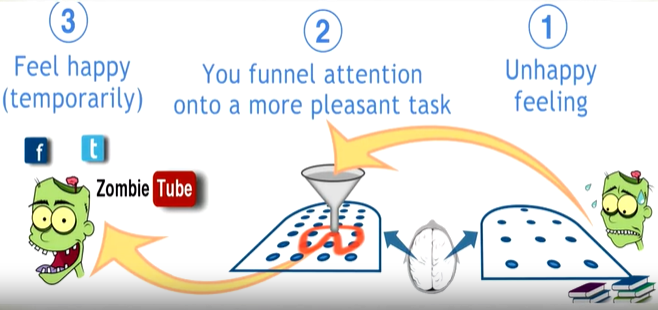
Procrastinators have a tendency to put off little things, starting small yet repeating their behaviours. They become increasingly desensitised and used to this pattern — appearing unaffected — but once again, the long-term effects are not to be understated. That said, you should be wary of squandering your willpower (something which uses up a lot of neural resources) on the fight against procrastination (something which is very easy to fall into). Quite simply, it’s not needed!
Dissecting Habits
Once you’ve chunked a piece of information — especially a physical action — you no longer have to focus as hard on or be fully conscious of the action. It instead becomes ‘second nature’, whereby your brain enters a sort of ‘zombie mode’. In neuroscience, chunking is related to the formation of habits. Habits are energy savers, giving us the ability to free our minds for other thoughts and activities, as we no longer have to think about the patterns of behaviour in a focused manner. We enter into this so-called zombie mode far more often than you might think!
Habits can be good or bad, long or short — and one way to deconstruct them is into four parts as follows:
- Cue — the trigger which initiates the habit and one’s entry into an autopilot-type state of mind. The cue is not intrinsically helpful or harmful, rather it’s the routine — i.e. what we do in reaction to the cue — which counts.
- Routine — the habitual response you develop after your brain receives the cue.
- Reward — the reason why habits form and are maintained. The reward is the immediate feeling of pleasure you feel. Recall how in procrastination you switch your mind to something much more pleasant; this is what sustains the behaviour. On a related note, this therefore emphasises the need to set up rewards which promote good study habits.
- Belief — the source of any habit’s power is one’s belief in it. To change a habit, you’ll first need to change your underlying belief.
Process vs Product
When it comes to learning in general, it’s completely natural and normal to begin a learning session with some negative feelings. This can be the case even if it’s a subject you already like! What differentiates people is how they handle such dispiriting feelings. To exemplify this, researchers have found that successful non-procrastinators manage to cast their negative thinking aside by telling themselves optimistic mantras such as “quit wasting time and just get on with it” or “once you get going, you’ll feel better”. Lastly, it can be pivotal to try and minimise distractions in your environment, and to train yourself to let a distraction simply ‘flow by’ when it presents itself.
If you have a tendency to avoid tasks because they make you feel uncomfortable, it can often prove useful to reframe the situation by focusing on the process instead of the product. The process is characterised by the flow of time and associated habits, and the product is the outcome e.g. an assignment you need to finish or test you’re preparing for.
The product is the thing that triggers a pain response, which in turn incites you to procrastinate. You should instead redirect your focus towards the process, and the small amounts of time you calmly spend preparing for the outcome. This calls to mind the Pomodoro Technique, which forces you to focus on completing a particular 25-minute work session as opposed to thinking about the completion of a task.
It’s far simpler to enlist the ‘zombie’ part of your brain to help with a process and not a product, as it better resonates with habitual work. This choice to prioritise process over product allows you to relax into the learning session without judging yourself or thinking too deeply about the endpoint. In summary, focus your attention on building and carrying out processes. Processes relate to simple habits which coincidentally allow you to complete the unpleasant tasks which need to be done.
Controlling Your Habits
To override a particular habit, you must look to alter your reaction to its cue. This is the only juncture at which you need to apply your willpower. Cues can be a location, time, feeling or reaction (to other people or events, say). You can prevent the most dangerous procrastination cues by limiting distractions for brief patches of time, as when completing a Pomodoro. Always remember that it can take some time to get into a ‘flow state’ of work. For example, you might find yourself getting through a few Pomodoros before you start to enjoy the work you’re doing on a new topic.
The routine is the point where you need to actively focus on rewriting your habit. The key to this is to have a plan in place, in other words to develop and optimise a new, replacement ritual.
The reward can also be tweaked or swapped. Can you substitute an emotional pay-off? For example, a feeling of pride in accomplishing something. Perhaps you could provide yourself with a reward based on the magnitude of the achievement? The addition of a new — and hopefully enticing — reward can help you to overcome your previous neurological cravings. However, it’s of course crucial to deliberately delay such a reward until you finish the desired task! Similarly, setting a reward to be redeemed at a specific time creates a ‘mini-deadline’ which can help to spur work and productivity.
The most important part of dismantling your procrastination habit is the belief that you can do it, even if things become difficult or stressful! This belief could be reinforced by finding a new community, especially one comprising of individuals with a ‘can-do’ attitude, or who are doing the things that you want to be doing. Developing and encouraging such a positive, driven and non-procrastinating culture with like-minded friends can help us to keep track of the values that — in moments of weakness — we tend to forget.
Balancing Life and Learning
Learning usually necessitates a complex balancing of many different tasks, and — as discussed several times before — is best done in the absence (or minimisation) of procrastination cues in your environment. You can help yourself to maintain a perspective over what you’re trying to learn and accomplish by writing a brief weekly list of key tasks in a journal (or some equivalent). You can make notes in your planner journal about what’s working and what isn’t, in order to iterate and improve the learning and productivity systems you have in place.
Further to this weekly self-assessment, it can help to — on a daily basis — write a list of the tasks that you can reasonably expect to work on or accomplish in a given day. This daily list is best written the evening before, as this enables your subconscious diffuse mode to help you grapple with the tasks on the list overnight such that you can best figure out how to accomplish them when the day arrives. You’re in effect calling upon your mental ‘zombies’ to help you accomplish the items on your list the following day!
Writing your tasks down is important. If you don’t write them down, you’ll use up valuable and limited working memory space which you need free for problem solving. Some of these tasks will be process-orientated and therefore have no specific outcome, with them merely being a case of spending an allotted period of time grasping or reviewing something. Others will be product-orientated as they’re doable within a limited period of time. It can be helpful and productive to try and work on the highest priority or least desirable task early in the morning — say with at least one Pomodoro as soon as you wake up — this is related to the notion of ‘eating your frogs first thing in the morning’.
Mixing up your learning with other (ideally less cognitive) tasks, particularly ones which can be utilised as ‘diffuse mode breaks’, seems to make the entire learning process more enjoyable and prevents you from prolonged (and very unhealthy!) bouts of sitting. Also, it’s just as important to plan your quitting time as it is to plan your working time, and the value of break time should be appreciated. Finally, it’s wise to remember — in a lot of cases, individuals who commit to maintaining healthy leisure time alongside their hard work generally outperform those who instead choose to work endlessly.
Further Exploration of Memory
Memory is a fundamental component of learning and acquiring expertise. Humans actually have outstanding visual and spatial memory systems which can help form part of our long-term memory. Our minds have evolved to reliably retain this sort of general information about a place! This is because our distant ancestors relied upon such systems to increase their chance of survival, for example being able to recall where food was found or how to return home after a hunt. As such, evolution has acted to ramp up our ‘where things are’ and ‘how they look’ memory system.
Tapping into these inherent visual and spatial memorisation capabilities can greatly enhance your ability to remember. You can try this by conceiving a very memorable visual image representing a key item you want to remember — funny or evocative images work really well. Images are important to memory as they connect directly to your right brain’s visual spatial centres. In this way, you’re utilising visual areas of the brain with enhanced memory abilities, and establishing stronger memory traces by evoking the senses. This all boosts the chance of you being able to recall the underlying concept and what it means.
More generally, to transition something from your working memory to your long-term memory:
- The idea needs to be memorable. The more you can turn what you’re trying to remember into something memorable, the easier it will be to recall.
- The idea must be repeated. Before you can strengthen and solidify a memory, repetition is needed to offset the neural metabolic dissipative processes which cause the neural pattern related to the memory to fade away. Repetition helps you to firmly lodge an idea in your long-term memory, and — as discussed — sporadic or spaced repetition is best for this. Increasing this spacing as you become more confident with the material and certain of mastery will help you to lock it more firmly into place.
The use of flashcards is advisable as writing and saying what you’re trying to learn greatly enhances retention. For example, handwriting notes appears to help you more deeply encode (i.e. convert the learned material into engrained neural memory structures) what you’re trying to learn. Also, saying things aloud serves to form useful ‘auditory hooks’ to the material. Flashcards naturally lend themselves to the practice of interleaving, as you can try mixing them up before testing your ability to recall what’s on the other side.
As a final — albeit random — memory tip, one of the best ways to remember a person’s name is to retrieve it from memory at increasing time intervals after first learning their name. This is connected to point 2. above!
Long Term Memory
The process of consolidation involves storing an item in the long-term memory by modifying synapses on the dendrites (branches) of neurons. These long-term memories can remain dormant for a long time until they are retrieved and reinstated in the working memory. This reinstated memory can then be transferred back to the long-term memory, altering the older memory through a process known as reconsolidation. Thus, as we learn new things our old memories change, and it’s true to say that our memories are intertwined with each other. Both processes of consolidation and reconsolidation occur during sleep.
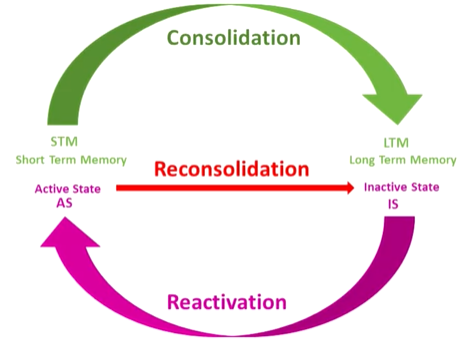
Brains contain several varieties of supporting cells known as glial cells, in addition to neurons. The most abundant glial cells are astrocytes, which provide nutrients to neurons and are involved in neural repair following injury. The arms of the astrocytes wrap around the neurons, each one embracing thousands of synapses. Experiments suggest that these astrocytes also play an important role in learning. Here’s a fun fact… Einstein was found to have significantly more astrocytes than the average human — the only major brain difference they could find!
More Memory Tricks
- Another key to effective memorisation is to create ‘meaningful groups’ which simplify the material.
- It’s easier to remember numbers by associating them with memorable events (famous, personal or otherwise easily memorable dates for instance).
- Memorable sentences can be used to help memorise concepts, where the first letter of each word in the sentence is also the first letter of each word in the list that needs to be memorised.
- The memory palace technique is a very popular and powerful way to remember things, especially unrelated items such as a shopping list. It involves calling to mind a familiar place (for example the layout of your house) which you can then use as a visual notepad into which you can deposit the ‘concept images’ that you want to remember. The key is to imagine yourself walking through this place which you know well, containing shockingly memorable images of what you want to remember. This technique will naturally be slow the first few times as it takes a while to conjure up a solid mental image. However as with most things, the more you do it, the quicker it becomes.
Using the mind in these creative ways allows memorisation to become a fantastic exercise in creativity, which simultaneously builds neural hooks for even more creativity. Research has shown that students who employ memory tricks in general outperform those who don’t. It’s been established that memory tools like this speed up the acquisition of chunks, and that ‘big picture templates’ help to transform novices to semi-experts much more efficiently (even in a matter of weeks!) All of these tricks work by ‘expanding’ your working memory by facilitating easy access to long-term memories.
Part 4 of 4: Renaissance Learning and Unlocking Your Potential!
Introductory Tips
In this final section we’re going to tie things together, discuss the importance of mindset on learning and also talk about the best ways to approach tests.
According to Dr Sejnowski, “the best gift that you can give your brain is physical exercise.” We now know that new neurons are born every single day in a few locations in the brain, including the hippocampus. When you learn something, new neurons can be generated which help you in your learning, but they’ll die if you don’t use them. However, new experiences will rescue them! It’s well established that exercise helps new neurons to survive as well, being far more effective than any other drug on the market which purports to help you learn better.
Interestingly, there are certain critical periods in the development of the brain, when sudden improvements occur in specific abilities. This of course won’t be applicable to everyone, but if you’re a parent, for example, you can expect these critical periods to happen in your children and prepare for them! For example, first language acquisition (and language acquisition more generally) has a critical period extending up to puberty.
Learning doesn’t necessarily progress logically such that every subsequent day adds another neat package to your shelf of knowledge. Sometimes you will hit a wall in constructing your understanding. This sort of knowledge ‘collapse’ seems to occur when your mind is restructuring its understanding in order to build a more solid foundation. Always bear in mind that it takes time to assimilate new knowledge! There will be inevitable periods where you seem to take a frustrating step back in your understanding. However, once you emerge from such period, you’ll often notice that your knowledge base has taken a surprising leap forward.
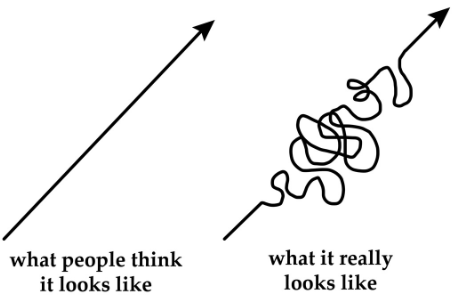
There have been an array of metaphors and analogies used in this course as learning tools. This is because the creation of a metaphor or analogy (especially ones that are visual) can be one of the best things you can do to remember and understand concepts. They help to glue an idea into your mind as they make connections to pre-existing neural structures. Remember that you can always revise or get rid of such metaphors once you’ve achieved a more sophisticated understanding of whatever topic you’re concentrating on! Stories work well in the retainment of ideas too.
Genius Envy
There’s an interesting link between learning an academic subject and learning a sport. We know that repetition of a physical action induces muscle memory, eventually getting to the point where your body knows what to do from a single thought (i.e. one chunk instead of having to recall all of the disparate complex steps). This same principle applies to mathematics and science as once you understand why you do something, you don’t have to keep thinking about how you do something each and every time.
As touched upon before, a far greater level of understanding is attainable when your mind has itself constructed the patterns of meaning, rather than simply accepting and regurgitating what someone else has told you. It’s important to remember that people learn best by trying to make sense of the information they perceive, as opposed to learning something complex simply by having someone else tell it to them.
Experts in a field often have to make complex decisions rapidly, utilising their well-trained intuition and deeply ingrained repertoire of chunks instead of their conscious system. This is the most efficient option, because at some point, self-consciously understanding why you do what you do at each stage can slow you down and interrupt your flow. This can actually lead to worse decisions! Such experts or masters aren’t necessarily ‘gifted’, but intelligence does play a factor, because being smarter often equates to having a larger working memory. However, having a larger working memory can — rather counterintuitively — make it more difficult to be creative due to the effects of Einstellung. This is because ideas that are already in mind have the potential to block you from fresh thinking.
If you find yourself less able to focus, or notice that your attention shifts unless you’re in a quiet place where you can use your working memory to its fullest — perhaps you’re more creatively inclined. Having a relatively somewhat smaller working memory means that you can more easily generalise your learning into new, more creative combinations. In other words, things aren’t locked into the working memory so tightly which means that you can more easily receive inputs from other parts of the brain.
In conclusion, deliberate practice on the toughest aspects of the material can actually lift ‘average’ brains into the realm of those with more natural gifts. Try to be wary of so-called ‘Imposter Syndrome’. It’s the unproductive feeling that it can only be down to luck when you accomplish something (doing well on a test for instance), and that your peers and family are going to figure out how incompetent you really are when you do something badly.
Change Your Thoughts, Change Your Life
Taking responsibility for your learning is one of the most important things you can do. Approaching material with a goal of learning it independently can give you a unique path to mastery. It’s good to remember that even what you’re taught by a single teacher or instructor is only a partial version or single view of the full three-dimensional reality of the subject, which has links to still further fascinating topics that are of your choosing!
There will always be those who criticise you and attempt to undermine your efforts and achievements — it’s a constant in nigh on everyone’s lives. This is because your perceived success can make people around you feel threatened. It explains why it sometimes feels as if the greater your achievements are, the more other people will attack and demean your efforts. On the flip side, a failure can result in critics throwing even more barbs and criticism your way: e.g. “you don’t have what it takes”.
It’s important to recognise this and to train yourself to switch on an occasional cool dispassion that helps you not only to focus on what you’re learning, but to tune out those who are solely interested in undermining you. Such behaviours are commonplace, as people are often just as competitive as they are cooperative. Use your qualities which set you apart as a secret talisman for success, use your natural contrariness to defy the ever-present prejudices from others about what you can accomplish.
The Value of Teamwork
Left and right brain views of the brain and assumptions around them are often misleading! Research suggests that the right brain helps us to take a step back and place our work into a big picture perspective. This function is exceptionally important for getting on to the right track and carrying out sanity checks. Therefore, when whizzing through a question without going back to check your work, you’re acting somewhat like a person who’s unwilling to use certain parts of their brain. Studies on people with strokes can serve to remind us of the dangers of not using our full cognitive abilities! In summary, it’s important to review what you’ve done with the bigger picture in mind to ensure it still makes sense.
Whilst the right hemisphere of the brain helps look for global inconsistencies, the left hemisphere tries to cling to the way things were. The left brain interprets the world for us, and goes to great lengths to keep this interpretation consistent. The focused mode of analysis — although possessing its advantages — has been linked through a plethora of research to a potential for rigidity, dogmatism and egocentricity. Even when you’re absolutely certain that what you’ve done is fine and shouldn’t be questioned, be warned that this feeling of overconfidence could be arising in part from the left hemisphere. When you step back and re-check your working, you’re allowing for greater interaction between the two hemispheres, taking advantage of the special perspectives and abilities of each.
One of the best ways to avoid the aforementioned blind spots and errors (which everyone falls prey to!) is to brainstorm and work with others. Your naively upbeat focused mode can skip over errors, especially if you’re the one who committed the original errors. As such it can often fall to others to realise your mistake and help you to iteratively improve your methods and understanding. Also, simply explaining your reasoning and thoughts to friends helps to build your own understanding! It’s no secret that working with others is helpful in career building as well e.g. getting tips from a colleague to take a certain course or look at a job opening.
Tests
Testing is an extraordinarily powerful learning experience in itself (both fully-fledged test-taking and the mini-tests you engage in during recall for instance). An hour of test-taking will help you to retain and learn far more than an hour spent studying. It has a great way of concentrating the mind!
At this point Dr Oakley presents a ‘checklist’ of questions that could prove useful to ask yourself if you’re preparing for a test (not all will apply) If you can answer ‘Yes’ to a lot of them, you’re on the right track! I’ve written them out below:
- Did you make a serious effort to understand the text? This means not just looking at worked-out examples.
- Did you work with others on homework problems, or at least check your solutions with them?
- Did you attempt to outline every homework problem solution prior to working with others?
- Did you participate actively in group discussions? That is, by contributing ideas and asking questions.
- Did you consult with the instructor or teaching staff when you were having trouble?
- Did you understand all your homework problem solutions when they were handed in?
- Did you ask (in class or otherwise) for explanations of homework problems that weren’t clear to you?
- Did you carefully go through your study guide and convince yourself that you could do everything in it?
- Did you attempt to outline lots of problem solutions quickly? This means without spending time on algebra and calculations.
- Did you go over the problems and study guide with others, and quiz one another?
- Did you attend the pre-test review session and ask questions about stuff you weren’t sure about?
- MOST IMPORTANT: Did you get a reasonable night’s sleep before the test? This one is crucial and has the potential to invalidate all of the other ‘Yes’ answers you have!
There is a tip for test-taking known as the ‘Hard Start, Jump to Easy’ technique. The fundamental idea is to start with the harder problems (which often call for the greater creative powers of the diffuse mode) but to quickly switch to the easy ones if they prove too challenging. Have a practice with it and see if it’s for you:
- When the test is handed out to you, first you should carry out a quick scan of it to get a feel for what it involves.
- When you start answering the problems, begin with what appears to be the hardest problem but prepare yourself to be able to ‘pull away’ and switch to another question if you become stuck or get a sense that you might not be on the right track.
- At this point you should switch to (and hopefully complete) an easy problem, then move to another difficult looking problem and try to make a bit of progress. Again, if you feel yourself getting bogged down or stuck, you should change to something easier once more.
When you start with a hard question, you load the most difficult problem in your mind (focused mode) and then switch away from it if you can’t make progress, both of which allowing your diffuse mode to function. You’ll often be surprised when you return to the more difficult problems how the next step(s) in the problem are more apparent to you with a fresh second or third glance. You may not be able to complete the entire problem, but at least you’ll be able to get further before you switch to something else on which you can make definite progress.
This technique allows for more efficient use of your brain by allowing different parts of your brain to work simultaneously on different thoughts. The only catch here is that you must have the self-discipline to pull yourself away from a difficult question if you find yourself stuck for more than a minute or two.
Final Test Tips
The body releases chemicals such as cortisol when it’s under stress (as in a test situation), resulting in symptoms such as sweaty palms, a racing heart, a knot in your stomach etc. However, research tells us that it’s how you interpret these symptoms which matters, in other words the story you tell yourself about why you’re stressed. A thought such as “this test has made me afraid” can be converted to something like “this test has got me excited to do my best!” This simple mental manoeuvre can really improve your performance.
Momentarily shifting your attention to your breathing can help more panic prone test-takers as well. This is most effectively done by relaxing your stomach, placing your hands on it and taking a deep breath. This motion should cause your hand to move outwards, something known as belly or diaphragmatic breathing, something useful to practice and become comfortable with. You can also try consciously relaxing your tongue at certain time intervals — you’ll be surprised at how much tension can be maintained in this area.
A tip for multiple choice questions: you could try covering them up first to see if you can recall the required information (answering it on your own) first. This can help you to avoid possible confusion when multiple (sometimes similar) answers are presented to you.
Having a plan in place for the worst possible contingency can also do wonders for reducing your fear, helping you to release stress and perform better. ‘Good worry’ helps provide motivation and focus while ‘bad worry’ simply wastes energy.
On the day before a test, have a quick and final look over the material to brush up on it — but don’t push your brain too far! If you prepared properly, it shouldn’t matter if you can’t bring yourself to do much the day before.
Be wary of your mind tricking you into thinking that something you’ve done in a test is correct, even when it isn’t. Shift your attention and then double-check your answers from a big picture perspective, asking yourself, “does this really make sense?” Finally, checking your test back-to-front sometimes seems to give your brain a fresher perspective that can allow you to more easily catch errors.
Summary
Congratulations! This marks the end of my article and the course. If you’ve accompanied me this far I’m very grateful to you and hope that it has equipped you (as it has me) with a range of useful tools and nuggets of knowledge that you can use to elevate your confidence, boost your learning potential and start to conquer more topics with ease! If you have any feedback for me (good or bad) I’d be happy to hear it — until the next time!