

A Comprehensive Guide to XA Transactions for Modern Business Applications
A Deep Dive into XA Protocols, Components, and Real-World Applications for Improved Scalability and Performance
Thank you for being a part of this journey with me, and I hope to continue providing value to you for years to come! Giving tips by supporting me.
I would be overjoyed if you could support me as a referred member. However, the income I’ve received from my contributions on this platform has not proven sufficient to sustain the frequency of updates I’d hoped for. Facing this reality, I’ve made a difficult decision — to explore new income avenues. However, this isn’t the end; rather, it’s an exciting new beginning. I am thrilled to announce my upcoming Substack newsletter, where I’ll delve into my investing system, harnessing the immense potential of IT technology and embracing a system-thinking approach to investment strategies. Rest assured, I will still be posting when inspiration strikes.
Introduction
The rapid growth of the internet has led to massive data volumes and complex business operations, surpassing the limits of traditional databases. Modern systems require solutions for handling explosive data growth, business complexity, and high user demands.
Key Challenges and Demands
- Data Explosion: Annual data generation now equals all data produced before modernization, creating unprecedented storage and management challenges.
- Complex Business Systems: Interconnected platforms like e-commerce require seamless coordination of order processing, inventory, payments, and logistics, with strict data consistency.
- High Traffic: E-commerce events like “Black Friday” demand systems capable of handling tens of thousands of orders per second, necessitating robust concurrency solutions.
Businesses are adopting distributed databases for improved scalability and performance. By spreading data across multiple nodes, these systems can handle massive workloads. However, maintaining data consistency across nodes introduces new challenges, requiring distributed transaction protocols.
XA transactions are a widely adopted solution due to their standardization and strong consistency
- Standardization: Defined by the X/Open group, XA protocols support databases like MySQL, Oracle, and PostgreSQL.
- Strong Consistency: The two-phase commit (2PC) protocol ensures data integrity. For example, in interbank transfers, any failure triggers rollbacks to prevent errors.
This article delves into XA transactions, covering their concepts, principles, benefits, drawbacks, applications, implementations, and optimizations, along with real-world examples and comparisons with other protocols.
Basic Concepts of XA Transactions
XA transactions are a distributed transaction standard developed by X/Open (now part of The Open Group) in the early 1990s to support open systems standards.
Detailed in the X/Open CAE Specification (Distributed Transaction Processing), it defines the interface specifications between the Transaction Manager (TM) and the Resource Manager (RM).
XA transactions ensure ACID properties in distributed environments, providing consistency across multiple resource managers:
- Atomicity: Transactions are all-or-nothing.
- Consistency: Database states remain valid before and after a transaction.
- Isolation: Transactions are independent of one another.
- Durability: Committed data is permanently stored.
Components
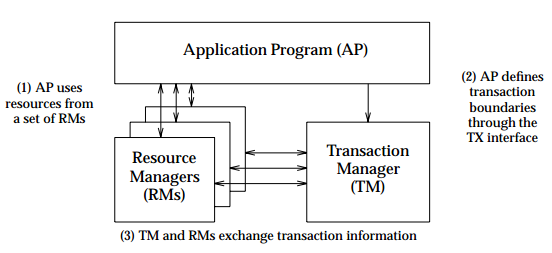
- AP (Application Program) — Initiates transactions and specifies data access for global transactions.
- Defines operations and interacts with TM.
- Example: E-commerce orders, inventory, and payment services initiate global transactions.
2. RM (Resource Manager) — Manages resources (e.g., databases) involved in transactions.
- Executes operations and reports outcomes to the TM.
- Example: Databases at two banks act as RMs in a cross-bank transfer.
3. TM (Transaction Manager) — Coordinates transactions and manages their lifecycle (commit, rollback, recovery).
- Orchestrates RMs and resolves transaction anomalies.
- Example: A banking TM ensures consistency between two banks’ databases.
Interaction Interfaces
The XA protocol specifies interfaces for TM-RM communication at various transaction stages:
- XA START: Begins an XA transaction with a global ID.
Example:
XA START '12345' - XA END: Marks the end of a transaction.
Example:
XA END '12345' - XA PREPARE: Prepares for a transaction commit.
Example:
XA PREPARE '12345' - XA COMMIT: Commits the transaction.
Example:
XA COMMIT '12345' - XA ROLLBACK: Rolls back the transaction.
Example:
XA ROLLBACK '12345' - XA RECOVER: Retrieves transactions in the Prepare phase.
Example:
XA RECOVER
Working Principle of XA Transactions
XA transactions are a distributed transaction processing standard, coordinating multiple resource managers (RMs) to ensure strong consistency through the two-phase commit (2PC) protocol.
Two-Phase Commit (2PC) Protocol
The core of XA transactions is the two-phase commit (2PC) protocol, consisting of a prepare phase and a commit/rollback phase.
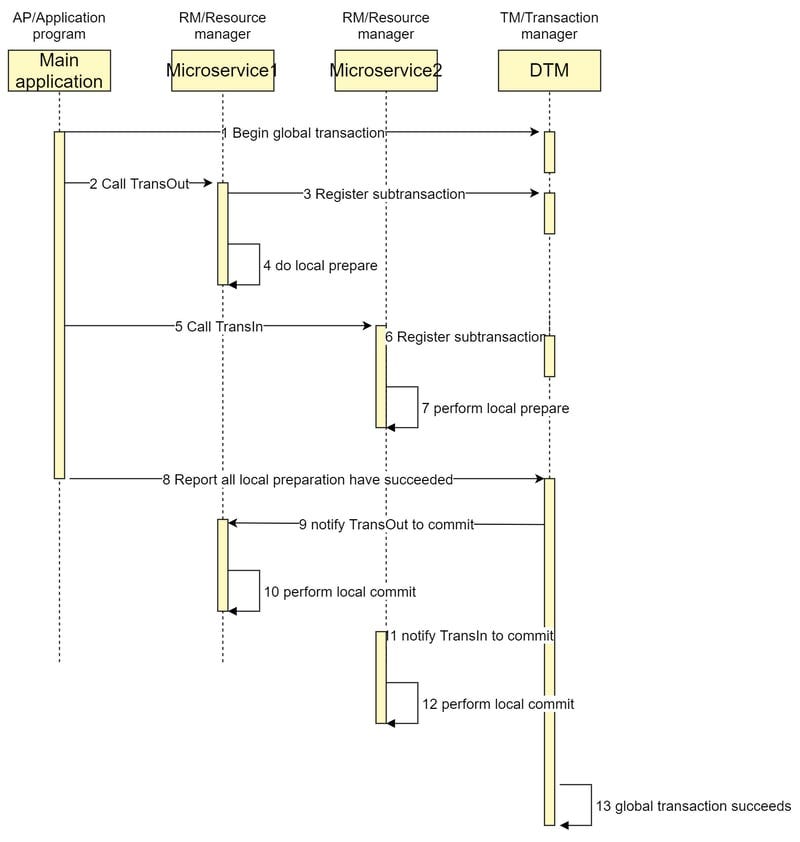
A) Prepare Phase
The transaction manager (TM) initiates the transaction:
- The TM, typically embedded in the application, manages global transactions.
XA START '12345';- The TM sends a Prepare request to the RMs。
XA END '12345';
XA PREPARE '12345';- Each RM performs its local transaction and responds to the TM。
-- Order database
INSERT INTO orders (id, user_id, product_id, quantity) VALUES (1, 101, 202, 1);
XA END '12345';
XA PREPARE '12345';

-- Inventory database
UPDATE inventory SET stock = stock - 1 WHERE product_id = 202;
XA END '12345';
XA PREPARE '12345';

-- Payment database
UPDATE accounts SET balance = balance - 100 WHERE user_id = 101;
XA END '12345';
XA PREPARE '12345';
The TM collects all RM’s Prepare responses:
- The TM receives Prepare responses from the order database, inventory database, and payment database, confirming that all RMs are ready to commit the transaction.
B) Commit/Rollback Phase
- Commit Phase
The TM sends a Commit request:
- If all RMs agree to commit, the TM sends a Commit request to all RMs.
XA COMMIT '12345';- Each RM performs the final commit operation and responds to the TM.
-- Order database
XA COMMIT '12345';

-- Inventory database
XA COMMIT '12345';

-- Payment database
XA COMMIT '12345';- Rollback Phase
The TM sends a Rollback request:
- If any RM indicates it cannot commit, the TM sends a Rollback request to all RMs.
XA ROLLBACK '12345';- Each RM performs the rollback operation and responds to the TM.
-- Order database
XA ROLLBACK '12345';

-- Inventory database
XA ROLLBACK '12345';

-- Payment database
XA ROLLBACK '12345';
Roles of the Transaction Manager (TM) and Resource Manager (RM)
TM (Transaction Manager)
- Initiates the transaction with the
XA STARTcommand, specifying the global transaction ID (xid).
XA START '12345';- Controls the commit or rollback of the transaction based on RM responses. If all RMs agree to commit, TM sends an
XA COMMITcommand; if any RM cannot commit, TM sends anXA ROLLBACKcommand. - Handles transaction exceptions, such as network interruptions and RM failures, to maintain transaction consistency.
RM (Resource Manager)
- Executes specific transaction operations and reports the result to TM.
- Reports the operation results to TM during the Prepare phase. For example, an order database reports readiness to commit, while an inventory database indicates insufficient stock.
- Follows TM commands to commit or roll back the transaction.
Fault Recovery Mechanism
Transaction Logging: Each RM records a transaction log during the Prepare phase to facilitate recovery after a system failure.
Fault Recovery: If the TM fails, a new TM can recover the transaction state from the transaction logs and continue with the Commit or Rollback operation.
A new TM:
- Reads the transaction logs and finds that the transaction with
xid12345is in the Prepare state. - Decides to proceed with a Rollback operation:
XA ROLLBACK '12345';XA Implementation
- MySQL — MySQL 5.0 and later, with full support in MySQL 5.7, incorporates the XA protocol through the InnoDB storage engine. MySQL uses transaction logs to track transaction states such as Prepare, Commit, and Rollback, which are essential for recovery after a system failure.
- PolarDB-X — Used with MySQL 5.6 and the InnoDB XA protocol, PolarDB-X offers BestEffort transactions to maintain consistency in most cases. Timestamp Ordering (TSO) transactions in PolarDB-X improve concurrency and performance by managing transaction timestamps effectively, reducing conflicts.
- Oracle — Oracle Database has supported the XA protocol since its early versions to ensure consistency of transactions in distributed environments. Oracle uses a transaction log (Redo Log) to record the state of transactions, enabling recovery after system failures.
- PostgreSQL — PostgreSQL started supporting the XA protocol from version 9.1 to ensure consistency of transactions in distributed environments. PostgreSQL uses a transaction log (WAL, Write-Ahead Log) to record the state of transactions, enabling recovery after system failures.
- MSSQL — It supports the XA protocol through the DTC (Distributed Transaction Coordinator) component. MSSQL uses transaction logs to track transaction states such as Prepare, Commit, and Rollback, which are essential for recovery after a system failure.
Practical Examples: Cross-Bank Transfer in a Bank System
Assuming a bank system where a user transfers money from Bank A to Bank B, involving databases of both banks.
A) Transaction Initiation
- The user requests to transfer USD 1000 from an account in Bank A to an account in Bank B through Bank A’s online system.
Bank A’s TM Initiates Global Transaction
- The Transaction Manager (TM) of Bank A starts a global transaction with a global transaction ID (xid) ‘67890’.
XA START '67890';Bank A’s RM Executes Local Transaction and Replies TM:
- Bank A’s RM checks if the user’s account has sufficient funds and deducts USD 1000.
-- Bank A Database
UPDATE accounts SET balance = balance - 1000 WHERE user_id = 101;
XA END '67890';
XA PREPARE '67890';- Bank A’s RM replies that it can commit the transaction.
Bank B’s RM Executes Local Transaction and Replies TM:
- Bank B’s RM checks if the target account exists and credits it with USD 1000.
-- Bank B Database
UPDATE accounts SET balance = balance + 1000 WHERE user_id = 202;
XA END '67890';
XA PREPARE '67890';- Bank B’s RM replies that it can commit the transaction.
B) Transaction Commit
- Bank A’s TM receives Prepare responses from both Bank A and Bank B’s RMs, confirming all RMs can commit the transaction.
Bank A’s TM Sends Commit Request
- Bank A’s TM sends a Commit request to both Bank A and Bank B’s RMs, instructing them to formally commit the transaction.
XA COMMIT '67890';Bank B’s RM Executes Commit Operation and Replies TM:
- Bank B’s RM finalizes the transaction by adding USD 1000 and sends a Commit response back to Bank A’s TM.
-- Bank B Database
XA COMMIT '67890';
C) Transaction Rollback
Bank A’s TM Collects RM Prepare Responses:
- Suppose Bank B’s RM responds with an Abort status during the Prepare phase, indicating that the target account does not exist.
- Bank A’s TM receives the Abort response from Bank B.
Bank A’s TM Sends Rollback Request:
- Bank A’s TM sends a Rollback request to both Bank A and Bank B’s RMs, instructing them to roll back the transaction.
XA ROLLBACK '67890';Bank A’s RM Executes Rollback Operation and Replies TM:
- Bank A’s RM rolls back the transaction, restoring the USD 1000, and sends a Rollback response back to Bank A’s TM.
-- Bank A Database
XA ROLLBACK '67890';
Bank B’s RM Executes Rollback Operation and Replies TM:
- Bank B’s RM ignores the credit of USD 1000 and sends a Rollback response back to Bank A’s TM.
-- Bank B Database
XA ROLLBACK '67890';
Failure Recovery Mechanism
- Transaction Logging: Both Bank A and Bank B’s RMs log the transaction status during the Prepare phase to allow recovery after a system failure.
- Bank A Database: Logs the deduction of USD 1000 as a Prepare state.
- Bank B Database: Logs the credit of USD 1000 as a Prepare state.
Failure Recovery
- If Bank A’s TM fails, a new TM can recover the transaction state from the logs and continue with either Commit or Rollback.
New TM:
- Reads the transaction log and finds the xid ‘67890’ in a Prepare state.
- Decides to proceed with a Rollback operation
XA ROLLBACK '67890';Problems Analysis A) Synchronous calls to remote interfaces can lead to thread blocking. B) Traffic peaks can overwhelm B Bank’s system, causing timeouts or failures during high-demand periods that impact business operations. C) System crashes can result in data inconsistency, such as incomplete transfer transactions affecting user account balances and trust.
Solution A) A Bank’s main thread is not blocked immediately during the Prepare phase. It only performs the final action during the Commit or Rollback phase, reducing main thread blocking time and enhancing system responsiveness. B) XA transactions coordinate multiple resource managers (RMs) through a transaction manager based on system load. C) The transaction manager can read the log, identify a transaction in the Prepare status, and proceed with a Rollback operation to maintain data consistency.
Advantages of XA Transactions
- Strong Consistency: The Two-Phase Commit (2PC) protocol ensures data consistency. Resource managers (RMs) lock resources in the Prepare phase to guarantee successful execution during Commit. If any RM fails, the entire transaction rolls back.
- Standardized Protocol: As an international standard by X/Open, XA is supported by major databases (e.g., MySQL, Oracle, PostgreSQL, MSSQL).
- Minimal Business Impact: XA relies on database mechanisms with minimal changes to business logic, simplifying migrations and upgrades.
- Multi-Resource Support: It coordinates transactions across databases, message queues, and file systems, ensuring consistency across different resources.
- Fault Recovery: Transaction logs enable recovery from system failures. Transaction states are tracked to ensure operations can continue or rollback.
Disadvantages of XA Transactions
- Performance Overhead: The 2PC mechanism adds network communication, disk I/O, and resource locking, leading to slower transactions.
- Synchronous Blocking: Resource locks during the Prepare phase block other transactions, reducing concurrency.
- Single Point of Failure: If the Transaction Manager (TM) fails, the transaction may enter an indeterminate state. Recovery is possible but complex.
- Risk of Inconsistency: If the TM fails to send Commit instructions, some RMs may commit while others do not, causing inconsistencies.
- Complex Setup: Configuring and managing XA transactions, including enabling a transaction manager and ensuring RM support, increases system complexity.
- Deadlock Risk: Resource locking during the Prepare phase can cause deadlocks, especially with multiple transactions on the same resource.
- Availability Limitations: XA requires all RMs to support the protocol. If any RM lacks support, XA cannot be used, restricting system flexibility.
Application Scenarios of XA Transactions
1. Financial Industry
- Bank Transfers: Bank systems often require transferring funds from one account to another across multiple banks, ensuring data consistency and integrity.
- Payment Systems: Payment systems coordinate transactions across multiple databases and systems to ensure transaction integrity and consistency.
2. Telecommunications Industry
- Billing Systems: Telecommunications billing systems coordinate transactions across multiple subsystems to ensure accurate billing data.
- User Management: Telecommunications user management requires coordination across multiple databases to ensure data consistency.
3. E-commerce
- Order Processing: E-commerce systems require coordination across multiple databases and systems to ensure order data integrity and consistency.
- Payment Processing: E-commerce payment processing requires coordination across multiple databases and systems to ensure payment integrity and consistency.
4. Logistics Industry
- Inventory Management: Logistics inventory management requires coordination across multiple databases and systems to ensure accurate and consistent inventory data.
- Delivery Management: Logistics delivery management requires coordination across multiple databases and systems to ensure complete and consistent delivery data.
5. Healthcare Industry
- Patient Information Management: Healthcare patient information management requires coordination across multiple databases and systems to ensure data integrity and consistency.
- Drug Management: Healthcare drug management requires coordination across multiple databases and systems to ensure data accuracy and consistency.
6. Government and Public Services
- Citizen Information Management: Government citizen information management requires coordination across multiple databases and systems to ensure data integrity and consistency.
- Public Service Records: Government public service records require coordination across multiple databases and systems to ensure accurate and consistent service records.
Future Directions
- Asynchronous Processing — Introduce asynchronous mechanisms during the Prepare and Commit stages to reduce network delays, improve transaction speeds, and minimize main thread blocking.
- Concurrency Control — Use advanced mechanisms like Timestamp Ordering (TSO) to reduce conflicts and improve concurrency by ensuring transactions are processed in timestamp order.
- Group Commit — Implement group commits to combine multiple transaction operations, reducing disk I/O and overhead, and enhancing submission efficiency.
- Multi-Replica Transaction Manager — Adopt multi-replica transaction managers for higher availability and fault tolerance, allowing seamless continuity if the primary manager fails.
- Automatic Fault Recovery — Develop automatic fault recovery systems to minimize manual intervention and expedite recovery by leveraging transaction logs to restore unfinished operations.
- Machine Learning and Prediction — Employ machine learning for optimized scheduling and conflict prediction, enabling proactive management based on system load forecasts.
- Intelligent Monitoring and Diagnosis — Utilize real-time monitoring tools for quick issue detection and resolution, offering detailed logs and performance metrics to streamline troubleshooting.
- Support for More Resource Managers — Standardize integration with additional resource managers like NoSQL databases and message queues, enhancing flexibility and compatibility with XA transactions.
- Cross-Platform Support — Ensure compatibility across various platforms and database systems to improve the reliability and portability of XA transactions.
- Enhanced Security — Strengthened measures to safeguard data against attacks and breaches, including transaction encryption, access control, and audit logs.
- Compliance Support — Ensuring XA transactions meet legal, regulatory, and standard requirements, such as log retention, auditing, and reporting.
Conclusion XA transactions serve as a cornerstone for ensuring strong data consistency in distributed systems, addressing challenges across industries such as finance, e-commerce, and healthcare. Despite their performance overhead and implementation complexity, XA’s standardization and robustness make them indispensable for critical operations. As the technology evolves, innovations like asynchronous processing, intelligent monitoring, and enhanced compatibility promise to mitigate current limitations, paving the way for more efficient and secure transaction management in the future.
References
If you’ve found any of my articles helpful or useful then please consider throwing a coffee my way to help support my work or give me patronage😊, by using
Last but not least, if you are not a Medium Member yet and plan to become one, I kindly ask you to do so using the following link. I will receive a portion of your membership fee at no additional cost to you.