
A Comprehensive Guide to Investing in Luxury Watches
An emerging alternative asset class?
In this article, I’m going to make a case for why you might want to look at luxury watches as part of your overall investment portfolio. It goes without saying, that this should not be your first and only form of investment. While there is a compelling investment thesis to be made, you would want to start your investing journey with the basics: life insurance, index funds, stocks, and possibly real estate. Probably some crypto on the side. However, if you’re already doing all that, you might as well explore alternative asset classes.
TIP: In case you didn’t already notice, this is a long article. Even if you can’t get through in one go, I’d recommend you bookmark this for later right now. If you’re considering buying a watch, pull this up later to use as reference material for your purchase research.
NOTE: Obviously, none of this is investment advice. If you consider it as such, then hey, at least you can curse at me in the comments with a nice watch on your wrist.
The investment thesis for luxury watches
In the following few paragraphs, I’ll outline why you might want to consider investing in luxury watches, followed by lots of examples of investment-grade watches in different budget ranges, with plenty of data to back it up.
The rising middle class in emerging markets
Each year we’re adding around 150 million people into what’s considered middle-class by income, mostly in places like China, India, Indonesia, and Brazil. Now it's not to say these people are out there shopping Rolexes, but just like everyone else, they’re looking to keep up with the Joneses. And yes, some small fraction of those will be out for a Rolex, and they only produce around 1 million watches per year, already in high demand. This just means that there will be more people as buyers for these watches, which means prices will continue to outpace inflation.
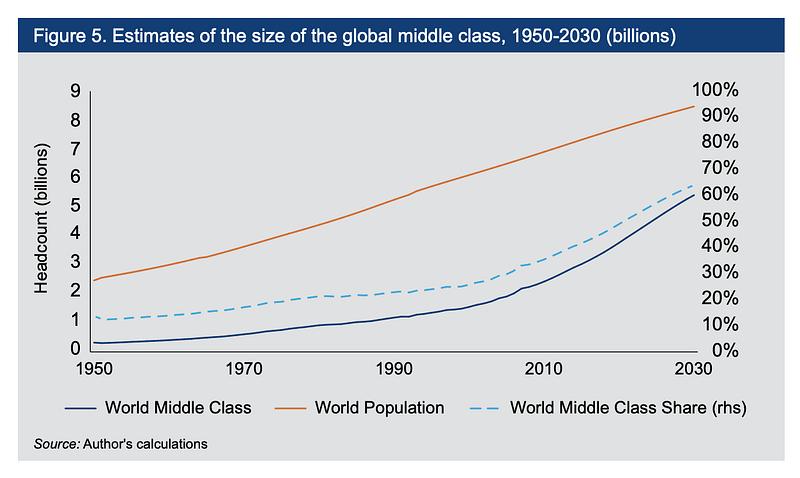
At the same time, it has been estimated there are more than 50 million millionaires in the world. That’s a whole lot of Ferraris, Louis Vuittons, and Rolexes. Just keep that in mind as you balk at the amount of money some of these watches are going for…
Strong historical returns
My investment case isn’t based on beating the markets or seeking to invest in watches strictly as a financial transaction. I mean, you could invest in watches in many ways without actually having a watch in hand. To me, in that case, I would rather just park my savings in the stock market. Leave the “watch funds” and NFTs aside for now. Instead, my thesis is based on an actual cash purchase and ownership of a handful of brand-name watches, that you also get to wear every day!
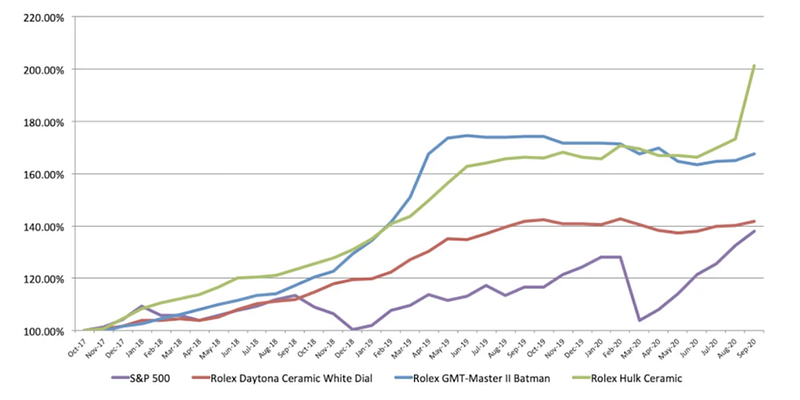
If we look at some of the hottest Rolex watches to come out in the past five years, you’ll see that their prices have appreciated massively. Again, I’m not positioning this as a reason to dump your S&P 500 ETF to buy a bagful of Rolexes. It’s simply worth pointing out, that watches can actually serve as legitimate investments. Further, it’s important to note that the prices above for these watches are secondary market prices. We’ll come back to why that’s crucial later on, as liquidity isn’t quite what you’d expect in stock markets.
Correlation with stock markets
While it would be ideal to have secondary market price data for luxury watches through the 2008–09 financial crisis, sadly we don’t. Platforms that gather such data haven’t been around for quite that long.
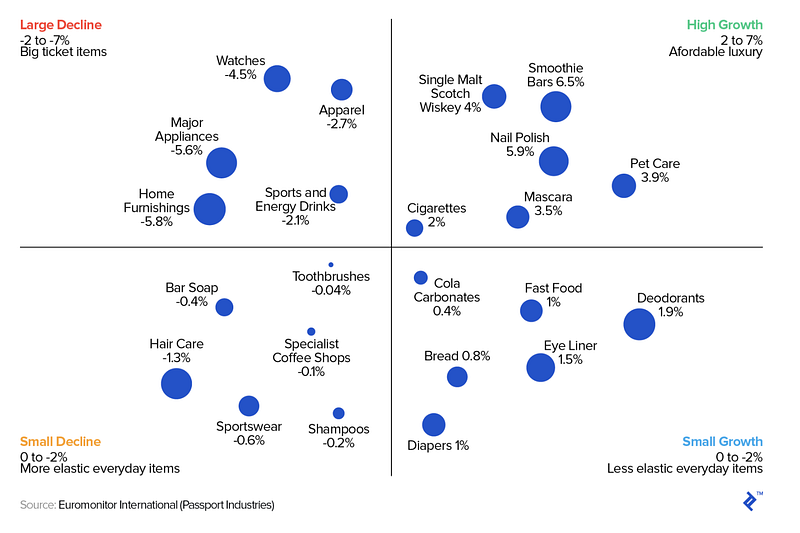
As a proxy, we can of course look at how luxury stocks performed over that same time period. What you see above, is that generally speaking luxury products didn’t take that bad of a beating. These are all single-digit losses, yet watches were on the worst quadrant among other big-ticket items. Certainly, it does matter which companies were grouped among these, as shopping mall brands would likely underperform hallmark brands like Rolex or Patek Philippe.
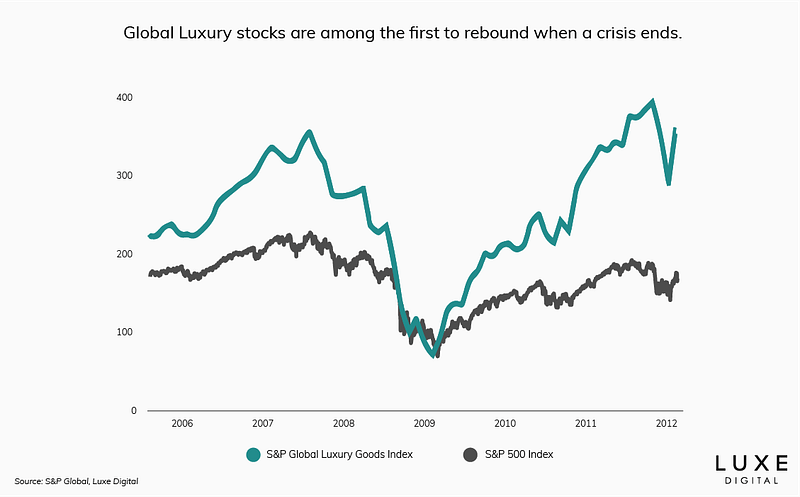
We can also see that while luxury, as a broader category, isn’t impervious to the dreaded market freefalls where everything becomes correlated, the bounce back from lows is much faster than the wider stock market index. In practical terms, you would never want to sell a luxury watch in a deep red market, so liquidity would likely dry up fast. This would have the effect of cushioning any market price reactions, as there is always some demand for dealers and collectors looking for any rare bargains.
Safety in enduring brand value
The Rolex crown is one of the great brand emblems alongside Apple, McDonald’s, and Nike. It has staying power — from baby boomers to millennials, Rolex is still cool. Not only that, they’re always in fashion. Just look at your favorite celebrities, whether rappers, athletes, or fashion models. More likely than not, you’ll find a Rolex on their wrist, if not an Apple Watch.
While the Apple Watch has taken the metaphorical crown of sales and units from the traditional watchmakers of Switzerland, there is no debate where the long-term value lies. If you paid $10,000 for that solid gold Gen-1 Apple Watch, chances are the battery is dead and Apple no longer supports software upgrades either. It’s a fancy 18-carat paperweight that no longer tells the time. Conversely, a $10,000 Rolex would be worth more today, and only needs service every decade or so. It will be functional long after you’ve passed it along to the next generation. If you’re investing, maybe stick with the guys who have been doing it for centuries.
As you’ll see, the luxury watch market has only accelerated since the Apple Watch. One reason might be that the wristwatch was more or less doomed into obscurity with the mobile phone in the 1990s. Even a basic phone had the time, date, calendar and it was always on accurate time. Since it was in your pocket, a wristwatch seemed unnecessary.
So in some sense, with the Apple Watch, people are suddenly putting stuff back on their wrist. You don’t really NEED an Apple Watch either, you can do most of it on your phone incl. measuring your heart rate and tracking workouts. It’s a modern status symbol, just like the Air Pods. Luxury watches are the logical next level up from the Apple Watch in terms of status.
What about art, cars, whisky, wine, and handbags?
You could absolutely make a similar case for these. The commonality amongst all of these is luxury. Generally speaking, luxury is always in demand. During recessions, the rich are still buying status symbols keeping demand and prices steady. You don’t see discount labels at Chanel or Ferrari for a reason. When the times are good, the best brands are always out of stock with waiting lists for the growing queue of up and comers.
“Luxury goods are the only area in which it is possible to make luxury margins.”~Bernard Arnault, Chairman LVMH
While the classic car and art markets are already big business with established channels, the online vintage watch market is just growing to its full potential. Most of the upside is actually in pre-owned or vintage watches, where new channels and platforms are emerging. In the past few years, more watchmakers have embraced “certified pre-owned” programs on their online channels, just like you’ve seen in the premium car category. Check out this in-depth analysis of the market structure, main players, and growth metrics. As you’ll see, most of my recommendations are in fact vintage watches, because of the inherent price stability from the fixed supply.
Art, cars, and handbags can also be enjoyed during ownership, just like watches. The only difference might be that investment-grade art and cars probably require a lot more starting capital than handbags or watches. While you might think that women would invest in handbags, there is an emerging group of women collecting serious watches. Ellen DeGeneres regularly wears many of the hottest investment pieces you’ll see below, and certainly not any “ladies” models encrusted with pink diamonds.
Why not buy luxury stocks instead?
You absolutely could just take my investment thesis and put some money in LVMH or Ferrari. In fact, you probably should just to diversify your stock portfolio further. Then again, it’s quite fun to enjoy the asset while it appreciates on your wrist! Maybe do both?
Investment-grade watches at different budgets
There’s no such thing as a sure investment with watches, and there is no brand where literally any watch will appreciate over time. Not even Rolex! Like with stocks, crypto, or any other investment, you have to do your own research and sort the Teslas from the Nikolas.
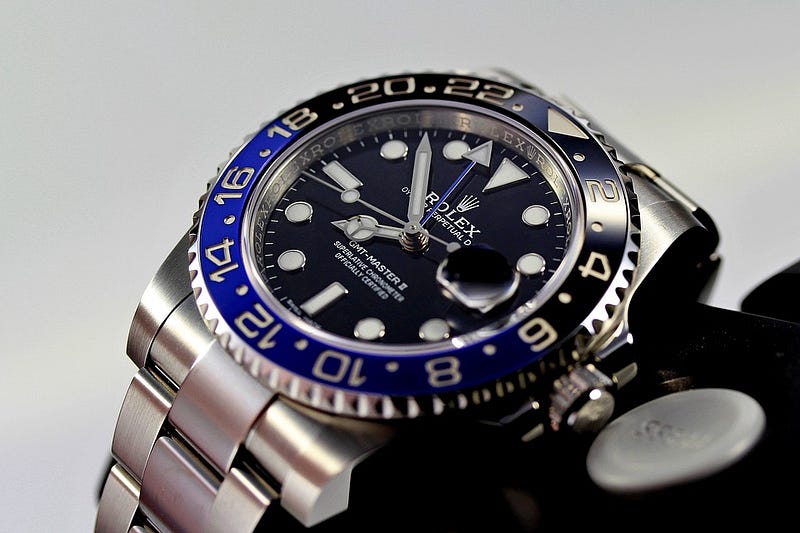
How did I choose which watches made the cut? Well, I tried to stick to watches that have been in the market for a minimum of 5 years, preferably more than 10 years, and in some cases several decades. Hot new watches can create a lot of hype, just like IPO stocks. But if you’re making a major investment, you’d like to see a track record of sustained performance.
Similarly, I’ve tried to stay with watches you can actually buy, which means there must be sufficient supply to establish a liquid market. Think of these as the blue chips of the watch market. Liquidity is critical because it means the value of your watch and investment is real, i.e. you could sell it close to market value at any time.
NOTE: During WWII, U.S. military pilots flying missions over hostile territory would be issued a “Life Barter Kit” including a Swiss-made watch (Milus Instant-Date), because it could be traded for safe passage anywhere in the world. That’s the value of liquidity!
So which one do you get? In real estate, the saying is “location, location, location”. Well, the equivalent for watches is “condition, condition, condition”. Further, it’s not enough to look good, it must be original parts only. Some patina on dials and lugs is better than replacement dials or polished lugs. In fact, some patina dials of famous references go far beyond market prices and have special nicknames like “spider dial”, or “tropical dial” depending on the specific type of damage incurred with time and usage. Here, it helps if you know the ownership history. Like with cars, finding an original owner piece is trumps.
Generally, watches that come with original paperwork will fetch better prices, because it helps with authenticity. Some manufacturers also provide authenticity certification services for a fee. The original box will also increase prices because it makes the watch more collectible to have the complete set. This is especially true for famous boxes like the cork box of vintage Patek Philippe Nautilus watches from the ’70s. This is why you will see the words “Box and papers” with watch ads, or even abbreviated to “B&P”.
The list is comprehensive, but not exhaustive, and certainly not complete. However, I’d be more than happy to hear your suggestions in the comments!
NOTE: While the price data below is going to be extremely helpful, it is no guarantee that your specific watch will be worth that amount of money. Just like yourself, most people prefer to buy from dealers that have warranties, not individuals. That means, when selling, you might get 10–30% less for your watch compared to the market price all else being equal.
Investment watches for $1,000 or less
Let’s be honest. There’s not much here. You really do need to pony up more cash to get into proper investment-grade watches. No serious investor builds a portfolio from penny stocks. That applies equally to watches. Nevertheless, you can absolutely start your watch collecting journey here, as most do.
The first watch I bought was a $300 Certina DS-1, and it gives me great joy to this day. In fact, I’m wearing the $100 Citizen Promaster I received as a gift from my father for my 18th birthday as I’m writing this very article. There is no real correlation between enjoyment and price in watches, but the investment potential is going to be more limited in this category.
Swatch (Limited Edition)
Valuations (November 2021): Fair Investment grade: D (Penny Stocks)
The Swatch Group is, in many ways, the Swiss watch industry. With the emergence of cheap battery-powered quartz watches in the 1970s, the mechanical Swiss watches were in big trouble. In a desperate move, two struggling conglomerates came together to try and rescue the sinking ship while riding the tide by offering their own line of quartz watches. Today, Swatch owns several top brands like Omega, Longines, and Breguet. Meanwhile, they continue to produce their famous affordable watches under their own name. While most of their models aren’t collectible or investible at all, there are a few exceptions. Their limited Hodinkee collaboration models sold for $100 but now go for $300 to $500. There is also renewed love for retro models like the neon-colored “Grand Prix” chronograph, which go for $1,000 or more now. Most people just buy these as fun everyday watches, and that’s how I’d recommend you see them, rather than investments.
Casio G-Shock (Limited Edition)
Valuations (November 2021): Fair Investment grade: D (Penny Stocks)
The people who collect sneakers seem to also be into G-Shocks. So there’s definitely a market for them globally. While most G-Shocks are around $100 new, there are increasing numbers of premium metallic watches in the Mr-G line that go in the low thousands. Then there’s the GWF-1000TM “Murakami” that went for $4,000 retail (yes, for a plastic battery watch) and is now trading at $20,000. Broadly speaking, the appreciation is going to be limited for G-Shocks, so you’d need to really love these watches to invest in them. Plus you wouldn’t want to actually wear them as the plastic and rubber cases will show wear quickly degrading your investment value. I would rather save up for something mechanical from a luxury brand, personally.
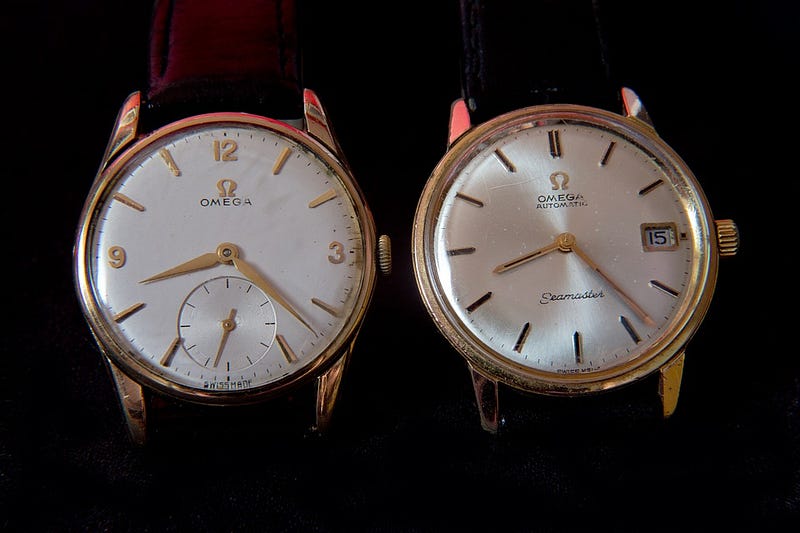
Omega Seamaster DeVille (Vintage)
Valuations (November 2021): Undervalued Investment grade: C+ (Small Cap Stocks)
One of the only respectable investment-grade options below a thousand would be a vintage Omega Seamaster, especially the DeVille range from 1963 to 1967. While these haven’t appreciated a ton, they aren’t going to lose any value either. Right now the demand isn’t huge for small dress watches, but that might change as the trend for big watches is definitively over. The designs are simple, even timeless, and if you dress smart then these would go perfectly with a suit. The movements are Swiss quality automatics, come with a date function, and are built to last a century or more. I would stick with a stainless steel model, as collectors never like gold-plated anything. You can then dress these up or down with a plethora of aftermarket strap options.
Seiko (Limited Edition)
Valuations (November 2021): Undervalued Investment grade: B (Small Cap Stocks)
The kings of watchmaking have traditionally been in Europe, with most mechanical inventions coming from England, France, and Germany. The principles of mechanical watches were developed originally for church tower clocks during medieval times to draw in the huddled masses for worship. Components such as the balance spring and lever escapement replaced the clock pendulums to enable portable pocket watches in the 16th century, yet you’ll find those same parts ticking away even in modern wristwatches.
At the turn of the 19th century, the quiet Swiss cottage farmers turned artisanal watchmakers came away with the top seat, as the industry transitioned from clocks to wristwatches, and the Swiss have been at the pinnacle of watchmaking ever since. Well, aside from actually almost going out of business during the 1970s, when Japanese-made quartz watches nearly put them out of business. That threat was mainly from Seiko, and they have been producing millions of high-quality affordable watches every year since.
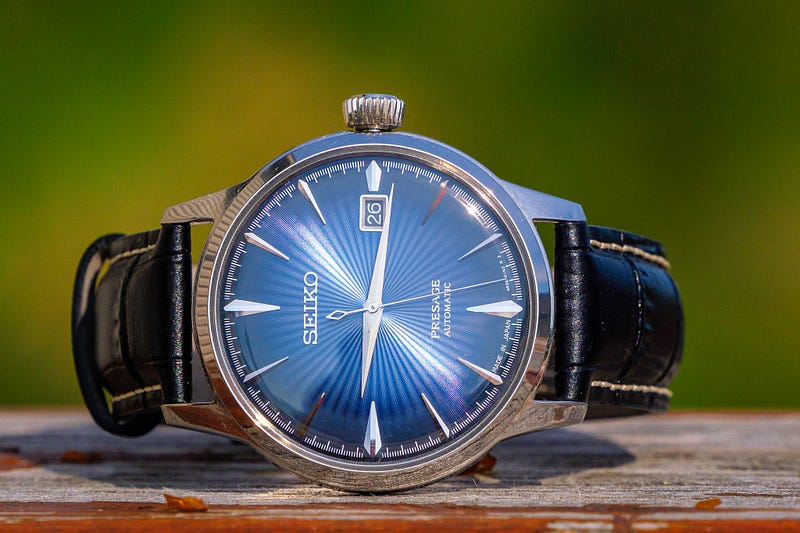
You wouldn’t think of 99% of Seikos output as anything worth an investment, but they do produce some great watches. Besides their Seiko brand, they compete with the likes of Rolex and even Patek Philippe under their Grand Seiko and Credor brands, respectively. Around the $1,000 mark, you should look for limited editions within the Presage “Cocktail Time” and Prospex families of watches. The former would work well with office and formal attire, and the latter are designed for professional use with a focus on diving watches.
All are exceedingly well made, require little service, and should hold their value decently. While some of their special Prospex models go well above the $5,000 mark, I would transition to other brands at that point as the demand for very expensive Seikos is going to be limited, given the rather pedestrian positioning of the brand. If you prefer something more rare and interesting, look for their vintage “King” Seiko brand of automatics.
Example Seiko references around $1,000:
- Prospex “55th Anniversary” ref. SPB143J1
- Prospex “Ninja Turtle” ref. SRPC49J1 or SRPC49K1
- Prospex “PADI” ref. SPB071
- Presage Cocktail Time “Skydiving”, “Starlight”, “Frozen Margharita”, “Blue Moon”, “Tequila Sunset”, “Manhattan”, “Hojicha”, “Negroni”, or “Martini”
- Presage “Arita Porcelain” ref. SARW049, SARX061 or SPB095J1
- Vintage “King Seiko” from 1960s and 1970s
NOTE: To maximize confusion among buyers, Seiko uses different reference codes for the same watch, depending only on if it was produced for domestic or export sales.
Investment-grade luxury watches for $5,000
Could you buy a car for $5,000? Absolutely. Will that car be worth more in 10 years? Absolutely not. In fact, that hunk of junk will probably cost you some money to dispose of. That’s the beauty of watches. There are amazing investment-grade watches that have appreciated like this for more than five decades by now.
In case you’re wondering why we jumped from $1K to $5K, it’s because in between is a no-mans-land of “mall watches”. Ironically, it’s probably the $2,000 to $3,000 mark where most watches are sold, but it’s also the least interesting as an investment. If you love brands like TAG Heuer or Breitling, then skip the modern stuff and scroll down to the good vintage stuff, which can be fantastic investments.
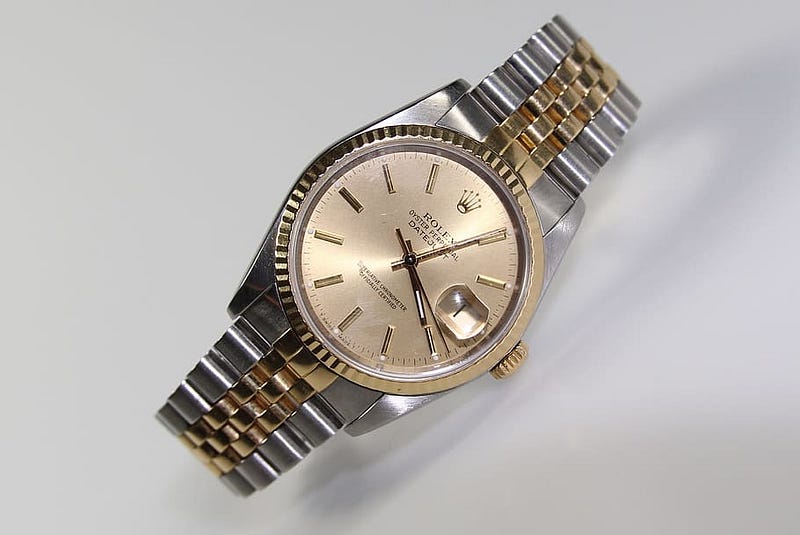
Rolex Datejust or Oyster Perpetual (Vintage)
Valuations (November 2021): Fair Investment grade: B+ (Blue Chip Stocks)
Yes, you can get into Rolex even below $5,000. One of the most recognizable brands and logos on the planet, and you can be part of that club. For many cultures, starting from the West, but increasingly the East, Rolex represents a sense of stature and accomplishment. Many are gifted such watches for special life events like graduation or retirement, and for good reason. Rolex is about lasting value, and that will never be out of style.
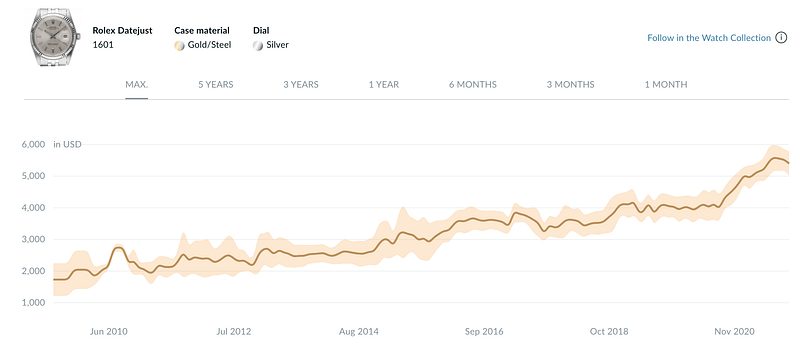
Example Rolex references around $5,000:
- Datejust ref. 1601, 1603 (produced 1950s — 1970s), read more.
- Oyster Perpetual ref. 1002, 1005 (produced 1959 — 1980s), read more.
The entry-level options are some of the most revered classic references, despite being known as “dad watches” for some time. Well, these are definitely back on-trend, and they match your “mom jeans” perfectly. This is a prestige watch made by the leading brand in watches, that you can keep for decades ahead as your only timepiece. Whether in classic two-tone or plain steel, these go with a suit and jeans equally, and will never be out of depth. Part of the appeal is the unisex sizing at 34 to 36mm, despite being originally sold as men’s watches. If there’s a “boyfriend shirt”, why not a “boyfriend watch” to go with?
Omega Speedmaster Professional (Modern)
Valuations (November 2021): Fair to High Investment grade: B+ (Blue Chip Stocks)
Yes, you can get the moon watch for under $5,000. I mean, what else do you need to know? Well, the one thing to know about Speedmasters is that there are quite literally hundreds of different references out there. Omega has been milking the NASA appointment and official certification since 1965 when NASA conducted a series of secret tests to find a watch capable of enduring space exploration, both inside and outside rockets.
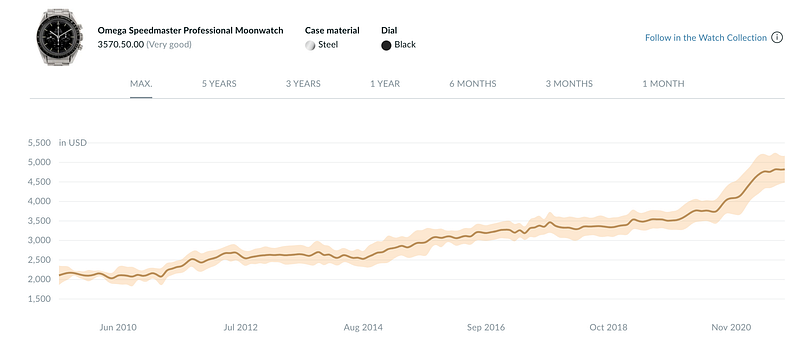
Example Omega Speedmaster Professional references around $5,000:
- Latest ref. 311.30.42.30.01.005 (retail $5,350 via Omega)
- Previous ref. 3570.50 (produced from 1996 — 2014)
- Previous ref. 3573.50 “Sapphire Sandwich” (produced from 2002 — 2014)
Generally speaking, you’ll want to stick to the “Professional” versions, which are the genuine item. There are automatic, ceramic, racing, and moon phase versions which are cool and collectible — but not moon watches. Even within the “Professional” models, there are dozens of references available. Some go for $5,000, others for more than $50,000. Yes, there are Speedmasters and then there are Speedmasters. Nevertheless, most of them are collectible, and as always you’ll want good condition and ideally with box and papers to boot.
Breitling Navitimer (vintage)
Valuations (November 2021): Fair Investment grade: B- (Small Cap Stocks)
Clearly, Omega has had the better marketing department. In many ways, the Breitling Navitimer is the superior chronograph with better heritage. In fact, it is the first Swiss watch in space. Yes, before the Speedmaster! You would think that would make this a hot property. Maybe its the busy slide rule design, or the fact that Speedmaster wearing Buzz Aldrin is just more famous than Breitling-strapped John Carpenter (Mercury astronaut), but the Navitimer remains the unloved cousin of the Speedmaster even today.
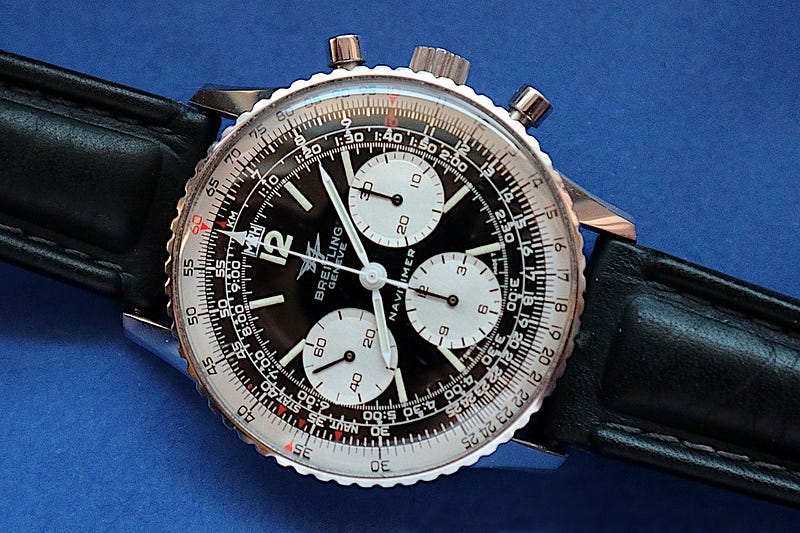
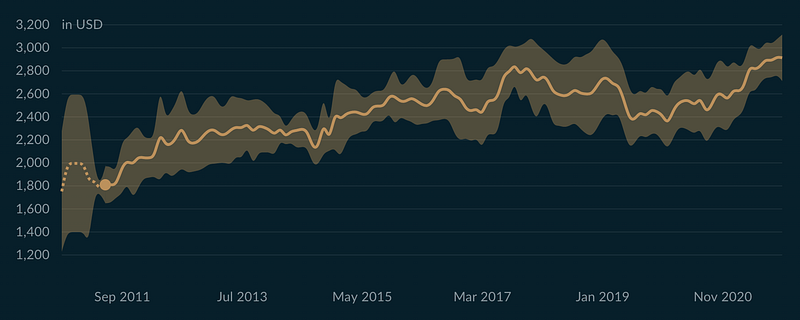
Nevertheless, the historical significance of this Breitling watch cannot be overlooked, and early references can make great investments at a budget half that of Apollo-era Speedmasters. Compared to the chart for the modern Speedmaster, you’ll notice a much higher variance in prices. The difference between a clean example with good paperwork and a beaten-up example might be up to 50%! If you can afford a good example with papers, that tends to be the safest investment long-term.
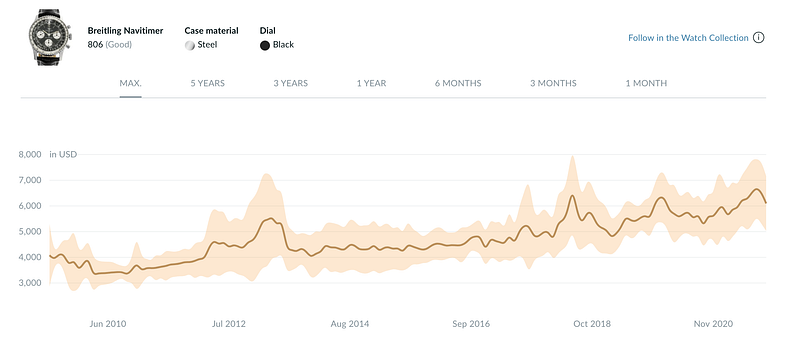
Pretty much the only investment-worthy Breitlings around $5,000:
- Ref. 806 (produced 1956–1971), read more.
- “Cosmonaute” ref. 809 (produced 1962 and 1963 only), read more.
NOTE: Do not confuse this with the “re-edition” 806 recently introduced by Breitling. Manufacturers are savvy to the vintage appeal of historically important references, and are now confusing collectors by making effectively new copies. The new ones will probably NOT be good investments!
Omega Seamaster Diver 300M (vintage)
Valuations (November 2021): Undervalued Investment grade: B+ (Small Cap Stocks)
If you’re not the space type, you might be interested in Omega’s Seamaster Diver line of watches. Besides the Speedmaster, this is one of the only investment-grade Omegas with a proper track history of sustained appreciation. Its name is associated with the modern Bond, with Daniel Craig sporting various models on the silver screen. Cool, if not quite Sean Connery cool…
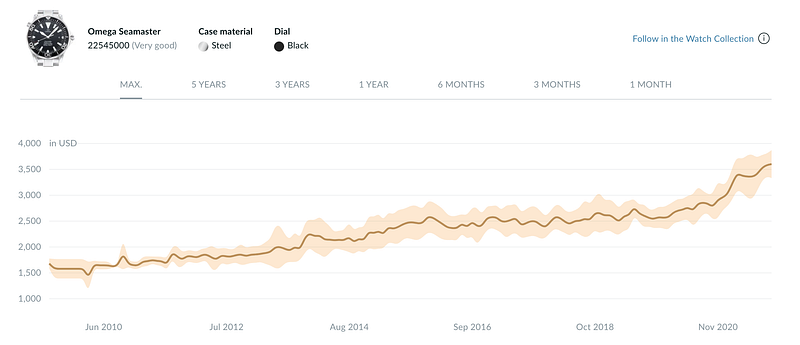
Pretty much the only investment-worthy Omega Seamaster reference below $5,000:
- Ref. 2254.50.00 (produced 1996 — 2009)
Generally, this is why it’s better to buy vintage watches. The newest Bond 007 watch is certainly a hot item right now, but will it be a hot item in 5 years? Usually, something even better eventually comes out. Only certain watches stand the test of time, while the rest fade away into obscurity. This Seamaster has shown staying power for more than two decades, possibly because of the “military” look reminiscent of real military issue Seamasters, which are the stuff of auction lore.
Grand Seiko
Valuations (November 2021): Fair (Modern), Undervalued (Vintage) Investment grade: B- (Emerging Markets)
A more speculative choice would be a newer entrant in the Japanese rival of Rolex: Grand Seiko. No, these are not your uncle’s Seiko. Grand Seiko is to Seiko what Lexus is to Toyota. Like Lexus does for cars, Grand Seiko is known for technological innovation. Their crown jewel is the famous Spring Drive movement that achieves quartz-like precision with mechanical components and no battery. They have been on a marketing rampage for the past few years, with a specific focus on the American market. Serious collectors are now picking these up on the regular, appreciating them for the best-in-class quality and handcrafted dials.
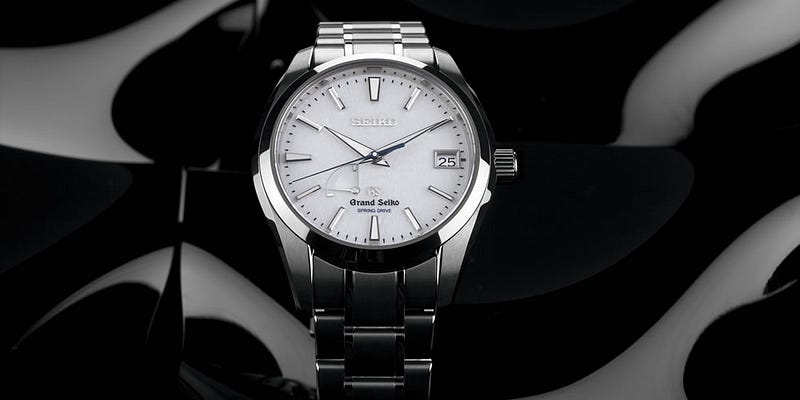
These pieces have all the style and quality attributes of Rolex and in most cases superior finishing. However, demand is still building, and they are producing a lot of limited editions which may risk collector appetite long-term. Many models are still trading below retail prices due to high production volume, which can make them a fair buy now. This just means you might want to hold onto these for a good decade to realize any investment gains.
Select important vintage references have gained increased interest with the collector community, and might be the safer investment at this time. Here’s a nice overview of the lineage of vintage Grand Seiko. While a few are available in decent volumes, there are certain special references like the observatory-grade “Very Fine Adjusted” or “VFA” models probably best found at auction.
Example Grand Seiko references currently below $5,000:
- Manual-wind ref. SBGW231 (retail $4,300)
- “GMT” ref. SBGM221 (retail $4,600)
- “Snowflake” ref. SBGA011 or SBGA211 (retail $5,800), read more.
- “First” in filled 14K gold ref. J14070 (produced 1960 — 1963), read more.
- “High Beat” ref. 6145 and 6146 (produced 1967 — 1974), read more.
- “High Beat” in 18K gold ref. 4522–8010 (produced 1970 only!), read more.
NOTE: Some of the modern limited editions (usually 1,000+ examples) like the “Kira-Zuri”, “20th Anniversary” or “Peacock” are going for relatively outrageous prices around $15,000 which I would not chase. Just wait for the next one and get in at retail instead, then charge some other schmuck double.
Investment-grade luxury watches for $10,000
At this budget, you finally get into the main ticket items. These are in many cases vintage watches you would find near $5,000 just 10 years ago, giving you an idea of the demand in recent years. While for many this might seem like a ludicrous amount to spend on a luxury item, this category represents the meat and potatoes of watches where both volume and demand are the highest.
Omega Speedmaster Professional (Vintage)
Valuations (November 2021): Fair Investment grade: A- (Blue Chip Stocks)
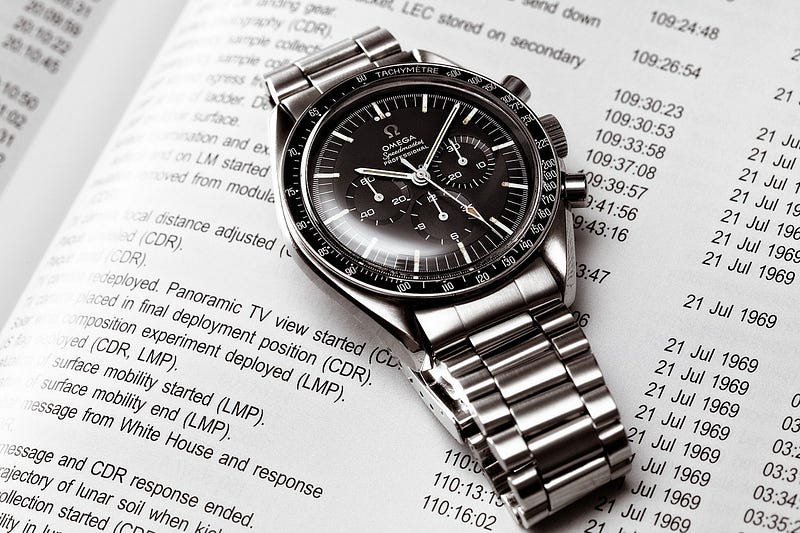
As I said, there are levels to this game. While you could grab most modern Speedmasters at half the price, the collectors are mostly after historically significant references. These could be limited runs or watches with specific relevance around NASA’s Gemini and Apollo programs in the 1960s. These include the ref. 145.012 below that was actually used on the moon. Our fascination with Apollo and the moon has never been stronger, with renewed moon missions planned by NASA and its commercial partners. These should be great investments over the next 5–10 years as new generations will learn about the history of space exploration and inevitably find the Speedmaster as a physical token of the early days.
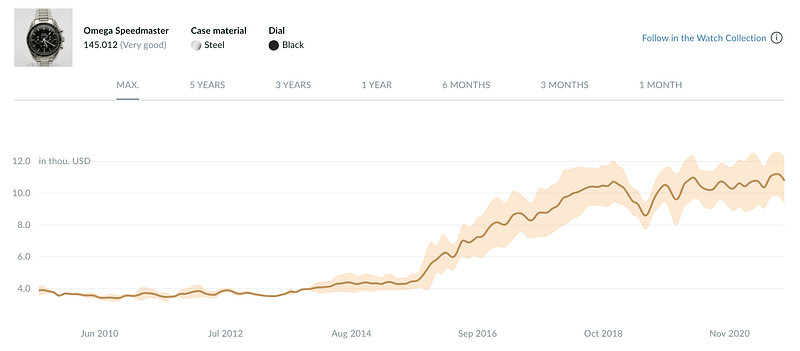
Example Omega Speedmaster Professional references around $10,000:
- Apollo-era ref. 145.012 (produced 1967 — 1969 only!), read more.
- “Post-moon” ref. 145.022 (produced 1968 — 1981), read more.
- Gemini IV 40th Anniversary ref. 3565.80.00 (produced 2005 only)
Compared to their modern counterparts, these vintage watches will have higher price variance. You might see a similar-looking watch go for $8,000 to $12,000 depending on condition and availability of original paperwork. To be on the safe side, and thinking of investment value, never buy the cheapest available. It will also underperform its class as an investment. Generally, the ref. 022 will be up to 50% cheaper, as the ref. 012 has the more famous Caliber 321 movement going for it, besides going to the moon…
Rolex (Vintage)
Valuations (November 2021): Fair Investment grade: A+ (S&P 500 Index)
Many people would say the Rolex Submariner is the best watch in the world. It would be a challenge to argue against it. If it was good enough for James Bond, then it's good enough for most. No, not Daniel, the real Bond. Sean Connery can be seen sporting a “Sub” in Dr. No and Goldfinger.
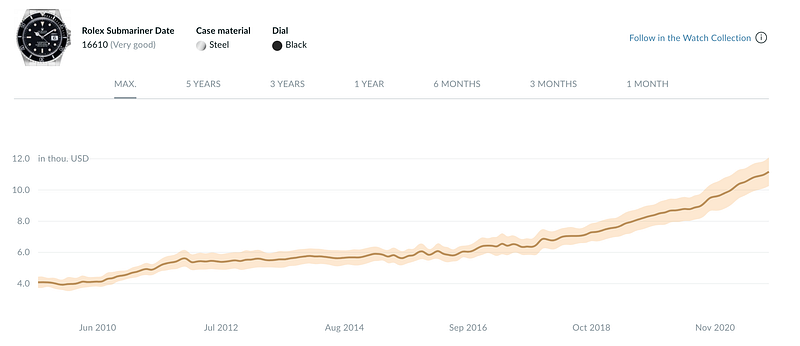
No, you won’t be sporting Bond’s Submariner at these prices, but you will get the quintessential classic reference 16610 produced from 1987 to 2010 that is more watch than you could ever possibly need. It’s traditionally considered the perfect size, and it is built to take a beating, whether above or below water. Before these became luxury items, they were frequently used by military and professional divers, not just in movies. This is also the last of the aluminum bezel Submariners, before the new blingy ceramic bezels were introduced. If you prefer something off the beaten path, then go for the “no date” ref. 14060 or even the Sea-Dweller ref. 16600 designed for professional saturation diving.
There are so many wonderful historical Rolexes, that they would deserve their own post entirely. This gigantic guide should do the job. There really should be something here for everyone, no matter your taste and style. Most Rolexes were designed for professionals like pilots (GMT-Master), engineers (Milgauss), divers (Submariner, Sea-Dweller), sailors (Yacht-Master), or mountain climbers (Explorer). Given these are some of the strongest investments in all of watches, I would encourage you to peruse this list carefully before settling on something else.
Example vintage Rolex references around $10,000:
- Submariner Date ref. 16610 (produced 1988–2010), read more.
- Submariner Date “Two-tone” ref. 16613 (produced 1988 — 2009)
- Submariner Date ref. 16800 (produced 1979–1987), read more.
- Submariner “No Date” ref. 14060 (produced 1988 — 1999)
- Sea-Dweller ref. 16600 (produced 1988 — 2008), read more.
- Explorer 36mm ref. 14270, 114270 (produced 1989–2021), read more.
- Explorer II ref. 16570 (produced 1989 — 2011), read more.
- GMT Master II ref. 16710, 16713, 16760 (produced 1989 — 2005), read more.
- Milgauss ref. 116400 (produced 2007 — 2016), read more.
- Yacht-Master “Platinum” ref. 16622 (produced 1999—2011) , read more.
- Datejust II 41mm ref. 116300 (produced 2009–2016)
- Datejust 36mm ref. 116234, 116200 (produced 2004 — 2019)
- Datejust 36mm “Two-tone” ref. 116233 (produced 2004–2019)
NOTE: If you insist on a genuine “Bond” Submariner ref. 6538, in good condition, you better have a spare kidney. While examples in terrible condition go for six figures, a mint condition Bond watch recently went for a cool million in auction! At this point, it might be easier to invent a time machine and travel to 1955 when you would have paid just $300 for it brand new. Sigh. Okay, let’s just move on…
Rolex (Modern)
Valuations (November 2021): Fair to High Investment grade: A- (Blue Chip Stocks)
While vintage Rolex is all the rage with collectors, most people who buy a Rolex would still prefer to walk into an official brand boutique. After all, it’s a big part of the experience. Getting a newspaper-wrapped box in the mail just doesn’t feel the same. Rolex consistently produces around a million new watches a year, all in Switzerland, so that shouldn’t be any problem, right?
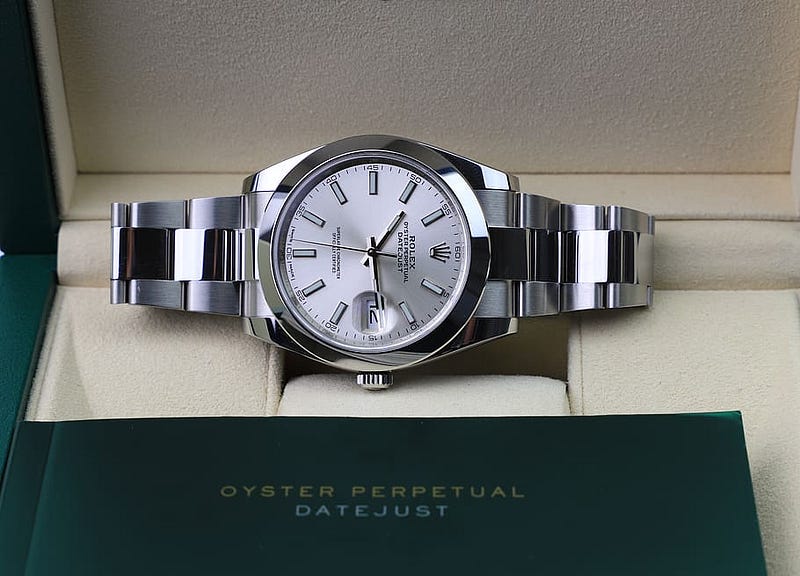
Let’s imagine you wanted a new Rolex Submariner. You could, in your naivete, decide to walk to your nearest Rolex boutique and present such a request. If the lack of Submariners in the window wasn’t a hint, the condescending tone of the salesperson will quickly reset your ego. They don’t have any. After you foolishly ask if any other Rolex boutiques might have any, you’ve just set yourself up for an eye roll. You can make it a life mission of yours to discover that little-known Rolex boutique, tucked away in some quaint seaside town in Europe, full of Submariners and Daytonas on display. It ain’t happening in reality, though.
Example modern Rolex references around $10,000:
- Submariner “Ceramic” ref. 116610 (retail $8,550)
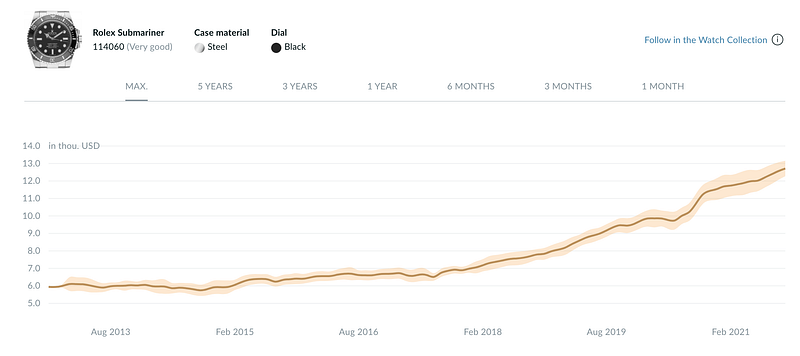
- Submariner “Ceramic No Date” ref. 114060 (retail $7,900)
- Explorer II ref. 216570 (retail $8,700)
- Datejust 41 ref. 126300 (retail $8,000)
- Oyster Perpetual 41 ref. 124300 (retail $6,000)
- Air-King ref. 116900 (retail $6,200)
TLDR: You can’t buy most of these at retail, from Rolex, especially the Submariners. There are waiting lists going on for years. Rolex has sagely managed the dynamic relationship between supply and demand to keep collectors frothing at the mouth. Sadly, this situation is only made worse by the ongoing supply chain crisis, even acknowledge as such by Rolex. The good news is you could walk away with a Datejust or Oyster Perpetual of some manner, and that will be a decent investment too while you wait for your Submariner/retirement. If you must have a modern “ceramic” Submariner like the ref. 114060, your only choice is to buy well above the advertised $7,900 retail price in the secondary market. As you can see, these are going up, up, and away very quickly. Get in before $20,000?
Tudor (vintage)
Valuations (November 2021): Fair to High Investment grade: B+ (Small Cap Stocks)
Some people find Rolex a little tacky despite the heritage and brand value. Maybe you love the heritage, but just don’t want to be a person that wears an expensive Rolex, given the associations that might create with people you meet. Either way, there’s an alternative for you…
Tudor is the wholly-owned sister brand to Rolex. They were really always positioned more in the tool watch category, whereas Rolex has been the premium product and brand. Today, Tudor is making a major comeback with an array of exciting vintage-inspired models in the “Black Bay” series, even developing its own movements. With vintage Tudors, the cases came from the Rolex factory, marked as such, while cheaper movements came from third parties like Swatch Group. Many models also feature the famous Rolex “cyclops” date window.
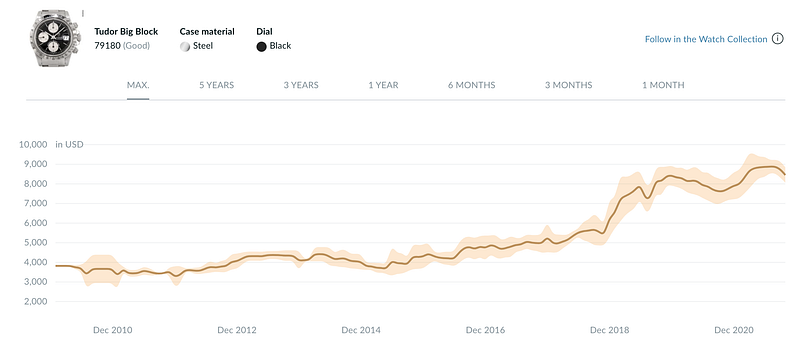
For example, if you like the design of the Rolex Daytona, but either dislike the Rolex branding or can’t afford the genuine item, then you could look at the famous Tudor “Big Block” chronographs, currently trading below $10,000. Similarly, if you really wanted a blue dial Rolex Submariner, those have always been available in white gold exclusively, with a retail price of around $40,000. Hence a blue dial Tudor Submariner in steel might be just the thing, available below the $10,000 mark and trending up steadily.
Example vintage Tudor references around $10,000:
- “Big Block” Chronographs ref. 79160, 79170, 79180 (produced 1989–1996), read more.
- “Big Block” Chronographs ref. 9420, 9421, 9430 (produced 1976–1988), read more.
- Blue Dial Submariner Date 79090, 79190 (produced 1989 — 1999), read more.
- “Lollipop” Submariner Date ref. 76100 (produced 1984 — 1988), read more.
- Prince Oysterdate Submariner ref. 9401, 9411 (produced 1976 — 1983), read more.
NOTE: There are also rare models that go for much higher prices incl. the “Snowflake” Submariners, “Marine Nationale” Submariners, and the “Monte Carlo” chronographs. It’s harder to recommend these as investments as relatively few pieces are available with highly varying provenance and paperwork, making it harder to establish liquid markets. Best found at reliable auctions from original owners.
Wait, what about other vintage chronographs?
Isn’t there anything else worthwhile to invest in besides Speedmasters? Well, for this money, not a whole lot. Tudors are investible, and the big brother Rolex Daytona is over $20,000 already. Don’t get me wrong, there are incredible chronographs out there, but most of them suffer from niche demand and low volumes. The people who want these watches REALLY want them, making them collectible rarities people hunt around for years in search of the perfect example. That resets the market higher even if less pristine examples remain unsold for long periods.
Here are some famous and collectible, if not investible chronographs:
- Longines caliber 30CH
- Heuer ref. 2447
- Heuer ref. 2446C
- Jaeger-LeCoultre “Shark” ref. E2643
- Zenith El Primero ref. A386
- Universal Geneve Compax “Nina Rindt” ref. 885103/02
Frankly, once we get into the $20,000 tier, these watches can’t hang with Apollo-era Speedmasters or the Rolex Daytona. You really have to be an aficionado of these brands or watches to justify overlooking those two legends of the watch game for that money. Especially if you ever need to sell one back into the market, you’ll be limited to finding those aficionados who know the value of what you’re offering. In comparison, especially Rolexes are as liquid as gold — accepted anywhere!
Investment-grade luxury watches for $20,000
These are big boy watches. Not just great watches, but special watches. Certainly, there are lots of special watches available for a lot less money, but these are the cream of the crop when it comes to investability. These watches will get you credibility among any group of collectors.
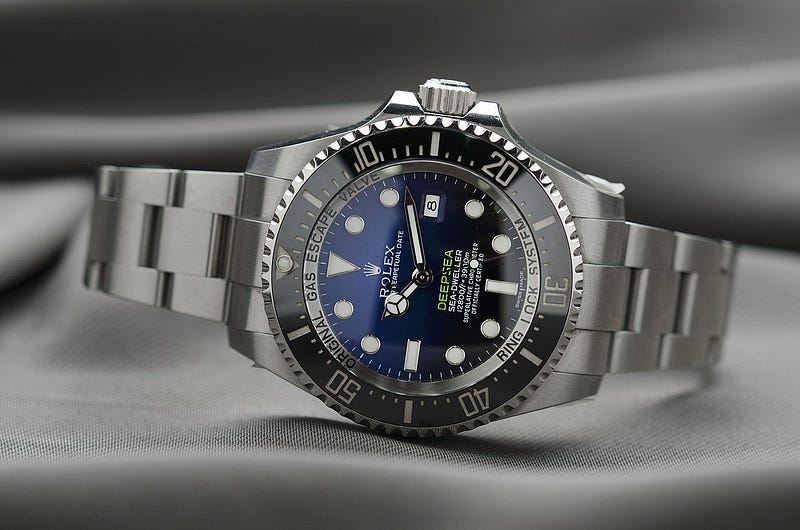
This seems to be a price point at which a lot of famous watches settle into. It’s kind of a sound barrier of collectibility. There’s all sorts of good and bad for sale, but around $20,000 is where the special vintage references separate themselves. The challenge is that some beloved watches like the Zenith A386 are hard to come by, and therefore hard to recommend as investments if you can’t find them anywhere, or only sell them to a few passionate vintage collectors.
Rolex (Special references)
Valuations (November 2021): Fair Investment grade: A+ (NASDAQ-100 Index)
Rolex has always been popular. They’ve always produced a lot of watches. One thing they haven’t done a lot is limited editions. Due to the demand, a model that might be in production for less than a decade can be harder to find than many actual limited edition watches from other manufacturers. While some of these are vintage and no longer produced, some are fairly recent (low) production models and just very much in demand.
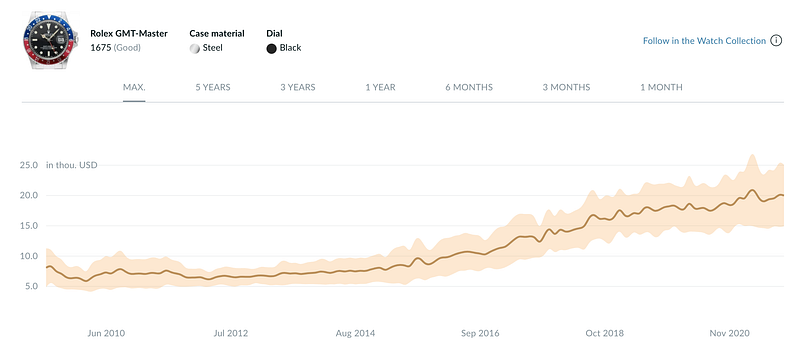
Notice the price variance (yellow area) above for the Rolex GMT-Master 1675 is much higher than earlier charts, because the condition and patina will vary greatly on watches that are several decades old. Bad samples with no papers may go for just $15,000 while watches in good condition might fetch above $25,000. In fact, a mint condition GMT ref. 1675 with full paperwork might register way off the scale in auction. The same goes for most vintage watches, not just Rolex.
Special Rolex references around $20,000:
- Deepsea D-Blue ref. 126660 “James Cameron” (retail $13,000), read more.
- GMT Master II “Batman” ref. 126710BLNR (retail $9,850), read more.
- Sky-Dweller “Annual Calendar” ref. 326934 (retail $14,400), read more.
- Submariner Date “Hulk” ref. 116610LV (produced 2010 — 2020), read more.
- Submariner Date “Kermit” ref. 16610LV (produced 2003–2010), read more.
- Submariner “Bart Simpson” ref. 5513 (produced 1962 — 1989), read more.
- Day-Date “President” ref. 18038 (produced 1977 — 1988), read more.
- GMT Master “Pepsi” or “Root Beer” ref. 1675 (produced 1959 — 1980), read more.
- Explorer II “Freccione”, “Frog’s Foot”, or “Steve McQueen” ref. 1655 (produced 1971–1984), read more.
- Explorer “Ian Fleming” ref. 1016 (produced 1963–1989), read more.
As with everything, there are further levels above simply special. Beside’s the legendary “Bond” Submariner, another mythical model is the “COMEX” Submariner. This watch was used by a professional French diving company of the same name, bearing its logo prominently on the dial. Why that’s worth above $100,000, well… collector logic. There’s a long list of more and more obscure special Submariner references out there, but the low volume and questionable provenance make them a sketchy buy in my view, unless you can afford to buy them at auction prices from Philips, Sothebys or Christies.
Rolex Daytona (Vintage)
Valuations (November 2021): High to Very High Investment grade: A- (Apple Stock)
Chances are if you’ve heard of Rolex, you’ve heard of the Daytona. The name comes from the Daytona 500 race, and if you’re a fan of racing you’ll see Rolex ads plastered all across famous race tracks on the F1 series. Rolex has famous watches for many professions: pilots (GMT), divers (Submariner), and even presidents (Day-Date). The Daytona is their racing watch, even if the provenance is somewhat less than TAG Heuer’s Monaco. Yet, for whatever reason, Daytonas are consistently the most sought-after models across the higher budgets across all vintages and models, while Monacos will barely keep their value.
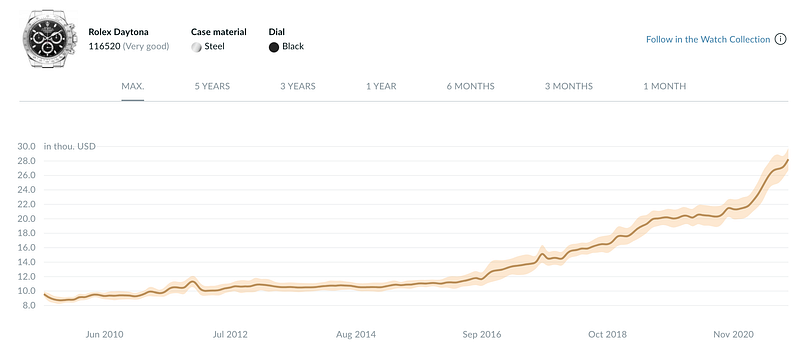
Rolex Daytona vintage references already above $20,000:
- Ref. 116520 (produced 2000 — 2016)
- “Two-tone” ref. 116523 (produced 2000–2018)
- “Zenith” ref. 16520 (produced 1988–2000), read more.
Pickings are pretty slim at this budget. I remember mulling over a white dial “Zenith” Daytona around the $10,000 mark years ago and just thought its too expensive. Which it absolutely was given my financial circumstances at the time, but it does sting a little (read: a lot) to look at the chart above now…
Omega Speedmaster (Special references)
Valuations (November 2021): Fair to High Investment grade: A- (Google Stock)
What qualifies as special? Well, whatever the collectors think is special. There are examples of vintage references like the references used by Gemini and Apollo era astronauts, as well as more recent releases like the “Silver Snoopy” trading at double retail right now. The whole game is just supply and demand.

Obviously, when you have historical references long out of production, it’s likely at some point demand will outpace the fixed supply. Just like Bitcoin, in a sense. The price volatility will be higher for newer references, so there is possibly more safety in vintage references with more of a stable price history. If you’re a space nerd, then it would be hard to fault going for the genuine item, which would be an Apollo-era Speedmaster, such as the ref. 105.012. Collectors also love the 105.003 which is considered a “pre-moon”, and was the first watch to be used on an EVA by astronaut Ed White.
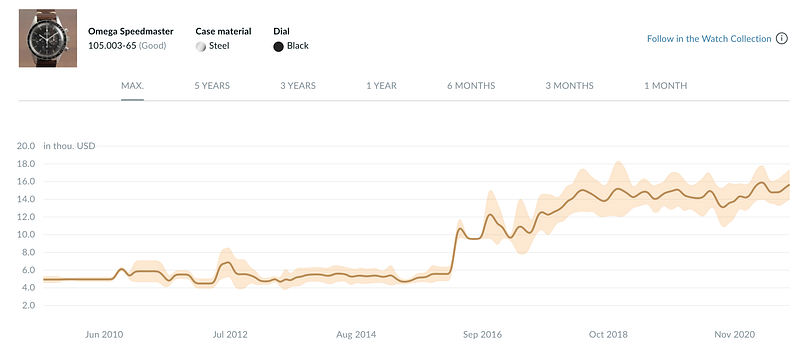
Special Omega Speedmaster Professional references around $20,000:
- “Apollo” ref. 105.012 as worn by Neil Armstrong and Buzz Aldrin on Apollo 11 (produced 1964— 1968), read more.
- “Ed White” ref. 105.003 (produced 1963— 1966), read more.
- “Alaska Project Re-edition” ref. 311.32.42.30.04.001 (produced 2008 only), read more.
- “Snoopy Award” ref. 3578.51.00 (produced 2003 only), read more.
- “Tintin” ref. 311.30.42.30.01.004 (produced 2013–2015), read more.
At this point, you might think you’d like a watch that was actually worn on the moon. Well, you and every watch collector on the planet had that idea at one time. Sadly for you, the watches weren’t gifted to the astronauts as keepsakes, but always remain property of NASA. Just like the moonrocks they brought back. The closest you’ll ever get to one is at the Smithsonian museum. I quite like it that way. Not everything should be for sale.
Audemars Piguet Royal Oak Offshore (Modern)
Valuations (November 2021): Fair Investment grade: B+(IBM Stock)
At this price tier, we can introduce another horological heavyweight: Audemars Piguet (“AP”). These days, the most likely place you’ll see these are on the wrist of your favorite rapper. Most likely “iced out” with aftermarket diamonds, effectively ruining investment value. Nevertheless, Audemars Piguet has demanded us to put some respect on their name since they were founded in 1875.
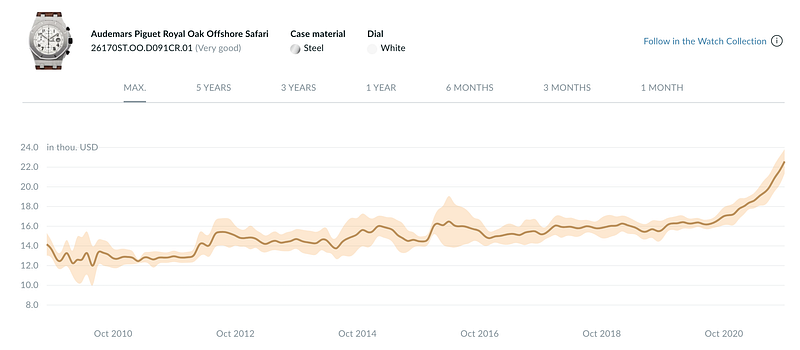
While the main event is the classic Royal Oak, which we’ll come across in the next price tier, the modern sportier take is not a bad investment either. It’s the entry-level item into the world of Audemars Piguet, and these big watches have remained popular ever since Arnold Schwarzenegger wore one in End of Days in 1999. If you’re a real man’s man, then look no further for your investment watch of choice! These will pair well with your truck and mustache.
Example Audemars Piguet Royal Oak Offshore references around $20,000:
- “Diver” ref. 15703ST.OO.A002CA.01 (retail $19,000)
- “Safari” ref. 26170ST.OO.D091CR.01 (produced 2005 to 2014)
- “Rubberclad” ref. 25940SK.OO.D002CA.02.A (produced 2002 — 2012)
Investment-grade luxury watches for $50,000
You thought we were finished? Bro, we haven’t even gotten to Patek Philippe yet. Barely scratched the surface of AP. We’re just getting warmed up here. Burning your hard-earned retirement fund is keeping us right toasty. Strap in for the ride, it’s about to get lit.
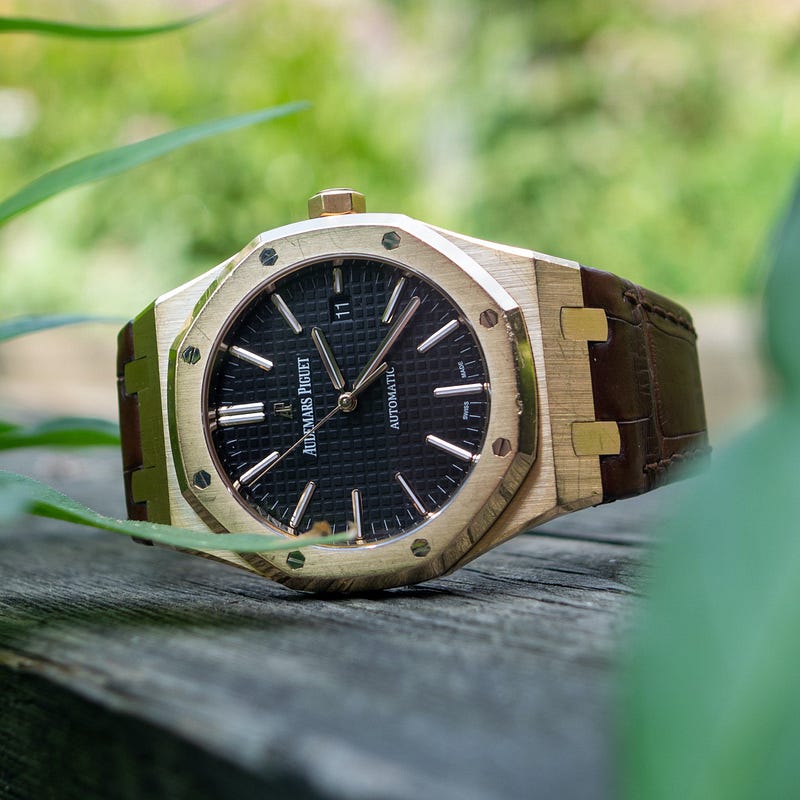
In all seriousness, unless you’ve secured financial freedom, and your net wealth is well into seven figures, you shouldn’t be considering investing this kind of money into a watch, let alone multiple watches of this caliber. There are several reasons:
- Such a watch would represent an unduly large portion of your net wealth. This kind of concentration risk is unacceptable even in a well-managed portfolio.
- You would worry too much to actually use such an expensive watch, defeating the purpose of enjoying your investment in the first place. Fill your bank vault with gold bars, not “safe queens”.
- The cost of ownership will be very high. Think Ferrari high. High insurance as injury, and exorbitant service costs as insult.
- At budgets like this and above, you’re getting into proper “hype watch” territory. While it’s nice to buy an asset in an uptrend, it’s less fun to hold the bag once the peak implodes. Frankly, instead of one of these millionaire poser watches, you could get an amazing set of historically significant watches from the categories above.
If none of the above applies, you have to show up your managing director, your Instagram followers demand it, or you’re simply clinically insane, let’s continue on our merry way and torch your black card like there’s no tomorrow!
Rolex Daytona (Modern)
Valuations (November 2021): Very High to Outrageous Investment grade: B+ (Tesla Stock)
To talk about one of the most in-demand watches on the market, we need to establish an important lesson in investing. You have to pay a good price, just like Warren Buffet would say. Warren wouldn’t buy Tesla at these prices, but he’s said he also wouldn’t bet against Elon Musk. Warren Buffet is an important investor, so he can agree to buy large amounts at special discounts. The way that works in watches is a special relationship with Authorized Dealers (“AD”). Except in watches, the special relationship allows you to buy at mere list prices, instead of at multiples above retail. Yes, that’s how it is.
NOTE: There are other amazing historical Rolex watches around this price point, but here the volumes become quite low and finding genuine examples with the right paperwork is a challenge. You could look at auctions for the Explorer II “Freccione” or the GMT-Master “Bakelite”.
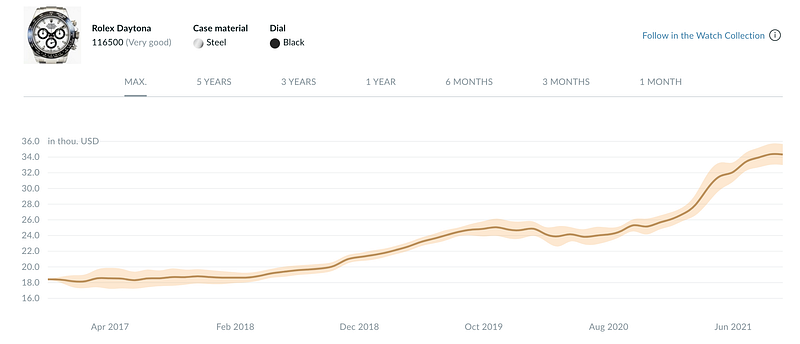
Rolex Daytona references below $50,000 (as of November 2021):
- “Panda” ref. 116500 (retail $13,150!!!)
- “Gold” ref. 116515LN (retail $30,000)
If you look at the chart above for one of the absolute hottest watches on the market right now, would you believe some people are still buying these at the retail price of $13,150? It seems like the bargain of the century. You immediately nearly triple the value when you walk out! That just seems too good to be true. In fact, when the “Panda” came out in 2017, it was in such high demand it was immediately trading almost 40% above retail, which is a rare event. In most cases, hype for new models builds over months and years.
Here’s the trick though. If you decided to do that today, you will probably get a Daytona in 3–5 years from now. Possibly never, because there’s a steady stream of new big spenders jumping the queue. But given the trajectory, you should try that anyway. If you get one, it’s effectively a miniature lottery win. In reality, most of these units will go to long-term collectors that have long-standing relationships with dealers, and the precious few units will get allocated to them.
As a private company, Rolex does not declare any numbers, but it is speculated that they would produce approximately 10–20,000 such stainless steel Daytonas per year. That’s for the entire world. That might sound like a lot, but trust me you’re more likely to see a flying pig than a stainless steel Daytona available for sale at a Rolex boutique. Large dealers might get 20–30 Daytonas to sell per year. Smaller dealers would be lucky to get a few, if any! Go check it out and ask them for one. Anywhere in the world the result will be the same. Enjoy the polite but condescending smile you will inevitably receive in exchange for your naivete!
TIP: As with any highly volatile asset, these modern Rolex Daytonas are only a killer deal closer to retail prices. I wouldn’t chase the rocket ship buying at the current peak— just like with stocks, buyer beware! Out of the options, the gold models actually seem the safer bet in this market, as there is less downside risk.
Patek Philippe Aquanaut (Vintage)
Valuations (November 2021): Fair to High Investment grade: A- (Disney Stock)
While Rolex has the strongest brand in watches, it’s Patek Philippe that has the strongest brand among enthusiasts. It’s peak Swiss quality, from the illustrious history spanning centuries to the conservative branding and artisanal manufacturing. In many ways, Patek Philippe is what you ultimately think of with Swiss watchmaking. While modern Rolexes come out of factories through robot hands, all Patek Philippe watches are still assembled and finished by the hands of expert craftsmen with white coats and awesome beards. They’ve always been at the top of the game, pioneering complicated watches in particular, and continue to show the way forward for the industry even today.
Perhaps it’s no accident that the main trio of watchmakers featured here all remain independent private companies. Like many industries, the watchmaking industry has gone through several periods of crisis and consolidation, and very few survived on their own. Most of the brands you come across will be part of large luxury conglomerates like LVMH, Swatch, and Richemont. The ones that do not are most coveted by collectors: Rolex, Audemars Piguet, and Patek Philippe. These companies remain private, choosing to stay outside of the short-term focused public markets, calmly planning for the decades and generations ahead.
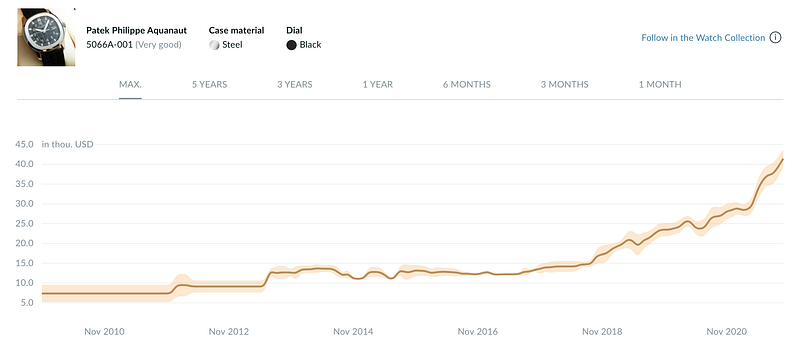
The only Patek Philippe Aquanaut references around $50,000 (not for long?):
- 38mm “Jumbo” ref. 5065A and the 36mm 5066A (produced 1998 — 2006), read more.
The first Patek Philippe example we’ve chosen is an interesting piece of history, as it is Patek’s attempt at being cool. If this seems out of place for the ultimate Swiss heritage brand, then you would be right. Many collectors used to see the Aquanaut as the ugly stepchild, not quite belonging with the rest of the esteemed family. Adding insult to injury, rather than being presented on exotic leather or a finely crafted metal bracelet, the Aquanaut came on a rubber strap. Just like your G-Shock, but yours for only $20,000.
For a long time, this unloved entry-level Patek traded well below retail value, but as you can see, things have changed dramatically in the past few years tugged for the ride by the unsatiable demand for its modern descendants. The sporty vintage Patek remains available at the mere cost of a luxury sedan from Mercedes-Benz. While the 5066A currently trades below the $50,000 mark, the extra 2mm upgrade to the “Jumbo” 5065A will cost you another $10,000 on top. Such is #collectorlogic.
Audemars Piguet Royal Oak (Modern)
Valuations (November 2021): High to Very High Investment grade: A- (Nvidia Stock)
If you asked people on the street what the most famous watch is, they would probably say Apple Watch. In the niche world of watch people, it would probably be the Royal Oak. It’s one of those timeless designs like the Porsche 911, that has been carefully tweaked for decades with restraint, while still feeling at home and exceedingly cool in each time period.
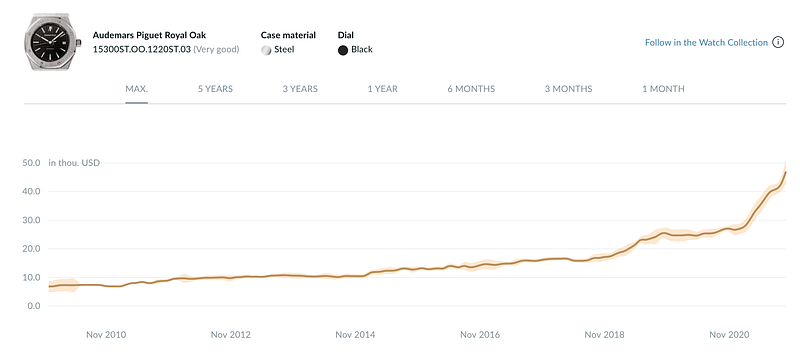
Audemars Piguet Royal Oak references around $50,000:
- Ref. 15500ST (retail $20,400!!!)
- Ref. 15400ST (produced 2012 — 2019)
- Ref. 15300ST (produced 2005–2012)
- Chronograph 38mm ref. 26315ST (retail $30,700)
- Chronograph 41mm ref. 26320ST (retail $24,300)
- “Kasparov” Chronograph ref. 25860ST (produced 1997 — 2008), read more.
While certain historical references have become more desirable than unobtainium, there are some more modern Royal Oaks that can be found at mere single-digit multiples of retail prices. While the “two-tone” steel-and-gold models have come up in value, I would steer clear. This peculiar style comes and goes, and might be temporarily propped up by the insatiable demand for the main steel models.
Traditionally, this has always been an expensive watch. In fact, even when it came out in 1972, it was ten times more expensive than a Rolex Submariner. It’s especially impressive given that AP produces an estimated 14,000 of these per year, which is similar to the Rolex Daytona. If you know a guy that knows a guy that can get you on that secret waiting list for a brand new one at retail, it’s the best investment you’ll ever make. Just make sure the guy actually knows the guy and isn’t selling you some fugazzi AP.
TIP: I know it’s tempting to jump on any Royal Oak below $20,000 including battery-operated quartz models, but it’s likely the investment value will be diminished greatly, if not completely. If you don’t have the budget, go for one of the Offshore models mentioned earlier, instead.
Investment-grade luxury watches for $100,000
While it’s somewhat unlikely you would want to start here unless you got in early into Bitcoin, or even earlier into a trust fund, let’s look at some options at the high end of the scale. It’s worth noting that for big-ticket vintage references, $100,000 is more the beginning than the end. Specific rare references from Patek Philippe and Rolex regularly go for seven figures in auction. Once you get into auctions, that’s its own sport entirely, which I will leave to experts in that field.
Patek Philippe Aquanaut (Modern)
Valuations (November 2021): Very High to Crazy Investment grade: B+ (Dogecoin)
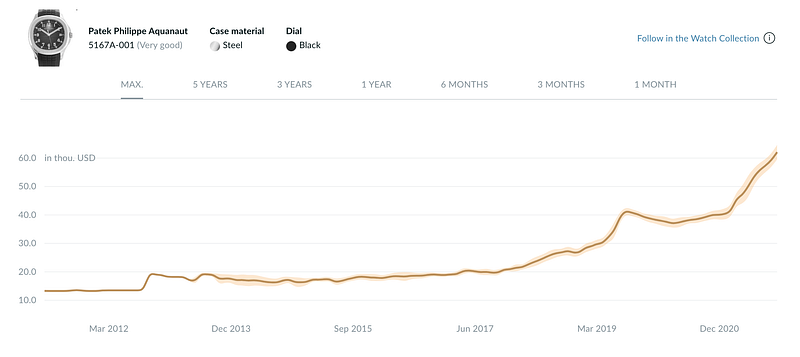
This is still technically the entry-level watch that Patek offers. Which is insane. In reality, it’s also one of the most desirable models, so you can’t get one from Patek themselves. Hence, the secondary market value is going exponential. If it's hard to get a Daytona or Royal Oak, then this is the boss level of waiting lists. While Patek produces around 60,000 watches total per year, only a small fraction of those are going to be Aquanauts, somewhere in the thousands then. Not many to go around as a new generation of collectors are learning about the brand.
Modern Patek Philippe Aquanaut references below $100,000:
- Ref. 5167A (retail $20,300!!!)
- “Travel Time” ref. 5164A (retail $36,400)
I mean, what is there to say. These are up 30% year-on-year and heading towards $100K like a rocket ship. It obviously can’t go on forever, given the watch already sells 200% above retail. If you happen to own one, congratulations. If you somehow win the Patek Philippe lottery and are permitted to purchase one at retail, you’re golden. Other than that, I wouldn’t go chasing these prices. The vintage Aquanaut is the more reasonable investment here.
Patek Philippe Nautilus
Valuations (November 2021): Astronomical to Incomprehensible Investment grade: C+ (Cyberpunk NFT)
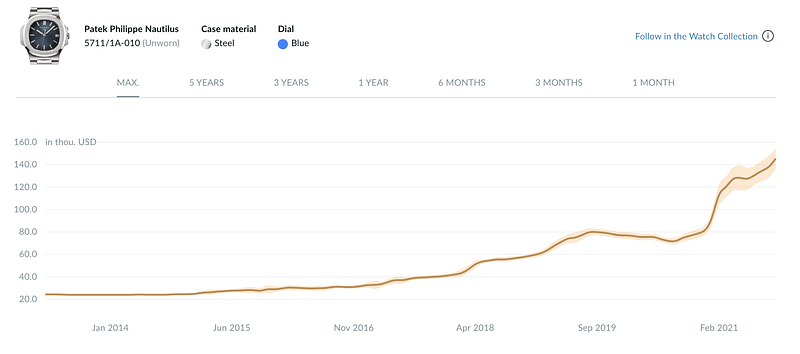
Modern or vintage, the Nautilus is possibly the most desirable watch on the planet right now. If you bought one five years ago, pause here to pat yourself on the back. It’s hard to imagine that there was a point these would go below their $35,000 retail price. It hurts to even think of those people who thought “Nah, I’m good”. I feel your pain.
Patek Philippe Nautilus references still below $100,000:
- Ref. 3800 (produced 1981 to 2005), read more.
Patek Philippe Nautilus references WAY above $100,000:
- Ref. 5711 (recently discontinued, retail $34,893!!!)
- “Moonphase” ref. 5712 (retail $33,500)
- “Jumbo” ref. 3700 (produced 1976–1990), read more.
As of today, the base model Nautilus 5711, the hottest watch on Wall Street is discontinued, so you can’t get one, period. So prices may go up even more until the replacement model settles in among collector tastes. Those that need one to show up to their hedge fund yacht club buddies need to liquidate some major assets pronto. Honestly though, I would stay out of the Nautilus game for now, and focus on your winning personality instead.
Audemars Piguet Royal Oak (Special references)
Valuations (November 2021): Frothy to Exorbitant Investment grade: A- (Classic Porsche 911)
If the Royal Oak is the coolest watch, then the “Jumbo” is the coolest Royal Oak. It’s the basic version with no frills but presented in the perfect size and thin on the wrist. It’s the air-cooled 911 of watches. Among the rare specimens, the original issue “A Series” is the one that top collectors want, and in some cases will demand double the price for a similar watch from a later series. Yes, collectors are that insane.
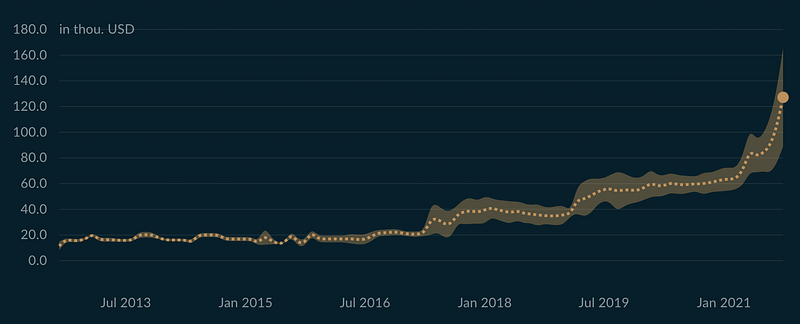
Audemars Piguet Royal Oak references below $100,000:
- Current “Jumbo” 15202ST (to be discontinued, retail $22,700!!!)
Audemars Piguet Royal Oak references WAY above $100,000:
- “Salmon Dial Jumbo” ref. 15202BC (retail $55,400), read more.
- “Titanium Jumbo” ref. 15202IP (produced 2018 only), read more.
- “Early” Perpetual Calendar ref. 25654 (produced 1982 — 1993), read more.
- “Jumbo A Series” Ref. 5402ST (produced 1972–1973 only), read more.
Which explains the 500% growth of the vintage “Jumbo” in the past five years. I wouldn’t recommend chasing these at this point. Get it third-hand on Mars in a few decades at Elon’s pawnshop instead. Given the relative rarity of the perpetual calendars, they might be the safer investment if you simply must partake in the vintage Royal Oak game.
Rolex Daytona (Special references)
Valuations (November 2021): Fair to High Investment grade: A- (Classic Ferrari)
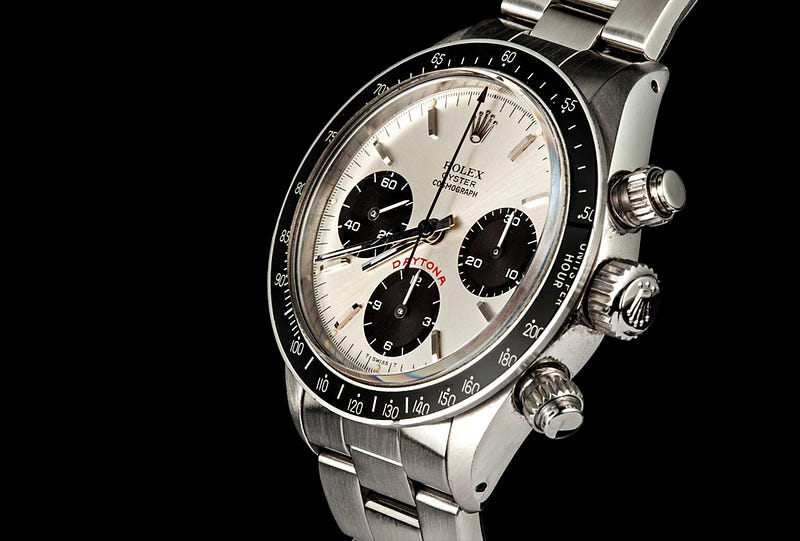
If Rolex is the king of watches, then vintage Daytona is Elvis. It is the coolest Rolex on the planet, and any celebrity rocking one with score major points with watch nerds. Now that massive bulky watches are no longer cool, a svelte vintage chronograph at 37mm seems to be the ultimate subtle swag for those in the know.
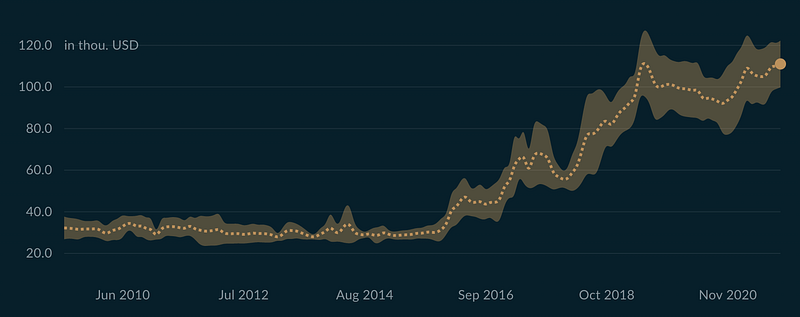
As you can see, prices have skyrocketed but remain rather volatile. The high variance depends on the condition and patina, as well as provenance (read: paperwork). These are still common enough to plot data outside of auctions, whereby if you wanted one you could choose from around 100 examples on Chrono24 at any given time. Despite the seemingly incredibly high prices, the demand for these is unlikely to decrease with time given their unquestionable status at the peak of Rolex collecting, and supply is obviously fixed for vintage models. Hence these can still be considered good investments, especially compared to hyped up modern Nautilus and Aquanaut references which are still in (limited) production.
Besides the vintage stuff, there are some hot modern references like the platinum case, green dial and “Rainbow” Daytonas. The latter is has gone a little too crazy to consider a viable investment anymore, but the other two remain in production and steady demand.
Rolex Daytona references WAY above $100,000:
- “Platinum” ref. 116506 (retail $75,000)
- “Green” ref. 116508 (retail $34,650!!!)
- “Big Red” ref. 6265 (produced 1971 — 1987), read more.
- Ref. 6263 (produced 1971–1987), read more.
- “Paul Newman” ref. 6239 (produced 1963–1969), read more.
NOTE: In case you were now tempted to seek out Paul Newman’s personal “Paul Newman” Daytona, then you’ve just missed your chance. It went for $17M in auction. Catch it next time around?
What about Patek Philippe Grand Complications?
If you know anything about Patek Philippe, then you know we’ve only scratched the surface of their incredible catalog, both vintage and modern. There is no shortage of absolutely legendary references, covering all manner of complications, most of which Patek Philippe has either invented or been the first to implement in a wristwatch. The world-timer, the perpetual calendar, the annual calendar, the minute repeaters, the tourbillon, and even astronomical complications — Patek has done it all, often combining several at a time. There are special double-signed dials, “Tiffany” dials, and even unique commissions created for prodigious Patek aficionados with heavy wallets, incl. Henry Graves Jr., George Thompson, John Mayer, and one Eric Clapton.
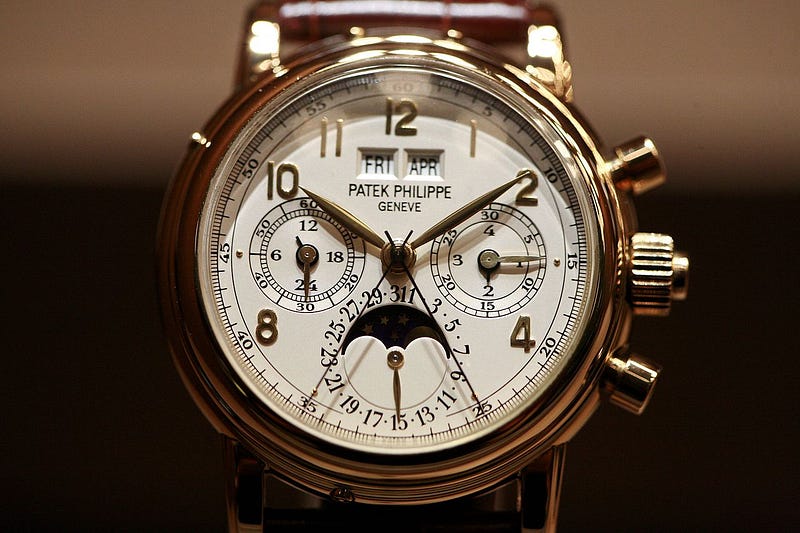
The problem with these watches is that while they’re potentially the pinnacle of any watch collection, they aren’t that investible. Not at least in the sense that I’m talking about. Many complicated Pateks haven’t been great investments. Patek literally put the first perpetual calendar in a watch, yet their classic ref. 3940G has been up and down for a decade without any steady upward trend, still available below retail prices while APs are going vertical. The finest manual wind chronograph in the world is not in fact the Rolex Daytona, but the classic hand-finished 5170G from Patek Philippe, yet the latter trades $20,000 below retail.
Even higher up the Patek food chain, the unbelievable platinum annual calendar (invented by Patek) with chronograph ref. 5960P is still 40% down from retail prices. That seems like an absolute steal over some basic Royal Oak. Confusingly, same watch in stainless steel is actually now worth more than the platinum version, which again only makes sense to watch collectors. You could even buy the quintessential Patek Philippe grand complication, the peerless perpetual calendar chronograph 5970G close to its retail price of $160,000. Among their most elaborate creations, the Grand Complications Celestial, which is a photorealistic mechanical recreation of the night sky at a location of your choosing on Earth, is available even below its eye-watering $300,000 price tag. This just doesn’t make any sense, does it?
Legendary references 2499, 1518, or even the new “Olive” dial final edition Nautilus ref. 5711 are like unicorns. You’ll simply never see one, apart from the video above, or an auction catalog with reserve prices in seven figures, so there’s no point talking about them here. You might as well invest in Picassos, while you’re at it. If that’s a thing you can do, then absolutely, find that unique dial 1518. It’ll make a great talking point at your next Illuminati dinner party.
What does this all mean? Is there no correlation between intrinsic value and market value in watches? Why would a time-only entry-level Aquanaut be more valuable than a platinum annual calendar chronograph, from the same manufacture? Well, markets are like that. It’s all about supply and demand, and the weird psychology that emerges with market participants. The very finest Patek has to offer just isn’t as desireable as their most basic creations. That trend isn’t likely to change very soon, if at all. If you were a contrarian investor, you would load up now on Patek grand complications instead of chasing the Nautilus train.
What about other famous watch brands like Cartier and Panerai?
The reality is that the only sure bets in watches for the last several decades have been Rolex, Patek Philippe, and Audemars Piguet. That’s not even a controversial statement. Certainly, not even all of their references have appreciated, so the market demand is very high but also incredibly narrow.
To separate the wheat from the chaff, it’s important to separate luxury watches from so-called “fashion watches”. To make matters complicated, some famous fashion houses such as Hermes, Louis Vuitton, Chanel, and Ralph Lauren now make proper mechanical luxury watches. Not great investments yet, but some great watches for sure. Meanwhile, you have Gucci, Armani, and Boss that also sell tons of watches. Stay away from these. They are cheaply made, battery-powered watches that will hold zero value. The same goes for your mall brands like Daniel Wellington and Fossil. You can still absolutely buy and enjoy them, but don’t mistake them as an asset with any value.
The main issue with many important and popular luxury watch brands like Panerai, IWC, and Cartier is that they simply produce too many watches to build resale value, i.e. they are maximizing sales supply against retail demand. Each absolutely has hidden gems coveted by collectors, like the Panerai “Egiziano”, Cartier “Crash”, or IWC “B-Uhr”, but often available examples are very few and likely only available at auction. This makes it harder to buy and significantly harder to sell these watches. Then again, the core range is mostly flat in terms of value appreciation.
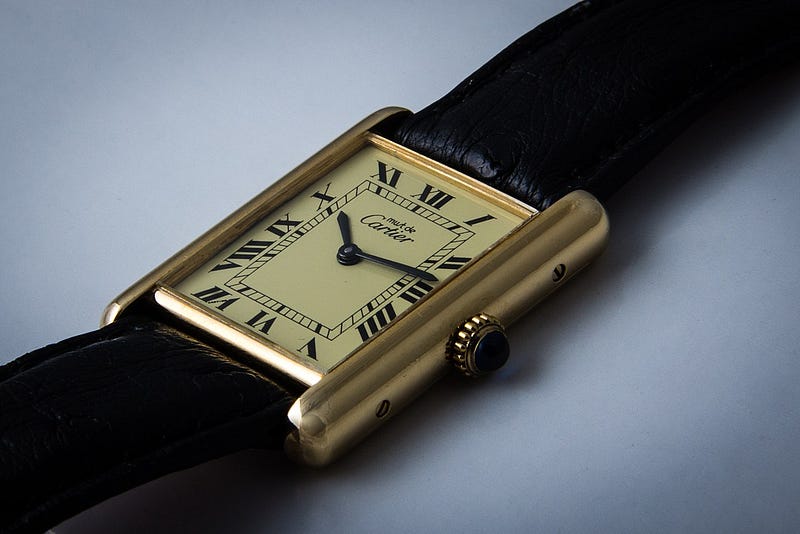
There are also many watches that have amazing investment potential but don’t have enough of a track record yet. A. Lange & Söhne produces some of the highest quality watches ever produced since the brand’s revival in 1990 but has yet to establish solid secondary market value. Other new entrants like FP Journe and DeBethune have built a cult-like following among serious collectors, but low volumes limit their strength as investments despite soaring secondary prices for select models. Having said that, if you ever find yourself being offered the distinct honor of purchasing a Chronometre Bleu from Francois-Paul Journe himself, just do it and thank me later.
Over the last 12 months, Vacheron Constantin, the last member of the famed “Holy Trinity” of watchmaking alongside Audemars Piguet and Patek Philippe has suddenly become cool again. Getting a blue dial Overseas ref. 4500V is now just as hard as a Royal Oak or Nautilus. Their limited-edition “Everest” ref. 7910V might be the hottest watch of 2021. Yet Vacheron still needs to prove that the new Overseas wasn’t a fluke. Which is an odd thing to ask of a company that was started before Napoleon was even born.
Nevertheless, I believe most high-quality watches from well-established brands will appreciate (slightly) over longer periods. An example below of my first major watch purchase, a Breitling dive watch. While 29% profit over a decade isn’t going to rock your world, it certainly beats inflation and has been providing me joy for ten years. Better than cash under the mattress, that’s for sure.
If you’re scrolling manically to find where Richard Mille watches come in, keep looking. I suppose they represent their own category of hype watches, but they don’t have a long track record of sustained value, at least yet. While Instagram celebs are still rocking the “milli” watches, I’ve seen a significant decline in appetite among serious collectors. Celebrities are also notorious for setting and then forgetting trends. In fact, many of your favorite rappers have moved up to rocking Patek Philippe and Audemars Piguet now. Not just iced out aftermarket models anymore, but proper investment pieces listed above.
How to buy authentic luxury watches
If you made it this far, you’re probably thinking about the risk of buying a fake watch, whatever the budget. The motto of buying watches online is “Buy the seller”. Many collectors still sell watches within their direct network, often locally, on platforms such as online forums or even social media. If you don’t personally know the seller, you’re always taking some risk. However, there are ways to manage that risk through online marketplaces dedicated to watches.
As you can see, these new fakes from China are no joke. It’s deepfake quality but in the metal. Obviously, if you purchase a new Rolex at retail prices from a Rolex boutique you don’t need to think twice. If that’s not an option for you, then platforms with verified sellers, watch authentication services, escrow accounts, and hundreds of authentic reviews are the next best bet. As always, just never buy the cheapest available.
Right now those would include:
- Chrono24: This is the de facto global marketplace for watches. Most of the inventory is offered by third-party dealers, who are verified as sellers by the platform. You can find anything here.
- Watchfinder: A popular choice for beginners, Watchfinder offers a wide range of watches that have been authenticated by the company themselves.
- WatchBox: If you’re looking for high-end pieces, new or vintage, then this is the specialty of WatchBox.
- Hodinkee: One of the main media platforms in watches, Hodinkee have gotten into watch sales both new and vintage.
- eBay: While you might be surprised, eBay has recently launched its own authentication service for watches.
- A Collected Man: If you’re on the hunt for something truly special, and your wallet feels particularly heavy, then look no further.
- Auctions: Obviously if you’re going for the proper high-end or obscure specialities this is your only route with Philips, Sothebys or Christies.
Maintaining investment value of your watches
While the upside of watches as an investment is getting to enjoy them, the downside is you have to protect your investment. Here are a few parting tips on your watch collecting journey.
- Get insurance. Chubb offers watch and jewelry insurance in most countries through banks and credit cards, or just talk to your home contents insurance provider about covering your watches. Just watch out of any per item claim limits given these valuations! Kevin O’Leary has publicly said his collection has been stolen twice from his home, so it’s no joke. It really does happen. Protect your assets.
- Don’t swim with your vintage Daytona. Get a $500 Seiko Prospex for the pool and beach. Actually, don’t even swim in your vintage Submariner even if it was made for diving unless you really get it professionally serviced annually with fresh seals and pressure tested for water resistance. If you see condensation on the inside of your dial, panic, scream, and seek help immediately.
- Don’t wear your $20,000 watch in places where lots of people will notice, get a $500 Seiko Presage for those situations. Don’t get drunk in clubs showing off your wrist game, show off your personality instead.
- If your collection is worth more than 10% of your net worth, I suggest you store most of it at a safe deposit box at your nearest bank, or at least invest in proper home security incl. a safe. I would avoid traveling with more than 2–3 pieces at a time, unless you have 100% insurance cover. Even if you get your money back, the emotional damage of losing a rare vintage find might be the bigger risk.
Buy what you like?
At the end of the day, a common phrase you’ll hear from watch collectors is “buy what you like”. That makes complete sense purely as a collector. However, this is convenient self-reinforcement for those obsessed with shiny objects, and something luxury brands are more than willing to take advantage of in their marketing.
Buying a watch as an investment but never wearing it, or worse, keeping in the safe defeats the whole idea here. You might as well just invest that money in stocks if you’re purely after ROI. That much I agree with, but I find the community objections to even mentioning resale value rather ignorant. It’s not particularly admirable to spend thousands of dollars on luxury goods thoughtlessly. That’s just wasteful and vain in my view. Considering investment as part of your purchase criteria just seems like a responsible thing to do #adulting.
Therefore, if you find a watch you like on this list, somehow connect its history to your own story, and it’s also a decent investment… well, that’s what you should look for in my view! You may never want to sell such a piece, but if you’re in a situation where you need cash urgently, it won’t hurt to have some liquid luxury assets. Hopefully, you’ll Buy & Hold forever like Warren Buffet, and can hand over a precious heirloom to the next generation, just like the perfect white families with amazing hair in the Patek Philippe ads.
“You never actually own a Patek Philippe. You merely look after it for the next generation.”
So, what did I miss? If there’s a watch or brand that I’ve overlooked, let me know in the comments!
The author, Aki Ranin is the founder of two startups, based in Singapore. Bambu is a Fintech company that provides digital wealth solutions for financial services companies. Healthzilla is a health-tech company and creator of the Healthzilla health analytics app for iOS and Android smartphones.


