avatarHair Parra

Free AI web copilot to create summaries, insights and extended knowledge, download it at here

2241

Abstract

e"><img src="https://cdn-images-1.readmedium.com/v2/resize:fit:800/1*aG18qFd9qvZ8mn2LO3go5Q.png"><figcaption></figcaption></figure><p id="c3d9">For the ACV (autocovariance), consider the lag h=0 (i.e. the variance)</p><figure id="9de0"><img src="https://cdn-images-1.readmedium.com/v2/resize:fit:800/1*M8eq_VHR7nNAIRVrC_raFQ.png"><figcaption></figcaption></figure><p id="152b">Solving for the ACV(0), we have that</p><figure id="c91d"><img src="https://cdn-images-1.readmedium.com/v2/resize:fit:800/1*Ow-OyZ8G9l-HxIEJx_dgKA.png"><figcaption></figcaption></figure><p id="77f5">When h is not 0, it follows that</p><figure id="349d"><img src="https://cdn-images-1.readmedium.com/v2/resize:fit:800/1*Kz4ZJ1J4_0clkGHAC2yQsw.png"><figcaption></figcaption></figure><p id="eb6d">Note that sometimes we are using “+h” and others, “-h”. These are equivalent; we will see later that the ACV function is <b>symmetric</b>, that is, ACV(h)=ACV(-h). Plugging back what we had before,</p><figure id="cc2f"><img src="https://cdn-images-1.readmedium.com/v2/resize:fit:800/1*5-QHHzoSvEFoT2Vb92TXjQ.png"><figcaption></figcaption></figure><p id="67d0">What a cool formula! Further, you can verify using the definition that the <b>autocorrelation</b> is given by</p><figure id="83e4"><img src="https://cdn-images-1.readmedium.com/v2/resize:fit:800/1*oCPz8VWxm-Ri4D_UH2mt8g.png"><figcaption></figcaption></figure><p id="f2a0">Notice something? If the absolute value of phi is more than 1, the correlation will only become worse as the lag increases! Contrarily, this tells us that if phi is less than 1 in absolute value, the autocorrelation will <b>decrease exponentially</b> the further the lag.</p><p id="1c0f"><b>How to R</b></p><p id="0382">Let’s simulate some AR(1) data with phi=0.7 X:</p> <figure id="1fcf"> <div> <div>

            <iframe class="gist-iframe" src="/gist/JairParra/b9c0eb5e68105406ff3ae67137f54d8e.js" allowfullscreen="" frameborder="0" height="undefined" width="undefined">
          </div>
        </div>
    </figure></iframe></div></div></figure><p id="27f9">First, we set up the true AR(1) coefficient to 0.7, then we compressed this into a <code>list</code> object. We

Options

set <code>ma=NULL</code> because we want to create an AR(1) process. Then, we pass this to the<code>arima.sim</code> function to generate 600 observations using the model. We can now inspect both the data plot and the ACF plot as follows:</p> <figure id="673d"> <div> <div>

            <iframe class="gist-iframe" src="/gist/JairParra/7ef55d91f32aaab7d46325ca084c7a48.js" allowfullscreen="" frameborder="0" height="undefined" width="undefined">
          </div>
        </div>
    </figure></iframe></div></div></figure><figure id="2f21"><img src="https://cdn-images-1.readmedium.com/v2/resize:fit:800/1*iQNCAE5C9KQyOy_2o2BB4g.png"><figcaption></figcaption></figure><figure id="1a52"><img src="https://cdn-images-1.readmedium.com/v2/resize:fit:800/1*EnqZaJFoEFZHVQ0hzOzJUw.png"><figcaption></figcaption></figure><p id="8c35">We can see that the process is indeed mean zero, and that the ACF decreases exponentially in h. Although it appears to increase a bit at lags 10 and 25, it mostly stays within the bounds.</p><h2 id="7335">Next time</h2><p id="5e87">We will continue next time with another important process: the <a href="https://medium.com/@hair.parra/a-complete-introduction-to-time-series-analysis-with-r-stationary-processesiv-21bb484d8148"><b>moving average MA(1)</b></a> process, along with its expectation, ACV function and cool R visualizations like these ones :)</p><h2 id="5be5">Previous article</h2><p id="23d0"><a href="https://medium.com/@hair.parra/a-complete-introduction-to-time-series-analysis-with-r-stationary-processesii-e0f66d10051a">Stationary Processes II</a></p><h2 id="d0a5">Main page</h2><p id="0cf2"><a href="https://readmedium.com/a-complete-introduction-to-time-series-analysis-with-r-9882f2d44c9d">https://readmedium.com/a-complete-introduction-to-time-series-analysis-with-r-9882f2d44c9d</a></p><h2 id="2f49">Follow me at</h2><ol><li><a href="https://www.linkedin.com/in/hair-parra-526ba19b/">https://www.linkedin.com/in/hair-parra-526ba19b/</a></li><li><a href="https://github.com/JairParra">https://github.com/JairParra</a></li><li><a href="https://medium.com/@hair.parra">https://medium.com/@hair.parra</a></li></ol></article></body>

A Complete Introduction To Time Series Analysis (with R):: AR(1)

Last time, we defined a characterization of stationarity, and explored three important examples: the IID Noise, the White Noise, and Random Walks, along with how to produce and inspect their data plots and ACF plots to determine stationarity. This time, we will explore two examples of the most important processes for Time Series Analysis: the First-order autoregressive process AR(1)

First-order autoregressive process AR(1)
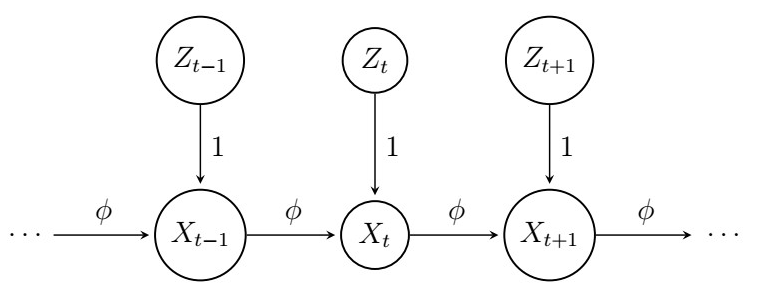
Dependence graph of the AR(1) process

Let’s see the definition of the AR(1):

Then the AR(1) process satisfies
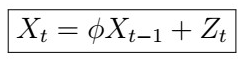
You can think of this process as follows: the value of the present observation has some dependence on the present noise and some portion of the previous time step value, but not on values further. Inspecting the mean and variance, we can easily see that
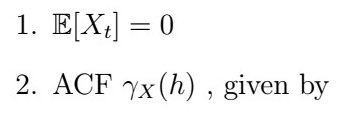
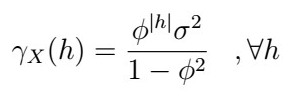
Wait, what? That’s not obvious at all! Let’s see why this is true. If we take the expectation, we have
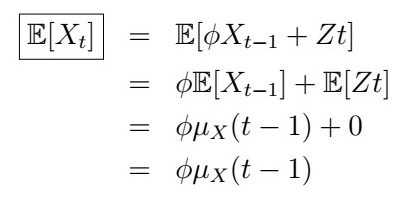
However, in order for X_t to be stationary, this can only be true if the mean is zero, that is

For the ACV (autocovariance), consider the lag h=0 (i.e. the variance)
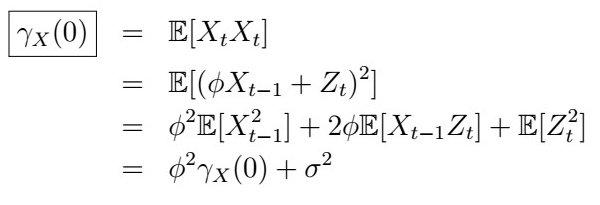
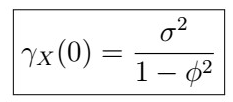
Solving for the ACV(0), we have that
When h is not 0, it follows that
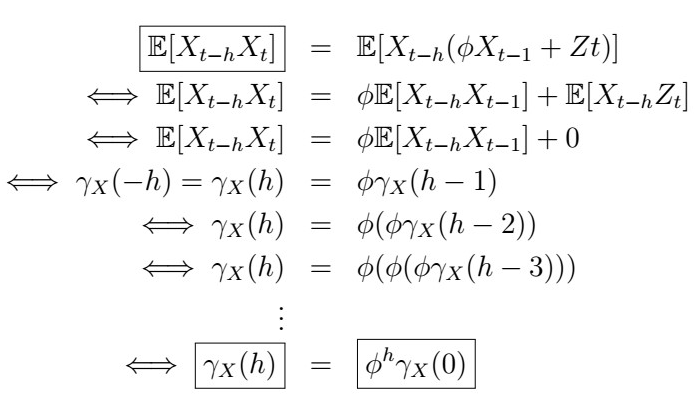
Note that sometimes we are using “+h” and others, “-h”. These are equivalent; we will see later that the ACV function is symmetric, that is, ACV(h)=ACV(-h). Plugging back what we had before,
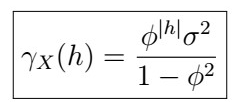
What a cool formula! Further, you can verify using the definition that the autocorrelation is given by
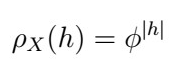
Notice something? If the absolute value of phi is more than 1, the correlation will only become worse as the lag increases! Contrarily, this tells us that if phi is less than 1 in absolute value, the autocorrelation will decrease exponentially the further the lag.

How to R

Let’s simulate some AR(1) data with phi=0.7 X:

First, we set up the true AR(1) coefficient to 0.7, then we compressed this into a list object. We set ma=NULL because we want to create an AR(1) process. Then, we pass this to thearima.sim function to generate 600 observations using the model. We can now inspect both the data plot and the ACF plot as follows:
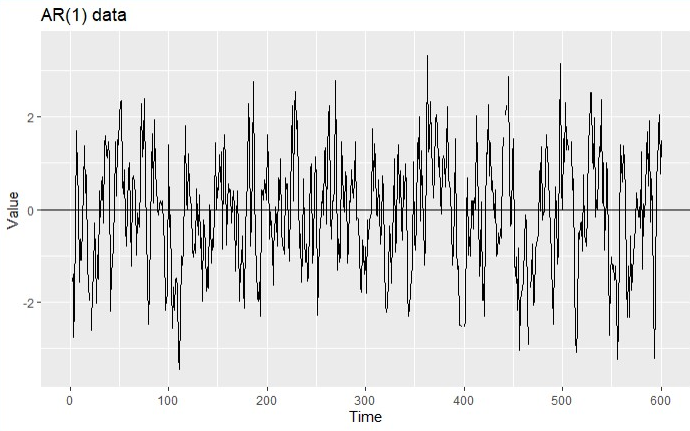
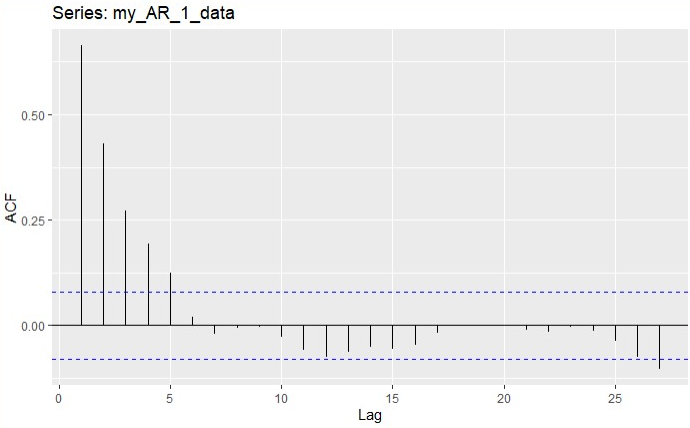
We can see that the process is indeed mean zero, and that the ACF decreases exponentially in h. Although it appears to increase a bit at lags 10 and 25, it mostly stays within the bounds.

Next time

We will continue next time with another important process: the moving average MA(1) process, along with its expectation, ACV function and cool R visualizations like these ones :)

Previous article

Stationary Processes II

Main page

https://readmedium.com/a-complete-introduction-to-time-series-analysis-with-r-9882f2d44c9d

Follow me at

  1. https://www.linkedin.com/in/hair-parra-526ba19b/
  2. https://github.com/JairParra
  3. https://medium.com/@hair.parra
Timeseries
Forecasting
Machine Learning
R
Statistics
Recommended from ReadMedium