

A Complete Guide to the Science of Self-Talk
How to stop rumination, compulsive thinking, unrealistic rule-following, and negative self-talk
Listen to an interview with the author about this article on the Better Humans Podcast.
For the past five years, I’ve been obsessed with language and self-talk, and how they relate to emotion. This obsession grew out of the realization that self-talk and anxiety drove me toward a life of chronic heroin addiction. Tormented by the voices in my head, and the stories that I told myself, I was completely unaware of how they controlled my behavior.
Addiction brought me to the very edge, but I was lucky. Pounded into submission by the most painful night of my life, I received a gift. Call it what you will — a perspective shift, an awakening, or simply dumb luck — this also became the most important night of my life.
I had fought long and hard to keep my addiction alive, terrified of facing reality without drugs, but through the pain of this night, I finally surrendered. In doing so, I released my vise-like grip on the story that I had been telling myself, the one that had protected my addiction. My mind went quiet, and my new life began.
Captivated by this experience, I soon went to university to study the source of my suffering, and I am now doing a Ph.D. It was there that I met Professor Yvonne Barnes-Holmes, a wizard of a therapist, and world expert in the field of language and cognition. Yvonne has since guided me on my journey, both personally and professionally, and now we have written this article together.
A Theory of Language, Self-Talk, and Emotion
The symbolic nature of language
The arbitrary nature of language
The generative nature of language
Language as a vehicle for emotion
Change Your Self-Talk, Change Your Life
1. Reframe your self-talk
2. Challenge your self-talk
3. The power of metaphor
4. Practice self-observationConclusionA Theory of Language, Self-Talk, and Emotion
“The limits of my language are the limits of my world” — Ludwig Wittgenstein
Negative self-talk, rumination, compulsive thinking, and unrealistic rule-following are parts of most forms of human suffering. Maybe you can relate to this. One powerful explanation of why we engage in these harmful behaviors comes from relational frame theory (RFT), a novel account of language, self-talk, and emotion.
At its core, RFT argues that language and self-talk are relational in nature, where “relating” is a type of covert behavior that involves responding to one stimulus in terms of another. Take this sentence: “A seat is the same as a chair.” In this case, “seat” and “chair” are related to one another as similar. This is the simplest form of relation, but stimuli can be related in a variety of different ways.
For example, look at the sentences “Feeling sad is the opposite of feeling happy” or “Mindfulness is a type of meditation.” The latter is a hierarchical relation, where mindfulness is contained within meditation. There are also comparative (e.g., “more than” or “less than”) and spatial relations such as “Whiskey is stronger than wine” and “The chair is beside the table.”
These relationships get more complex as they are combined. For example, “Yesterday was a lousy day for me, but today is better.” In RFT, “me” denotes a self-based relation coordinating the word “me” and the actual person making the statement. This sentence also includes a temporal relation between yesterday and today, as well as a comparison relation (today is better than yesterday).
It’s important to note several things here. Some of these observations come from existing theories of language, while others are a little different.
First, in RFT, language and self-talk (i.e., thinking) are the same types of behavior. That is, they are both relational. That means that rumination, compulsive thinking, unrealistic rule-following, and negative self-talk are also all the same type of behavior.
Second, language is symbolic (i.e., it relates words to real things). For example, the word “seat” is something we have chosen to represent an actual seat. Thus, the word and the object are relationally coordinated, and you are reinforcing that coordination when you use the word “seat.”
Third, language is generative. This means we can learn new relationships without being directly told, or even being aware, of them. For instance, if you know whiskey is a strong liquor, and I tell you that poitín is a type of whiskey (i.e., they are now related), what you know about whiskey will transfer to what you know about poitín, even though you have only just heard about the latter. This is a key facet of how we think and learn.
Fourth, the relational nature of language provides a vehicle for emotion. That is, emotions travel through words and thoughts. As a result, rumination, compulsive thinking, unrealistic rule-following, and negative self-talk — all forms of relating — are key vehicles for emotional and psychological pain.
The symbolic nature of language
Ludwig Wittgenstein was one of the most influential thinkers of the twentieth century. He produced two major pieces of work, both of which had an enormous impact on the sciences, and still do to this day.
His first work, the Tractatus Logico-Philosophocus, addressed a central problem in both philosophy and science: how language and thought are related to reality. He proposed that for thoughts and language to make sense, they must be represented in the form of pictures—an objective reality, if you will.

In the photograph above, there is a man sitting in a chair with a table between his legs. There is a book on his head and a ladder leaning against the wall.
Each of the statements in these sentences can be represented in reality and therefore be made to make sense. That is, when you hear the words of these sentences, you can paint a picture of what they are describing in your mind. It is this relationship — between words and reality — that underpins the symbolic nature of language. RFT is consistent with this theory but sheds greater light on how objects, pictures, and words are related.
RFT also aligns with Wittgenstein’s later work, the Philosophical Investigations. In this book, Wittgenstein argues that human language is a type of social game, in which the meaning of words can only be found in their use.
The arbitrary nature of language
Language, for the most part, is arbitrary and socially defined. What does this mean? For any word, someone at some point in history made it up and gave it a specific meaning. Did you ever wonder why the word “window” refers to the thing you look out of and not to a dog instead?
This is true of all words. They might have evolved differently in other languages, but at some point in time, words were simply plucked out of thin air.
There’s another level on which language is arbitrary. Think of how the word “table” resembles an actual table. You can’t, of course, because there is simply no resemblance between the word and the object. The relationship is completely arbitrary because the spoken or written word “table” looks nothing like a table. That’s why we say that language is symbolic.
It’s this arbitrariness that’s believed to be the reason why animals can’t think in the same way humans do. Animals (and nonverbal humans) can only relate stimuli based on their physical properties; they cannot relate them as arbitrary entities.

The generative nature of language
When children are about two years old, psychologists and linguists often talk about a language burst. This occurs when children begin using new words and sentences that were never directly learned seemingly out of nowhere. A common manifestation of this phenomenon is children’s use of bad grammar. For example, it’s not unusual for toddlers to use words and phrases like “mouses,” “I runned,” and “I gived,” which they would not have learned from adults (well, I hope not, anyway).
We can think of this as an illustration of the generative nature of language. But while this aspect of language is crucial for our development, our ability to generate relations so quickly also has a downside.
Imagine you meet the man/woman of your dreams. For argument’s sake, we’ll say it’s a man called Bill. Your whole body flutters at just the sound of his name. Then along comes a friend who tells you that Bill was seen leaving your best friend’s house in the middle of the night. All of a sudden, your heart is in your throat, and your mind is filled with uncertainty, worry, and anger.
How did this happen? Through the generativity of language. In simple terms, your friend created a relation between Bill and your best friend, and your mind added relations to deception, lost love, and a lack of future. But remember, you never even saw this apparent “cheating,” and neither did your friend, so you don’t even know if it happened. This is the dark side of language, and it reveals how its generative nature can cause emotional pain.
Language as a vehicle for emotion
From this cheating example, you can see how language is a vehicle for many of our emotional experiences. RFT provides a novel way of explaining how this process works, an explanation that is fully supported by scientific data.
When stimuli are related, they acquire each other’s corresponding psychological properties. For example, if you like oranges, and you’re told that clementines are like oranges, the psychological properties of “liking” will transfer to the clementines.
Research also shows how this process operates at a biological level. If you salivate when you think of a lemon, and I tell you that a “something” is like a lemon, you will salivate when you encounter the “something” because you now relate it with a lemon. You couldn’t stop yourself from responding like this even if you tried. Just like relating, this transfer of psychological properties often occurs totally outside of your awareness.
To illustrate this more clearly, consider my own personal experiences when I was addicted to heroin. Through arbitrary relations, the spoken word “heroin” held many of the same psychological properties as an actual bag of heroin. Even during severe withdrawal, by simply hearing I was about to get a fix, my functioning would dramatically improve.
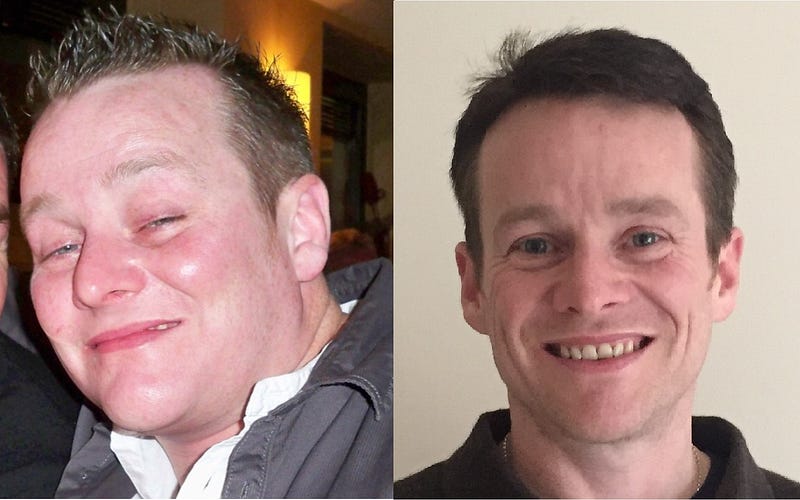
On one occasion, I remember feeling fine until I realized I had forgotten to take my methadone. Within seconds, my stomach was upset, I had begun to shiver, and sweat was streaming down my cold body.
Change Your Self-Talk, Change Your Life
“I am, by calling, a dealer in words; and words are, of course, the most powerful drug used by mankind.” —Rudyard Kipling
I was instantly taken by the science of self-talk and emotion, but one instance in particular blew me away. During my first year at college, Yvonne was head of the Psychology Department, but she soon moved to Ghent University, and we lost contact for several months. When I eventually emailed her, she asked me if I wanted to chat via Skype. As much as I wanted to, I was terrified of Skype and declined.
I had never done a video call before, but there was another reason I was fearful of it, one I was completely unaware of. How we speak, especially when talking to ourselves, is grounded in our history. That is, our decisions are reinforced by what has worked, or what has appeared to work, in the past, and this determines our future behavior. Staying out of sight had served me well in addiction, and this was driving my fear of taking part in the call. Yvonne realized this and sent me an email with a hidden intervention.
Before she had gone to Ghent, we had spent many hours in her office talking about language and emotion. These were some of the most inspiring conversations of my life, and Yvonne used them as the focus of her intervention. In what first seemed like an overly repetitive email, she linked the proposed Skype call with our previous meetings.
The email went something like this:
Hi Brian, don’t be worrying about Skype. It’s easy. It’s just like our conversations in the office. We’ll have a great chat about language and emotion and it will be fun. Skype is so simple when you think of it. It’s exactly the same as our previous meetings. It will be just like we are sitting in my office. We’ll be still face-to-face. It’s so easy. It will be great fun, exactly like our previous chats.
After reading the email, I thought to myself: “That sounds so simple. What the hell was I afraid of? I can’t wait to Skype Yvonne.”
As I stood up to put away my laptop, it hit me: “Holy shit! What the hell just happened?” In the space of a few minutes, my fear of Skype had not just vanished, but been flipped on its head. “How is this possible? Is Yvonne some kind of wizard?”
When I sat down to read the email again, I recognized what she had done. It was genius. In RFT terms, Yvonne had relationally coordinated our office chats with the proposed Skype call. As a result, the psychological properties of “easy,” “fun,” and “relaxed” were transferred over to Skype.
My self-talk had shifted, and so had my willingness to act.
This is a difficult intervention to implement on your own, and I had a wizard to help me. However, below are four techniques that can help you change your self-talk and, as a result, change how you feel and act.
1. Reframe your self-talk
“I used to think that the brain was the most wonderful organ in my body. Then I realized who was telling me this.” — Emo Philips
We all have a story, and it is written with the words we use. If you tell yourself you’re depressed, you’re going to act accordingly. If you tell yourself you suffer from anxiety, it’s likely that you will. It is therefore critical to choose your words carefully, especially when talking to yourself.
In a world full of distractions, our stories about procrastination have become particularly problematic, with many people crippled by an inability to act. I’m certainly not immune to this modern-day phenomenon, and as I sat in my kitchen writing this article, I found myself struggling with this very thing.
The sections above took me over a week to piece together. Distracted on many fronts — some important, some not — my self-talk sounded something like this: “Maybe I should start tomorrow,” “Maybe it’s best if I do X first,” “Am I hungry?,” “Oh, I’ll just check my social media first. Then I’ll get back into it.”
When this kind of internal dialogue goes unchecked, nothing gets done. When you do catch it, however, it is vital that you act. I simply switch all of the above with “Just do it,” or, if I’m feeling less motivated, I’ll say “Let’s just make a start.” Sometimes a start is all you need, and momentum will take care of the rest.
Less obvious language that can stop you taking action should also be avoided. For example, reactive words and phrases such as “I can’t,” “if only,” “I must,” or “he/she made me feel like that” should be replaced with proactive words and phrases such as “I will,” “I choose to,” and “let’s look at this another way.” This practice is empowering, and when you make the switch, even your posture will change.
In challenging situations, you should also track the questions you ask yourself. For instance, replacing “why me?” (head-based) with “what can I do about this?” (action-based) will instill in you a sense of strength, directing you toward corrective action rather than being blocked by worrying about your problems.
2. Challenge your self-talk
“The words you speak become the house you live in.” — Hafiz
I used to struggle with public speaking. For days before a presentation, I’d fill myself with all kinds of anxiety-inducing self-talk. “What if you faint on stage?” “What if you have a panic attack?” “What if you can’t stop sweating?”
What do you think happened on the day of the presentation? Damn right, I was crippled with anxiety. It was a self-fulfilling prophecy, or, as Henry Ford once said, “Whether you think you can or you think you can’t, you’re right.”
This experience is very different for me today. When irrational self-talk enters my mind, I identify and dispute it immediately. When I do this, it quickly becomes clear how irrational it is. I have never fainted in my entire life. I’ve only ever had one panic attack. And as for sweating on stage, who cares. Most people wouldn’t notice anyway, and you can always wear black.
But of course not all self-talk is irrational or off-the-wall. Before a presentation, my internal chatter might say: “This is going to be nerve-wracking,” which is often true. When this occurs, I use a form of reappraisal in which I replacing “nerve-wracking” with “exciting.” This tactic works well in many stressful situations, as it’s often our interpretation of events (i.e., the language we use to describe them) rather than the event that determines our emotions and behavior.
3. The power of metaphor
“Unless you are educated in metaphor, you are not safe to be let loose in the world.” — Robert Frost
Metaphors, which refer to one thing by mentioning another, provide an excellent tool for explaining difficult concepts. For example, when explaining how atoms work, you might say that “an electron circles around a nucleus in the same way that a planet circles around the sun.” From an RFT perspective, we are relating (as similar) a well-known entity (the solar system) to a lesser-known entity (an atom) to better describe how the latter works.
Metaphors can also be used on a psychological level to explain abstract concepts such as anxiety, acceptance, and suffering. When used correctly, the psychological properties of one reference point transfer over to the other, thus providing people with a more concrete understanding of their problems.
Here are two examples. First, a person struggling with anxiety will often try to fight back against it. But this only creates more anxiety. A great metaphor for this is a tug-of-war with an anxiety monster. You have one end of the rope, and the monster has the other. In between you, there’s a bottomless pit. You pull as hard as you can, but the monster is stronger and pulls you closer to the pit. You’re stuck. What should you do?
Drop the rope.
Yes, the monster’s still there, but you’re no longer in a struggle with him. It’s the same for anxiety. When you stop struggling, you rob it of its power.
That brings us to our second example. Many people resist change. They might genuinely want to change, especially if they’re struggling, but persist in the very behavior that caused their problems in the first place. Think, for example, of an alcoholic who continues to drink or someone with social anxiety who refuses to leave the house.
The “person in a hole” metaphor describes the situation such people encounter best:
A person aimlessly wanders into a field full of holes. Disoriented by past experiences, he falls into a big one. The sides are steep, and he can’t get out. But he’s lucky: he has a toolbox with him. Without thinking, he takes out a shovel and tries to dig himself out. This obviously doesn’t work, so he starts digging with greater intensity. But this just leaves him deeper in the hole. Feeling dejected, he gives up. Suddenly, like a blessing from the skies, a person walks by with a ladder and throws it into the hole. Finally, some luck. But what does he do? He picks up the ladder and tries to use it to dig himself out of the hole.
For individuals stuck in such situations, this metaphor can help them to better understand their problems and, hopefully, change their ways.
See this link for a list of metaphors used by therapists and a practitioner’s guide used in Acceptance and Commitment Therapy (ACT).
4. Practice self-observation
“Dialogue is about creating awareness through self-observation; it starts from the inside out, not the outside in.” —Oli Anderson
Instead of trying to change how you think, sometimes it’s best to practice self-observation. This simply means mindfully observing how you think and feel.
For example, if I asked you to observe your bodily sensations, you might take a step back and focus on a specific area, such as your breath. If I asked you what you were thinking (i.e., about your self-talk), you could observe this too. You might be planning for the week ahead, worrying about money, or doing something else; regardless of what this internal chatter might be, it’s possible to take a step back and observe it. It’s the same for feelings. If I asked you how you felt, you could take a step back and observe this.
The point is, you can take an observer’s perspective of your self-talk, feelings, and bodily sensations. However, when you do this, you must simply observe, without engaging. Like the blue sky watching clouds drift by or the person on the riverbank watching the leaves float past, you watch your thoughts come and go, without engaging in them. This is important. Be the blue sky. Be the observer.
When you practice self-observation regularly, you will create a sense of detachment from challenging self-talk and emotions, and when they do arise, they will no longer consume you.
Conclusion
Self-talk is powerful. It has a huge impact on how you act and feel.
If you tell yourself that you will suffer, it’s likely that you will. The same is true of many of your psychological experiences.
But you don’t have to suffer. If you want to change how you act and feel, you do have a choice. You can reframe your self-talk. You can challenge your self-talk. You can use metaphors to better understand how you think, act, and feel. And you can mindfully observe your self-talk and accept how you feel, rather than engaging with it.
By practising these techniques, self-talk will lose its potency, and it will no longer consume you.
Listen to an interview with the author about this article on the Better Humans Podcast.
👉The Better Humans publication is a part of a network of personal development tools. For daily inspiration and insight, subscribe to our newsletter, and for your most important goals, find a personal coach.👈


