
A Coalition of Chimps Killed Infant Gorillas: Why Researchers Must Stop Playing “Prime Directive” in the Wild
We are not living in the Star Trek Universe.
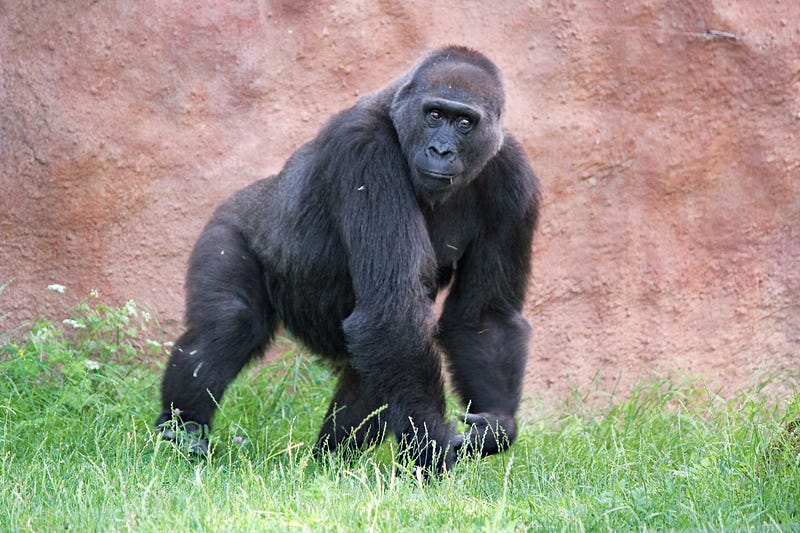
Twice in the past two years, a coalition of chimpanzees (pan troglodytes troglodytes) attacked a group of western lowland gorillas (gorilla gorilla gorilla) and killed two infant gorillas. They ate one.
You read right: a group of chimps planned and killed infant gorillas.
I am outraged. We all should be outraged.
This should be a bigger news event than it has been. It’s the first time researchers have witnessed chimps attacking and killing gorillas. CNN, Livescience, and a handful of other papers carried small stories about this first-ever interspecies murder.
The July 2021 article in Nature recounted the live research that witnessed this startling and horrific event. There were two recorded attacks, lasting 52 and 79 minutes. In the second attack, there were 27 chimps and just 5 gorillas.
But why didn’t the researches intercede and stop this attack? What could you possibly need to learn from allowing one species of hominid to kill another?
Humans have easy means to disrupt an attack of this sort, a shotgun blast to the air or an airhorn, To not intercede is entirely shameful.
There are plenty of issues in this world to get outraged about: the Taliban takeover of Afghanistan; the earthquake in Haiti; America’s response to COVID-19, including the vocal unvaccinated, the Delta variant, and the mask mandate controversies.
But chimps killing gorillas for the first time really boils my blood.
According to the Smithsonian’s National Zoo & Conservation Biology Institute website, Western lowland gorillas are a peaceful species. native to the Congo basin. Their primary predators are humans, leopards, and crocodiles.
On the Conservation Status scale, critically endangered is one step above “Extinct in the wild.”
So as humans, we must do everything possible not to let this beautiful and peaceful species become extinct. We must go to extraordinary lengths to reverse decades and centuries of human mismanagement of the earth and ecosystems.
You don’t sit back and watch one species slaughter the babies of another.
Look, we don’t allow hunters to shoot California Condors. We do our best to stop whalers from depleting the earth of its largest mammals. We stop the gross and illegal slaughter of sharks for their fins. There are so many protected species, mostly because humans have encroached on animal lands, changing how animals behave in order to survive. Animals become aggressive when they need to find food.
The researchers suggest that predation or competition for food brought on by climate change could account for the aggressive behavior of the chimps. And just who is responsible for climate change?
Our world is coming apart at the seams, as witnessed by the recent IPCC report and the incontrovertible fact that human activity is causing/has caused climate change.
We are the top of the food chain. We are destroying the world.
This is not some giant science experiment. We are not the Starship Enterprise seeking out new life. We are not under orders of the prime directive of noninterference.
Plain and simple — the researchers could have and should have stopped the attack.
If a dog comes into your yard intent on killing your cat, you would stop it, and you would be right in stopping it. Even though it’s the nature of that dog, perhaps, to want to chase and even to maybe want to kill the cat, you will protect your cat from that dog. Not all dogs are cat killers, and I don’t mean to malign any well-intentioned, peaceful chimps.
As an academic, I’m well aware of the observer’s paradox. But the least we can do is suspend the idiotic premise of reportorial and documentarian objectivity and intercede when we can, especially when it can stop one species from murdering another.
Lee G. Hornbrook taught college English for 25 years and is the editor of The Writing Prof. Subscribe via email. Sign up for his 5-day free course on The Writing Process.


