
A Closer Look at Albert Einstein’s Ph.D. Thesis
“Logic will get you from A to B, imagination takes you everywhere”
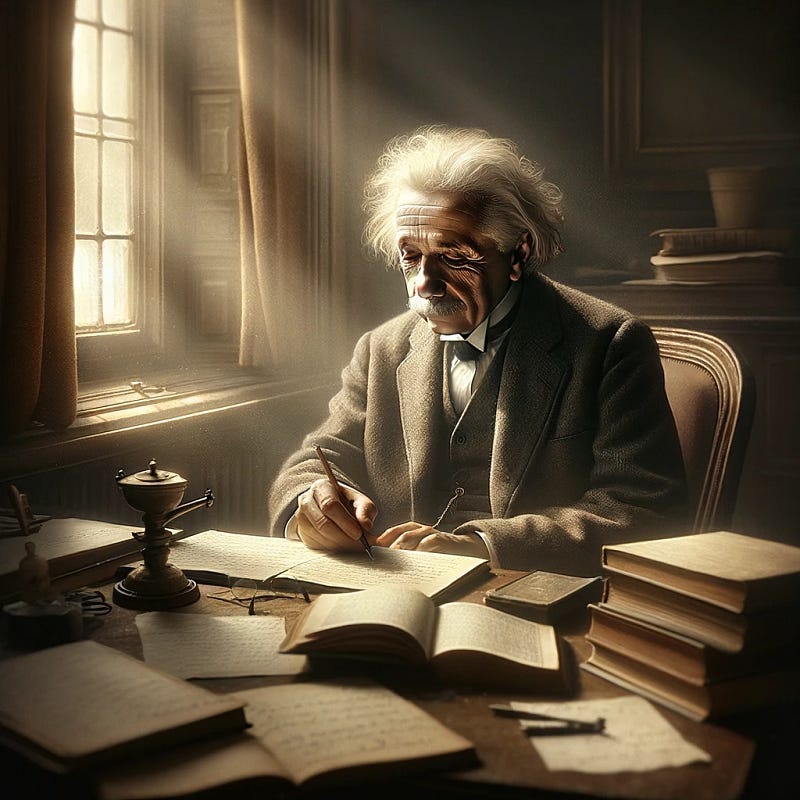
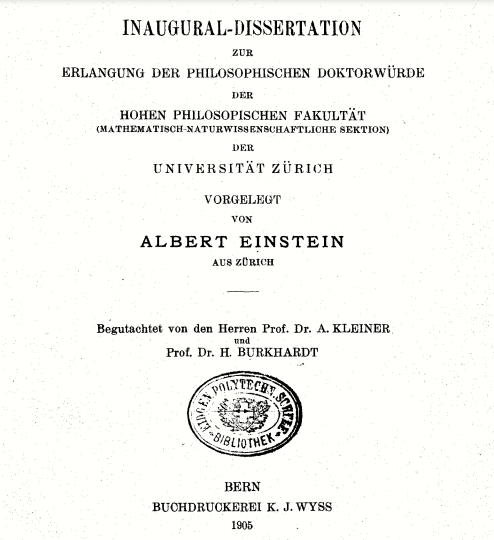
Einstein completed his Ph.D. thesis in 1905 with Professor Alfred Kleiner, who was an experimental physicist at the University of Zürich. He was awarded a doctorate degree with the dissertation entitled “A New Determination of Molecular Dimensions.’’ It was not the same institute from where Einstein completed his previous degree, it was ETH, and ETH was not allowed to award PhDs at that time. Until 1909, their students were authorized to submit their dissertations to the University of Zürich.
The year 1905 was known to be the annus mirabilis means “marvelous year” of Albert Einstein’s life. That year he successfully published four groundbreaking research papers that reshaped the scope of the subject. One of them was on the photoelectric effect which made him achieve the Nobel Prize in physics in 1921. The others were on Brownian motion, special relativity, and the one in which he introduced the equivalence of mass and energy i.e E=mc².
All of his efforts provided him with the attention of academic society at such a young age. Moreover, his fifth paper became his Ph.D. thesis. The first four research papers attained widespread attention but unfortunately, his doctoral thesis was not considerably appreciated in the early years. So I decided to write about it to have a bit of insight into it today.
Einstein’s thesis was printed in Bern, on the 30th of April 1905. The interesting fact about his thesis is that it was a calculational work of 24 pages, which is too short for today’s doctorate degree.
In his research, he was trying to explore a new theoretical method to calculate the molecular size/radii. Moreover, he presented the value of Avogadro’s number from the viscosity data for the solution of sugar dissolved in water and the experimental diffusion rate. Though the estimate came out wrong with a factor of nearly 3, after a few attempts he came closer to the presently known value.
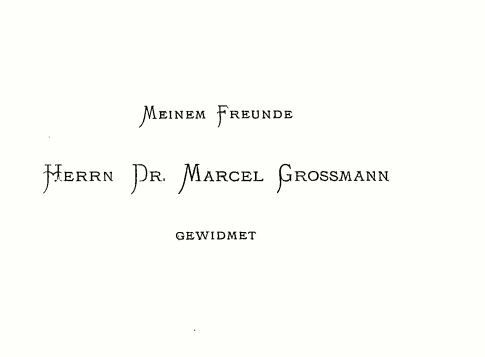
Einstein chose to dedicate his work to one of his close friends Marcel Grossmann. He was a skillful mathematician who helped Einstein by providing his course notes whenever Einstein skipped classes. Moreover, he was also credited with recommending Einstein for the job at the patent office with his father’s assistance. Einstein was really grateful to him because he thoroughly helped Einstein in his difficult times as a genuine friend.
The main part of the thesis involved hydrodynamics and the relation between coefficients of viscosity. To perform the calculations, he considered the stationary flow of a homogenous and incompressible fluid. By neglecting the effects of acceleration he made use of the Navier-Stokes equations to describe the motion of the fluid, which is given below

where ν, p, and η are the velocity, hydrostatic pressure, and the viscosity of the fluid respectively.
The next step is to suspend a large number of identical spherical particles in the liquid. The total volume of particles was taken smaller than the volume of fluid. Then he made several suitable assumptions like no external forces are influencing, the particles are not affected by the movement of other particles, hydrodynamic stresses are applicable on the surface only for the particles, and the boundary condition of the flow velocity is taken zero on the surface of the spheres.
Einstein then indicated that the flow can still be described by the above equation with a different value of η. It was then replaced by a new factor known as the ‘effective viscosity’ η*, which is given by

here ‘φ’ is the proportion of the unit volume occupied by spherical particles. Then he made use of the following relation
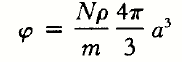
which connects N with a. Here ’N’ is Avogadro’s number, ‘a’ is the radius of a molecule, ‘m’ is the weight of a molecule, and ‘ρ’ is the mass of the solute per unit volume.
After that, by making use of the available data Einstein quoted:
“One gram of sugar dissolved in water has the same effect on the coefficient of viscosity as do small suspended rigid spheres of a total volume of 0.98 cm3.”
Furthermore, he extracted an amazing formula for the diffusion constant of suspended spherical particles by making use of Van’t Hoff’s law for the osmotic pressure and Stokes’ law for the mobility of a particle.
He then applied these results to the solution of sugar dissolved in water and successfully obtained a nearby value of Avogadro’s number and an estimation of the radii of sugar molecules.

A few years later in 1909, a French physicist Jean Perrin independently estimated a significantly different value for Avogadro’s number with the careful evaluation of Brownian motion.
Einstein then introduced his hydrodynamical approach to Perrin. A student of Perrin named Jacques Bancelin checked Einstein’s calculations mindfully and pointed to a discrepancy in his viscosity formula.
On 27 December 1910, Einstein contacted his ex-collaborator Ludwig Hopf from Zürich and told him about this confusion.
He wrote:-
“I have checked my previous calculations and arguments and found no error in them. You would be doing a great service in this matter if you would carefully recheck my investigation. Either there is an error in the work, or the volume of Perrin’s suspended substance in the suspended state is greater than Perrin believes.”
Hopf too pointed to an error in the differentiation technique. Einstein then realized and modified his thesis work. He published the correction in his thesis through a magazine article in 1911 with the assistance of Paul Drude the editor of Annalen der Physik. In this alteration, Einstein wrote 18 pages of calculations and estimated Avogadro’s number to be N = 4.15 x 10²³.
After a few years, Einstein’s second attempt was proved wrong again by a factor of nearly 1.5 from the results of the experimental work. Einstein made the third attempt at correction with the help of a friend with the availability of better data on sugar solutions. This time, the obtained value was N = 6.56 x 10²³, which was not so bad.
Now there are other accurate techniques to derive the presently known value of Avogadro’s number, which is N = 6.022 x 10²³. Moreover, the modern experimental data for sugar solutions excellently provide the same value.
“A precise determination of the size of molecules seems to me of the highest importance because Planck’s radiation formula can be tested more precisely through such a determination than through measurements on radiation.”
Dr. Kleiner, his dissertation advisor, who was among the two faculty reviewers, judged his work with a positive perspective.
He remarked:
“The arguments and calculations to be carried out are among the most difficult ones in hydrodynamics, and only a person possessing perspicacity and training in the handling of mathematical and physical problems could dare to tackle them, and it seems to me that Mr. Einstein has proved that he is capable of working successfully on scientific problems. I would therefore recommend that the dissertation be accepted.”
Dr. Kleiner then sought another expert review by one of his colleagues Heinrich Burkhardt who was a mathematics professor at the University.
“The mode of treatment demonstrates fundamental mastery of the relevant mathematical methods. What I checked, I found to be correct without exception.”
Interestingly, in his biography, titled ‘ Albert Einstein: A Documentary Biography’ by Carl Seelig, it was written: “Einstein later laughingly recounted that his dissertation was first returned by Kleiner with the comment that it was too short. After he had added a single sentence, it was accepted without further comment.”
From some of the letters to his wife Mileva Marić, it can be inferred that Einstein had discussions on a diverse range of ideas with Professor Kleiner. Also, Einstein tried submitting a copy of his dissertation four years earlier, probably in 1901, but that didn’t survive because it was not clear and complete.
Einstein then withdrew his dissertation three months later. After that, he somehow lost the motivation to complete his doctorate. He once wrote to his best friend Michele Besso sorrowfully: “As this doesn’t help me much the whole comedy has become tiresome for me”. But appreciably, he seemed to have changed his mind by the next year.
Thus, it can be stated with precision that Einstein obtained his doctorate for his paper “A New Determination of Molecular Dimensions”. The revised version of this paper became so popular that it was rated among his most cited research papers.
This research was found to have more extensive practical applications than any other work by Albert Einstein. Apart from some fundamental results, he derived in his thesis, there exist other reasons also to classify this paper as unusual.
The important patterns of scientific reference can be traced through the study of citations. Four of the articles by Einstein were most cited between 1961 and 1975, among which his thesis or, rather, the 1906 paper ranked first. That was equivalent to four times as often as his paper on the general theory of relativity, which made him prominent. The Brownian motion paper was ranked third.
Certainly, relative citation frequencies are of less importance. Because who would not yearn to write a foundational paper that will soon be known to everyone and yet cited by a very few, comparatively? Just like the paper about the introduction of a very basic concept of gravity.
Therefore, the fact that even Albert Einstein’s thesis was not perfect is an encouragement to all the hard-working graduate students around the globe. Those who struggle for such a long time under crushing pressure and are expected to produce a huge dissertation book comprising 200 to 300 pages.
A copy of Einstein’s dissertation is present in ETH’s research collection, also it is attached here in the German language.
Thank you for reading this story and see you again. Feel free to leave a comment if you have any thoughts, feedback, or suggestions about it!
If you’d like to show your appreciation, give this story a maximum number of claps, or else, you can treat me to a cup of coffee ☕️🙂.


