
A city designed for the automobile
The automobile has enabled humans to travel all the time whether for long or short distances for different reasons such as going to work, sightseeing, for trades, leisure or to migrate. In a way, the automobile pushes us to move at any distance. It prompts us to travel any distance.
Today, in all metropolitan areas of the world, the automobile problem and its impact on urban societies have become a major problem whether for sparsely populated cities like Los Angeles or more densely populated ones like Manila or Bangkok in developing countries.
The automobile took off in the 1920s and 1930s in the United States. In 1910, Los Angeles County had 20,000 cars and this number has increased enormously over the years with 100,000 cars in 1920 and 800,000 cars in 1930.
We can compare the State of California, with other states at the beginning of the twentieth century which had one automobile for every 4 inhabitants in 1924, the State of Texas owned, in the same year, one automobile for every 9 inhabitants and the United Kingdom, which was the most motorized European State in Europe, had one car per 100 inhabitants. Four years later, in 1928, California had one automobile for 2.25 people. In general terms, California was ahead of its time for the democratization of the automobile and Los Angeles is the symbol of the latter. The car is a sign of success, individual freedom, and progress that is part of human life. The automobile is “an outward sign of wealth” and the type of car can reflect the social rank of the individual.
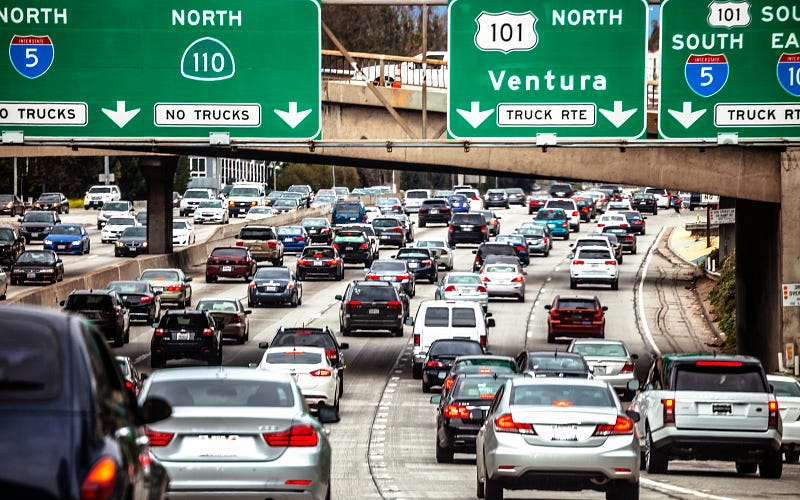
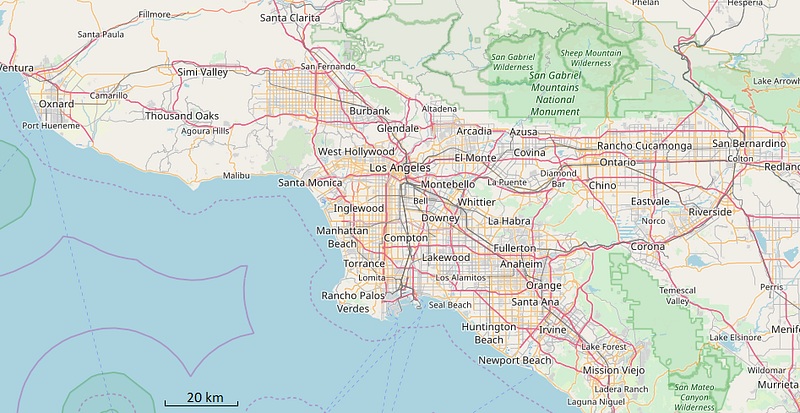
Los Angeles is huge, made up of countless roads that shape its urban planning (picture 1). It is a city made “by and for the car” which is a symbol of modern urbanism which has allowed the perpetual expansion of cities to become wider that has reshaped the scale of “space-time”. The Californian city became a synonym for the automobile during the 20th century. At one time, the tramway network in the Downtown district was gradually replaced by bitumen because, in the 1920s, the inhabitants did not accept the densification of urban planning and the only solution to make these tramway investments profitable was to cover those tram lines with bitumen. So, the people of Los Angeles have chosen urban sprawl and private transportation movements, i.e. the automobile.
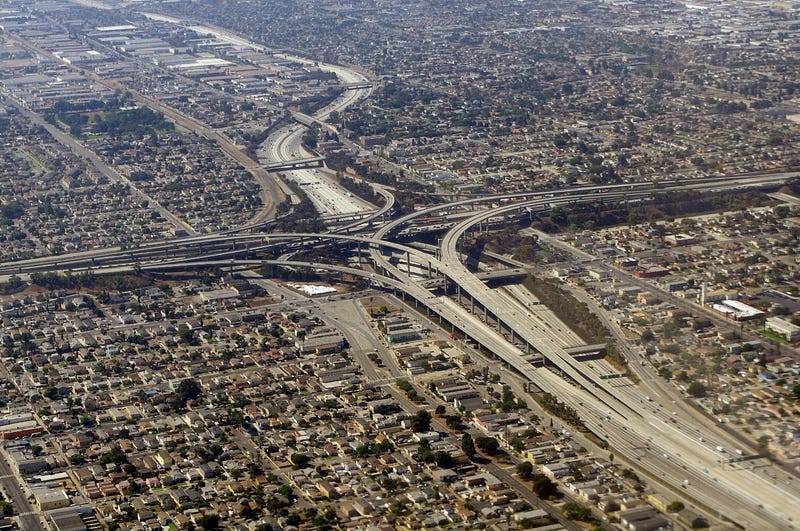
Los Angeles is flooded with highways that are very wide and can have up to eight lanes, with freeway interchanges and ramps (image 2) which can rise on several floors and this highlights an extremely dense road and highway network in which “the car reigns supreme”.
What is interesting is that some of these highways are displayed with a blue and red coat of arms followed by a number with the letter “I” preceding them. This letter “I” corresponds to the word Interstate, which means that the Federal State of the United States was responsible for financing the construction of these road networks.
In a way, the Federal government’s investment has favored the urban expansion of Los Angeles so LA took advantage of it as shown by the large network of highways throughout the Los Angeles metropolitan area.
The car is the second home for Los Angeles residents due to a large number of trips that are made and the time we stay in the incessant traffic jams. The car is so deeply rooted in the urban landscape and mentalities that envisioning a post-automobile era in Los Angeles is impossible.
These highways are an “identifiable place, a state of mind and a complete way of life”.
It is not a question of eliminating cars but of profiting from them in another way, finding another place for the automobile in everyday life. Thus, a study should be made of “a city balanced between the possibility of pleasant urban life and reasonable automobile use”.
The problem is that the car is closely related to Los Angeles, all city trips are done by car, this is not a place made for walking.
As an article in the monthly scientific journal Smithsonian says, “Nobody walks in L.A” as the city is known to be hostile to pedestrians. The author of the article shares his experience in Los Angeles where he moved to and mentions that a one-bedroom apartment in Los Angeles does not have a refrigerator but is, however, equipped with a parking space in which the building manager retorts that they only “provide the essential”. Thus, the automobile is paramount in the life of Angeleno people, it’s part of Angelenos’ identity. Los Angeles is a “car city”.
Let’s look at the 2035 mobility plan data and information provided by the Los Angeles Department of Urban Planning.
With an area of 1,214.03 km2 and 4 million inhabitants, there are 12,070 km of streets, 60% of which are “local” streets, and 40% “arterial and collector” streets. 224 km2 of the surface is occupied by streets, there are 17,300 km of sidewalks, 42% of which are in poor condition, 1,287 km of narrow streets, and 291 km of highways. There are 40,000 intersections, 22,000 pedestrian crossings, 4,398 traffic signs, and 38,011 parking meters on all this pile of asphalt.
121,022,668 km are traveled every day in Los Angeles, of which 53% on highways and 47% on streets.
Moreover, in 1970, more than 1/3 of the Los Angeles area was dedicated to automobiles in streets, highways, and parking spaces.
One of the major consequences of using the vehicle is the congestion that plagues the entire Los Angeles area.
Thus, with an average of 102 hours spent in traffic jams for each inhabitant during the year of 2017, Los Angeles is the most congested city in the world for six years in a row and so of all the United States (According to INRIX Global Traffic Scorecard). L.A is still highly ranked for traffic jams today.
This traffic jam affects the quality of life, economic competitiveness, safe driving, social justice, and air quality.
According to these analyses, 12% of the total driving time is spent in traffic jams but these traffic jams have a cost to the driver, $2,828 is the total cost for each driver and $19.2 billion in direct and indirect costs to the city in 2017. Direct costs are the value of fuel and time lost, while indirect costs relate to the transportation and business costs of company vehicles that are immobilized in road traffic and which are reflected in households’ budgets through higher prices.
We can even say that Los Angeles invented the concept of rush hours that symbolizes it so much. Being the most congested in the world, Angeleno traffic jams are the very definition of hell. Besides, $9,122 is the average annual cost that an Angeleno resident spends on his/her car and Angeleno households spend between 15% and 20% of their income in transportation. But cars have drawbacks. They are expensive to buy. They cost thousands of dollars a year to operate, weighing down a household budget. And they depreciate.
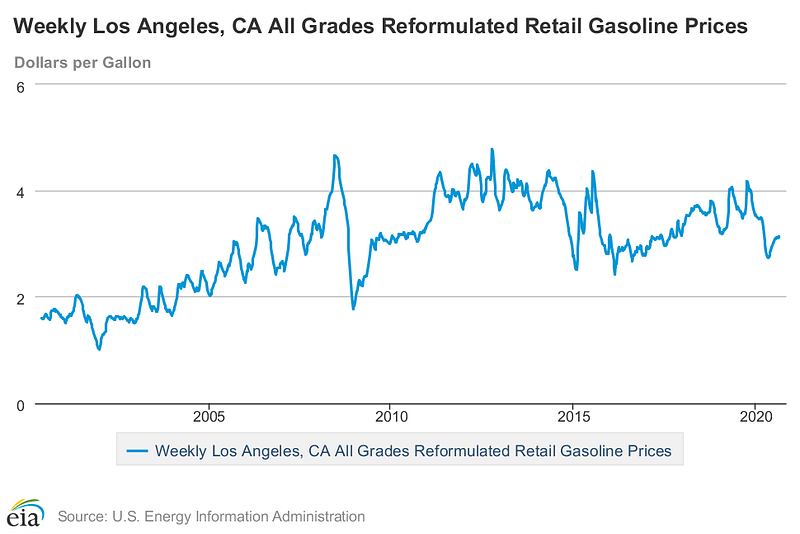
If we refer to the graph in image 3, the price of gasoline in Los Angeles varies quite often during the period 2000–2020, going from $ 1,592/gallon inJune 2000 to $ 3,313/gallon in August 2020. The price has increased during these years but remains below $1 per liter today with peaks of rising and fall in price. In a way, the price of gasoline, which is relatively low and was even very low some years before, makes it easier to take the car for traveling around the town. Even though the price has increased, this is not a factor in reducing vehicle use or reducing endless traffic jams. The Los Angeles designed for the car has not only resulted in traffic jams but also the frequent occurrence of smog that covers the entire Californian city.
But that, we’ll see it in another article.