
Leadership / Personal Growth
A Child’s Death Is My Earth Rod
Leadership: Don’t ever believe your own press releases

I looked up from my computer, aware of someone hovering in my office doorway. The office cleaner was obsequiously bobbing from foot to foot, looking at a spot on the floor.
As general manager my corner office was huge, disproportionate to the size of the business and importance of the role. She crossed the expanse of floor to my desk avoiding eye contact all the way, passing over a scrap of paper with that odd gesture of respect of touching her unused hand to the elbow of the outstretched arm.
She smiled shyly, bobbed her head and backed away a few steps before leaving the office.
Two years in I was accustomed to the routines and rituals in this role. I worked with 120 Zulu and Afrikaans employees across two businesses based in South Africa and Mozambique. I was 38 in January 2003, my MBA barely 2-years old. Three years of study hadn’t prepared me culturally for this position; my previous operations manager roles all based in Australasian countries.
High power-distance relationships¹ were accepted in the country, creating subordinate dependence on those in positions of authority; a situation antithetical to my Kiwi upbringing. At my ripe old age (!) I was sought for life advice, support and intervention by people in their 50s and 60s who had endured dreadful hardship during the worst years of South African apartheid. People who, despite my protestations, called me General or Sir when they spoke to me; a gesture of acknowledgement and respect for my position.
Life was hard in South Africa even for those lucky enough to work. It was not uncommon for employees to leave home at 4a.m for a dangerous journey. They would walk, catch buses, transfer to vans, back to walking again then finally arrive at work for an 8 a.m start. Some were attacked on the way for their meagre possessions and turned up at work stabbed or beaten — many carried weapons for self-defence. They would do manual work through the heat of the day before reversing the trip in the evening, arriving home at 10 or 11 p.m. Unskilled workers earned less than US$50 a month with statistics showing one salary supported 10 dependants.
Small wonder low paid employees approached the company for loans to get them through hard times. If the employee had sufficient ‘collateral’ in annual leave and sick leave I advanced them the sum needed and subtracted a small amount from their pay each month until repaid. When I felt unable to risk the company’s money due to a lack of collateral I personally loaned them the money.
During 3.5-years in the role no one defaulted on their borrowing. Ever.
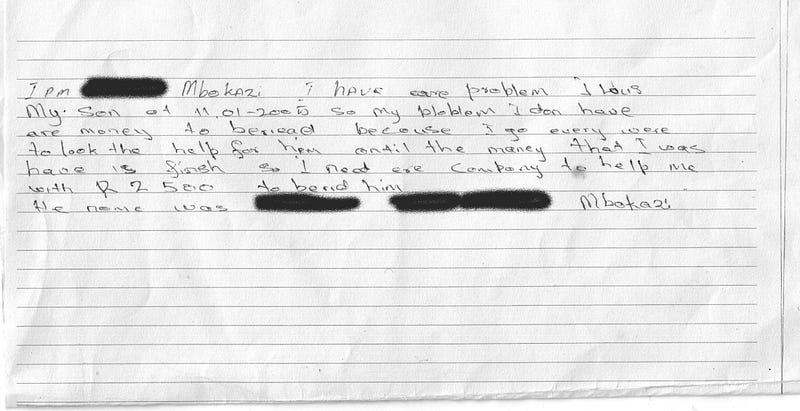
Unfolding the scrap of paper, I struggled to make sense of the words hand written in black ink. It was from one of the workshop employees; for this article and his anonymity I will change his first name, calling him Sifiso Mbokazi.
Painstakingly written, it was short and to the point. Sifiso needed money; the note mentioned his son and hospital. He had misspelled two words I couldn’t place.
During my time in South Africa I was amazed at the private health system. Known as a destination of choice for ‘medical holidays’ one could rest in the sun with a choice of voluntary medical procedure, recovering in the comfort of a resort while bruising and visible evidence subsided before heading home. As an expatriate it was inconceivable to not have private health cover and from the few times I needed the private health system, I can attest to its outstanding qualities. Modern, technologically advanced, efficient, I’d back it against any health system in the world, bar none.
The public health system was a different matter. Starved of resources I was warned to avoid it. I do recall an employee going into hospital with a fractured arm. They never returned to work and I was told they had died having never left the hospital.
It transpired Sofiso’s young son had been HIV positive. Mother to child transmission of HIV was a common problem then.
As the boy’s illness worsened, Sifiso did what all parents would do in a similar situation. He left no stone unturned in a quest for his child’s remission. I imagine the measures undertaken by a desperate family as their little boy quietly removed himself from their lives. For a worker on Sifiso’s wage anti retro-viral access was almost impossible. Sifiso’s money ran out and his son died.
It seems the words I couldn’t read on the note were meant to be ‘lost’ and ‘bury’.
It’s easy to disconnect from human tragedy if we maintain it as something abstract. Witness the rhetoric today from those who demonise asylum seekers or are blasé about deaths in custody. The citizens during the COVID-19 lock-down who believed their personal rights or freedoms trumped the rights of the elderly, the disabled, the immune-compromised who the rest of us tried to protect by staying at home and isolating ourselves. As we’ve seen throughout history, when we make people faceless or bad, atrocious behaviour can be explained, excused, accepted and defended.
The poignancy of the note making it hard for abstraction was not the loan request but the reason he needed it. The undertaker was refusing to release the boys body for burial until paid in advance. They wanted 2,500 Rand, about US$135. Two and a half months salary for someone like Sifiso.
Imagine the grief of the family in losing their son, add to that the despair of not having any money left to bury him and finally the humiliation of having to ask your young white boss if he would lend you the money. Money which, if granted, you would need to spend months paying back. I imagine the family waiting for Sofiso to return that evening with my decision.
The kicker however was the simple last line. He wrote out his son’s full name.
His son had existed.
He was a person.
He was loved.
I can only imagine the pride, love and intense grief as he wrote these words.
40-years in the workforce and I am a very different person now from when I began. I emerged from my MBA as a wannabe leader of the universe. Spouting nonsense about globalisation and laughing when arrogant business people smirked while making facile, moronic bumper-sticker statements like “The harder I work, the luckier I get”.
When I hear those words today I think of people like Sofiso. They will spend the rest of their lives working hard and I doubt life will bestow them much ‘luck’.
In those first few years I strutted the world in business class convinced of my right to special treatment, glorying in my status and power.
Hubris writ large.
I cringe inwardly at the memory.
My work allows me to live and/or work in many countries; along the way I’ve collected the lessons, the scars, the insight and stories which have become a part of who I am. They shaped me and they continue to do so. I am a very different person today.
Thankfully.
As I read Sifiso’s letter the pathos of the moment returns and I am humbled. I am reminded of both how lucky my life is in comparison and of the precious gift people give you in allowing you to lead them. I recall W. B. Yeats’ poem “The Cloths of Heaven”. Written with a different meaning to a different audience I am, however, struck by the applicability of the final lines to leaders and people in power.
“…I have spread my dreams under your feet
Tread softly because you tread on my dreams“
Many quotes speak of power; two stay with me. One, which is often misattributed to Abraham Lincoln, was actually made about him in 1883 by writer and orator Roger Ingersoll and it resonates with me, particularly when I look back to realise how close I came to taking the wrong path in life and career. Ingersoll said of Lincoln:
“If you want to find out what a man is to the bottom, give him power. Any man can stand adversity — only a great man can stand prosperity. It is the glory of Abraham Lincoln that he never abused power only on the side of mercy. [Applause]. He was a perfectly honest man. When he had power, he used it in mercy …”
The other by Friedrich Nietzsche acts as a cautionary tale:
“Not necessity, not desire — no, the love of power is the demon of men. Let them have everything — health, food, a place to live, entertainment — they are and remain unhappy and low-spirited: for the demon waits and waits and will be satisfied.”
I have learned hubris is an enemy; ever present. It blinds us to reality, creates decisions for the wrong reasons, inspiring hatred and cruelty. It belittles and destroys us, leaving the world a colder, darker place. It treads the world stage dressed up as a leadership that credulous people emulate.
It is ubiquitous, beguiling and dangerous.
Mahatma Gandhi said the following;
“We but mirror the world. All the tendencies present in the outer world are to be found in the world of our body. If we could change ourselves, the tendencies in the world would also change. As a man changes his own nature, so does the attitude of the world change towards him. This is the divine mystery supreme. A wonderful thing it is and the source of our happiness. We need not wait to see what others do.”
I’m not a great one for souvenirs. Little tangible evidence of my journeys around the world remain; just the beliefs I hold and the behaviours I strive to exhibit.
One thing I have kept. It’s a scrap of paper handed to me in an office in Kwa-Zulu Natal in 2005. Something that, even today, I am unable to take out and read without emotion. Emotion at a family’s loss; their despair and pride transmitted in a simple note. I am catapulted back in time.
Occasionally I read Sofiso’s note. Not that I can’t recall what it says, but to recapture the moment. To remind me of who I am, where I have come from. A recognition that as my power grows in any situation, so must my self awareness and my humility. When time comes that power must be exercised, I shall wield it lightly, fairly and objectively.
As in Gandhi’s quote, I strive to be the change I wish for the world. All these years later, Sofiso’s note still serves to ground and guide me.
What do you use?