
THE TALES OF SHINAAN CONTINUE: SHINAAN AND THE SEVEN SISTERS
A Chase Against Time, Part 1: Farewell, Goldstone
A disillusioned astronomer sets out to explore a different frontier, and seven mysterious women walk into a desert town…
A Quick Prologue…
The Law of Unintended Consequences is simple: If you don’t completely think the matter through, your “brilliant solution” will be worse than the problem, and the Law will bite your ass.
Despite decades of warnings from scientists of the inexorable results of human-made climate change, the problem worsened. Sea levels rose, rainfall became dangerously erratic, drought struck, and uncommon wind speeds carried wildfires to places which never faced such horror. Only when all these phenomena combine to visit havoc on the post-industrialized world did the call for action finally rise.
The governments of the Earth, even the richest among them, were bleeding financial resources on an overwhelming escalation of crime, the urges of the military-industrial complex, the imperatives of alternative energy sources, and the perennial bugaboo of overpopulation.
Thus, defaults and bankruptcy loomed. Governments turned to private industry for a solution to the crisis which that very sector created. The profit-driven corporations of the mid-21st century came up with the dubious answer: a controlled seeding of the clouds over the entire planet, coupled with geosynchronous satellites which would regulate the seeding and even — no one would discuss how, for reasons of “security” — cool the oceans to nearly the pre-crisis level, and hopefully bring the return of ice sheets and glaciers.
Yes, they were dead serious.
The corporations, holding many of the governments safely in their pockets, behaved true to form: the cheapest alternatives brought out in the fastest time frame. Nobody really thought the entire process through; one disaster replaced another.
The upshot: near-incessant rainfall along the coasts and nearby inland areas, a reduction in the already-sparse rainfall in the interior, and thus an expansion of the deserts.
The governments that didn’t collapse (e.g., the U.S.) reduced their presences and outreach, preferring to retreat to the safest areas of their lands and realign national defense against the “inevitable invaders” who would come to avail themselves of a country’s perceived weakness.
In reality, no country had any capability to assault another. The survival imperative infected every level of every society. This was the backdrop of the year 2089…
Cameron Philip Emmanuel Tarver used to believe in science.
He still did, albeit not to the panacea-level extent to which he once held. Such assurance ended the day his idol failed. One failure after another. One disaster after another.
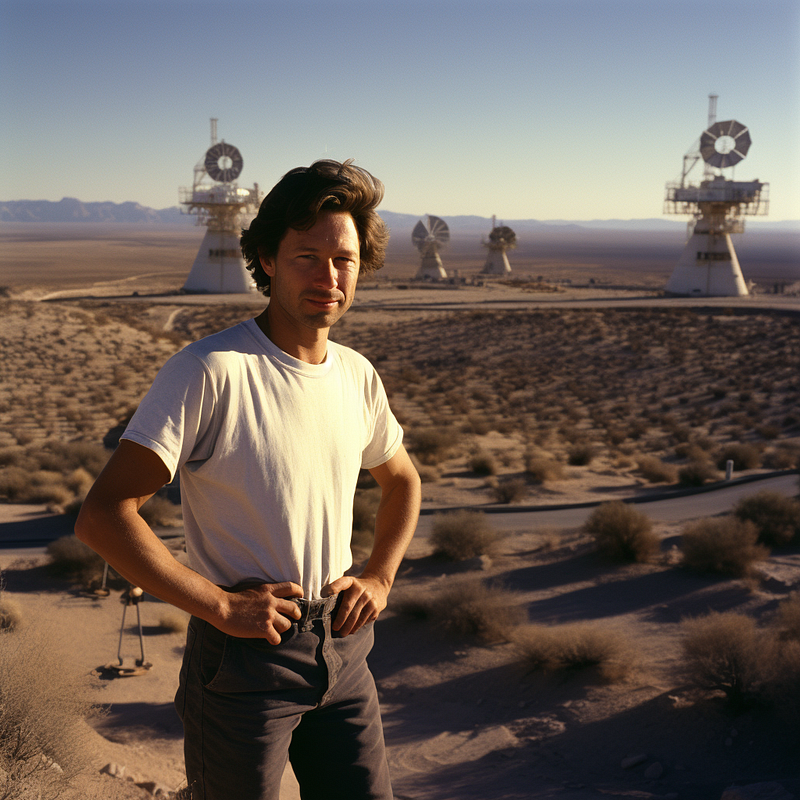
His thoughts invariably went there whenever he strode up the bluff overlooking Goldstone II. He looked out at the array of radio telescopes and advanced high-gain antennas, at one time the main node of communication with the interplanetary spacecraft, manned and otherwise, which humanity hoisted into the further reaches of the Solar System. The Primary Station, and the subsidiary stations code-named (for over one hundred years) Apollo, Echo, Mars, Venus, and Uranus, also were the primary means of communication from Armstrong Moon Base and the Mars Colony — all of which were empty.
He turned around and beheld, not for the first time, the vast Mojave Desert, its mountains jutting up out of the arid valleys, now sparsely dotted with the makeshift villages and settlements which replaced the towns of the past.
Once upon a time, I worked here. I used to be an astrophysicist. I ran the place.
He and the other fourteen scientists, engineers, and technicians who remained, still maintained the Main Station, along with Apollo and Venus. The others had to be abandoned when NASA folded. None of the private firms wanted to spend the money on them; Tarver and the teams managed to continue on a shoestring, with help from nearby Fort Irwin and parts surreptitiously spirited from the abandoned Edwards Air Force Base. The Marine Corps Logistics Base in Yermo wanted no part of it, and made that clear with weaponry and threats.
Rabid dogs on a presidential leash. A huge collective ego and delusions of invincibility. Kill whoever Daddy tells you to, and when you run out of targets, beat up on yourselves.
He turned back to the the vista of Goldstone II.
Now we’re all leaving. After living here for eight years since the seeding fiasco, everyone’s tapped out, weary of the thankless tasks. I don’t want to go, but I can’t do this shit alone.
He’d thought about it, though. Only he knew of the secret supplies of food and water, kept fresh by solar-powered appliances, stashed at the vacant and derelict Mars, Uranus, and Pioneer Stations. He tried to convince as many of his colleagues to stay as he could, alluding to the food caches while also mentioning their agreement with Fort Irwin for supplies and security.
“Cam,” one of them said the previous week, “this oddball way of living is draining, even if we had unlimited food and water and enough weapons to keep the psychos at bay. Eight men and seven women can’t go on like this without some kind of major weirdness cropping up.”
“What kind of major weirdness?” Tarver already knew the answer.
His colleague gave a look that said it all. “You know as well as I do about the open secret of polyamory around here. Passing each other around like a plate of bacon-wrapped dates. I know you’ve stayed out of it, even though that sexy sergeant at Irwin made it pretty clear she’s warm for your form.”
Tarver was not all that amused. “I’m still waiting for the ‘major weirdness’ part.”
“Two words, Cam: jealous and possessive. We’ve all gotten along swimmingly during all this, and I don’t want anyone to suddenly drown, if you catch the drift.”
Tarver was silent for a minute, maybe more, mulling over what he had just heard. The man was right; the collegial team could morph into a powder keg under these unique conditions, so it was better for all to go their own ways before the basal reflexes took over.
“I hear you,” said Tarver. “We’ve done all we can.”
For the better part of the last eighteen months they acknowledged the reality of their uselessness. The space probes they monitored were not a priority any longer. The denizens of the moon bases and the Mars colony returned home, rather than face the horrifying uncertainty of resupply and communications. As far as Goldstone II was concerned, space held no one to talk to. The upkeep of the facilities, fueled by the hope of a return to something, anything, resembling normalcy was a dead issue.
“Normal” wasn’t going to happen anytime soon. “Normal” had a plethora of new definitions which nobody wanted to ponder.
The fourteen staff people had neatly paired off with minimal disruption. They all packed what they could into rucksacks from the Army, and during that gleaning of whatever was needed was when Tarver explained the secreted food and water.
“I’m sorry I didn’t divulge any of this. It’s not that I didn’t trust any of you; I didn’t trust anyone from outside finding out about it. I kept it to myself because it was for emergencies and other unique and extraordinary events. What we’re doing now surely qualifies as the latter. I’ll dole it out equally to each one of you; it should get you where you plan to go, or at least to the next town or trading post or…whatever.”
“We get it, Cam,” said one of the women. “Desperate times, et cetera.”
Now Tarver stood looking at the outpost to which he once dedicated himself. Just below the rise were seven couples, laden with backpacks, canteens, and duffle bags. Each couple had a vintage M-4 rifle and ten magazines of ammunition.
Which I hope they will never need. I’m the only veteran here, and I taught them how to shoot as best as I could.
Tarver carefully descended from his perch to face his colleagues. The sinking, heartrending feeling he’d been fighting off for weeks finally appeared, refusing to be walled off any longer. Fighting back tears, he spoke.
“I can’t thank you all enough for staying this long, for what you chose to endure here. I wish I could say that stories will be written about your dedication to what we already knew was a lost cause. My hope is that what we know, what if anything we learned, will be of some use to what passes for civilization now.”
He paused to wipe his eyes. The fourteen people before him all did the same.
“I’m the first to admit to a growing cynicism, an enormous disenchantment borne of the misuse of nature by the faceless institutions we all believed should have known better. Science failed us, failed the entire planet, a sin against Earth I mark as unforgivable.
“I of course will never expect any of you to echo my sentiments; where some of you are going, to do so would be tantamount to blasphemy, and thus doom you to a life none of us wish on anyone. The philosophies to which we adhered for two decades or more may or may not be welcome; space exploration and honest science have been replaced by one form of survivalism or another as a result of the insanity visited upon the world.
“Most of you are heading for one coastal city or another — Los Angeles, the Bay City Complex, maybe even points farther north and east. I really don’t blame you; some of you still have relatives in those places, and after so many years in the desert, settling in a place that rains nearly all year long is a welcome relief. Those of you who are remaining further inland, you know what might await you: an expanding desert where the prairies are now, and we’ve all heard the nonsense about the Great Lakes receding.
“I’m gonna get a bit paranoid now. The cities may look advanced and brimming with the latest technologies, and they seem to be growing and spreading — but keep in mind that they are dangerous to newcomers in more ways than we know. Same goes for the desert towns and settlements; those can be as parochial and insular as an old-fashioned cult, and not exactly welcoming.”
One of the women spoke up. “Well, Cam, where are you going?”
Tarver chuckled. “East toward Vegas. The desert’s been in my blood ever since my childhood in old Hesperia. I don’t know how long my sanity would last in a rain-soaked city.”
He figured he’d said enough. He knew he was putting off the inevitable, the parting of fifteen souls bonded by a common love of space and the hope that smarter heads would prevail in reconstructing civilization, which didn’t happen.
He embraced each of them, all of them knowing they may never see one another again. One couple after another climbed into the jury-rigged old “buggy carts” they used to travel from one antenna station to another in better times. Goldstone II originally had twenty such vehicles in its heyday, yet the dwindling staff ended up cannibalizing some of them for parts until only ten remained. Each couple took one and, as a parting gift to Tarver, allowed him the remaining three.
“You know some High Desert hotheads are gonna steal these two extras,” Tarver said with a laugh.
“I’ve seen you with a gun, Cam,” said one of the men. “I don’t think anyone’s so stupid as to try snatching anything from you.”
“We’ll see, then.”
With that, they were gone, the dust raised by their vehicles along Old Goldstone Road receding in the distance. Cameron Philip Emmanuel Tarver took one last look at his home for the previous ten years, settled into his little three-car train, and headed down Old Goldstone himself.
Suddenly and oddly, Tarver remembered someone he knew in a nearby settlement, if one could call 91 miles “nearby;” someone who could catch him up on whatever was happening in the High Desert or anywhere else. He needed that intelligence before heading into the broader desert, which was still significantly less populated than the slowly sprawling urban areas to the west — and held many perils from scavengers, bandits, and who-knows-what-else that could jump out at you with little if any warning.
Instead of turning left on the old interstate toward Las Vegas, Tarver went to the right, to Wasteland City.
Once upon a time, Wasteland City was a temporary site near California City for an annual gathering of aficionados of the post-apocalyptic, steampunk-meets-science-fiction role-playing event dubbed “Wasteland Weekend.” It was makeshift vehicles, scantily clad denizens, all creatively masked and carrying their self-made modified stunt weapons, conjuring their own world based on popular films of a similar genre.
The towns in the area were once the homes of most of the employees of Edwards Air Force Base; the population hovered around 15,000 until the climate crisis and the resulting government shrinkage forced the base to close.
Thousands of residents fled to the coastal cities and beyond, leaving less than 900 souls to call California City home. A large cadre of the Wasteland Weekend tribes returned to permanently stay in their improvised settlement, now that what was once a fictional apocalypse become reality, because they knew how to adapt to it. What was left of California City, with help from Barstow, an hour away, became a supplier and adjunct to Wasteland City, in one of the few peaceful aid agreements left in the High Desert.
Tarver made his way along the old Interstate 15, reduced to a sandy, pockmarked thoroughfare bested suited for the type of modified vehicle he now drove. He hadn’t ridden in an automobile — at least in a car of the classic sense — for over a decade. -
Such a machine wouldn’t last long these days.
Despite the ever-oppressive heat, Tarver preferred to travel in daylight; it was much safer than taking one’s chances while journeying alone at night. He noticed, however, that even in his mid-30s the heat was taking more out of him than it did before.
The fucking desert ages you, inside and out. Soon I’ll sport that withered leathery skin of a desert rat, if the heat or the anarchy doesn’t kill me first.
Cameron Tarver startled himself with those thoughts, the kind he’d been kicking back into the nether regions of his mind for years. His level head and sensible optimism were what kept Goldstone II going for as long as it did. Now that the distant radio dishes were relegated to his memories, the darker animals of his psyche wanted out.
Two hot and arid hours after leaving Goldstone II, Tarver approached the gated makeshift wall of Wasteland City. The settlement was not quite a shantytown, yet was also not the meticulously organized vision of an urban planner. The original structures, thrown together long ago, were mixed with more carefully constructed buildings, which were surprisingly sturdy against the battering of the environment. About 3,000 souls called this their permanent home; another 200 or so sauntered in and out in the course of a year, seeking supplies, a place to rest, or just curiosity.
The ever-present guards halted him at the threshold. They looked straight out of any latter-day fall-of-civilization film, sporting mohawks, dusty cargo pants, tight-fitting body shirts, and of course, wielding automatic weapons. One of them, a tall 30-ish man wearing aviation sunglasses, stepped up to Tarver’s vehicles.
“State your business,” said the guard in a gravelly voice, locking a stare on Tarver through the shades.
“I’m here to see Willy, in the Canteen,” replied Tarver.
The guard looked back at his colleagues, then back at Tarver. “You wanna see Willy, huh? Hey guys, he wants to see Willy!”
“Is Willy still here? I haven’t been here for a few years.”
The guard squatted ominously beside Tarver. “Y’see, that’s part of the problem, pilgrim. We don’t get many infrequent fliers anymore, so I might need more than just ‘I’m here to see Willy.’ Tell me,” he continued as he stood up and unshouldered his rifle, “ exactly why are you seeing Willy today?”
Tarver knew that escalating here would be very foolhardy, even fatal. The guard detail could see that Tarver was armed, yet they also knew he was one man against five.
“Because I say he can, asshole!” came a strident female voice from behind the mohawks.
The source of the voice came walking up from among the startled men. She was a lithe, yet well-muscled, woman of about 35 years of age. Her denim jeans were looser-fitting than the pants of the guards, and her leather halter top left little to the imagination. Her combat boots were covered in desert dust, and she carried a 9-millimeter pistol on either hip.
The sentinels parted for her like the Red Sea. Tarver looked at her with a more than a modicum of confusion. She had a slightly familiar physiognomy that, for a few seconds, he couldn’t quite place. She returned his look with a knowing smile, which removed all doubt as to her identity.
“Katrina, does your father let you out of the house with that outfit?” said Tarver to the girl he hadn’t seen since she was twenty-eight.
“Cameron Tarver, the space watcher!” said Katrina, Willy’s only child. Tarver got up from his seat to receive the hug from the woman. “What’s your lame excuse for not coming to see us in what — five years?”
“ Uhhh, seven. Can I answer that in a less oppressive setting?” asked Tarver. The sweat he avoided feeling while driving began pouring off his face.
Katrina got into the passenger seat of the lead buggy. “Let’s go. Dad’ll be glad to see you!”
Tarver slowly maneuvered his train along the main drag of the settlement. He recalled a time when there wasn’t exactly a speed limit, but the increased population required a safer environment.
“Don’t let the goons get to you,” said Katrina. “It’s the only power they have; they swing their dicks around every chance they get.”
“How did you know it was me?”
“I saw you from Dad’s place. He’s now on the second floor, while my gun repair shop took over the ground floor. I see alllllll!” she said in a spooky voice, giggling.
“Gun repair? I mean, you were always the mechanically inclined one, but I thought you’d be fixing rides like this one instead.”
“Oh, I do,” said Katrina, “Wasteland only has three mechanics, and we don’t compete because we all have plenty of business. I got into the weapons thing about a year and some change ago. Learned it from books and a super tough redhead who was here picking up supplies after the Bakersfield Boys backed off from trying to invade.”
“Who? They what?” Tarver was ignorant on a lot of things; the focus at Goldstone II was solely on the operation and maintenance of the radio telescopes.
“Dad’ll fill you in. You spent way too much time in those hills, Doctor Tarver.”
“Yes, we did. That’s why I’m here. We — the last fifteen of us — decided to leave Goldstone.”
Katrina’s eyebrows shot up as her deep brown eyes widened. “That had to be really hard, Cam,” she said softly. “I’m sorry.”
“Please, Kat, don’t be. Common sense said it was time.” Tarver shook his head. “Shit got complicated.”
“Yeah, like shit always does. Hey — here we are!”
Tarver pulled up in front of a three-story building that looked like it came from an old Ikea store and was hastily assembled a long ago. The frontage had the same basic colors as every other structure in Wasteland City: a random combination of dark brown, sepia, and gray weathered wood. Some places had brick or stone inexpertly woven through the design; nonetheless, haste and necessity rendered the architecture resolutely utilitarian.
This building had two large, meticulously hand-painted signs over the first-floor entrance, green letters on a black background: “THE KAT REPAIRS GUNS & THINGS” and “WILLY’S CANTEEN.”
“Cam, boy!” came a booming voice from the second story balcony. “Gitcher ass in here!”
Tarver looked up to see a stocky, slightly graying man of 70 standing on the balcony, hands on hips and wearing a white chef’s apron, stained with the splatters of a thousand meals.
That fucker just doesn’t get older. He looked just like this seven years ago.
Katrina ushered Tarver into her shop and straight up the still somewhat-rickety staircase leading to the Canteen.
“JEE-sus!” said Willy. “You look like hell!”
“Are you ever gonna fix those stairs?” asked Tarver.
“And take away their endearing character? Perish the thought!”
The two men embraced. If Tarver ever allowed himself a father figure, it would have been Willy.
“Willy — ” Tarver began.
“No no, don’t apologize, Cam. You never apologize for doing your job, especially with the sense of duty you have. I know that’s what kept you away. It can’t be easy.”
“It wasn’t, Willy,” said Tarver. Willy’s eyebrows shot upward at the use of “wasn’t.”
Willy was silent for a minute. His jollity transformed into concern. “Is that why you’re here, Cam?” He paused a second time. “What happened, son? Did Fort Irwin renege? Are you needin’ supplies?”
Tarver exhaled loudly, enough to cause Katrina to quickly turn her head. “We got tired, Willy. We lost hope. Only fifteen of us left, nothing but static out there. No change in the government bullshit.” He breathed in, then out. “Things got complicated among us, and we decided to abandon ship.”
Willy stepped behind his bar to draw three beers. He proffered one to Tarver, one to Katrina. “Here’s to wise decisions, Doctor Tarver.”
The three clinked their mugs and took a deep swig of cold Pilsner. Willy gestured to one of the tables for all to sit.
“Cam, you’ve nothing to be ashamed of,” said Willy. “You and your cohorts stuck it out for as long as you could. I remember when fifty people staffed Goldstone, and I sure as hell remember when most of ’em left, the last time you were here. Never seen you that sad.
“Frankly, I expected you to bug out a lot earlier. Look, you have got to be starving. On the house.”
“Willy, I can pay — ”
“Your scrip ain’t no good here, Spaceman,” laughed Willy. “What’ll you have?”
“You still make that split pea soup?” Tarver asked.
Katrina interjected. “Oh hell yes he does.” Turning toward Willy she added, “And he’d better fucking teach me to make that shit before he floats away on some goddam desert breeze.”
Willy’s hearty laugh filled the room. “Well, how about one night you stay home from manning the ramparts, or maybe close the shop early, and I’ll show you exactly how to do it, Kat.”
Tarver allowed himself a good laugh, his first in a long time. “Do me a favor, you two: do not ever change.” He dove into the bowl of soup with sourdough bread Willy had placed in front of him.
“It’s a date, Dad,” said Katrina with a wink at Tarver. “When’s the next batch — ”
She stopped her question when Willy held up his right hand while walking toward the front window. He stared out the glass for a moment before saying, “Kat, fetch my binocs, will ya?”
Katrina quickly strode behind the bar and returned to the window with the oil-lens binoculars. Willy focused them and peered through.
“Shit,” said Willy. “Why the fuck are they here? Are they after you?”
Tarver looked up from his soup bowl. “Are who after me?”
Willy tilted his head toward the window. “Them.”
Tarver went to the window where Willy stood and looked out through binoculars.
Seven women, all barefoot, carrying an assortment of automatic weapons, and each bearing a sword in a sheath around her waist, slowly entered the main dirt street of the makeshift town. Their clothes were tattered dresses, skirts, and tube tops; each woman’s skin seemed miraculously untouched by the desert sun. All bore a stern visage, and they glanced in every direction, clearly assessing for any threats.
“Never seen ’em before,” said Tarver. “Who are they? You didn’t seem at all glad to see them.”
Willy went back behind his counter. “The Pleiades,” he said, “at least that’s what we call ’em. Also called the Seven Sisters, the younger folk call ’em The Barefoot Babes. Scavengers, bounty hunters, wanderers, you name — each one a crack sharpshooter and damned scary with a sword. Oh, plus goddamned unpredictable.”
“How’s that?” asked Tarver.
Willy lowered his voice, barely audible to Tarver. “Out here, you never know why they show up. They haven’t been through here for over a year. Sometimes it’s just for provisions, or a few drinks, maybe even a new set of clothes. It’s the other times that make everyone nervous — tracking down a bounty, or some punk who had the rotten luck to piss off one or all seven.”
“Who’s the tall one with the long white hair?” asked Katrina. “They replaced Mother Meaca?”
Willy grunted. “That one’s still a mystery, Kat. Showed up a little over three years ago, right after Meaca died. They helped put the Red Boys in their place, and rumor says that Amazon kept the Sisters from splitting apart.”
Tarver looked over at Katrina with a face that clearly expressed confusion and ignorance. “I think I actually did stay up in the hills too long.”
Willy motioned toward their table again. “Have another bowl. Another beer is coming. Let’s catch you up.”