
A Celebration of “Speed” on its Silver Anniversary
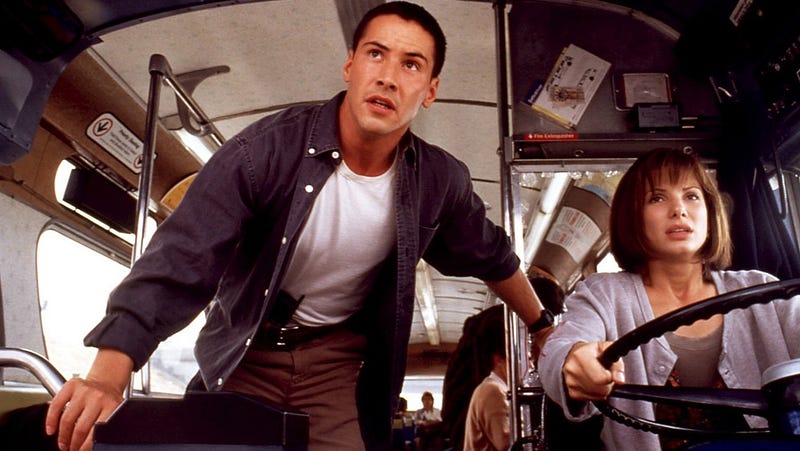
One of my favorite things about film is the subjective nature of it. A dozen people can see the exact same film and each have wildly different assessments of its quality and interpretations of its themes. At times, it can be remarkably challenging to engage in calm, rational discussion when you feel so passionately about a piece of art and someone comes along and presents a diametrically opposed viewpoint. But, nevertheless I continuously strive to be open to such discussion and debate.
Well, most of the time, anyway. There are certain things I just flat out refuse to debate. One of these things is that Speed is the greatest action movie ever made.
Speed was released on June 10, 1994 — exactly 25 years ago today. The film was hardly projected to be a box office smash, let alone a genre classic. The film was the big screen debuts of director Jan de Bont and screenwriter Graham Yost, and was producer Mark Gordon’s sixth attempt at big screen success after his first five films failed to make a splash. The film also had no marquee names attached. Sure Keanu Reeves was a rising star who was well known in the industry, as he had already starred in the Bill and Ted films, Point Break, Dangerous Liaisons, and Bram Stoker’s Dracula. And with credits like Easy Rider, Blue Velvet, and Hoosiers to his name, Dennis Hopper was a highly respected industry veteran at the time of the film’s release. But no one would have called either of them a major box office draw in 1994. As for costar Sandra Bullock, who would later go onto become a bigger star than either of them, her sole major credit prior to that point was a supporting role in the Sylvester Stallone/Wesley Snipes misfire Demolition Man.
It seemed that pretty much all Speed had going for it was an intriguing premise — a city bus has to stay above 50 miles per hour or a terrorist will detonate a bomb.
But then to the surprise of many, it received some very high profile rave reviews upon its release. Roger Ebert, the best known film critic of his time, gave the film a rare perfect 4 star rating. Senior Entertainment Weekly critic Owen Gleiberman gave the film an “A.” Its opening weekend didn’t break any records, but word-of-mouth spread quickly and the film ended up grossing $121 million in the US and $350 million globally (adjusted for inflation its domestic total would be a healthy $261 million, which would make it the 60th highest grossing R-rated film of all time.)
After its theatrical run, Speed would go on to be nominated for three Academy Awards, winning two (Best Sound Mixing and Best Sound Editing). It would also pick up six MTV Movie Awards (back when MTV was a really big deal). In the years since its release, it has been regarded as a modern classic, with Empire magazine ranking it among the 500 greatest films of all time, American Film Institute putting it on their list of 100 most thrilling films of all time, and Quentin Tarantino naming it one of the 20 best films of the ’90s and ’00s. The film is credited for launching Keanu Reeves and Sandra Bullock to the A-list, where they still remain 25 years later. (It also spawned Speed 2: Cruise Control, a spectacularly disastrous sequel that necessitates an entire article of its own.)
So how did a movie with no A-list talent in front of the camera or behind the scenes, a modest $30 million budget, an original story, and an absurd premise become a blockbuster and a classic? Well, because it is a great film and every so often being a great film is enough.
Without further ado, here are six reasons why Speed is not only a great film, but also my vote for the greatest action movie ever made.
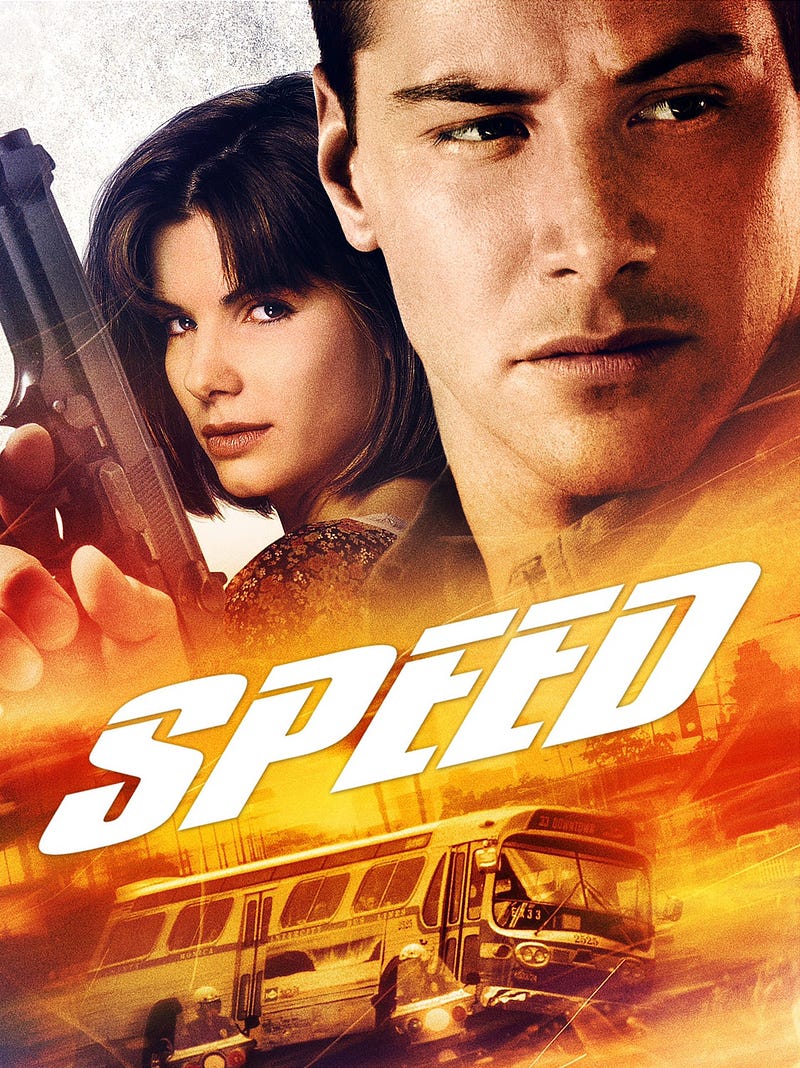
1.) It is breathtakingly action packed for its entire 115 minute running time. Rewatching the film in preparation for this article, I was astounded by how riveting the film is even when I knew every plot turn and line of dialogue by heart. I literally couldn’t do anything else while watching it. And it’s not action-packed in the frenzied, exhausting, overstimulating ways of most modern blockbusters, but rather with a series of cleverly conceived, carefully staged, well-edited action sequences that occur in rapid succession. There are a few quieter moments in which viewers can catch their breath, but they don’t last long enough to disrupt the thrilling pace.
2.) Its three-act structure is screenwriting perfection (even if the dialogue is rough at times.) The seeming absurdity and simplicity of Speed’s premise has been the source of much satire over the last quarter century, as has the one-note characterizations and token diversity of the characters on board the bus. Furthermore, criticisms have been lobbed at the film’s dialogue, which at times is remarkably hackneyed. Lines like “You’re not too bright, but you’ve got some big round hairy cajones,” “Don’t get dead,” and “Your life is empty because you try to stop the bomb from becoming” are quite groan-inducing.
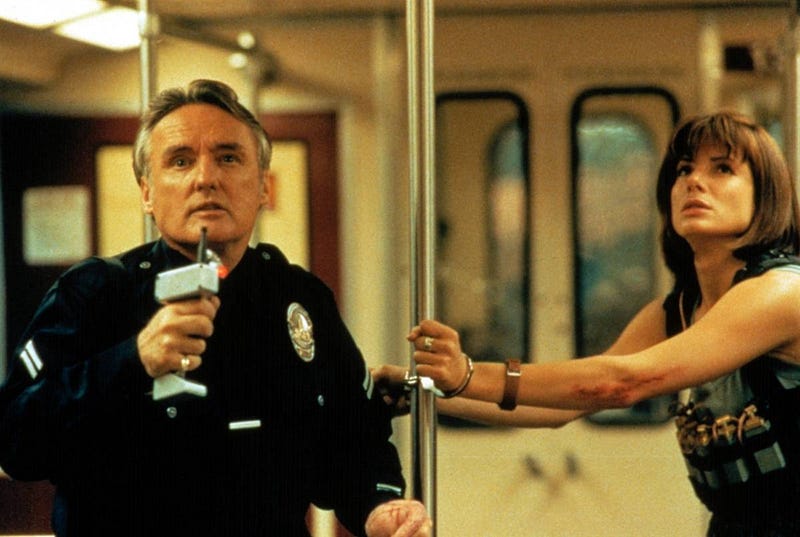
But the script has many strengths that more than make up for these flaws. Primary among these is the screenplay’s perfectly balanced three-act structure. The film begins with a 23 minute prologue, in which we get a nail-biting terrorist attack on a Downtown LA high-rise passenger elevator and get all the necessary background for our protagonist (LAPD Officer Jack Traven, played by Reeves) and our antagonist (madman Howard Payne, played by Hopper.) Then we enter a 67-minute stretch in which Traven manages Payne’s follow-up attack on a Santa Monica city bus that has been rigged to explode if it goes under 50 miles per hour. The film ends with an 18-minute climax in which Traven and Payne go head to head on LA’s subway system. They are all dazzling set pieces that never outstay their welcome.
3.) It is a remarkably humane and progressive entry in the action genre. In an era in which the majority of blockbusters are superhero films, disaster porn, shoot-em-ups, or monster movies, viewers are used to seeing hundreds, thousands, and even millions of people die in one film. And very rarely in these films do they ever even broach the topic of the emotional impact of the lost lives. In contrast, only a handful of people die in Speed and each death packs a real emotional punch. Furthermore, the film focuses on everyday people risking life and limb to save the lives of other everyday people, a rarity innblockbusters. In an era when action movies are going to such extremes to rouse the passiona of cynical, desensitized filmgoers, watching Speed is a reminder that injecting humanity into the proceedings can go a long way.
The film is also notable for the surprising strength of its female protagonist, Annie (Bullock). The vast majority of blockbusters at the time (and, honestly, even today) would reduce Annie to a love interest for Jack or a damsel-in-distress — or both. But Annie plays a major role in the film not because she’s hot or because the filmmakers wanted to inject some sexual chemistry into the proceedings, but rather because of how she steps up and commandeers the bus after a tragic accident incapacitates the bus driver. Through immense skill, clever decision making, and remarkable bravery, she keeps everyone alive — and even manages a few emotional crises along the way. Sure, the film ends with her and Jack in a hot lip-lock, but it plays out in a manner that feels very different from the typical hero-gets-the-girl formula. It plays out as two heroes who have been through hell together and are grateful to be alive collapsing into each other’s arms. Perhaps it is bold to call Speed feminist, but I’m feeling bold today.
4.) It provides perfect roles for 3 bona fide movie stars. Keanu Reeves, Sandra Bullock, and Dennis Hopper have all given better performances in their career than they do here. But rarely, if ever, have they ever felt more like movie stars. Keanu Reeves is a mix of reckless bravado and quiet compassion. He is more than adequate in his dramatic scenes and is truly striking in his highly physical ones. Dennis Hopper is unhinged madness, constantly verging on camp but being so damn entertaining and chilling that it somehow consistently works. Bullock is exceptionally effective as the charming, strong-willed “girl next door” who is full of wit and intelligence. And it certainly doesn’t hurt that the chemistry between her and Reeves is electrifying. (The film also contains great turns by character actors like Jeff Daniels, Joe Morton, and Beth Grant in supporting roles.)
5.) Its production values are top notch, and hold up a quarter century later. The film is a technical marvel, emphasizing stunt work and pyrotechnics over CGI. Despite some outdated vehicles and weaponry, the action sequences still play out with gritty realism and nail-biting tension all these years later. And the film is not just a feast for the eyes, but for the ears as well. In addition to the sound effects that won it two Oscars, it features a highly underrated, pulse-pounding score by Mark Mancina, that should have scored the film a fourth Oscar nomination. Despite how far film technology has advanced since this film was made, it has a timeless quality that allows it to still play effectively.
6.) It is one of the most quintessentially Los Angeles movies ever made. Surprisingly, Hollywood has not made an overwhelming number of great films about Hollywood. Sure, there’s a handful of classics set in the film industry (Stanley Donen’s Singing in the Rain, Robert Altman’s The Player, and Damien Chazelle’s La La Land immediately come to mind). There’s also a handful of film noirs that made great use of Los Angeles (Billy Wilder’s Sunset Boulevard, Roman Polanski’s Chinatown, and Curtis Hanson’s L.A. Confidential are obvious standouts.) But few great action films are set there and few, if any, of the films listed above are as quintessentially Los Angeles as Speed. The main action of the film is set in Downtown LA’s high rises, on the surface streets of the urban sprawl, and on the mammoth freeways that intersect all over the city. Major scenes take place at the city’s main airport and iconic Hollywood Boulevard. In addition to heavily showcasing the landmarks of the city, the film also touches on themes that are of deep relevance to Los Angeles life, including the hell of commuting (Los Angeles is a famously car-dependent town with some of the world’s worst traffic), the violence that plagues the streets (this was filmed the year after the L.A. riots), and the tremendous cultural diversity of its populace. Watching the film after making my home in Los Angeles was a very different experience than it was watching it in rural Upstate New York. Not necessarily a better experience, but certainly a deeper one.
In conclusion:
If you’ve never seen Speed, get to it.
If you’ve seen Speed and weren’t impressed, try watching it again.
If you’ve seen Speed a dozen times, try a 13th in honor of its silver anniversary.
Just don’t expect me to debate the merits of Speed with you. Some things are just not debatable.


