avatarAG Lafley

Summary

Success in brand strategy often hinges on an organization's approach to decision-making, which involves a clear and defined cascade of choices that positions the brand for sustainable advantage and superior value creation.

Abstract

The text discusses the critical role of strategic thinking in an organization's success, emphasizing that it's not merely the people but the strategy that sets apart successful brands. A well-defined approach to strategy enables managers to make clear and hard choices, which is essential for creating a sustainable competitive advantage. Strategy is described as an integrated set of choices that answer five key questions: the brand's winning aspiration, where it will compete, how it will win, the necessary capabilities, and the required management systems. These choices form a reinforcing cascade, with each decision influencing and refining the others, thereby guiding the organization towards superior value creation.

Opinions

  • The text opines that the difference between successful and unsuccessful brands often lies in the organization's strategic thinking process.
  • It suggests that a clear strategy is not only about defining goals but also about making informed choices that position the brand uniquely in the market.
  • The author believes that strategy is not an elusive concept but rather a set of definable choices that can be articulated through specific questions.
  • The article posits that the interrelation of strategic choices forms a cascade, where top-level decisions set the stage for more detailed choices below, and these detailed choices, in turn, influence the broader strategy.
  • It is implied that a successful strategy requires continuous refinement and influence from choices at different levels of the organization.

A Cascade of Choices

Why are some brands able to succeed spectacularly where so many fail? When the people aren't better or worse — not harder working, more dedicated, bolder or luckier than anyone else?

Oftentimes, it has to do with an organization’s way of thinking about the choices they make. Some organizations have a clear and defined approach to strategy, a thinking process that enabled individual managers to make clearer and harder choices, while others don’t. A company’s approach to strategy is what makes the difference.

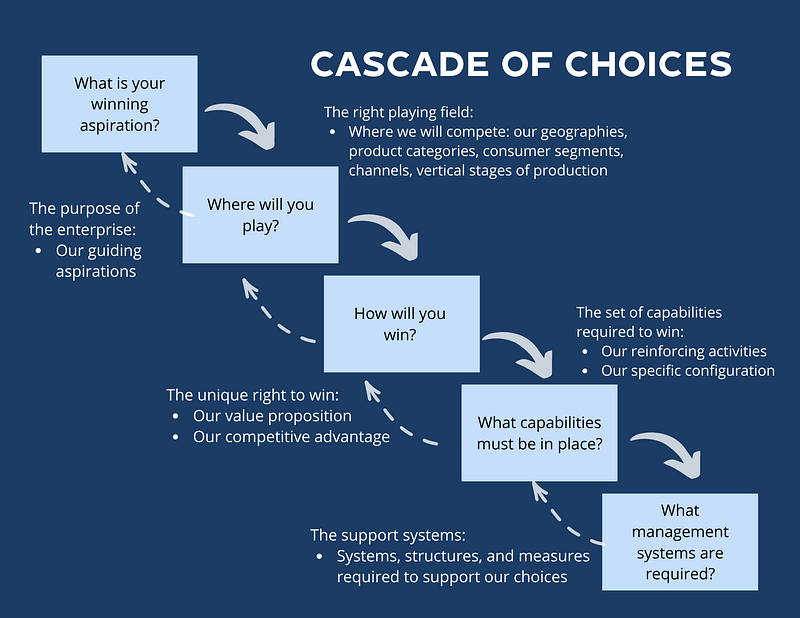
Although good strategy seems difficult to define, it isn’t. Strategy is easily definable. In the simplest terms, it’s an integrated set of choices about winning that uniquely positions a brand so as to create sustainable advantage and superior value relative to the competition. It’s the answer to the five interrelated questions in the cascade of choices:

  1. What is your winning aspiration?
  2. Where will you play?
  3. How will you win?
  4. What capabilities must be in place?
  5. What management systems are required?
An integrated cascade of choices

These choices, and the relationships between them, can be understood as a reinforcing cascade, with the choices at the top of the cascade setting the context for the choices below, and choices at the bottom influencing and refining choices above.

Leadership
Strategy
Business Strategy
Management
Choices
Recommended from ReadMedium