
A Broken Nose, a Limp, and a Trophy
Fighting in a Muay Thai kickboxing championship in the Republic of Korea
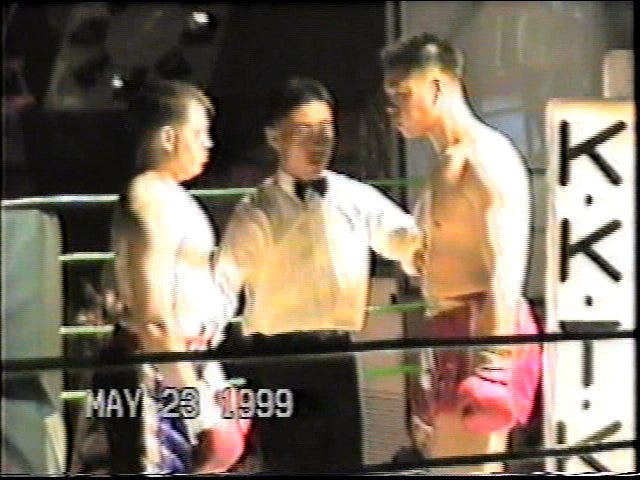
Prior to traveling to the Republic of Korea (ROK), I had already studied a number of different martial arts, including earning a Black Belt in Taekwondo. Now since the ROK is the birthplace of Taekwondo, you’d think during my time there I naturally would have continued training in the art and begin working towards my second-degree black belt. But instead, I somehow found myself walking into the Tae Woon Muay Thai gym.
There were no white uniforms, no black belts, and nobody doing traditional poomsae. The rugged, Spartan gym was filled with fighters wearing boxing gloves and sparring inside a ring, others were deftly jumping rope, and yet another fighter was landing heavy kicks on a banana bag (a long heavy bag that reaches the floor). The whole place smelled of leather, sweat, and fierce determination.
Muay Thai, known as “the art of eight limbs,” is the national martial art of Thailand. Its name comes from its use of eight striking weapons (punches, kicks, knees, and elbows). It is a brutal art where each fighter delivers and receives a great deal of punishment. As a warrior, I just couldn’t resist stepping into the ring to put my skills to the test.
After months of training, I was entered into the heavyweight division of the Songnam full contact kickboxing championship. It was a scheduled 5 round fight with Muay Thai rules (kicks and knees to legs, body, and head; punches and elbows to the body and head).
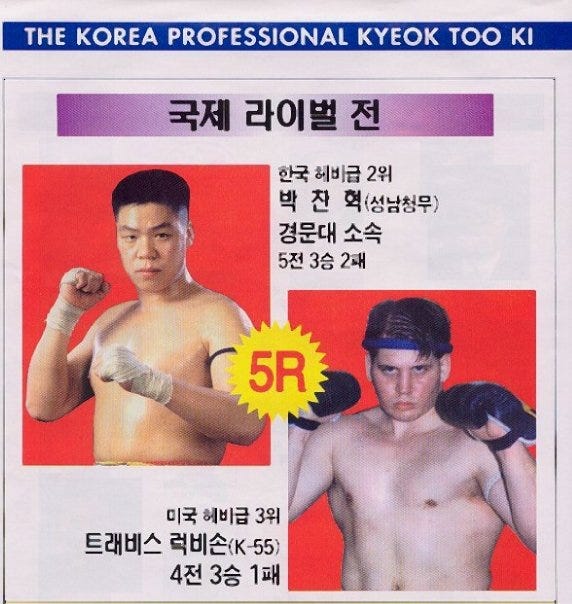
The fight poster had given me a look at my opponent as his picture was placed opposite mine to advertise our bout. However, the day of the fight was the first time I’d seen him in person. My trainer said that he was bigger than me, and that became readily apparent as I passed him in the hall of the club where the event was taking place.
I recognized his face from the poster, but until that moment did not realize how big he was. He stood at least six inches taller than me and outweighed me by a good 25–30 pounds. He was one of the largest Koreans I had seen since I had been in the country. Well, I had said that I was looking for a challenge.
We had arrived at the club early as some of the younger fighters from our gym would be competing in the first bouts on the card.
I had no way to know when my turn would arrive so I just had to keep moving to stay loose. The anticipation of getting in the ring had my stomach doing flip-flops and a nice sheen of sweat became like a second skin. It was terrible waiting around, I just wanted to get in there and fight!
The early bouts were over, so my trainer called me over to start getting ready. Before my hands were taped and the gloves tied on, he presented me with a prajioud, which is a traditional armband worn for protection and luck. He had made it himself specifically for me to wear in my fight. To my mind, it is one of the most valuable things that I brought home when I left Korea. I still display it proudly to this day.
As he finished with my gloves, my trainer told me that I was the only American competing, so I needed to knock my opponent out. If I did not get a knockout, the all Korean panel of judges would give him the decision. He said he knew it was biased and unfair, but that’s just how it was.
As I was warming up on the focus mitts, my opponent, Park Chan Hyuk, entered the ring. He made a circle inside the ring, then withdrew to stand in his corner as we approached.
Inside, my body was already at war; excitement and fear battling for control. On the outside I was all warrior; exuding strength with a purposeful stride, my face a mask of fierce concentration and eyes full of fire.
As we drew near, my trainer asked if I could do a flip into the ring. Having never tried before, I said no, but that I could vault over the top rope instead. I really didn’t want to lose the match because I botched a flip and knocked myself out.
I climbed to the edge of the ring, grabbed the top rope, and launched myself up and over. My feet landed with a resounding boom that shook the entire ring. I don’t know if the attempt at intimidation worked on my opponent, but it did draw a nice gasp from the crowd.
The referee called us to the center of the ring where he gave us our instructions. When he finished, he motioned for us to touch gloves, and return to our respective corners.
The wait was brief and the bell rang to start the fight. Wasting no time, I charged across the ring, planning to throw a hard front kick to knock my opponent into his own corner. As I reached him and raised my knee, he held his arm out to touch gloves; honor forcing me to return the gesture. My momentum stalled, yet I quickly re-engaged, throwing a kick to his leg, and then unloading with a barrage of left and right hooks, dropping him to the canvas.
As he fell, the referee motioned for me to back away. My opponent slowly got back to his feet and received a standing eight count.
As I stood there, the reality that I was in the fight hit home. Adrenaline coursed through my veins, accompanied by a rush of emotions. Cold, hard fear was quickly replaced by sheer exhilaration at battling with this giant. I felt a primal, savage need to see him fall before me. I imagine that must be what the battle joy was like for my Viking ancestors.
The fight resumed and I rushed headlong at him; the rest of the round spent trading punches, knees and kicks. We both found ourselves knocked to the canvas more than once before the bell finally rang.
Standing in my corner, I choked down some water while trying to hear the advice being given to me over the club’s music and the sound of my own heartbeat pounding in my ears. The rest was short-lived, and all too soon my mouthguard was pushed back in place, giving me a mere second to steady my breathing before the bell rang for round two.
Although I was not privy to what was said in the other corner, it must have been pretty motivating. He came out with renewed vigor and closed on me immediately, trying his best to take my head off with some big elbow strikes.
As the round progressed, I chased him into a corner where we were both throwing a multitude of punches. It was then that I made a mistake, weaving too slowly and catching an uppercut to my nose. There was an audible crunch as my nose broke, the deviated septum spraying blood everywhere. The impact dropped me to a knee and I covered my head against any more strikes coming my way.
The referee demonstrated his great concern for my wellbeing by halting the fight and wiping the blood from my face (by roughly scrubbing my now broken nose with a towel).
In his previous fights, my opponent had been able to use his powerful strikes to stop his opponents. But so far, he had given me his best shots and I just kept coming. Now, seeing blood, he thought he had finally managed to hurt me and wanted to finish me off quickly. Unfortunately for him, I had other ideas.
Although I could no longer breathe through my nose, the bleeding stopped enough to resume the fight. He immediately went to work, throwing shots right at my nose and trying to capitalize on the injury. Of course, I was feeling no pain, only a need to see him fall.
Moving to the center of the ring he missed with a punch and I responded, landing a quick left hook to his chin. His head wobbled violently and then he collapsed in a heap on the mat.
As the count started, he rose unsteadily to his feet. As he tried to regain his balance, I could read the fear in his eyes.
The referee started us back up, and I threw an uppercut to his face, redirected his counterpunch, and pushed him to the canvas. This wasn’t a knockdown, but more a show of force to increase his fear.
He got up throwing a desperate jab and cross, then started back peddling. Already moving backward, he sealed his fate by dipping his head. I answered his invitation with a left uppercut followed by a straight right hand to the face that knocked him flat on his back. He remained there for a nine-count but was saved by the bell ending the round.
The third round lasted about thirty seconds. There just wasn’t much fight left in him at that point. His end came when I threw a hard kick to his leg and he fell back into the ropes. I brought my right fist back to follow up, but the referee stopped the fight.
My arm was raised to the cheer of the crowd, and I won the championship bout with a third-round Technical Knock Out (TKO). I received a large trophy and a certificate attesting to my victory (along with a broken nose and a limp that lasted for a week after the fight).
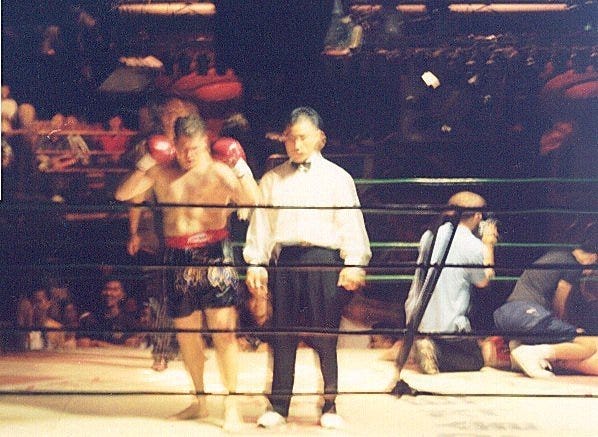
I had prepared for just about any injury that I might sustain during the fight, bringing wraps, gauze pads, medical tape, butterfly bandages, antiseptic, etc. Yet in all that preparation, I had forgotten to pack any kind of pain reliever. No acetaminophen, no ibuprofen, not even a single aspirin. And once the adrenaline wore off, I felt as if I had been hit by a large truck. But at that point, there was nothing to do but suck it up, ignore the pain and just try to revel in the win.
This had proven to be a true test of my courage and my fighting skills. My opponent, Park Chan Hyuk, was the Goliath to my David, the Frost Giant to my Thor, the . . . well, I think you get the picture.


