
A Brief History of the Canetuck Rosenwald School in Southeastern North Carolina
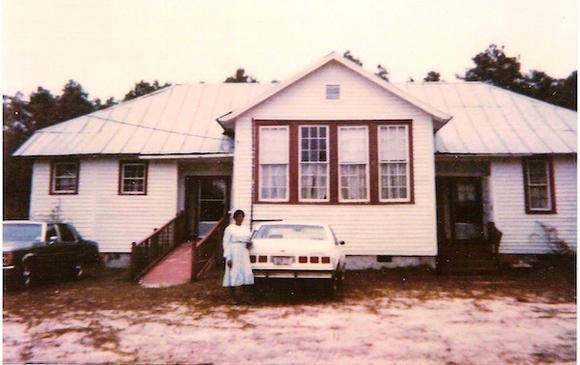
Lois Keith in her nursing uniform in an undated photo outside the Canetuck Community Center (former Canetuck Rosenwald School), picture courtesy of Lois Keith.
Prior to 1922, the only school available to African American children in the Canetuck community of southeastern North Carolina was an old lodge building, where classes were held sporadically. Lois Keith recalled in a 2004 interview that she was afraid of the dark lodge building. She was glad to be part of the first class to enter the Canetuck Rosenwald school, completed in 1922. The genesis of the school was $1,226 raised by African American residents of the Canetuck community. Communities had to organize to request a Rosenwald school, and donate funds over and above the taxes they paid. The Rosenwald Fund contributed $800, and Pender County spent $674 in public funds to build the two-room school.
Of the 18 Rosenwald buildings built on 15 campuses in Pender County, the Canetuck Rosenwald school is the best preserved. It is a rare and valuable cultural asset for North Carolina for, as the National Trust for Historic Preservation notes,
Of the 5,357 schools, shops, and teacher homes constructed between 1917 and 1932, only 10–12 percent are estimated to survive today.
George Corbett told this story to a newspaper reporter before his death in 1986: “We never had that opportunity [to read and write], but we wanted our children to learn, so we knocked on doors. Sometimes we got pennies, sometimes a dime, and once in a while somebody would give us a dollar.” Benjamin Franklin Keith, a European American resident of Canetuck whose family had r eceived thousands of acres in land grants in what is now Pender County, donated four acres of land for the school site. Pender County School Board records note that “The contract for building the school building in Canetuck colored school district was let August 1, 1921 to Mr. J.W. Flynn for $2300.”
The Canetuck school was built on the two-teacher Nashville plan (East or West facing) and the building retains its simple lines, original roof and even (under paneling) the original pale green and white interior paint scheme that was designed to reduce glare. Click here to learn more about Rosenwald school buildings on Dr. Thomas W. Hanchetts’s History South website. The Canetuck school operated from 1922 to 1958 as a two-teacher school, and at various times offered the first through the sixth or first through the seventh grades. Some determined students, including Keith and Corbett, then traveled across the county for high school at the Pender County Training School, another Rosenwald school in the county.
Alumnus Andrew Corbett, who attended the Canetuck school from 1940–1946, recalled that a typical day began with the Lord’s Prayer. He said his teachers’ constant message was “that we should love everybody.” Betty Thompson, who attended Canetuck from 1947–1951, recalled that the teachers encouraged her to excel. One teacher, Helen Foy Hall, took her to Wilmington to reward her for good grades. Betty Thompson later earned two Master’s degrees and became an award-winning educator in New Jersey. She attributes her success in college to the foundation she received in Pender County Rosenwald schools.
Lois Keith, who started first grade at the Canetuck school in 1922, the year it opened, went on to attend the Pender County Training School. She then worked for decades as a baby nurse in New York. She returned to the Canetuck community upon her retirement, and in the early 1970s gathered support to renovate her beloved school. Pender County sold the building back to community members for $500 after it had ceased operating as a school.
Keith persuaded the carpentry class at Cape Fear Community College to adopt it as a project, and students paneled the interior and removed the central partition. Canetuck community members also worked on this renovation, which included adding bathrooms (the entire time the school was in operation students used outhouses built on Rosenwald Fund plans). Keith and others formed the Canetuck Community Senior Center. The building has since been used for many purposes, from family reunions to quilting classes to disaster relief during hurricanes.
Keith passed away in 2008. Since that time, the board has changed the name to the Canetuck Community Center and built on the start that she and the other founding members made. In 2010, the Center received funding from the Lowe’s Charitable and Educational Fund for a complete exterior restoration. The roof and chimney were repaired, siding was repaired, caulked and repainted, and insulation was added for energy efficiency.
In 2019, the Canetuck Community Center was placed on the National Register of Historic Places. The building continues to serve the community as a place for family reunions, gospel concerts, educational events, and as a polling place. Canetuck alumni carry on a tradition of service at the former Canetuck Rosenwald school, which still exists at the heart of its community almost one hundred years after families there sacrificed so much to obtain a school for their children.
To hear more from Lois Keith and the Canetuck story, please see the documentary film Under the Kudzu (available on Amazon and Vimeo)
Portions of this article were first published in Rosenwald School Reflections: Documentation and Preservation (2014) by Claudia Stack (available on Amazon). Oral history of the Canetuck Rosenwald School and Pender County Training School is available in Stack’s documentary film Under the Kudzu, which can be viewed on Amazon Video.
Originally published at https://www.newsbreak.com.


