
A Book That Makes Me Happy
The Book of Joy: Lasting Happiness in a Changing World
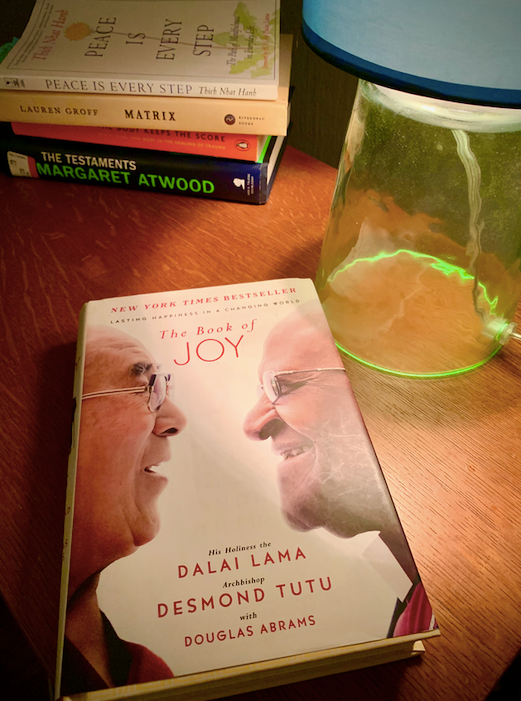
The book it brings me the most joy is, quite aptly, The Book of Joy: Lasting Happiness in a Changing World, by his Holiness the Dalai Lama and Archbishop Desmond Tutu with Douglas Abrams.
Of course, his Holiness the Dalai Lama is a Buddhist monk and the spiritual leader of Tibet who was awarded the Nobel Peace Prize in 1989 and who has continued to advocate for global non-violence.
And we very recently lost Archbishop Tutu, who sadly passed away just a few weeks ago. He was also awarded the Nobel Peace Prize in 1984 for helping to end “South Africa’s apartheid regime of racial oppression and for championing the rights of LGBTQ people.”
I have read the book forward to back at least twice, and yet it’s also the kind of book that you can open to any random page and find support, solace, and invitations to grace.
There have been many moments over the past two years especially when I spent my mornings seeking solace among its pages, when political turmoil, cognitive overwhelm, physical pain, and personal traumas left me feeling deep anger, sadness, and fear. Simply put, this book gives me an endless supply of hope.
The book was written with the writer, Douglas Abrams, who spent time with His Holiness and the Archbishop, interviewing them both together for a week while they shared a celebration of their birthdays in Dharamsala, India. Both survived through such deep loss and sorrow over the course of their lives, and yet they persist in their belief that joy is possible — and in fact, it is a power that can change the world.

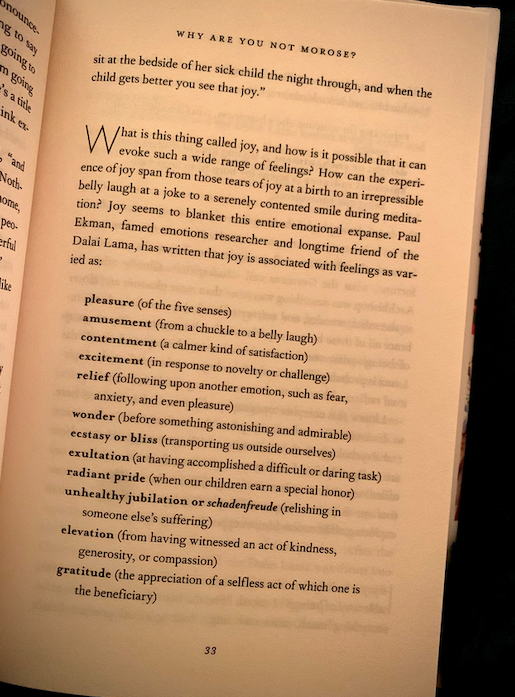
I’d like to share a few of my favorite quotations, which is just a very small taste of the incredible wisdom that can be found inside the pages of this extraordinary book:
“What the Dalai Lama and I are offering,” the Archbishop added, “is a way of handling your worries: thinking about others. You can think about others who are in a similar situation or perhaps even in a worse situation, but who have survived, even thrived. It does help quite a lot to see yourself as part of a greater whole.” Once again, the path of joy was connection and the path of sorrow was separation. When we see others as separate, they become a threat. When we see others as part of us, as connected, as interdependent, then there is no challenge we cannot face — together.”
“Meditative practice allows us to quiet the distracting thoughts and feelings so that we can perceive reality, and respond to it more skillfully. The ability to be present in each moment is nothing more and nothing less than the ability to accept the vulnerability, discomfort, and anxiety of everyday life.”
“‘The goal is not just to create joy for ourselves but,’ as the Archbishop poetically phrased it, ‘to be a reservoir of joy, an oasis of peace, a pool of serenity that can ripple out to all those around you.’ As we will see, joy is in fact quite contagious. As is love, compassion, and generosity. So being more joyful is not just about having more fun. We’re talking about a more empathic, more empowered, even more spiritual state of mind that is totally engaged with the world.”
In his recent condolences to the Archbishop’s daughter, Rev. Mpho Tutu, on the death of her father, his Holiness writes, “I am convinced the best tribute we can pay him and keep his spirit alive is to do as he did and constantly look to see how we too can be of help to others.”
A first small way you can carry this tribute forward is by reading this beautiful book — and then look to be of help so we can lift one another towards love, freedom, and joy.
I’d like to thank Marissa W for offering this week’s Coffee Times book prompt and for spreading book love! It also gave me a reason to dog-ear more pages!
E. Katherine Kottaras holds an M.A. in English and an M.S. in Kinesiology with a focus on Integrative Wellness, and she is a writer and teacher, having worked at the middle, high school, and community college levels for over two decades. She is a registered yoga teacher, personal trainer, and health coach while also living with invisible illnesses and neurodivergence, and she is passionate about mindfulness, bodily self-determination, and health equity. As the queer daughter of an immigrant, Katherine believes that holistic and inclusive approaches to healing and growth should be accessible to all.
Connect with Katherine on IG, FB, LinkedIn, or at katherinekottaras.com
Read every story from Katherine (& thousands of other writers) by signing up for Medium. Your $5/month membership fee directly supports writers.