
A Black Swan Event
An uncomfortable truth about our economy after a pandemic
UPDATE — I wrote this story several months ago, as the pandemic started its impact on the economy. One thing I left out of my thinking is that it is an election year. That only makes it eerier to me that no one is talking, with any real depth, about the economy.
Many major cities are experiencing the most severe economic downturn in their history. Social unrest continues to climb. I re-read the last part of this article, written months ago:
Collapses that are not caused by black swan events are preceded by a distressed economy, characterized by social unrest, loss of faith in the government, bankruptcies, and reduced trade volumes.
I read an article last night where the author offered a message about the economy intended to be comforting. The foundation of the article was that we should not worry about the long-term effects that COVID-19 will have on the economy because our entire economy is based on the concept of consumer confidence. We no longer use the gold-standard, meaning those digital numbers in our accounts or the green bills we exchange for goods will only continue to have value for as long as people believe in that worth.
One thing that has struck me throughout this strange time of the pandemic is how little attention the economy has gotten in the news. For the last few years, we have had what Wall Street deems a bull-market.
A bull-market happens when consumer confidence is high. The stock market took a bit of a wild ride during the early days of the pandemic but currently seems determined to remain on its bullish course. That should be good news, so what is bothering me?
The stock market isn’t the economy. Granted, it often acts as a snapshot of how the economy is doing, but the two things are separate entities. We have all seen the unemployment figures, and we have been assured it will get worse before it gets better. We could be facing 30% unemployment by the end of the summer.
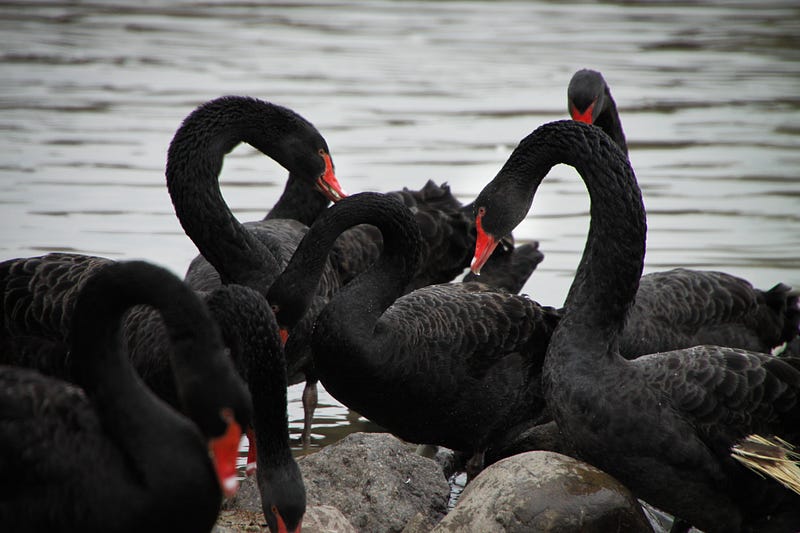
The coronavirus is a black swan event.
Many of those jobs will not come back when all stay at home orders cease. Why? Many people worked in the industries, such as airlines, that have received such a devastating blow that it will be years before they recover.
Almost half the American workforce is employed by small businesses, who have been hit exceptionally hard by the coronavirus pandemic. Small companies operate with much smaller reserves, leaving them unable to ride out the shut down of the economy. Many of these businesses will never be able to open their doors again.
Right now, the amount people receive for unemployment benefits is close to double the usual amount. It seems like a good idea, right? After all, no one could have foreseen this pandemic, and the havoc it would wreak on the economy.
So, the government increases the amount paid in unemployment to help people survive until the economy is on its feet again. The problem is that it is flooding our marketplace with money that didn’t exist a few months ago. It is not a sustainable solution, so what happens when the unemployment runs out?
The most concerning thing to me is the lack of information about the long-term impact this event will have on the economy. I think there are several reasons for the strange lack of information or even the usual speculation.
1. The coronavirus is a black swan event. A black swan event is a rare, unforeseen event with often devastating consequences, such as 9/11. Some people say that the Great Recession caused by the housing bubble crash in 2008 was another black swan event, but there is some push back on that as many in the financial sector knew it was a ticking time bomb.
2. We had never experienced a pandemic of this scale and magnitude in modern history. We operate with delicate “just in time” supply chains, and globalization is deeply entrenched into our way of life.
3. Our media is owned and controlled by powerful and influential individuals with a vested interest in keeping the masses calm, and real journalism is a thing of the past. We worry about what big data, combined with big brother, tell us to worry about, and we assume we don’t have to worry about the rest.
Given what we know about the mainstream media, and the sophisticated AI algorithms that control what you see on the web, are we experiencing a form of insidious censorship?
4. Even the brightest minds truly have no comparison or precedent for understanding where this is going. We have long heard the economy referred to as a house of cards, but remember, our economy and the shape it is in, only exists as a reflection of the confidence that we, and the rest of the world, has in it.
I admittedly have no experience in understanding the global financial markets. The only financial experience I have is managing a household budget, and that of a small business. I do know some inescapable truths, though.
Truth #1
If I attempt to operate my household budget by running an extreme deficit, where I am consistently spending far more than I have, I am eventually headed for a cliff. Sure, the people who depend on my extravagant spending may want me to continue spending for as long as possible. Still, there will come a time when they can no longer tolerate the risk that I will never be able to pay back all that I am borrowing. When that time comes, I will stand to lose everything I had bought on credit, and I would no longer have money to see to even my most basic needs.
Truth #2
Pumping new money into an economy is only a band-aid short term fix. Eventually, we run an extreme risk of hyperinflation as our money becomes worth less and less. A one-dollar bill is only worth as much as it can purchase in goods. Inflation, or even hyperinflation, hit when the value of money declines while the price of goods increases. Imagine that one hundred dollars will buy you a tank of gas and a week’s worth of groceries today. Next week, it will only cover the grocery bill. The week after that, it will only cover ½ the same amount of groceries, and you haven’t been able to afford gas in two weeks. By the end of the month, the same one hundred dollars might only get you enough food to survive, if you ration carefully. That is how hyperinflation works. Inflation is the same process but in slow motion.
Truth #3
All bills come due eventually. The United States has been running at an extreme deficit for some time. We use a lot of fancy footwork and terms to describe our never-ending cycle of juggling debts, but just like in your personal budget, there will come a time when you have to pay the bills.
Coming back full circle to the article I read that spawned these thoughts, the author sought to reassure us that our economy could not collapse because it doesn’t exist tangibly. The basic principle is that as long as we can prop up the belief that our economy is secure, and our money has value, we will continue to be okay.
History tells a different tale. The Great Depression of the 1930’s impacted economies around the globe and lasted for over three years. Unemployment during the Depression reached 24%, less than what is expected as a result of COVID-19. It s also noteworthy to recognize that in the 1930s, far fewer people lived in cities, and many maintained the knowledge, skills, and tools to subsistence farm.
Greece and Argentina are more recent examples of what an economic collapse looks like, but with one glaring difference from what we face today. Greece and Argentina suffered sovereign debt collapses, leading to hyperinflation and consumer riots. However, the global economy remained strong, and both countries received significant international bailouts. Given that the coronavirus has impacted the entire globe, who will be able to bail out a collapsing economy?
Historical Signs of Economic Collapse
- Historically, most economic collapses have followed a time of crisis.
- Preceding an economic collapse, waves of interventions and fiscal measures usually take place.
- Before the Great Depression, the stock market had experienced unsustainable growth. Before it was over, more than 90% of the market had been wiped out.
- Collapses that are not caused by black swan events are preceded by a distressed economy, characterized by social unrest, loss of faith in the government, bankruptcies, and reduced trade volumes.
- Hyperinflation occurs when a government prints extra money to stave off an economic slowdown. The excess cash leads to a gradual rise in prices until the government loses control of price increases. Once hyperinflation hits, costs can start to double in less than 24-hours, and the money itself can eventually become almost worthless.
- A sovereign debt crisis occurs when the government accrues debt and becomes unable to pay the principal and interest when it becomes due. One of the most significant causes of a sovereign debt crisis is a loss of investor confidence in the government.
We have no frame of reference for the potential global impact of the coronavirus. History does have a lot to say about what happens when countries react to black swan events by seeking to pump money into its economy. How long will global and consumer confidence in the concept of the dollar, which is backed by nothing but the word of the U.S. government, continue?