
A Bitter Old Man’s Dying Words Suggest Life is About Love and Purpose
Cus Dámato had many enemies — but on his deathbed, all he thought about was his wife.
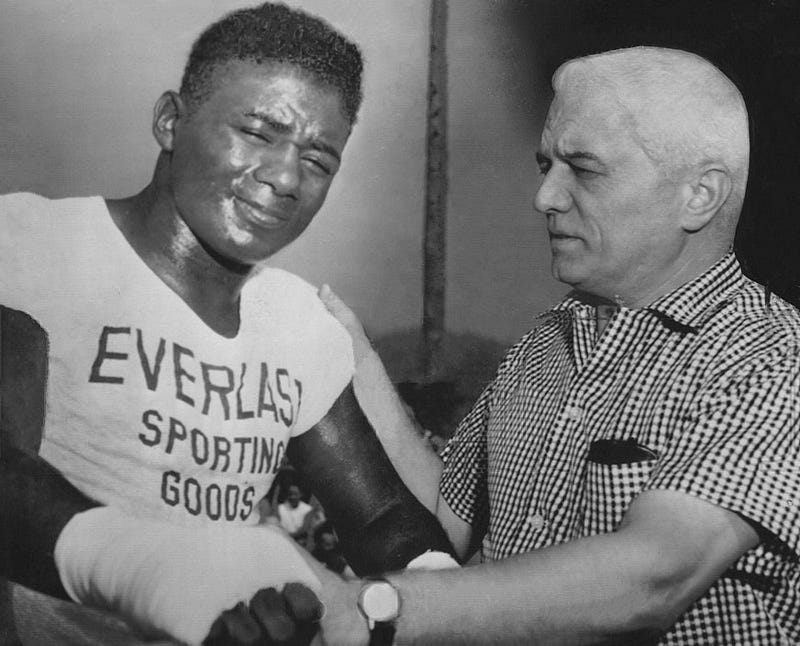
Cus D’amato was a legendary boxing coach.
Nicknamed “The Scholar of Boxing”, Cus is most well-known for adopting a young street urchin named Mike Tyson and transforming him from a chubby street kid to the youngest heavyweight champion of the world.
Tyson’s second autobiography, “Iron Ambition”, is focused on the relationship between him and Cus. It’s a surprisingly poignant book, and the last chapter struck me extra hard. It’s the scene where a 73-year old Cus is dying of pneumonia, and 19-year-old Mike is weeping inconsolably by his mentor’s bedside.
Cus gave Mike two final instructions before passing on. I have taken the liberty to distil two lessons from Cus’s last speech here. If applied, they will help you cut through the confusion of life and find out what truly matters, right at the very end.
What is the One Thing You’ll Care About In Your Last Moments? Focus On That.
“If you die, I’m not fighting anymore, I said, sobbing. Cus looked angry. “Now listen, if you quit fighting, then you’re going to find out if people can come back from the dead, because I will come back and I will haunt you for the rest of your life. You have to fight.” — Mike Tyson, Iron Ambition
Do you know what Cus’s last words to Tyson were? It wasn’t something loving like, “I love you, son, you’ve done me proud.” Cus’s last words to Tyson were: “Move your head, move your head.”
Even as he lay dying, Cus was adamant about giving Tyson boxing tips so that the young man could fulfil their shared quest of winning the heavyweight championship of the world.
I have to admit, this took me aback when I first read it. I mean, is that how you really want to spend your last few hours on earth? Fixated on a goal you will not live to see the accomplishment of anyway? But then I got older, read some good books, and realised one shining truth:
“The meaning of life is to give life a meaning.”
That’s what psychiatrist and Holocaust survivor Viktor Frankl concluded in his memoir, Man’s Search For Meaning. Frankl wrote: “Life is not primarily a quest for pleasure, as Freud believed, or a quest for power, as Alfred Adler taught, but a quest for meaning.”
The Japanese call this meaning “Ikigai.” The term has become popular in self-help circles as of late and is often mentioned in conjunction with a cute little Venn diagram, but as Amardeep Parmar explained, the true meaning of Ikigai is simultaneously deeper and simpler than that. Ikigai is simply “the reason to be and reason to live.”
Our lives have a purpose, one that is intensely personal and freely chosen. For example, my purpose is to be the best writer I can, one who can touch as many lives as profoundly as possible. That’s what I derive joy and meaning from in my otherwise inconsequential existence on this little blue rock.
The next time you are bombarded by petty distractions threatening to blow you around like a windswept leaf, ask yourself — what is your life’s purpose? What is the one thing that you will genuinely care about, even as you lie dying?
Double down on that. Ignore the rest. Like Stephen Covey so succinctly said, “The main thing is to keep the main thing the main thing.” That is how you cut through senseless distraction to do your life’s work.
There is No Room For Haters on Your Deathbed — You’ll Only Think of Your Loved Ones
“For the first time in my life I saw the truth as it is set into song by so many poets, proclaimed as the final wisdom by so many thinkers. The truth — that Love is the ultimate and highest goal to which man can aspire. Then I grasped the meaning of the greatest secret that human poetry and human thought and belief have to impart: The salvation of man is through love and in love.”
— Viktor Frankl, Man’s Search For Meaning
People think Cus is a sweet old man, but to paraphrase Tyson, he was actually more akin to a cantankerous Italian gladiator.
A large chunk of the book focuses on Cus’s bitterness. When Ronald Reagan came on T.V, Cus would throw an apoplectic fit, screaming “liar, liar, liar” at the TV. He hated Republicans with a passion — and he hated corruption in boxing even more. Tyson recalls how old man Cus would get into literal fist-fights with the judges if he thought his fighters were getting robbed; when Mike lost a decision in the amateurs, Cus chased the offending promotor around the ring.
Cus was vengeful, too. He would often go on dead-serious rants, saying how he would like to hurt his enemies, to make them lose their jobs, their very lives. And seeing that he was already an old man, many of his rivals were effectively unkillable — because they were already dead! Cus was angry at the ghosts of an unchangeable past. Here’s a non-exhaustive list of the people he had an issue with:
- Powerful executives from various boxing commissions
- Politicians
- Several boxers and managers
- Members of the mob
- And more
However, at the end of his life, none of them mattered. The only person he cared about was his long-time partner, Camille. Tyson recalls,
“He started crying like a child and sniffling. I was floored. I’d never seen any emotion out of him before. Cus told me that he was crying because of Camille. He was upset that he was never able to marry her.
I used to hear Cus say, “I wish I had taken care of Camille when I had money.” Cus had stopped crying by then and he put me on a second mission — to take care of Camille for the rest of her life. That’s what he wanted me to do — fight and pay the rent.”
So many of us use hatred as fuel. We are driven by the bosses that mocked us, the classmates that bullied us, and the lovers that scorned us. But the truth is when the end comes, both your haters and the people whom you hate will fade into the background. They don’t matter. They’re not going to go to your funeral and you’re not going to go to theirs.
Bronnie Ware, a palliative nurse who wrote a book detailing the common regrets of the dying, never once heard a dying person mention something along the lines of, “Oh, I can’t stand so and so’s guts, I wish I had the chance to tell him off before I die!” Instead, much like Cus, their regrets typically centre around feelings of affection. Not having spent enough time with friends and family, for example, or not having told their spouse how much he or she meant to them.
Psychologists agree love is a healthier source of motivation than hate. So focus on love. Use it to drive you, to spur you to higher heights. If anything, remember that when the grim reaper comes knocking, you won’t be worrying about the ones who were against you. Your sole concern will be the ones who stood by your side, faithful until the end.
In Summary: In the End, Life is About Love and Purpose
“We’re all going to die, all of us, what a circus! That alone should make us love each other but it doesn’t. We are terrorized and flattened by trivialities, we are eaten up by nothing.” ― Charles Bukowski
It’s easy to get lost in the hustle and bustle of life. That’s why the Stoics had a saying, “Momento Mori”. It translates to “Remember you must die.” It’s a morbid but essential reminder that we are all on this little blue planet for a limited amount of time.
So we might as focus on the positives, on the joys and wonders of being alive. We might as well focus on the fact that when we’re on our way out, we’ll likely only care about two things:
- Our purpose in life, and
- Our loved ones.
Forget about hate. Forget about all the distractions you allow to tug and toss you around like a loose leaf in a winter storm. The ones you hate, the ones who hate you, and all the ornamental knick-knacks of life won’t matter when you reach the last stop of your journey. Focus instead on two core things; your purpose, and on spending quality time with your loved ones.
That’s how you live a life worth dying for.


