
A birth, in 13 places
Welcoming our son, and leaving Bloomsbury, London
The bare facts are these: Oliver Kornel Hill, born 22.47 on 12 July 2007, weighing in at 4.02 kilos and measuring 55cm. Mum and baby both doing well. (Ed. These pieces written at the time, July 2007.)
Overjoyed is too feeble a word to describe the way we feel, and it’s near impossible to comprehend, let alone describe, what it really means. So I won’t even try.
Yet I have something to write about here. I feel I should, but I’m uncertain as to whether it fits. There’s no editor here, no paying readership, and no particular external constraints or raison d’être. Nothing I have to live up — or down — to. So do I say anything about Oliver here? I’ve lobbed this conundrum back and forth in my mind, like Nadal vs Nadal on clay courts, and admittedly on long sleep-deprived walks with Oliver, where there is little other obvious stimuli kicking around. Geoff Dyer, in his hilarious and brilliant Out of Sheer Rage, expresses this inconvenient problem best:
There were no constraints on me and because of this it was impossible to choose. It’s easy to make choices when you have things hampering you — a job, kids’ schools — but when all you have to go on is your own desires, then life becomes considerably more difficult, not to say intolerable.
“Intolerable”. I don’t tend to do ‘personal editorial’, the kind of material that defined the early days of blogging, when I started writing. But of course, personality surfaces all the time. Indeed, trying to suppress it would be a little like trying to prevent a rising water table in the Midlands. My personality is evident in the curation of subject matter, and the way I write, no matter what.
Yet given that what I write is often about place, something occurs to me as a way of noting Oliver Kornel Hill’s arrival on this planet.
People say — until it’s ultimately tiresome and essentially robbed of meaning — that having a baby ‘changes everything’. I’m not going to go into what that means to us — that’s personal — but I thought I would write a little about how the places and spaces that were familiar to us had begun to warp and twist in entirely new ways, and how I experienced new, unfamiliar places as a result of the birth.
And yet, as Dyer later suggests in his study of D.H. Lawrence, all writing — particularly note-based writing, which this is — is about yourself as much as a subject. And this is a good thing, at its best generating lightning flashes of insight on subject as well as self. He relates Rebecca West’s notes on Lawrence’s penchant for writing about a place as soon as he got there, without even experiencing it:
Fresh off the train: ‘tapping out an article on the state of Florence at that moment without knowing enough about it to make his views of real value’. Later she realised that ‘he was writing about the state of his own soul at that moment, which … he could render only in symbolic terms; and the city of Florence was as good a symbol as any other.’
I can’t promise any searing insights into “state of my soul”, and I’m clearly no Lawrence, but these reflections, roaming around aspects of architecture, history, service design, loose definitions of London, contemporary prams, hospital wards and nurses uniforms, music and such-like, are certainly in response to Oliver’s birth.
So this is the story of his birth, our birth, across the 13 or so places that define it for me. But it’s a story of those places too, the buildings that shape them and the things that shape those buildings. As I began to see the familiar in new ways, I jotted down these notes.
Almost all of the accompanying photos are taken with my mobile phone (Ed. At the time, probably a Nokia 6230 or N93) so please excuse the low quality. But then again, if buildings don’t look good on scratchy mobile phone pics, then they’re probably not any good. The imageability of the buildings, as Kevin Lynch would have it, should come through.)
I realised half-way through that it’s also a farewell to many of those places. We’re leaving for Australia in late August, and so I’m increasingly aware that I’m walking around Bloomsbury for the last few times. So this is also a farewell to a patch of London where I’ve felt most at home, a place I know inside-out and barely at all.
Birthplace #1: Scan; Private clinic, Harley Street, Central London
Our birth was fully public health care, save for one aspect. Inconvenient timing meant our 12-week scan would be late, due to Christmas, so we paid to have a scan at 11 weeks instead. The scan was done in one of the numerous private clinics on Harley Street.
Subsequently I visit another clinic a block east, for physiotherapy after a ruptured achilles tendon suffered playing football. Earlier, chest x-rays for my Australian visa had been conducted in another clinic. A full physical for the visa was conducted in yet another clinic just south, including an embarrassed cough into a doctor’s cupped hand, eye tests, blood tests and what felt like a curious form of jujitsu to test reflexes and coordination. I could begin to plot a map of my dismembered body across the five or six streets that bound this area.
All these spaces, including the private clinic we first see Oliver in, are based in what were once beautiful Georgian residences. Sadly, they’ve been sliced around with rather less care than the surgery they’re home to, and many of the rooms are peculiar, uncomfortable spaces as a result. Staircases are chopped in half; floors inserted awkwardly; rooms carved out of the body of the building. The x-rays are performed down a weird staircase into a basement; the physiotherapy in a couple of oddly-shaped rooms, one with massage table pressed up against dormant fireplace. Another, which is obviously half the original room, defined by cheap stud walls demarcating one financial arrangement from another.
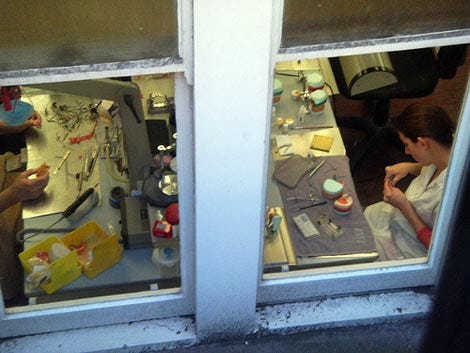
The streets themselves are of the broad eighteenth century variety, made to the width of a few horse-drawn carriages, with most buildings having steps up, and a basement level down below. Above one such downstairs office, I stood and watched people fabricating teeth. Friends who lived in the area report of fabulously wealthy middle eastern women departing clinics in the very early morning, with elaborate cosmetic surgery delicately concealed under burqa.
It’s been associated with medical practice for so long that the place name has become more of a sign for this work than a street-sign. ‘Harley Street’ can actually be used to refer to several blocks of streets around the real Harley Street, each dotted with clinics containing an 1500-strong army of medical practitioners, ready to pounce on everything from hair loss to occupational health to, well, baby scans and achilles tendons.
The street was named after Edward Harley, who is actually responsible for laying out most of the area, after inheriting it from his wife. But most of the area is now owned by the De Walden estate, whose signs you can see everywhere, if you look carefully. The De Waldon peerage goes back to 1597, apparently in exchange for one of them doing alright in the battle with the Spanish Armada. De Walden is one of the large London estates, dominating this side of central London, just as most of the later entries in this series are on land owned by the Bedford Estate. It isn’t obvious to the casual observer but most of central London’s land is owned by just a handful of estate owners (the other big landowners are more utility-based, like the rail companies or Transport for London).
In terms of urban development, opinion varies wildly on whether these traditional estate owners are an effective way of stewarding urban space. At an NLA exhibition a while back, the case was made firmly in favour of the estates’ enlightened husbandry, though it was sponsored by the estates themselves. The De Waldon Estate effectively curates the area, only accepting tenants which it feels are appropriate in some undefined way. The idea of carefully curating an area, as well as being open to emergent development, seems a good idea in principle and should be done more often. But it can go horribly wrong in practice. Trades like psychologists and osteopaths were treated with real suspicion and only really allowed into the area after World War 2. Worse, a recent decision to ban abortion clinics from the area seems misguided, particularly to align that with cosmetic surgery. Still, they own the land, and in London, a city essentially defined by money and property — and money for property — that’s what happens. The fact remains that central London is defined by this almost-feudal model of property ownership. Always has been, always will be.
It’s unclear how Harley Street developed into an area defined by medicine. It appears to be a classic case of an agglomeration economy, simple as that. In 1860, there were 20 doctors registered there, no doubt attracted by the fine residences, and it’s simply grown since then.
Will Self’s acid is sprayed liberally over Harley Street in one of his ‘pyschogeography’ pieces for The Independent, noting the fervent desire for an actual Harley Street address — and how the street’s space is warped, accordingly.
Between (Dr) X’s establishment on Lower Wimpole Street — The London Hospital for the Medievally Ill — and the corner of Harley Street itself, I passed Numbers 117, 117a, b, c, d, e, f … through z. So intense is the desire of quacks to obtain premises in the grid of streets between Portland Place and Marylebone High Street that some unscrupulous cosmetic surgeons have been known to tunnel in from as far afield as Hounslow. Obese dowagers are then strapped to motorised trolleys and powered through the underbelly of London to where they can have the fat sucked out of them for vastly inflated prices, purely on the basis that they’re “in” Harley Street.
I seem to recall that one of those early doctors in the area was Sir William Withey Gull, whose surgery was hereabouts, and who was implicated by Alan Moore in From Hell as Jack the Ripper. He resided a few streets south in Brook Street however, an area south of Oxford Street that continues the urban form, though now highly commercialised, full of galleries, shops, cafés.
In contrast, there’s a curious feel to the Harley Street area, as it’s essentially residential/surgery/small office space, with no such shops, amenities or other functional space. Sandwiched between Oxford Street and Marylebone High Street, there are numerous attractions a few minutes away, but it’s an area perhaps overly defined by one function. Just block after block of gorgeously articulated Georgian architecture, mostly offering up its haughty, impenetrable grandeur.
Unless you have an ailment and some money. Or you need a scan and can’t wait a few weeks. And so it’s here, in the undistinguished interiors of distinguished addresses, upstairs in an eastern European consultant’s untidy little office, that we first see Oliver Kornel Hill wriggling away on an LCD monitor.
Place #2: Elizabeth Garrett Anderson Hospital, UCLH, Huntley Street, Central London
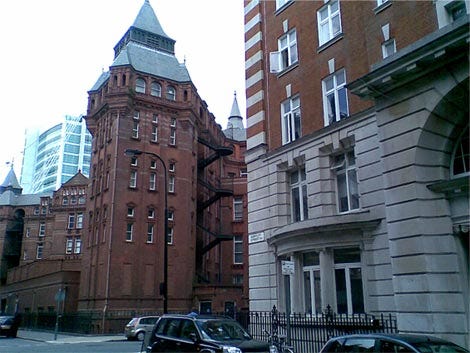
Many scenes in Oliver’s birth take place in the Elizabeth Garrett Anderson and Obstetric hospital, which is part of University College London Hospital. As a building, it’s caught between late Victorian and Edwardian styles, and sits heavy in Huntley Street, which is tucked in between Tottenham Court Road and Gower Street.
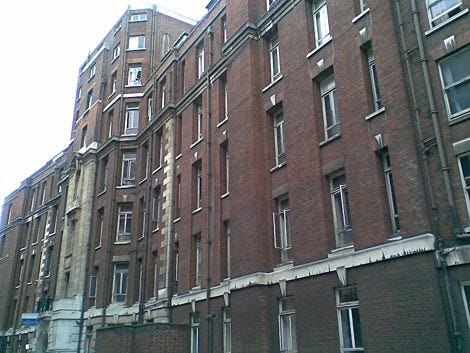
It’s a fairly well-known old London hospital — thousands upon thousands of Londoners will have been born there. Founded in 1866 as a dispensary for women in Bryanstone Square, it wanders across to Marylebone Road in 1872, and is housed in a new building on Euston Road, as the New Hospital for Women in 1890. Looking at the foundation stones by the entrance of this building, we see King George V’s name commemorating the “New Obstetric Hospital and Residents’ Quarters built by the generosity of the Rockefeller Foundation USA” in 1923, with a later engraving denoting the opening, by the Prince of Wales in 1926. (In these two stones we see two facets of the British establishment’s ‘special relationship’ with the United States: the former enjoying the benevolence of the Rockefeller’s deep pockets; the latter enjoying Wallis Simpson to the extent that he would later abdicate and run off with her.)
The hospital is named after the founder of that first dispensary, and the driving force behind the subsequent hospitals, Elizabeth Garrett Anderson, after she died in 1917. Garrett Anderson was the first woman to gain a medical qualification in Britain, as well as a suffragette and then the first female mayor in Britain. What a gal. The New Hospital was originally staffed entirely by women, and originally had a broader remit across women and children, but now seems focused around obstetrics.
My mother had her tonsils out there in 1949, and remembers being in for two weeks, not allowed to see her parents. Her Uncle Jim smuggled himself in and gave her a fountain pen as a present at the end of her stay.
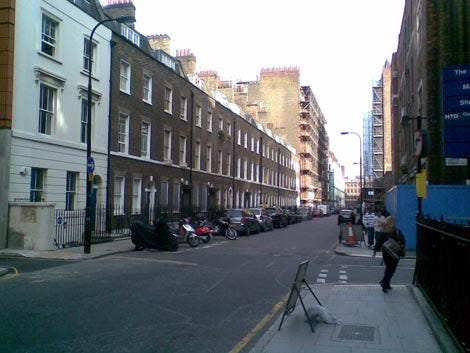
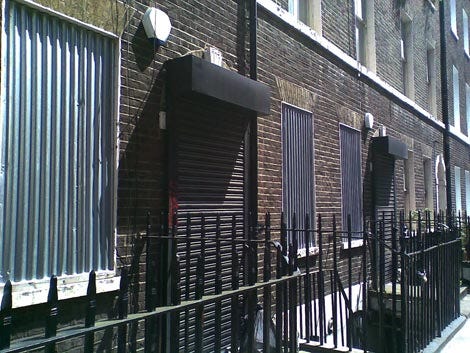
I’d never really walked past it before, as Huntley Street only really goes to the hospital. The bottom end of Huntley Street is dominated by one of those lovely large mansion blocks, like Gordon Mansions, with glazed brick around the base, and then some semi-derelict old terraces. The latter seem a dreadful waste, like some of the fine but empty addresses on Gower Street, a few metres east. They may be caught in that London property dilemma: the land is too expensive to sell, with developers circling, eye-ing the space hungrily, but it’s too difficult and costly to simply re-furbish and re-use the dilapidated built fabric. So it ends up in limbo, neither being redeveloped or torn down. They’ll rot from the inside eventually, so nature will do the demolition job for the developers.
We come to EGA for several visits — for scans, check-ups and visits with the ante-natal class — and Oliver’s birth and transitional care, so we get to know the building fairly well. Inside, you can see the original layers of what was once a fine bit of architecture, but it’s been chopped around over the years, ending up as the familiar mish-mash of styles and shapes that define many old public buildings in Britain. Different regimes, different funding schemes and different functional and aesthetic requirements all accrete around the building until the hospital ends up as kind of untidy palimpsest. There are floors at random junctions, peculiar illogical corridors, odd dead-ends and an internal spatial form that is entirely beyond comprehension. You just have to go with it.
In fact, it has ended up a bit like the fictional hospital that I seem to recall from an old Will Self short story, possibly in The Quantity Theory of Insanity, about a North London hospital that is essentially alive; long corridors unfolding as arteries and capillaries, a huge grey body-mass, slowly enveloping its inhabitants in stud walls, bureaucracy and medical equipment.
EGA isn’t as malevolent as Self’s hospital; just occasionally confusing and a bit tatty. It’s to be replaced as part of the next phase of development in the ‘EGA wing’ of the new UCLH building 100 metres away at the top of Gower Street, and is clearly on its last legs. Having said that, any other building this close to the end of its life would be left to rot a bit more obviously; you can’t do that with a functioning hospital.
There is evidence everywhere of earlier layers of the hospital. There are some quite lovely wooden doors, crowned with semi-circular glass windows, and set with brass handles smoothed by a million hands. These appear on a few corridors downstairs, away from the patients’ areas. You can find a few lovely porthole windows, including some elongated ovals. A corridor for staff, that I quickly get asked to leave, features some fine wood paneling and pigeonholes, light flooding in from tall metal windows. Here are some snaps (again, sorry about the mobile phone quality).
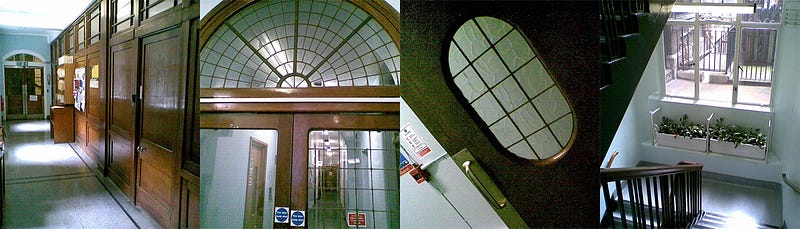
But the building is slowly being left behind, no doubt about it. A good way of spotting the status of a building is by checking the signage. If the owners care about a building, the signage is usually spot on, updated properly. Here, the signage is all over the place, with temporary additions stuck on with sticky tape, or propped over structural elements. The signage itself conveys the age and decrepitude of the building, sadly, with recent layers of change only registered with masking tape.
Across the road from Elizabeth Garrett Anderson is the famous Cruciform building, by Alfred Waterhouse, and the centrepiece of University College Hospital for years.
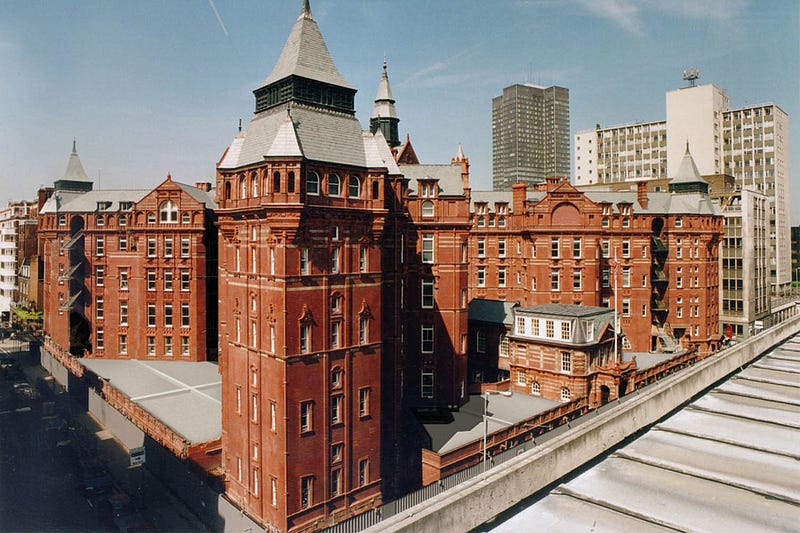
I’ve worked in a Waterhouse building before — the glorious Manchester Town Hall. He’s better known for the Natural History Museum in London — and less well known as the architect of Strangeways prison in Manchester — but all his buildings are wonderful examples of dramatic Victorian architecture, each with their own internal logic, and program suffusing the fabric of the building itself. They’re proud, powerful, muscular evocations of the British Empire, standing long after the latter was dust.
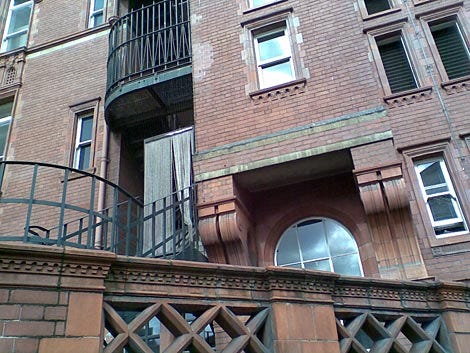
The terracotta and hard red brick were chosen to withstand London’s filthy pollution as much as anything else. Another choice — say, the Portland stone visible in the more genteel streets west of here — would have required constant cleaning, and even then a dirty-looking hospital would’ve stood out in all the wrong ways. Now these choices appear to be part of a late-Victorian aesthetic; and aesthetic only, the functional choice of red brick having been long forgotten.
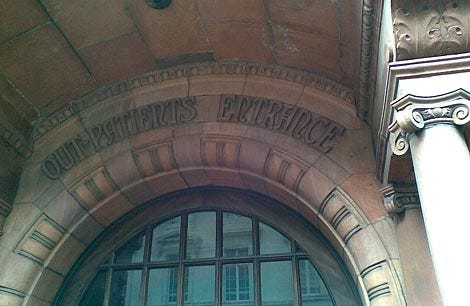
As with the Elizabeth Garrett Anderson, the interior reflects building on a grand scale — contemporary revisionists, it’s worth noting it went 200% over budget — with terrazzo, mosaic and wood block for the floors and glazed bricks for the walls, and with marble for the formal outpatients’ entrance. The exterior has some wonderful brickwork details and carved lettering. Unlike the Elizabeth Garrett Anderson, It’s being re-furbished now, a new home for the Wolfson Institute for Biomedical Research.
In Waterhouse’s Manchester Town Hall, I remember decorative codes, hidden in the stonework, to indicate subtly what floor you’re on (industrious bees for the Chamber of Commerce etc.) Here, the distinctive cross-shape of the building itself tells a story of its function. The Cruciform Building’s logic is arranged with separate wards for particular ailments, along each arm of the cruciform. The beginnings of an understanding that fresh air, ventilation and sunlight might aid recovery meant these long, radiating wards maximised light and minimised infectious horizontal crossover, in favour of organising ailments vertically, with the open central core providing services to all. Although the windows are still far too small by 20th century standards, it lifts the building and practice out of the dark ages of medicine. As such, it’s a specific entry in the development of Western architecture towards clean, open, light-filled spaces that would ultimately lead to a defining characteristic of modernist architecture, and with a specific antecedent in Alvar Aalto’s Paimo Sanatorium. There’s a good short history of the Cruciform building here.
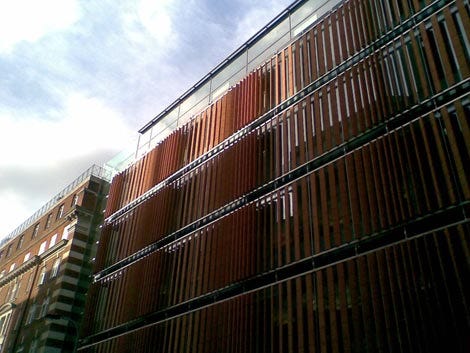
Directly opposite the Elizabeth Garrett Anderson hospital, and on the adjacent block to the Cruciform, is a fine new building. It’s unlabelled, and possibly still uninhabited, but it’s quite lovely, creating a new statement on an old street whilst blurring well with its surroundings. It shares the terracotta colour of the adjoining architecture, but here what looks like actual terracotta, deployed in some gorgeous ceramic-looking shutters, rippling across the entire front of the building. These look as if they might move independently, reacting to light and heat, but despite staring at them for minutes on end, willing them to move, they don’t.
I must walk past this building 30 or 40 times during Oliver’s birth and it looks wonderful each time. I wish I knew what it was, but it’s heartening to see something inventive and progressive built here, providing good company for the Elizabeth Garrett Anderson and Cruciform Building. (Ed. I later discover it’s the UCL Cancer Institute, by Grimshaw.)
Birthplace #3: Active Birth Centre, Tufnell Park, North London
With a pregnancy, you have a series of scans at the start, and obviously the end gets a bit, well, involved. But in the middle, aside from the 20-week scan (done at EGA), there is a huge yawning gap of very little engagement with healthcare. It’s back to your own familiar surroundings here, and a process of gently altering one’s life in small but significant ways.
But a 21st century pregnancy lends several other opportunities to learn what your parents never did, and we take up one of them, enrolling on a two-day ‘active birth’ workshop in North London.
The Active Birth Centre is in a managed workspace space on Bickerton Road, in what I suppose is Tufnell Park. It looked like some kind of converted Victorian light-industrial space — which of course means a comparatively heavy Victorian factory. So an extremely sturdy, muscular building looms overhead. As with Georgian terraces and the archetypal textile industry buildings — as seen in central Manchester or downtown Manhattan — you simply can’t shift these things. And why would you? They convert beautifully. This one offers up a large high-ceilinged room to our class, with light streaming through tall metal windows. It ends up a little like a school-like space, reinforced by the format of two days of learning.
It’s a particular school, though; private, essentially. And so an utterly homogenous white middle class crowd, comprising English and Australian couples. Of which we are, of course, entirely representative.
I’m not really a fan of North London. Actually, I’m only really a fan of Central London, come to think of it. I end up in North London seeing mates who unaccountably choose to live there, or doing things like this. However, one thing North London suburbs do tend to offer up are fabulous views of central London. You can enjoy great vistas of the city by taking an arc from Regent’s Park outwards through Primrose Hill, Hampstead Heath, Crouch End, Muswell Hill, Alexandra Palace …
And at lunch, C. and I take a stroll in the warm sun, stopping atop a grassy bank surrounding a reservoir, eating our sandwiches, gazing down at the hazy towers of the city of London miles to the south-east.
Birthplace #4: Antenatal classes; 1A Roseberry Avenue, Central London
In stark and healthy comparison to the Active Birth Centre, the antenatal classes are raw London. It’s a cross-section through Camden in particular, with Chinese, Italian, African-Caribbean, Indian, Bangladeshi, Pakistani, Eastern European, East African Asian, Irish, American, white Anglo-Saxon, and, well, who knows. And across several income groups, societal classifications, married couples and single parents, wives with massively disinterested boorish partners who read the paper while ventouse extractions are being discussed, as well as doting dads who run in late from work, apologising profusely. Basically everything, all at once. And it feels incredibly vibrant and alive as a result.
The room itself is laid out a bit like a nursery for grown-ups, with orange squash at the back, pictures propped on windows sills, and toy babies around — although the latter are soon being revolved through plastic pelvises, which I suppose doesn’t often happen in the nursery.
It’s a converted building, again, this time as part of a large new development at the junction of Roseberry Avenue and Farringdon Road. Almost all the buildings in this series are conversions or adaptations from some other original purpose, which seems very London to me. The city doesn’t really change abruptly or radically that often — certainly not like many American or Japanese cities, never mind Seoul, Lagos, Singapore or São Paulo — but instead London changes constantly, incrementally. It’s in constant motion, permanent renovation but generally rebuilding itself from the inside-out, rather than through massive interventions.
Oddly perhaps, I hear an echo of this in Geoff Dyer describing an extraordinary letter by D.H. Lawrence, loosely around England:
Each paragraph pulses into life from the seed of the preceding one; each paragraph offers an emended version of the same material; each version enters more deeply into the experience, and, at the same time, advances it incrementally. It is like hearing alternate takes of a piece of music but, as these different versions unfold, so a narrative emerges: the narrative of his attempts to fix an experience that is vast, shifting, apocalyptic.
And if you’ll allow me to rip that quote right of context, I think that’ll do as a description of how London’s buildings move.
In this series only the new UCLH and Camden Town Hall are buildings performing their originally intended function (as long as we assume that Elizabeth Garrett Anderson hospital had a wider remit before being focused solely on obstetrics; it’s certainly been re-modeled and re-shaped numerous times.)
I think this particular newly-refurbished building is called the 1A Centre, at 1A Roseberry Avenue. And as well as these antenatal classes, as if to brazenly flaunt its sheer Camden-ness, its very Camden-ity, it’s also home to regular meetings of the Mãrtisorul Romanian Folk Dance Club.
There’s little to say about the building, save that the chairs were a little more uncomfortable than you’d think ideal for a room of heavily pregnant women. There’s plenty to say about the classes themselves, which are generally very informative, but that’s for elsewhere.
In a less interesting moment — possibly on homeopathic remedies to take during labour, which seems a little like using a water pistol to put out a house on fire — I spy some lovely public lettering on the wall of the building opposite on of the side windows. The photo I took ends up on a SIM card in a Nokia that I inadvertently ‘donated’ to a taxi driver in New York, so you’ll have to take my word for it, or go see for yourself.
Birthplace #6: Delivery Room 1, Labour Ward, Elizabeth Garrett Anderson Hospital, UCLH, Huntley Street, Central London
The midwives and doctors all hate Delivery Room 1. It’s the coldest in winter, attested to by the unplugged portable electric heaters leaning against one wall, and the hottest in summer, with the window propped open with bits of cardboard. It’s extremely hot today, 12th July 2007.
The room, as part of the Labour Ward, is indeed quite a long way removed from the Bloomsbury Birthing Centre across the corridor. It’s a far more obviously medical space, with multiple large machines amidst the trappings of modern medicine. There is also a beautiful old-fashioned analogue Marsden scale, which come in handy later. The large bed in the middle is an extraordinarily malleable piece of equipment, something like a an early Matthew Barney piece. It’s made by Hill-Rom. Given our surnames are Hill and Romaniuk, I grasp at this as a positive sign.
The room looks out onto an internal light well in the building, the base of which is covered with air conditioning units, which combine to create a ghostly low-volume shriek when the wind blows back through them. It occurs to me that Stockhausen would enjoy the effect; a bit like his ‘Helicopter Quartet’, as it too is rotor-driven, but with an aleatoric element derived from the chaotic patterns of the wind. It also occurs to me that if this isn’t the very last thing a woman in labour would want to hear about, it must be pretty bloody close. So I keep quiet about it.
I won’t go into the details of the labour, but Oliver Kornel Hill is born in this room at 22.47 which, ultimately, is a moment as wonderful and astonishing as everyone says it is.
For one reason or another, we end up sleeping our first night with Oliver right there in Delivery Room 1. Now, in the middle of the night, the warmth is finally welcome.
Birthplace #7: A&E, UCLH Main Building, Gower Street, Central London
I’d been sick the day before Oliver’s birth and hadn’t eaten anything at all for 24 hours during the labour, during which time I’d been standing up in the overly warm Delivery Room 1, attending to C. As a result, I actually collapse and black out, twice, and am rushed to A&E for a rapid-fire battery of tests. Again, I’ll skip details, but after an anti-sickness jab I was able to eat some food, get an hour’s kip and rejoin the labour. C. is simply amazing, stoic and heroic, all the way through this, just as she had been during pregnancy and just as she continues to be.
But such is the seriousness of the situation at the time, in order to get from Elizabeth Garrett Anderson to the A&E at the adjoining main UCLH building, I travel in an ambulance. Ludicrously, the one-way system around UCLH, and its dense traffic, means the hospital journey takes 10 minutes, even though it is 100 metres away. This is a condition often experienced in London traffic, a distortion of space and time that would be fascinating were it not so irritating. Most Londoners will have experienced the sheer helpless frustration of being stuck in a tunnel on the tube, unable to just get out and walk. Few ‘urban transport solutions’ place the passengers in such a futile position as London’s extremely deep tube. I didn’t think it at the time, but being strapped to a stretcher in the back of an ambulance was essentially the same condition as travelling underground. London’s transport can just enfeeble sometimes. Were Londoners a more sensible, calm people, these delays might induce a zen-like state throughout the city, as people enjoy the enforced meditation. Though if they were a more sensible, calm people, they wouldn’t have got things into this mess in the first place.
Wired to the wall in UCLH, with tubes emerging from my hand and tiny heart-trace monitors stuck all over my body, I realised we’d been in the new UCLH building before, for a scans six weeks and at 20 weeks. It’s a giant complex, replacing an entire series of hospital buildings in central London, including the old Middlesex Hospital at Mortimer Street (originally founded 1745; rebuilt 1928) that S. used to work at, several floors underground.
The new UCLH rises at the top of Gower Street in green and white, as if dressed in surgical robes. I’m not a huge fan of the building. Strapped to its wall, I begin to feel at one with it, but that’s quite different.
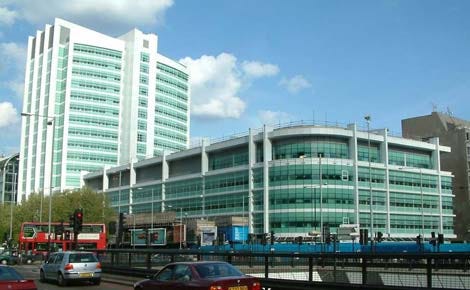
What really lets the place down is the service design job, or rather, lack of it. It’s as if the contractors left the building once the basic structure had been done. After that, little care appears to have been given to use of space, signage, design of systems etc. The food in vending machines is uniformly terrible — how can a hospital be selling crisps, fizzy drinks, powdered soups and chocolate bars? There are fabulous views east from the floor-to-ceiling window by the lifts, but a bizarrely hidden door entry system to the Early Pregnancy Unit 10 paces in the other direction. The ‘Enter’ button is actually positioned around a wall, away from the door. Moreover, the receptionist on the other side has to leave her chair to press the ‘door open’ button. When you’re at the EPU reception, there is only room for 3 people to sit. On the mornings we visited months before, there were 10 or 12 waiting for an appointment, so we have to overflow into an unused seminar room opposite, arranging the chairs into an impromptu waiting room. Another morning, however, this seminar room is in use. For a seminar. So we stand, or sit in the ward itself, as bed-ridden patients have consultations around us.
On one occasion, we have to sit in a storage cupboard to wait to receive some results. Receiving results is a nerve-wracking situation at the best of times. I’m not sure whether the absurdity of being asked to sit in a cupboard to wait and receive them makes this better or worse. And this, in an area allegedly designed for pregnant women. There were several other system faults that are really too tiresome to explain.
Odd, as the architects are Llewellyn Davies Yeang, with the latter being the interesting Ken Yeang — he of ‘ecodesign’ and a vertical theory of urban design etc. There’s little evidence of his work here, though.
While it’s clearly as state-of-the-art as a British PFI-built programme will allow, the building itself is nothing special. It doesn’t seem to aspire to do anything, or be particularly progressive at all, sadly. In that respect, the Cruciform Building is still more interesting.
For instance, the UCLH ‘skyscraper’ also makes a virtue of all floors gaining natural light. Yet Cruciform did that too. Technology has allowed it to be 16 storeys tall, but there’s no real conceptual advance. Similarly, each floor has a symbolic element — a polar bear on the children’s ward etc. — but as I noted, Waterhouse did that in his Manchester Town Hall too. Their colour-coding scheme, with each floor having a different colour, won’t be particularly relevant for patients, each of whom generally will only see one floor and the reception. As with website design and other spatial organisations with multiple non-linear access points, colour coding is not that relevant. Only the designers see all the floors, all the pages, all the colours, the overall scheme. I’ve no doubt many other improvements have been made, which my untrained eyes won’t perceive, but as a patient it didn’t feel like the great advance you’d expect from a new hospital in Central London.
There was a form of post-occupancy evaluation on the new UCLH in Building Design a couple of months ago. It was hardly objective, being conducted by a couple of the Llewellyn Davies Yeang team. Still, it’s an interesting read, having experienced the building myself as a patient. What’s particularly pertinent, other than the fact is was designed in 1995, is that the facilities management company, Interserve, get a gentle kicking in the article (lifts not working; floors not cleaned sufficiently etc.) from both architects and staff. This element of the living building is as fundamental as any other, and to see the architects and staff passing the buck indicates why it’s not working. Until these projects are run holistically and in multidisciplinary fashion, with the architects feeling more responsibility for this ongoing service design, these kind of holes will persist and patients, in this case, will suffer.
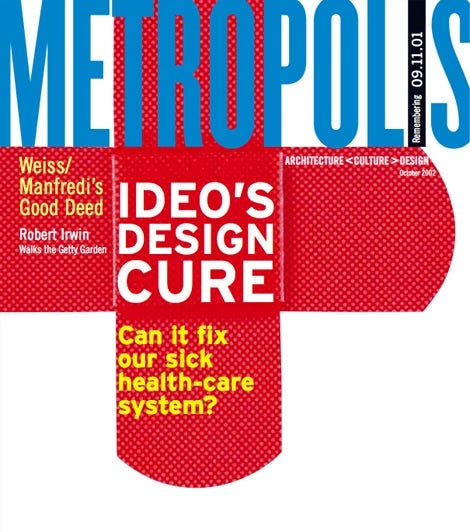
A while ago, IDEO did some interesting, progressive work on rapid-prototyping within a ‘patient-centred’ approach to redesigning hospitals in Indiana and St. Louis. (There’s an excellent Q&A with Peter Coughlan of IDEO, by Mark Hurst at Good Experience; Further, Metropolis magazine covered IDEO’s health care work.) Importantly, these were fixes that were “more informational than architectural.” (Wonder how the work was received — it’d be interesting to see the equivalent of a post-occupancy evaluation on that.) I’m not sure it always needs the sheer heft of a in-depth IDEO consultancy, though it would probably benefit from that. Most of fixing the above is common sense, and thus being able to take the time to lend attention to detail.
As with other bits of the NHS experience we were immersed in, the staff in these buildings were generally fantastic: hard-working, capable, knowledgeable, skilful, available, caring and helpful. However, the softer infrastructure around them — signage, systems, IT, interiors — was not so good.
I don’t want to rattle on about this, as much of the UCLH built experience was fine, nor do I wish to use Ollie’s birth as a platform to stand on for a moan. Hospitals suffer the unfortunate condition that, save for a few curious psychological anomalies, everyone is glad to see the back of them as soon as possible, no matter how well the job was done. Perhaps only prisons share this condition with medical establishments. What is it like to design and build under these conditions? Hospitals witness the extremes of human conditions, from intense joy to crushing despair, and yet are designed as places to numb, anaesthetise in all senses. And then you try to get out as soon as possible, perhaps because of the possibility of those extremes.
Though I was only there for an hour or so, I for one was certainly glad to have the long tube removed from the back of my hand, the pulse check from my finger, the heart-trace monitors peeled of my body, and to be out of there. But thanks to the extremely calm and capable doctors and nurses who helped me, and to Lucia, the midwife who came to check and ferried messages back and forth between C. and I. It was time for another trip up and down Gower Street and then back into Elizabeth Garrett Anderson Delivery Room 1.
Birthplace #8: Amenity Room 6, Nixon Suite, Elizabeth Garrett Anderson Hospital (part of UCH), Huntley Street, Central London
Early in the morning after the night before, the three of us — yes, now three — move up to floor five of Elizabeth Garrett Anderson, carrying multiple bags, nomads trying out yet another a new space in the hospital. We’re heading for one of the ‘amenity rooms’ — known as Green Rooms, due to the colour of their walls. These are rooms you have to pay for the use of, as opposed to going on the ward. I’ve nothing against public wards, but tired as we are and ready for a bit of focused rest, we decide to get one.
The pale green of the walls is, to my eyes, utterly redolent of British public service. It seems only to conjure up schools, hospitals, and other public works from the 1930s onwards, and in particular the green and yellow hard plastic plates that used to get stained purple with pickled beetroot at school. I seem to remember that Richard Macormac wanted to nod to this with a palette of colours for the new BBC Broadcasting House building, but it didn’t happen. I wonder why those colours are associated with that period? A form of paint technology meaning that could be produced in high volume for low cost? It’s actually a rather pleasing colour, and of course entirely fitting for an old British NHS hospital. The overall sensation reminds me of enamel tins, E.A. Rothholtz and Abram Games, Rennie’s, Isokon, Festival of Britain and so on. It’s almost impossible not to get nostalgic in these situations but equally, it’s important to resist. The atmosphere those things were forged in was progressive and wouldn’t have had much truck with nostalgia. That’s well skewered by Peter York here. Ultimately it’s good that this hospital is moving on.
However, for now, the room itself is peaceful and comfortable. The cupboard’s mirror is cracked and masking tape snakes across it. The old porcelain sink is pristine though. There’s an unnecessary television atop the cupboard — who would watch at a time like this? — but the rest of the room is fine, and in good nick.
Out of the window, there’s a view down onto a light well. It’s entirely covered with netting. Cedric Price might stick an aviary in there. That would be like a giant mobile for all the newborns. Looming over that, there’s a fine view of the excellent Post Office tower, or BT Tower, depending on your age/prediliction.
We’re only in the amenity room for a day or so, and then happy to be out with Oliver, out in the world with him for the first time.
Birthplace #9: Café Deco, Store Street, Central London
Before we’re out of the amenity rooms I have to leave the hospital as partners are asked to, on the first night. I’m not sure why this is — are we infectious? (Possibly.) Presumably it’s to ensure rest all round. Anyway, as our first night together is actually in Delivery Room 1, with me sleeping in a chair at the side of the bed that Oliver and C. lie on, I actually leave at 06.30 the morning after, walking out of Elizabeth Garrett Anderson, feeling a warm ebb and flow of emotions and thoughts that I can’t place, or describe.
Rather than head home and go straight to sleep, I feel I have to mark the occasion somehow. And given my ‘episode’, as the doctors called it, using that appropriately dramatic term, I should get something to eat. I should also skip down the road like Gene Kelly, but it’s not raining. It’s actually a lovely sunny morning. I have a full English breakfast instead, having virtually floated to Café Deco on Store Street, just around the corner from our flat. I need some ballast.
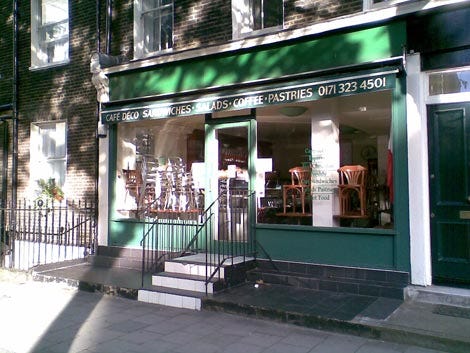
Café Deco looks like it should be just about the best Italian-run English caff in London, but it doesn’t quite cut the mustard. I like the place, but despite itself. It closes too early, and though the food is good solid greasy spoon nosh, it’s nothing special. It’s a great spot, although the traffic of Gower Street needs to come down a notch. But nice and light, with lovely big windows shrouded by trees, and the tables outside are excellent places to watch the street perform. This particular morning I watch in amused horror as the ‘chef’ peels a pre-cooked, chilled, flattened fried egg from a clingfilm-wrapped plate covered in 7 or 8 such things, rubbery grey-white discs of albumen dotted with pale yellow, and adds that to the plate in the microwave, which has sausage, bacon and beans on it. That’s not quite right. Still, with a hearty dollop of tomato ketchup, an uncharacteristic teaspoon of sugar in my tea, and on this morning, everything tastes fantastic.
I stop off next door at the newsagents beforehand, to buy three newspapers — again, trying to mark the day. They are of course the day after, so that doesn’t really work. I also feeling like announcing to everyone in the café — about four workmen, also sitting outside, smoking and intently studying quite different publications to mine — that I’m a new dad, and looking forward to their hearty congratulations, men bonding over my new fatherhood. But instead I sit there, quietly eating my breakfast and glancing at the newspapers, not really taking them in, and I watch Store Street slowly wake up.
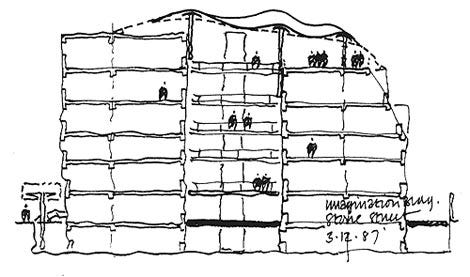
I love Store Street. It’s between two hellish streets for traffic in Tottenham Court Road and Gower Street, but generally avoids any overflow. It has a row of independent, idiosyncratic shops and cafés on it, struggling valiantly against Britain’s creeping homogenous high street chains. It’s home to New London Architecture; Cedric Price had his offices around the corner; and the Imagination Building features a conversion by Archigram’s Ron Herron on the roof.
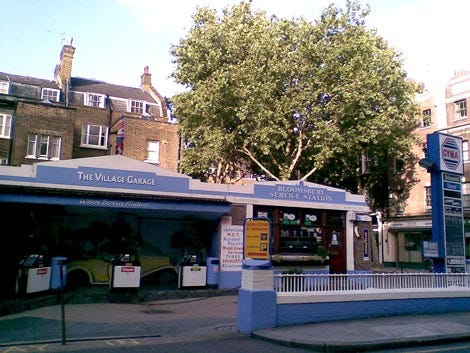
There’s a Korean supermarket which always has men sitting outside it, chatting all day, sometimes squatting on their haunches in the oriental fashion, other times propped on a pile of the Korea Times. Unlike the Anglo-Brits, these guys know how to use the street. Fopp was 20 paces away until a month ago; there’s Busaba Eathai and a not-great pub; despite the late 20th century, there’s an independently-run garage. (Ed. About five years later, much of this had gone, such as the garage and the Korean supermarket. There is still a healthy independent strain to some of the spaces—and some certainly improved, if a little more up-market—but other addresses have indeed become generic franchises, and the street’s lost of some of its charm.)
Allegedly, Mary Wollstonecraft wrote the Vindication of the Rights of Women here in 1792; it’s got good trees; and you can sit outside Café Deco, on the corner of it and quietly eat a full English breakfast having just seen your first child enter the world.
Some of my happiest personal moments have been alone in cafés in cities, in the rare moments when I’ve had time to just sit and enjoy it. I have numerous other happy memories with others, but the quiet solitude of sitting having a coffee in a café, with nothing to rush you, is such a delicious pleasure. I remember distinctly a coffee in a café by the Tate in Pimlico about 10 years ago; a series of flat whites at Urban Grind in Brisbane last year, and many others in-between, often when I’m on business in a city overseas and find myself in some non-time in the gaps between flights, meetings, conferences. It’s a complete luxury of time and space — what Will Hutton and others call ‘time sovereignty’ and usually apply to working patterns. It is to be grasped firmly if the opportunity presents itself. And ironically, given everyone’s knowing warnings about ‘never having any more time ever again’, Oliver’s birth offers up such an opportunity.
Birthplace #10: Transitional Care Unit, Elizabeth Garrett Anderson Hospital (UCLH), Huntley Street, Central London
A day after walking home with C. and Oliver, we have to return to Elizabeth Garrett Anderson, as the bub has a bit of jaundice and weight loss. Nothing serious, but they have to keep an eye on it. So it’s back into hospital, and I do the 10-minute journey between Gower Mews and Huntley Street maybe 20 more times over the next three days.
EGA’s Transitional Care Unit has about 12 beds, across 2 open wards and a few amenity rooms. This time we’re on a ward, which is another new experience. It is of course a fairly open space, with frequent good attention from midwives and nurses, and then further visits from various specialists. Privacy is occasionally sought, so that C. can get some kip and the curtains on rails around the bed provide temporary walls. These really are curtain walls.
A ward is a public place, providing random cross-sections of society. Like a park, a public library or a school. Actually, more like a park, given the way schools increasingly tend to focus around socio-economic groups and British public libraries increasingly tend to disappear, sadly. Parks, libraries and hospitals — as well as some streets — may be the few places where all socio-economic groups are present. (At least in the UK, or in other nations with a strong tradition and practice of public health care.)
In the 4 beds immediately surrounding us we get another glimpse of the flavour of London, as with the antenatal classes. C. and I are Australian x British Anglo-Saxon in origin, and I’d guess that the nationalities immediately surrounding us are: Bulgarian x American; American-Polynesian x British-Lebanese; French/Asian x White French; British Anglo Saxon x Japanese. This mix is only likely to happen in a major world city, and it gives me such pleasure. It’s that fundamental point of the city. The condition that makes the city the greatest of all human inventions: ensuring people encounter diversity and difference in the space that they inhabit.
Cities are places where learning to live with strangers can happen directly, bodily, physically, on the ground. The size, density, and diversity of urban populations makes this sensate contact possible — but not inevitable. One of the key issues in urban life, and in urban studies, is how to make the complexities a city contains actually interact. [‘Capitalism and the City’, Richard Sennett, Zentrum für Kunst und Medientechnologie Karlsruhe]
The hospital ward is one such place where the complexities inherent within a large city actually interact. And despite its erosion in public life, as with libraries, it was still alive and kicking at Elizabeth Garrett Anderson.
In the few days we’re on this ward, we learn a lot about having a baby too. The public ward affords many opportunities for asking midwives and nurses, as it has the essential properties of a corridor. It’s the kind of space that architects like Gehry try so hard to carve into spaces like the MIT Stata building. A thoroughfare, with pockets of people dotted along it, maximising the possibilities for informal interaction.
It actually makes us think that we’re out of hospital too early in the UK. It’s usually within 48 hours of the birth. My mother had to be virtually kicked out of the hospital in Zürich I was born in, after nine days. It was too good. Our Finnish neighbours report you’re in hospital for four or five days after birth in there. That seems better system, in terms of both care but also informally gaining parenting skills. I don’t know if this is a philosophical decision or a pressure on hospital beds in the UK.
The staff are generally fantastic here. Yet midwives and nurses are working 12.5 hour shifts on average, with one nurse saying she’d done a 15-hour shift the day before, unable to get away. Given shift patterns, and these long hours, patients receive sometimes apparently contradictory advice from different people on different days. A few of our fellow residents on the ward reported this too.
There are a couple of possible fixes here. C. suggests a simple visible communication of what patients have been told, affixed above the bed, even on a whiteboard. There are written notes, but they’re kept away from the patient, and only scanned by the practitioner in real-time. That would certainly help.
Another is to do the shifting cast of players. There are nurses, neo-natal nurses, midwives, doctors and consultants. And different ones each day. All work across the ward, and all have different areas of expertise and levels of authority. You have little idea of which is which, and as each is dressed in civvies, you’ve no way of knowing who is who.
One small improvement might be a return to uniforms. This would enable you, at a glance from 20 metres away, to spot a midwife approaching and direct your midwife questions to her. While we might have moved away from uniforms for some good reasons, we have lost some functionality as a result. Again, this is not exactly service design gold, and hardly with the prevailing mood in terms of workwear. The creative challenge would be to do it in ways that didn’t run counter to the active birth philosophies mentioned earlier, but to convey a sense specific expertise where that is relevant. By the time you’re on a transitional care ward, you’re perfectly happy with the idea of medical intervention.
There are some other things about this space you’d fix — the only source of drinking water is behind the door entry system, which fails numerous times in the few days we’re there. Put one in the ward.
But again, this is Elizabeth Garrett Anderson — a very old hospital, which is about to be moved. And despite the above and more, thanks to the energy and expertise of the staff and Oliver’s improving health, we’re happy with our few days there.
Birthplace #11: Home, Gower Mews, Central London
Home, finally, and for good, for now. I pace our small living room, carefully carrying this little bundle, shushing him to sleep. Time begins to slip around, become fluid.
I play The Necks’ Mosquito/See-Through on repeat. As each of the two tracks takes an hour, and is composed of repetitive fragments in the first place, placing them on repeat seems like a very odd thing to do. It feels an odd use of ‘the interface’. They are almost inherently ‘on repeat’, structurally. Mosquito just sounds apt, its trickling percussion and twinkling piano possibly conducive to re-creating womb-like conditions. As far as I know.
Sod all that new age nonsense of whale song and ambient electronica for the baby. Wombs sound more like Sunn O))) as I understand it. Apparently new-born babies like white noise, so I mentally reconfigure the space in the apartment accordingly, as we seek out promising areas: the hum of the fridge; the extractor fan in the bathroom; the water heater by the kitchen; we move towards taxis as they turn round outside the window. Raymond Scott’s 1963 classic Soothing Sounds for Babies might be investigated later, but just for fun and just for me. Our friend M. reminds me that nice tasteful Scandi wooden toys are for the parents whereas kids love those horrible garish plastic horrors that make unpleasant noises and probably consist entirely of toxic components assembled by child labour.

For now an Aussie piano trio is all that’s required. See-through is just as good, not least for the way the sense of space is articulated. The track is composed of great swathes of silence sitting amidst pools of shimmering noise — presumably lending the porous allusion in the title. It feels, structurally, like encountering a loose lattice of Diller+Scofidio blur buildings in an endless ocean. While Ollie is briefly asleep on my chest, I’m reading James Cook’s Hunt for the Southern Continent (in the beautiful Penguin Great Journeys edition), which also suggests this idea that the track might be a meandering route-less voyage, chancing upon mighty ice masses amidst a vast fathomless sea of nothingness.
Again, the sheer length and fluid formal qualities of the music distort my sense of time, proving a perfect accompaniment for this continual circuit of the room. Having lived in the same place for over four years, the room now becomes familiar in new ways. I see new details, and reconsider the space, just as the arrival of Oliver and our imminent move to Australia — meaning many belongings are now in a crate in Wembley, ready to be container-shipped across that great Southern ocean — has reconfigured the room and its primary functions. What was once a wall of vinyl and art and architecture monographs is now dominated by a tall shelf of nappies, babygros, muslin cloths and a changing table. This is a good thing, but before Oliver arrived, the room was in limbo, and felt half-naked as a result. (A half-naked limbo might sound appealing, but isn’t in this case.)
Now Oliver has moved in, it feels more alive than its ever been, with entirely new, and very bodily, functions. It works. But what’s actually going on is that this room is suggesting the next room, which will be in Sydney, Australia. Its change in function is its last act, and as I pace around I fantasise instead about living in a Jean Prouvé Maison Tropicale, hoisted up on the hills above Bronte beach. Despite our endless circuits of the room, we’re already moving on.
I will be sad to leave the Mews itself, too. Earlier, I’d carried Oliver up and down the sunny mews, the sling pacifying him and therefore me, my free hand hoisting up a copy of James Cook, who was at that point sailing north from Antarctica thoroughly annoyed with the lack of prospects amidst the giant icebergs.
The London mews is a near-perfect urban form for living in, at least in this city: medium density but low-rise scale; a semi-pedestrianised space that safely swallows up cars, without passing traffic; capable of being spruced up with pot plants and small trees; tucked in between larger roads and streets, so generally amidst services and shops. It seems like a sawn-off version of the continental European apartment block, perhaps the closest thing London got to that fine form without copying it, or a Tokyo side-street. Instead of European square of apartments surrounding a shared internal courtyard, the mews takes those same apartments, unfurls them and lays them down end on end with a shared drive. It’s not quite as efficient, but close, and with similar civic qualities.
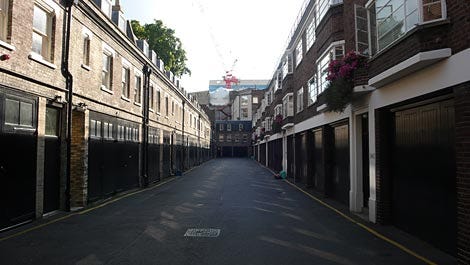
A Bloomsbury mews like ours is generally a little more functional, utilitarian that its West London alternatives in Chelsea and Pimlico. It has fewer of the wooden plant boxes and garage conversions with more garages used as storage for local businesses. The Korean grocer around the corner on Store Street employs a garage for storage here. Closer, a cleaning company called Sparkle Cleaning equips its vans with products first thing every morning. The other garages are used as parking space, and rarely to do with the flats above.
Gower Mews has been here since at least 1792. I recall seeing it on maps of the city at the excellent ‘London — A Life In Maps’ British Library exhibition that I visited with R+J last year.
It’s clearly visible on Harwood’s “PLAN of the Cities of LONDON and WESTMINSTER the Borough of SOUTHWARK and PARTS adjoining Shewing every HOUSE”, from 1792. It is clearly shewn here (below). Note that it is right at the edge of the developed patch of central London.

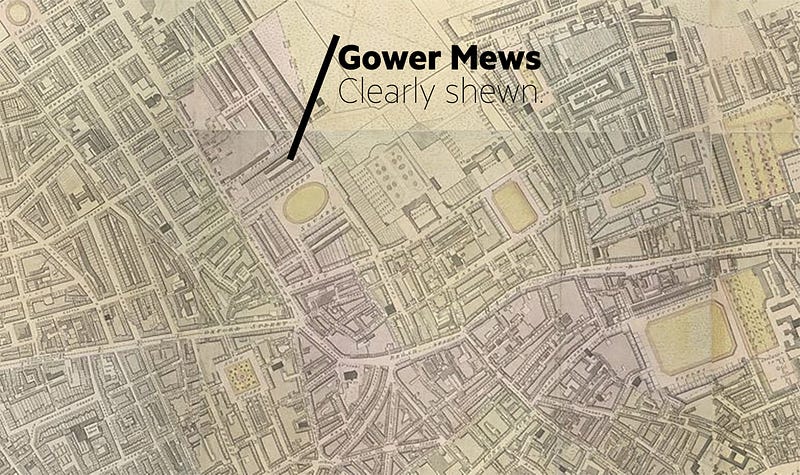
But I don’t think it’s on Rocque’s An Exact Survey of the Citys of London, Westminster, ye Borough of Southwark, and the Country near Ten Miles round from 1746.
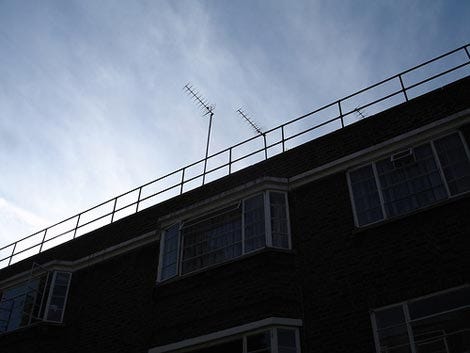
There are a couple of layers of history visible in the brickwork, even of this small Mews. One side looks Victorian — recessed sash windows, flush garage doors, and a garret-level top floor. The other looks more inter-war — metal frame bay windows, recessed garage doors, flat roof.
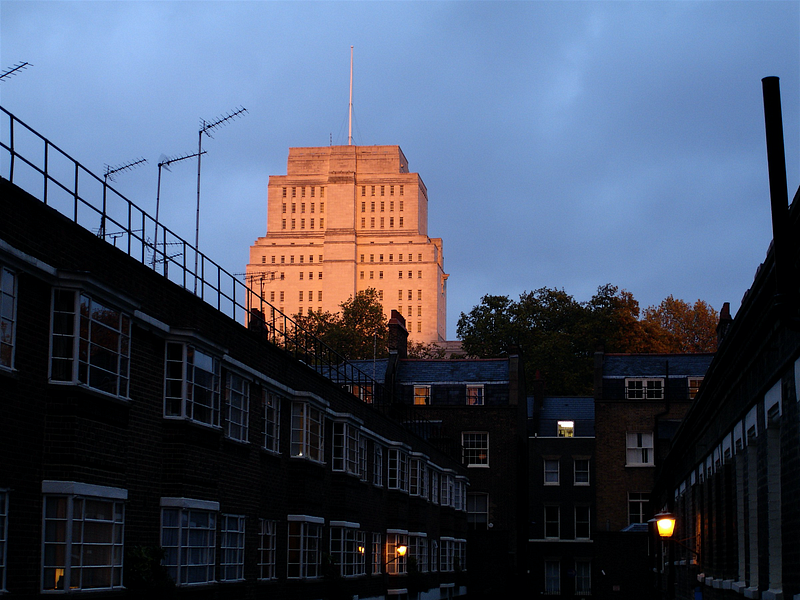
This side could be post-war bomb damaged houses rebuilt, but the style looks slightly earlier than 1950s. It reminds my mother of the 1930s blocks in the far North West London of her youth. So perhaps it is interwar rebuilding; but what bomb damage from World War 1? There was some bombing of London in WWI, from Zeppelin raids. (What a romantic way to trash half a street — in a zeppelin raid. I’ve walked past this great plaque on Farringdon Road many times.)

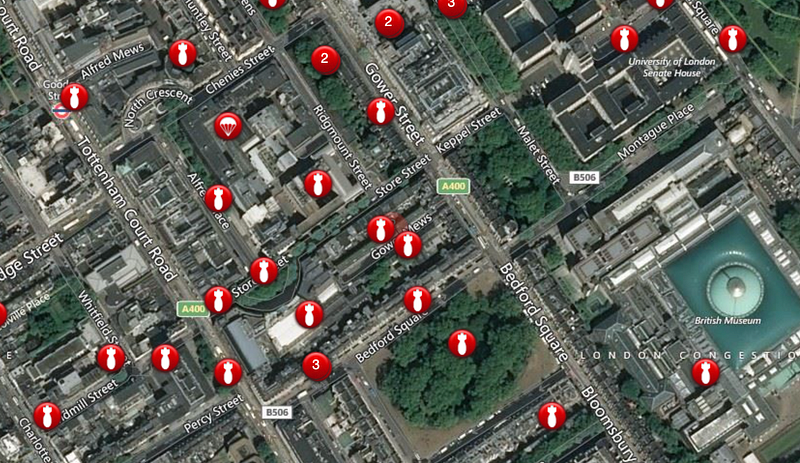
(Ed. Some years later, the Bombsight website suggests that, despite my ‘romantic longing’ for a Zeppelin bomb, Gower Mews took at least one, perhaps two, high-explosive bomb hits during World War 2, with the map indicating this ‘non-Victorian’ side to the left, from my point-of-view. So it must be a late-40s, early-50s rebuild after all.)
Time for another quote on the way London redevelops itself, this time from Churchill:
London is like some huge prehistoric animal, capable of enduring terrible injuries, mangled and bleeding from many wounds, and yet preserving its life and movement.
But I have no evidence that one side of the Mews was rebuilt for any other reasons than a spot of dry rot. (Subsequent Ed. Though see above.)
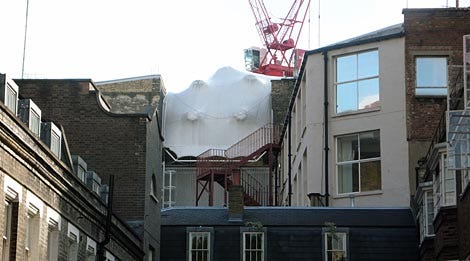
The Mews is sandwiched between a few great bits of architecture, on different scales. A dimpled canopy over the atrium on the Imagination building behind us, converted by Ron Herron of Archigram fame, from an Edwardian schoolhouse in the South Crescent of Store Street. This is almost secret, spied only from a few aspects—including this one—so how lovely to live under a chunk of London designed by the man who gave us The Walking City.
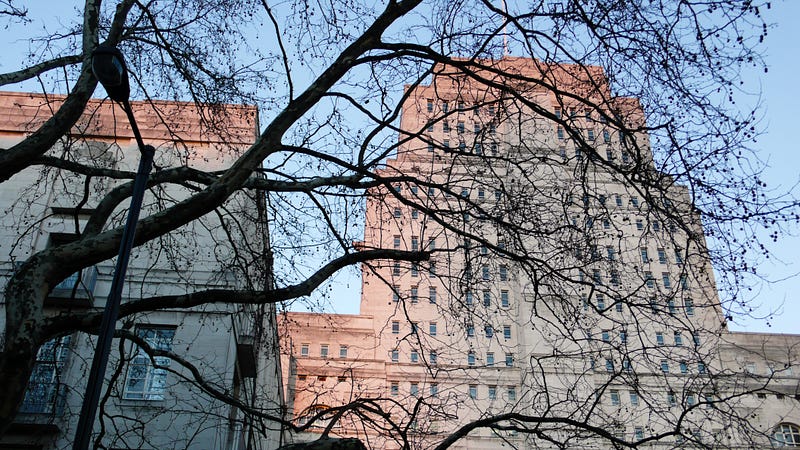
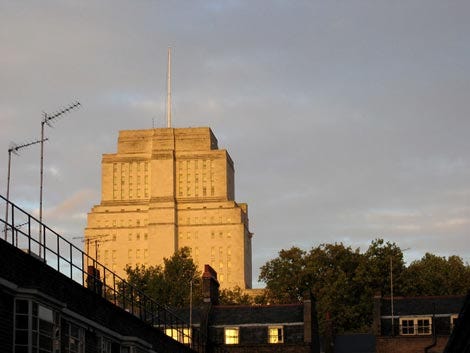
Bedford Square is to the right (I can hear the wind rustling through its trees as I type); and there’s a wonderful view of the imposing Senate House in front, gleaming in the sun during the day and well-lit at night. I’ve written about Senate House in some depth before. I’ll miss it.
This apartment, and the Mews, is the quietest place I’ve ever lived in London, despite being bang in the middle. Far quieter than Stoke Newington, Clapham, Shoreditch, Fitzrovia … I repeat this hymn to quietness, noisily, until C. can stand it no more.
We’re right at the end of the Mews, with a view up back up the street. Perfect for people watching, and over the four years I’ve lived here, I’ve built up a detailed picture of who lives where, speculating as to what they do, sometimes giving them fake names I won’t reveal here. It may not be surprising that ‘Rear Window’ is one of my favourite films. This Mews isn’t that diverse for London, but it’s still diverse, and that diversity is one of the things I enjoy the most about living here.
There’s an opera singer a few doors down on the left. How Bloomsbury? We’ve often heard her warbling up and down the scales during the day. If it’s who we think it is, she’s pregnant too. (We can’t confirm the opera singer is the person we see leaving the flat, having never seen her sing. She just looks like one.) I say congratulations to her, and she asks how long I’ve been in the Mews. I reply “Four years”. They’ve been there 10 years. “The last bargain in London”, she claims, smiling. (Many London conversations between strangers turn quickly to property.) They’d only noticed me recently, she laughs. She thinks that’s “Very London”.
(Ed. A month after I posted this at cityofsound.com, the opera singer neighbour (Louise) posted this comment: “Hi, Just been researching the Bloomsbury Birthing Centre and stumbled upon your fantastic musings! I am the warbling opera singer….afraid you do get the scales and the practise rather than the performance from the windows of the flat….(apologies!) I agree that the Mews is a wonderful place to live and indeed there is a real sense of community here in its own reserved kind of way. You mention Jessie (my wonderful neighbour who died 2 months ago). She had lived in London all her life and moved to Gower Mews in the 50s when she got married and said she was so proud of her little flat. She tolerated my singing with great fortitude and told me she missed my tunes when she finally had to go into a nursing home. She also told me many interesting tales of the Mews too numerous to mention here, suffice to say there have been many famous, infamous and colourful residents here over her time! Anyway, sad to hear you are moving after just being introduced! Good luck and congratulations on your baby boy.”
Upstairs are our wonderful Finnish neighbours plus 8-month-old Alvar, who are moving to Helsinki about the time we move to Sydney. (Ed. In a curious and lovely turn of events, we ended up moving from Sydney to Helsinki four years later, to end up in an apartment about two blocks away from these Finnish neighbours again!)
There’s an American-British couple up the road who have a had a baby recently too. We’re beginning to repopulate central London. There’s a couple of little old ladies further up. Adjoining to the left is a flat of four impossibly cool Japanese students, who pop out at night to smoke; glamorous in the way that only Japanese students could be, apparently with a different outfit every day … And so on, and so on, up the Mews.
Steven Johnson has written about the social cohesion that a baby affords. As he put it, “children strengthen the connective tissue of urban streets.” I don’t mean to suggest that social cohesion is only possible via toddlers. Indeed it would be unutterably lazy, selfish and careless to rely on a baby to engender good civic behaviour; equally, folks without babies are entirely capable of creating their own ‘connective tissue’ in cities, thankyouverymuch. But it’s certainly true for us that our neighbourhood has become something we’ve engaged with more, as Oliver approached. Our street has tilted on its axis slightly, as our lives have.
Even before Oliver, I felt more at home — actually in a neighbourhood — than at any other point in my 10-year history in London. I actually know my neighbours. The note of surprise there is very real. I’ve never had that in London before.
And yet I think the one of the little old ladies who lived next door to the left may have died recently. The one I used to say hello to as she peered down from her living room window. I’m not sure. There were reports of a hearse one morning, and I just haven’t seen her at all recently. The picture frames are still propped up on her window sills, but the curtains aren’t drawn at night. So the social binding is so loose that a neighbour can die and you don’t know about it. Indeed she might not be dead. This, it seems to me, might be a condition of an archetypal contemporary central London street. (Ed. See Louise’s comment above.)
For Jonathan Raban, the anonymity of the city has been a theme through many of his books, from Soft City, via Hunting Mister Heartbreak, to his recent Surveillance. It is a great pleasure of cities; the ability to lose oneself in a crowd, in a street. Equally, Richard Sennett’s point I quoted earlier — learning to live and interact with strangers — is also fundamental. Rear Window is poised on this contradiction between anonymous observation and visible participation. It’s this fluid, homeostatic balancing act of life — it’s up to you how you choose to live your life, but always in the context of others — that makes the urban experience so rich.
Birthplace #12: Bloomsbury, Central London
Our first night home with Oliver, and we’re not sure exactly how to put him to bed without him waking. This is before the learning acquired when we’re re-admitted to the Transitional Care Unit. So I end up taking Oliver on a long three-hour walk at 6AM on a Sunday morning, back and forth around the four or five blocks of Bloomsbury that surround our flat. He’s in a sling, fast asleep for most of the time.
Going over the same terrain, over and over again, even terrain I’ve walked a thousand times, I see it in a new light, particularly on this cool overcast early Sunday morning, with streets largely without traffic. It gives me a chance to write about the area Oliver arrives in, and that we’ll be leaving soon.
I’ve written a fair bit about Bloomsbury over the years — on the Brunswick Centre, Senate House, Bedford Square, the London bombing, filming Batman, even the collision of 4 different types of street sign on our street corner.
We wander across to Bedford Square, a few metres from the entrance of Gower Mews. Writing about the privatisation of Bedford Square, I’d provoked a response from Mark de Rivaz, Steward of the London Estate — and our landlord, I guess.( You can read the comments here in the original post, before I reposted the piece here). It’s lengthy, lucid, considered, historically informed and though I have never replied to his comment, hoping others might offer a further opinion, I still don’t agree with him. As one of the earlier comments notes, neighbouring public squares like Russell Square, Gordon Square and Bloomsbury Square are all well-kept and well-used all year round. The centre of Bedford Square itself is still empty of people almost all of the time. That just can’t be right. When a centrepiece garden like that is kept pristine but also devoid of people, you can only assume its primary use is to lift property prices. It becomes little more than an attractive buttonhole.
The improvements to the street furniture on Bedford Square have spruced the place up no end, but there are still issues with drug users around the Square. What would really change the Square, as well as making the centrepiece public, is a more mixed-use approach to tenants, curating the area somewhat, as previously discussed. This would mean the Bedford Estates not trying to earn maximum revenue from every square metre, but seeing the betterment of the area as a goal too, balancing their income across a few high earners to offset a few different tenants that aren’t charged as much. Freed of the constraints of maximising revenue, genuinely improving the area through mixed-use development becomes an achievable goal. I can’t see that happening anywhere in property-obsessed London though.
However, the Bedford family have owned the area since 1669 — when it really was all fields — and would argue they know what they’re doing.
It’s heartening to see one property on the Square — the first for year s— applying for planning permission for conversion back to residential use. But the only other non-commercial use on the square is the Architectural Association, and that’s disappointingly opaque most of the time. Ironically, the AA needs to work on its public access and permeability, it really does.
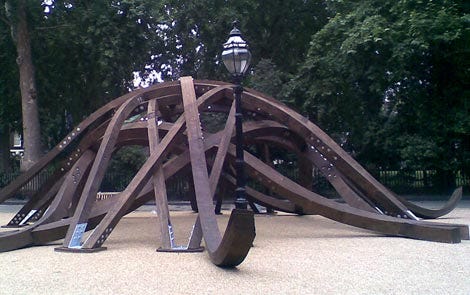
One recent initiative the AA does well is a summer pavilion for Bedford Square. Last year’s was fascinating, possibly derived from 3D Pythagorean trees. This year’s is equally good, being a dome-like structure composed of huge sweeping wooden struts, curving up at the ends like great Wooly Mammoth tusks. Alone in the square, we stand underneath it, a limited bit of cover from a few spits of rain. It’s a nice piece of work, from a project by student Margaret Dewhurst. On sunny days, the great trunks of wood become impromptu seats for people to lean back on.
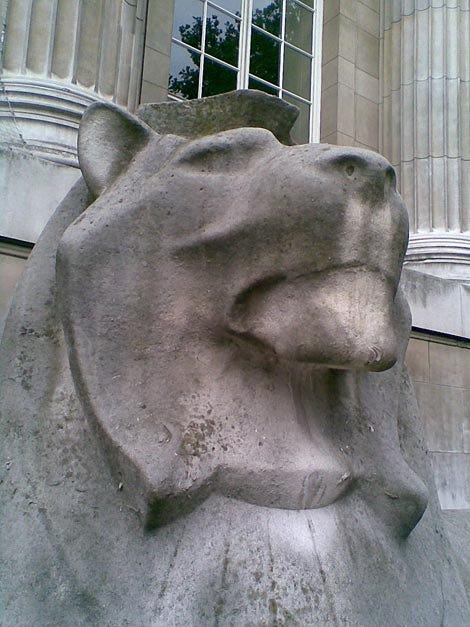
Wandering across to the British Museum, I note the Great Court opens at 9AM, and pin that as our goal … Ollie seems OK with this. Then again, he’s three days old — what does he know? Two drowsy, punky young Americans hail me from across the street, asking for directions to Bedford Place. The girl is annoying at first, but they both melt on seeing Oliver in the sling. They stumble off towards Russell Square, heading roughly in the right direction. I see them ask for clarification from a tourist coach driver no more than 20 metres further on, having clearly forgotten anything beyond the last 10 seconds. Oliver and I turn our attention to the two fine haughty lions, imperiously guarding the back entrance of the British Museum.
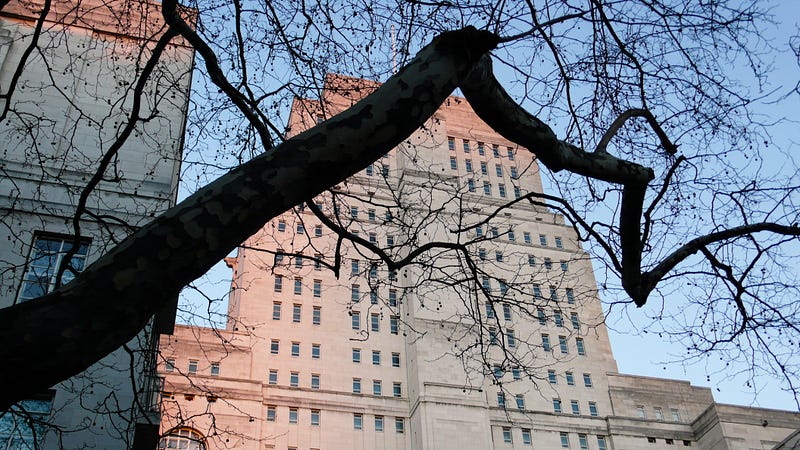
Bloomsbury is physically and psychologically dominated by two large institutions, whose administrative relationships are entwined in such labyrinthine ways it’s impossible to pick them apart: University College London (UCL) and University College London Hospital (UCLH). I’ve written quite enough about the latter in this series, and a fair bit about the former, including its complex history emerging from the University of London, in my tour of the iconic 1930s building, Senate House, the university’s administrative headquarters.
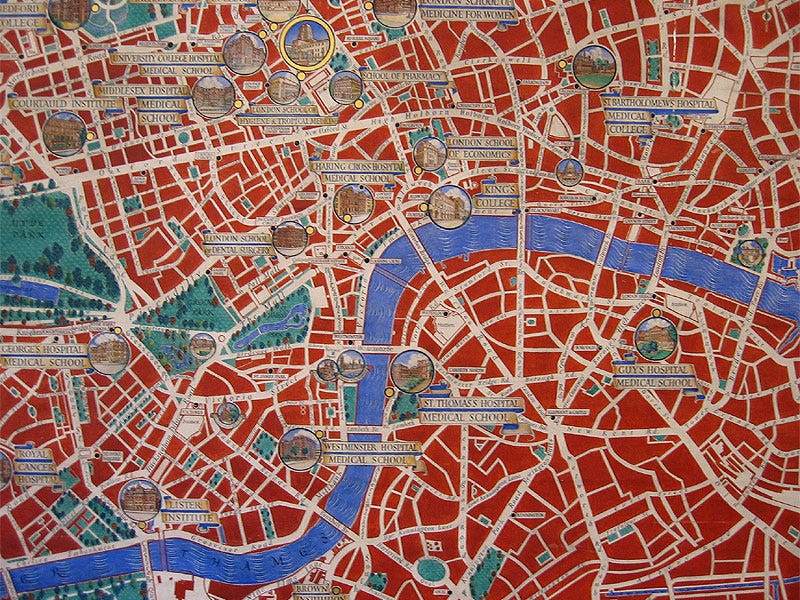
Like London itself, the University of London was poly-nodal, with multiple institutions under its umbrella. A smart concept, ahead of its time maybe. It was a network of networks, and is depicted at its simplest in a beautiful tapestry map in Senate House. Still, that’s wall-sized and it’s got more complex since then.
The centrepiece and focal point was always this area though, with Senate House at its heart. Its influence spreads over the entire area, though, with the end result that it almost feels like a campus. It lends the place “the character of a university town” according to Peter Campbell, in a lovely piece on the area in the London Review of Books.
This it does, and there’s a remarkably placid, civic feel to the place. Even though the area around Malet Street is historically a home to protest, it’s always a very genteel form of protest.
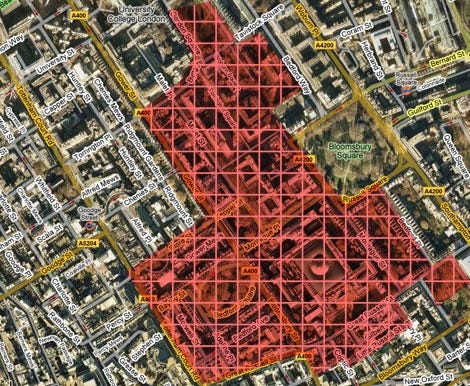
The smallish area we’re walking around is marked out here. You can see the area is characterised by squares, the university, and the British Museum, with the hospital to the left. Just out of view are the Brunswick Centre to the right, and then all of London’s centre further to the left. As such, this area is perfectly placed and articulated — a “university town”, with numerous perfect green squares, and almost everything else you’d need within walking distance.
Strolling through the UCL campus, we look ahead to see someone stretching, preparing for a run. There is hardly anyone else around. To our left is a small but neat extension of SOAS — the famous School of Oriental and African studies. Next to a curving 1930s block, it enjoys floor-to-ceiling picture windows, with text in numerous scripts engraved on the left-hand panes, from ground to roof.
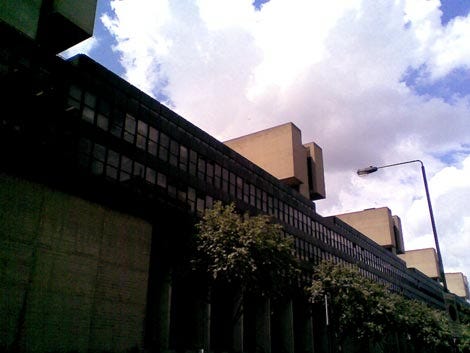
We then come to a favourite point of mine: the Denys Lasdun-designed Institute of Education building. I love this megastructure of a building. It actually picked up the gauntlet of the original plans for Senate House, which proposed a vast extension to the north of the tower. That never happened, but Lasdun’s Institute of Education, opened in 1977, at least continued in the same brave, progressive vein. Though this too only completed one of the five proposed wings.
Round the back, where we are, there is what I reckon is London’s Most Thrilling Staircase. It seems to rear up at you and recline backwards, simultaneously. It provides a serrated edge to this side of the building, and punctuated with holes, frames numerous great views from all angles. So thrilling is the staircase, in fact, that access seems utterly denied, with metal railings all around every possible egress point.
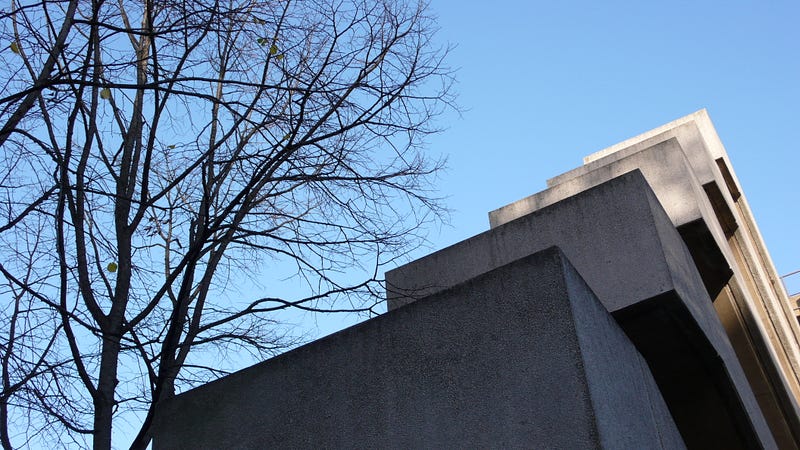
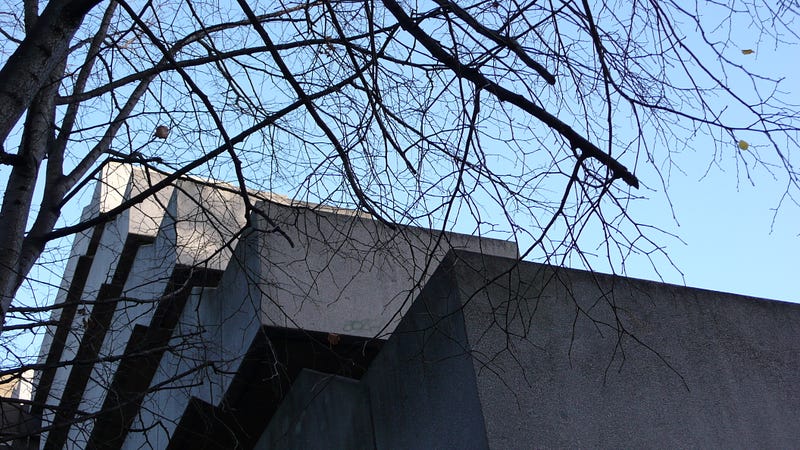
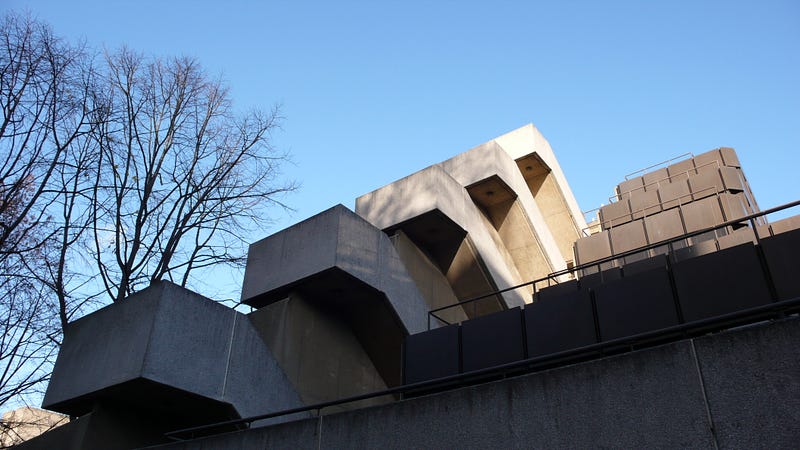
I suppose it might have some competition from Lasdun et al’s other staircases on the South Bank. The Trellick Tower’s staircase is too showy, too obvious. And I’m discounting the many fine internal staircases in London. So this is it. I pause to consider the fact that I’ve made a up mental list of London’s Most Thrilling Staircases. I move on, quickly.
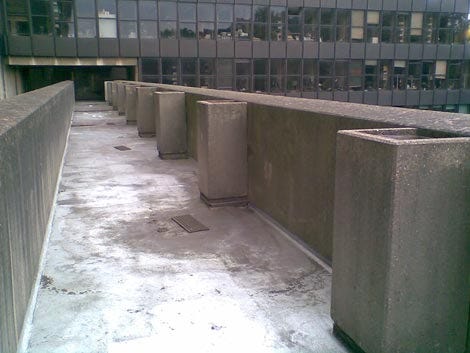
I walk across the rear courtyard of the IoE with Oliver, and up some stairs to a podium level to nowhere. There are what I assume to be concrete plant pots built into the podium wall, sadly dry and bereft of life. Imagine how popular opinion of brutalist buildings might change if they were actually kept as green as they were supposed to be? This kind of building looks extraordinary when encrusted or engulfed in green, or visually counterpointed by stark pencil scratches of denuded branches in winter. Why are our finest buildings not serviced properly?
A security guard sleepily calls up to ask “What I’m looking for?” I say I’m just looking around, going for a walk with my baby. He says I’ll set off alarms, so I saunter back down the steps, half-heartedly, It’s a podium to nowhere — what alarms? Investing in alarms but not plant pots seems odd. The guard is good-natured though, closer to Ollie’s heavy-lidded state than my inquisitive meandering — I imagine he’ll be asleep within minutes too.
Peter Campbell’s aforementioned LRB article centres on Russell Square, and the Bloomsbury squares in general. Though he disagrees with me about private squares — he says they’re better than private gardens; I say let’s have private gardens and public squares — he paints a good likeness of the reinvigorated Russell Square:
In the centre children tease the new, pond-less fountain by dashing through the spray; flocks of parasite-ridden pigeons ease the itch as they bathe there with ruffled feathers. If you cross the square early you strike the dog walkers and the t’ai chi adepts. Later it is tourists asking the way, unable to believe that the British Museum can be where their maps say it is, and parties of schoolchildren eating their sandwiches.
Friends of mine think it disgraceful that the wiping clean of the area has also eradicated the casual and harmless gay sex that Russell and Bloomsbury Squares afforded the night. Indeed, the squares are possibly too sanitised now. As with the Brunswick Centre, this involves a fine balancing act possibly beyond the nous of London’s private developers or public councils. Or more generously, beyond the tight, property-driven framework that contemporary London allows them.
As we approach Russell Square this morning, I spot a slightly bedraggled man hopping out of the bush on a traffic island near the square, and start scrabbling around in the undergrowth, looking for something. I don’t think he’s an amateur botanist, though he may be looking for a weed of sorts. But probably something harder. He’s harmless enough.
Also scrabbling around in the undergrowth, though you’d expect them to, are several squirrels. Seeing them frozen on the spot, barely twitching, then darting with impossible speed, then freezing again, I’m reminded of John Updike’s characterisation of squirrels as constantly posing for photographs.
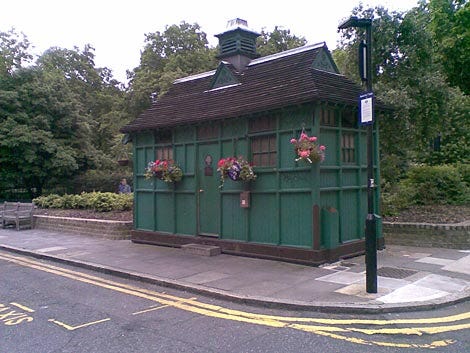
We head back towards UCL, past the Cabman’s shelter, past the Faber building on the corner, with the brown plaque commemorating when TS Eliot worked there. Bloomsbury has an intense concentration of heritage plaques, and as we wander over to Gordon Square, via Woburn Square, we see an aggregate plaque for the Bloomsbury set — great artists, writers, economists but also purveyors of the hilarious Dreadnaught Hoax, in which abearded Virginia Woolf fools the British Navy. Writing, publishing and a gently British political provocation infuses much of the psychogeography here.
The squares are gorgeous. What a great bit of planning this is. No need for a large park, surrounded by serried ranks of streets. Far better to intersperse the area with a series of smaller squares. This kind of London pattern reveals the poverty of imagination that is Central Park in New York. I’ve already mentioned the private Bedford Square and the public Russell Square, but there are several lesser-known public squares — Gordon, Bloomsbury, Woburn — that are all well-used and well-kept.
Surrounding each is a quiet riot of varied architectural styles, but at its core the Georgian terrace. Campbell again:
The homogenous domestic style of the Bloomsbury squares starts very simple (brick, with stucco ground floors and no ornament except around doorcases). Even the full stucco fronts and porches of the later 1800s are not much more than heavier make-up on the same faces. These styles still cover much of Bloomsbury like tattered wallpaper.
Indeed they do, but what wallpaper. There’s a pure, minimalist grace to the Georgian terrace, which is also extremely adaptable. Campbell notes “the terrace house is an adaptable building type which can fit most needs.” As with the Harley Street buildings earlier, it’s an adaptive design of firm foundations, and simple, clear, boxy layers that can stand a fair bit of reconfiguring. Its clear beauty and human scale, and lack of the rich ornamental detailing that came later, also enable simple conversions.
We wander across to Gower Street. Gower Street is a bit sad, really. It was clearly a very fine London street once, but is now impossibly choked with traffic. The current incarnation of the street is defined by many useless hotels — and a few nice small ones — and even some derelict terraces, which is amazing and terrible given the location and fine building stock.
There’s the original RADA building. Bisexual society hostess and incurable romantic Lady Ottoline Morrell had a house just opposite the entrance to our Mews. And in between the two, appropriately for a street effectively lying dormant in terms of genuine use, there’s a plaque marking where the first anaesthetic was given in Britain. The street itself has now been anaesthetised by traffic coursing through its veins, and is going nowhere slowly, just like the cars and buses. The new UCLH dominates the top end, and Bedford Square marks the bottom end, but aside from all the blue plaquery, the only real point of interest is the excellent Waterstones bookshop at no. 82, which specialises in academic text books and has a good remainders department.
Across Gower Street, we’re veering too close to the hospital Oliver’s just emerged from, so we wander back, pausing only to note the lovely solid mansion blocks of Ridgmount Gardens and Gordon Mansions. British architecture has none of the lightness or permeability of, say, Pacific Asian/American equivalents, simply due to the climate. It’s brick and stone, in varying degrees of grace. It is solid, stolid, sturdy and that’s that, somewhat like its traditional cuisine. So these mansion blocks, and buildings like EGA, Cruciform, Senate House, IoE etc, will always symbolise much of British architecture to me.
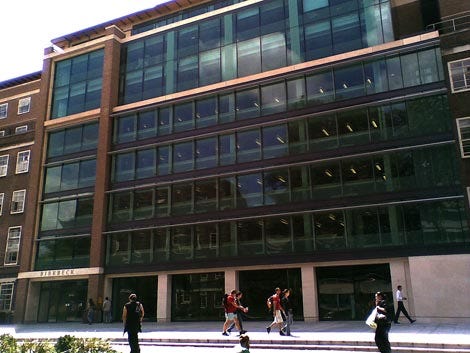
Back around the block again, this time we note the new Birkbeck building, just behind Senate House. As with the new building opposite Elizabeth Garrett Anderson, it blends beautifully with the existing building that adjoins. Note how the tiled ‘piping’ at the top continues from old building to new. It’s not that it’s an absolutely knockout bit of architecture; just distinguished. Both of these buildings move forward — the one by EGA most of all — but not at the expense of synthesis with the existing architectural fabric. Which, frankly, probably made them achievable.
We wander through to Tottenham Court Road, which is now beginning to get busy. It’s not a great street, particular at the lower end, towards Centre Point and St. Giles (which I’ve also written about). There are numerous interesting details to TCR, both in and on the buildings and the inhabitants, but it’s in no way pleasant. So we move back towards the comparative shelter of Bloomsbury.
I realise how much I’ve enjoyed living in the area. I’m ready to move on, though, and it’s at this point — alongside the peculiarly utilitarian block on Bedford Way — that I really realise I’m saying goodbye as well as showing Oliver around, and looking forwards to Sydney.
I think on this through all the way across to Great Russell Street, past the lovely 1957 Congress House with Jacob Epstein statue, with its “noble aspirations”, according to Peter York.
Down Coptic Street, along Little Russell Street, round the back of Hawksmoor’s St. George’s with its distinctive stepped tower derived from the Mausoleum at Halicarnassus, as seen in Hogarth’s etching ‘Gin Lane’. Onwards up Bury Place past the wonderful London Review Bookshop, and up and down Great Russell Street a few times, not wanting to expose Oliver to the slowly rising fumes of Southampton Row. I don’t come to any particular conclusions, but given the time afforded by Oliver, I just relax into the thoughts.
This sense of time is different to that I’m used to. I’m usually cramming information into every spare moment. I’m someone who reads a magazine, with the radio on, while brushing my teeth. Here, I have nothing to distract me. Indeed, can have nothing to distract me, due to Ollie.
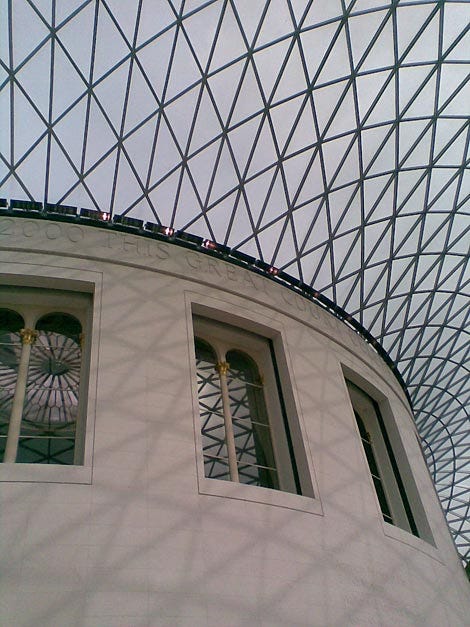
By now, it’s nearly 9AM, and I make sure I’m around the front of the British Museum on Great Russell Street. Grabbing a coffee, we enter the building’s huge forecourt and head up the steps into the Great Court, by Foster & Partners, the only part of the building that’s open.
As much as I love this space, the light in here is often unappealing — a strangely dead non-white is cast evenly to every corner. Perhaps it’s the lack of crisp shadow that unnerves. Here though, virtually empty, the space does seem quite majestic. It’s me, Oliver and the Japanese tourists.
The latter had actually, and quite uncharacteristically, turned up 12 minutes early. They found themselves in the unusual position of having to ‘hang around’. This they did by taking pictures of each other, as if to actually perform a perfect stereotyped portrait for me.
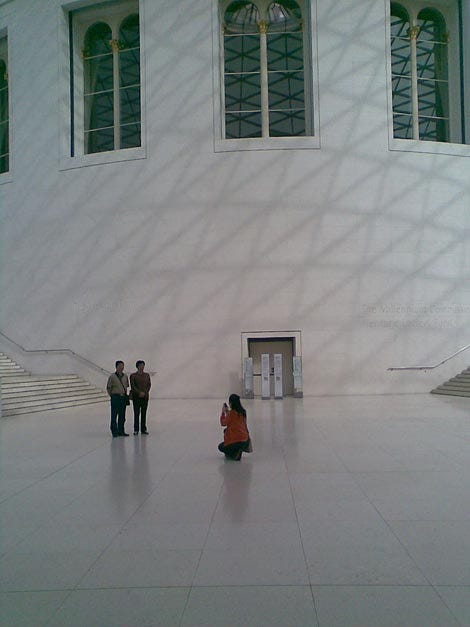
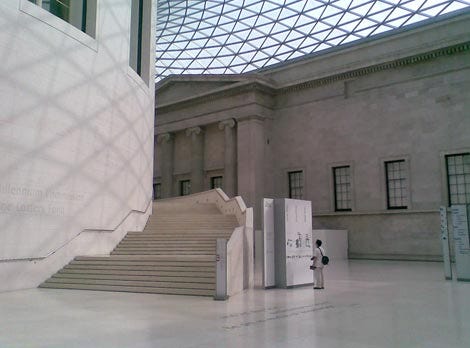
Inside, with the pale English sun shining through, we wander quietly around the empty space.
I notice a spattering of discreet black marks on top of the canopy, but upon looking carefully, I can see they’re birds sitting on Foster’s roof.
I’d never seen this before, on many previous visits when the space below had been very full. I wonder if the noise of the inhabited Great Court reverberates upwards, transforming the glass into a form of giant snare drum. We should fix some microphones to it.
In 1869, Henry James called Bloomsbury, “an antiquated ex-fashionable region, smelling strong of the last century”.
Yet, 138 years later, I can report that Bloomsbury feels just fine (even if bits of it do smell of various points in the last 3 centuries). We head home …
Birthplace #13: Registry Office, Camden Town Hall, Central London
This series could clearly go on and on, but you have to draw a line somewhere. So the official registration of Oliver’s birth seems a good opportunity.
This can only be done with the official Registrar at Camden Town Hall. The latter is essentially another solid 1930s building at Judd Street, opposite the scaffolding-clad spires of St. Pancras station.
It’s our first trip out with Oliver in our pram, the Bugaboo Cameleon. Bugaboos are rather over-exposed in Britain and the USA — indeed, they get nicked to order in North London — but we went for it nonetheless. It’s a great bit of engineering and it handles beautifully. (In no way am I sounding like a dad, right?)
The excellent Daddy Types covers new prams amidst numerous other objects it’s OK for new dads to get distracted by, with detail, passion and, thankfully, good humour. The forthcoming release of the new Bugaboo stroller, the Bee, is anticipated with much the same fervour that the Second Coming might be. He has an interview with the Bugaboo boss, who speaks of his “desire to change the world, not just fill out a product line”, with the Bee a product of “form integrated with function.”. I appreciate that level of passion in a product. And so far, the Bugaboo is working well.
For instance, for this first trip with Oliver, we step out into what the newspapers would later describe as ‘TWO MONTHS OF RAIN IN JUST ONE DAY’. It’s an absolute monsoon for 20 minutes, far closer to a tropical summer storm in Brisbane that England’s usual light persistent drizzle. But under the Bugaboo’s rain cover, Oliver is completely dry. We’re soaked, but he sleeps right through it.
To Camden Town Hall, which doesn’t quite have the grandeur of the great gothic town halls of a generation previous. The original layer is not a bad building — it’s relatively distinguished, solid, but somewhat mundane.
It does have some lovely interior touches typical of the era, such as those also seen earlier in the older layers of Elizabeth Garrett Anderson — doors, internal windows, door handles etc.
Juhani Pallasmaa has said you can tell a lot about a city by looking at its door handles. In Helsinki, it’s one of the first things you notice. Handles by Holl, Aalto and others, visible from the street. In London, all the best door handles are internal. Is London an internalised city?
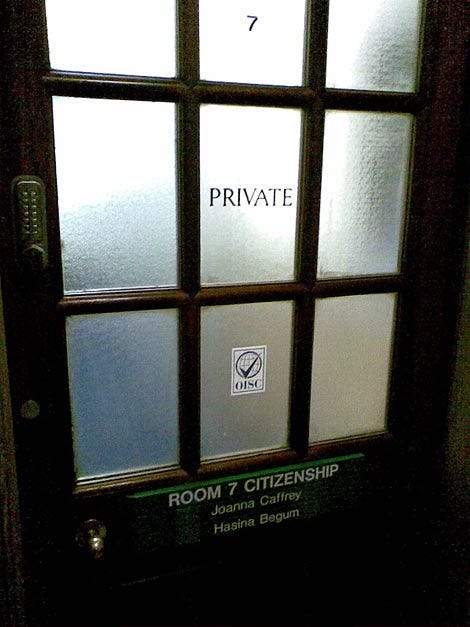
Inside here are some great old municipal touches — doors with Orwellian things like ‘Room 7 — Citizenship’ written on them. There’s a delicious nostalgia in all these things, but this building isn’t really of the quality to preserve; these touches are not enough to warrant it standing in the way of progress, and a more flexible, adventurous, contemporary building to represent Camden is probably required.
Others have clearly thought so too, over the years, though with variable results. The Town Hall has been adapted, with a modern layer constructed along the Argyle Street and Euston Road sides. Again, quite typical of British town halls — see also Sheffield Town Hall, with its 1970s egg-boxy adornment attached to the side of the gothic host. This looks similar, but unlike Sheffield’s doomed extension, is still standing.
It continues to show its age inside with a haughty interior of white marble and grand staircases. The flow of this space is disrupted by a new desk in the foyer, but the functions of the town hall have changed somewhat since the staircase was envisaged. The space was still imposing enough to stand in for the US embassy in Moscow, for the execrable Val Kilmer vehicle The Saint. It also features in Shadowlands and Breaking and Entering, presumably playing itself.
The role it’s playing now is that of Registry Office Suffering a Computer Breakdown, so all the paperwork has to be done by hand. The details of this episode are rather dry, the only thing that is today, and we’re done within 30 minutes. Oliver officially exists. And we’re out, back via the Brunswick Centre, through Senate House, to Gower Mews.
And there I’ll leave it. I felt the need to write something here, so collected the thoughts that felt most appropriate — how I saw some of the buildings, places and things involved in, or altered through, Oliver’s birth. It’s also a farewell to the area, an act of self-preparation for moving on to Australia. As such they are perhaps the most personal entries I’ve written here.
And at the same time, it isn’t the full story at all, and I’m certainly not suggesting it’s C.’s story, nor is it Ollie’s. They will have their own to tell, although Ollie’s might be even more impressionistic than mine.
Involving less brickwork too, I would imagine.
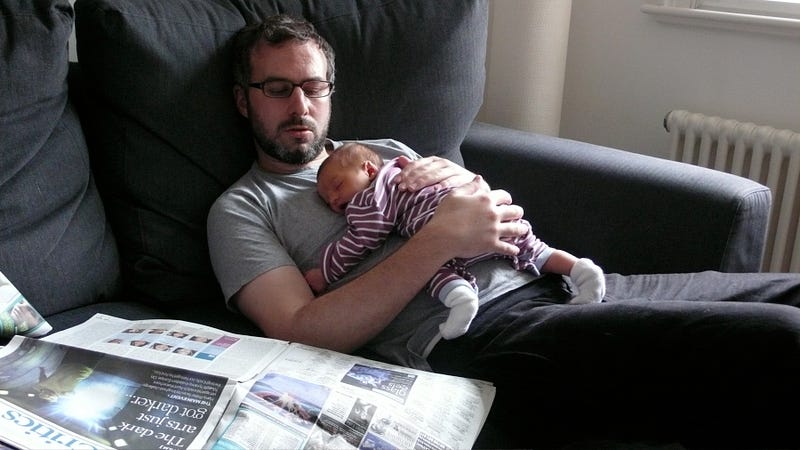
—Bloomsbury, London, July 2007
These pieces originally published in thirteen parts at cityofsound.com, during the wee small hours of July 2007.
Hannah, our daughter and Ollie’s sister, was born in Sydney, Australia two years later, August 2009. I started writing a similar piece, but could never get beyond the introduction, probably due to there now being four of us. So Hannah, if you’re reading this years later, I could tell a similar story of our little Lilyfield house, the doula’s birth classes, the room in the hospital (almost) decorated like a bedroom, a less eventful birth, and England winning the Ashes on the morning of your birth. But you’ve heard all that before …