
A Behind-The-Scenes Look at My YouTube Channel Gear
I’m starting a YouTube channel and I’m documenting my journey.
At the time of writing, I have six subscribers.
One of them is me.
Another is my cousin.
I think the rest are also people I know. But I don’t care. I’m making my way through the early days of something for which I have big plans.
You might be doing the same. It could be the reason you’ve found this article. Perhaps, like me, you’re starting on the bottom rung of the YouTube ladder and need to remind yourself of the fact you’re not alone.
Whatever reason you have for falling upon this post (thank you), I have a feeling you might be interested in the gear I’m using. Because, let’s be honest, a YouTube channel can’t exist without gear.
My choices, however, might surprise you.
A quick disclaimer
Part of what I do for a living involves both photography and videography. I’ve also loved fiddling around with cameras and playing Steven Spielberg since I was a kid, so it will come as no surprise that I already had some relatively decent gear to hand when I started this channel.
So, if you’re entering the realm of YouTubing for the first time and need advice on what you should be using, I would ignore huge swathes of this post. My choices are:
That is, they would be if I’d started with an empty kit drawer and a decent budget. I really wouldn’t have picked any of what I’m about to reveal if that were the case.
What follows is the gear I use to shoot my current YouTube vlogs. It’s cobbled together and consists solely of the stuff I use to shoot client work.
Enjoy.
The camera: a renowned low-light beast… but a dreadful vlogging cam
I have more than one camera, but the process of elimination when it came to picking one for the first batch of videos on my channel was pretty straightforward.
There was just one overriding requirement.
You see, if you’re a solo YouTube creator and don’t have the benefits of a camera operator (few but the biggest on the platform do), you need a camera which is capable of retaining pin-sharp focus on your face without you ever touching it (the camera, not your face).
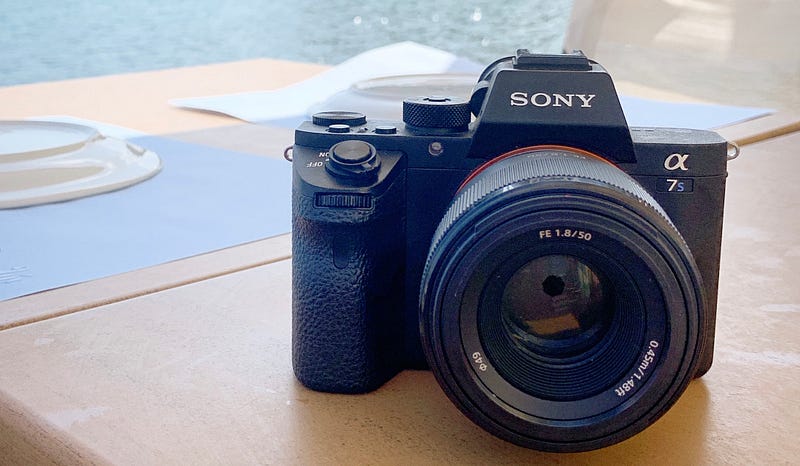
My beloved Canon 5D mkiii can’t do that. But my Sony A7 Sii can.
The Sony is an incredible camera. It shoots great 4K, can practically see in the dark, features in body stabilisation and has a wonderful tone you can colour grade to your heart’s content. The little 50mm 1.8 prime I’ve paired it with results in a delightfully compact, sharp camera setup.
But it has _dreadful_ autofocus. Watch any of my videos, and you’ll see it constantly hunting for something to focus on, even when I’ve pointed the focus spot directly at my face.
It’s a terrible vlogging camera — really, really, biblically bad. I long for Canon’s dual pixel autofocus or Sony’s latest equivalent.
Alas, I’m not about to spend a fortune on gear I don’t need, so the Sony is the current best tool I have for the job. And you know what? It’s doing a pretty good job so far. Hooked up to a quite brilliant external monitor that’s angled my way, it produces clean, crisp video.
The mic: a get-away-with-it lav
Audio is so important when it comes to video.
I’m also an audio nut.
You, may, therefore, wonder why I’m using such a cheap audio setup.
The mic in question is a Rode Smartlav+ Lavalier. It’s cheap, a little flimsy and has recorded hours of footage for clients without a hiccup. Therefore, recording a static ‘me’ for ten minutes or so each time shouldn’t be an issue. And it isn’t.
If you need a cheap starter mic, go for this — it’ll even hook up to your phone if you’re heading down that route.
Stability: the overkill pair
Ok, hands up. This is where it gets a bit silly.
To stabilise my useless vlogging camera, I use one of these two monstrosities:
Neither makes any sense for a startup YouTuber — particularly when I reveal how I use the Ronin S.
This is a heavy-duty gimbal intended for providing buttery-smooth b-roll. It isn’t designed to be a desktop DSLR tripod. I could spend about £30 and get something which performs that role perfectly and which doesn’t take three months to set up each time.
The Viltrox is just daft because it’s such a big, bulky tripod which is designed for use by a camera operator. Using it as a stand to film me, on my own, is silly.
I’ve even got other tripods that will do the job more easily and just as efficiently.
I don’t know why I’m using these two. Perhaps someone could help me out here in the comments.
Lighting: whatever’s nearest
If you’ve watched any of my initial YouTube videos (thank you), you’ll have noticed how often I refer to the natural light on which I’m relying so heavily. That’s because, after I’ve spent all that time setting up my silly tripods, poorly autofocusing camera and questionable audio, I can’t justify the time needed to set up decent lighting.
So, more often than not, I’ll rely on natural light from a nearby window.
In instances where I can be bothered to set up some lighting, I use either my trusty ring light, or something like the brilliant Yongnuo YN300 as key lights. But only if they’re within easy reaching distance.
Conclusion
I’m cutting corners, ‘making do’, and sticking with what I’ve got. For now. And it’s working.
What about you? If you’re a YouTuber and fancy sharing your gear of choice, get involved in the comments! Equally, if you have questions about my choices (don’t worry, I do, too), please don’t be shy — ask away.
I made a video about this, too:
Join my mailing list here.
This post includes affiliate links from which I may earn a commission if you click through and buy
Originally published at https://markellisreviews.com on July 7, 2020.


