A beginner’s guide to the basics of what cloud computing is about
Forget about definitions and technical explanations. Not everyone is a highly skilled DevOps Engineer and Cloud Architect. Salesforce CEO and Chairman Marc Benioff brings it straight to the point. Cloud computing is a better way to run your business according to him. The possibility of improving your business is something which is appealing to every decision maker across the globe. Who thought that the cloud would one day be considered as the digitization tool par excellence as n’cloud.swiss Founder and Chairman André Matter emphasizes again and again. The year 2000 will always be remembered as the milenium of the more and more oustanding pace of technological progress. New and old technologies are as close together as never before. The almost uncontrollable increase in human knowledge leads to endless incremental innovations. The hunt for the next big thing seems to be never ending.

Even though cloud computing still plays that role, one might think that it is being pushed aside by the likes of artificial intelligence and blockchain. But wait… most new technologies are distinguished by a huge number of data and intelligence. In other words, “the many disparate servers which are part of cloud technology hold the data which an AI can access and use to make decisions and learn things like how to hold a conversation. But as the AI learns this, it can impart this new data back to the cloud, which can thus help other AIs learn as well” as noticed Gary Eastwood from the IDG Contributor Network. Same goes for blockchain and other data intensive technology. Cloud computing is not only the digitization tool par excellence, it is omnipresent and plays undoubtedly a key role in today’s technological progress.
Providing IT resources and on-demand applications over the Internet at usage-based prices
“Simply put, cloud computing is the delivery of computing services — servers, storage, databases, networking, software, analytics and more — over the Internet (“the cloud”). Companies offering these computing services are called cloud providers and typically charge for cloud computing services based on usage, similar to how you are billed for water or electricity at home.” (Microsoft Azure)
Whether you run apps that share photos with millions of mobile users or support critical business operations in your organization, the cloud is a technology providing quick access to flexible and cost-effective IT resources. When it comes to cloud computing, you do not have to invest in hardware in advance or spend a lot of time managing it. Instead, you can provide the exact type and size of computing resources you need to implement your latest breakthrough idea or operate your IT department. You can access as many resources as you need almost immediately by paying only for what you use. Cloud computing provides an easy way to access servers, storage, databases and a full range of application services over the Internet. Cloud providers such as Amazon Web Services, Microsoft Azure, Google Cloud Platform or “Swiss made” n’cloud.swiss operate and manage the network-attached hardware needed for these application services, providing and using the resources you need through a web application.
Advantages of cloud computing
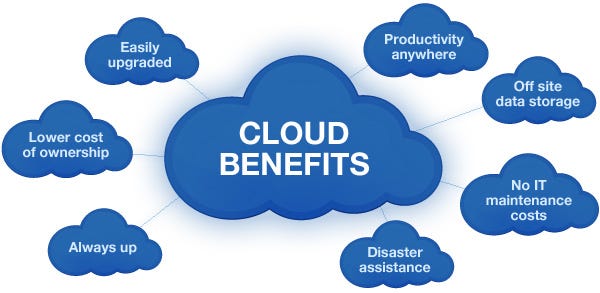
The cloud has become a technology that influences everyone’s daily life. The adoption of solutions and services in the cloud present a number of advantages and benefits, among others:
- No more costs for operating and maintaining data centers Focus on projects that differentiate your company in the market, not the infrastructure. Cloud computing allows to focus on customers rather than setting up, populating, and operating server cabinets.
- Speed and agility In a cloud computing environment, new IT resources are always just a click away.The time required to deploy these resources will be reduced to minutes. This leads to a remarkable increase in the agility of the enterprise. In fact, costs and the expenditure for experiments and development decrease substantially.
- Go for variable costs rather than investment costs Instead of investing heavily in data centers and servers, cloud computing makes it possible to work by paying only for the computing resources that are actually used.
- Flexible capacity No more uncertainty in determining the infrastructure capacity requirements. Customers can access as much or as little capacity as needed and adjust their demand for short notice as desired.
Types of cloud services: IaaS, PaaS, SaaS
Cloud computing consists of three main types, commonly referred to as Infrastructure as a Service (IaaS), Platform as a Service (PaaS), and Software as a Service (SaaS). Choosing the right cloud computing type consists in knowing your needs to achieve an optimal level of control with worrying about unnecessary tasks. Microsoft defines these types as follows:
Infrastructure-as-a-service (IaaS): The most basic category of cloud computing services. With IaaS, you rent IT infrastructure — servers and virtual machines (VMs), storage, networks, operating systems — from a cloud provider on a pay-as-you-go basis.
Platform as a service (PaaS): Platform-as-a-service (PaaS) refers to cloud computing services that supply an on-demand environment for developing, testing, delivering and managing software applications. PaaS is designed to make it easier for developers to quickly create web or mobile apps, without worrying about setting up or managing the underlying infrastructure of servers, storage, network and databases needed for development.
Software as a service (SaaS): Software-as-a-service (SaaS) is a method for delivering software applications over the Internet, on demand and typically on a subscription basis. With SaaS, cloud providers host and manage the software application and underlying infrastructure and handle any maintenance, like software upgrades and security patching. Users connect to the application over the Internet, usually with a web browser on their phone, tablet or PC.
Cloud deployments: public, private, hybrid
There are three different ways to deploy cloud computing resources. These are public cloud, private cloud and hybrid cloud.
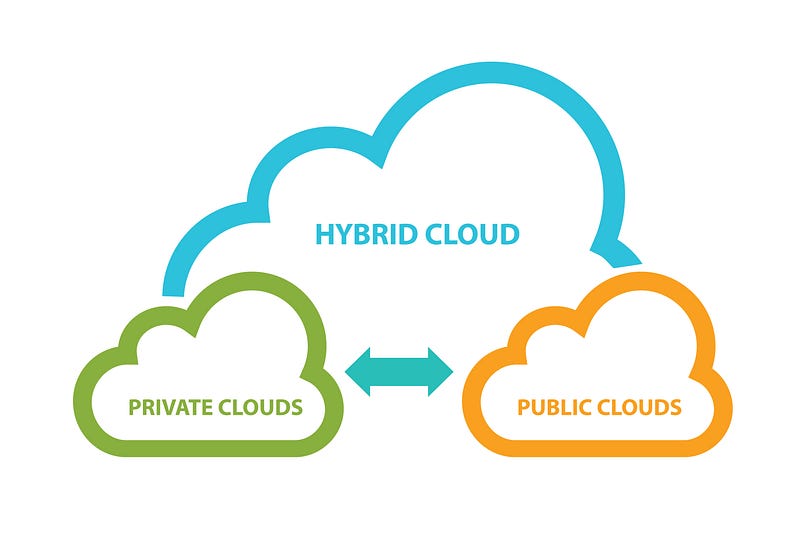
Public clouds are owned and operated by a third-party cloud service provider, and deliver computing resources like servers and storage over the Internet using a web browser. Today’s leading cloud providers Amazon AWS or Microsoft Azure are examples of a public cloud.
A private or on-prem cloud refers to cloud computing resources used in-house and exclusively by a single business or organisation. The particularity here is that a private cloud can be physically located on the company’s on-site datacenter.
A combination of both public and private clouds leads to what we call hybrid cloud. The advantage here is that a hybrid cloud allows data and applications to be shared between them. By allowing data and applications to move between private and public clouds, customers enjoy greater flexibility and more deployment options.
After which criteria do customers decide for a cloud provider?
Simply put, customers do not decide for one single cloud provider. Many companies pursue a multi cloud strategy to maintain the ability and flexibility to select different cloud services from different providers. Single multi-cloud infrastructure vendors like n’cloud.swiss are rare. Praised as a Swiss and European alternative to the major cloud providers, n’cloud.swiss is a cloud platform running in one of the world’s most secure data centers in Switzerland. The idea is to enable customers to design a cloud according to their specific requirements with the same product, either as a service model, an on-prem version in existing IT environments or as a hybrid variant. In addition, all cloud service models from Infrastructure as a Service (IaaS), over Platform as a Service (PaaS) to Software as a Service (SaaS) are part of the platform. All this is surrounded by an innovative internal n’cloud.swiss application catalogue. Within the latter, n’cloud.swiss offers more than 142 applications from 30 different IT categories “free and ready to go” as well as the opportunity to upload also other development applications and tools easily. In addition, personal support and competitive pricing models, API connectivity for easy and fast transfers of existing developments from or to other major cloud platforms award this Swiss cloud platform a unique selling point and a competitive advantage.
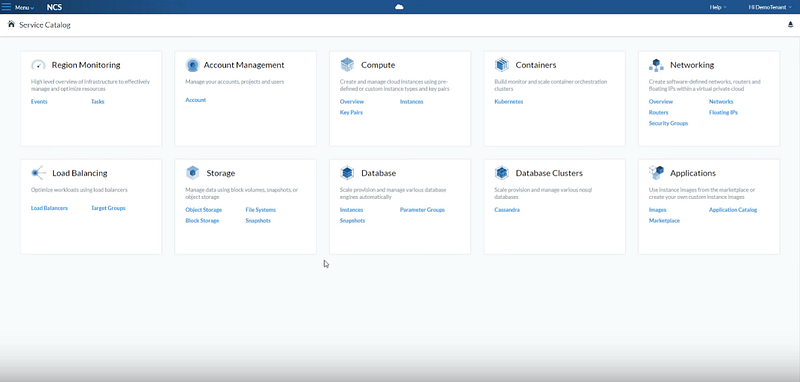
Overview of n’cloud.swiss products und services
UNMANAGED PRODUCTS
- Blockchain
- Edge Computing
- Compute Services
- Object Storage
- Block Storage
- CDaaS
- Kubernetes-As-A-Service
- Load Balancer-As-A-Service
- Database-As-A-Service
- Analytics EMR
- Networking
- Identity And Access Management
- File System
- Cloud Monitoring
- Application Catalog
- Migration Services (V-To-V)
MANAGED PRODUCTS
- Virtual Office
- Backup And Disaster Recovery
- Accounting / CRM / ERP
- Cloud Drive | Team Portal
- Managed Application Hosting
- Protection
- System Monitoring
- Hosted Exchange
- E-Mail Archiving And Encryption
- Internet Telephony
A cloud solution in minutes Try n’cloud.swiss for free 1. Create an n’cloud.swiss account 2. Start a virtual machine 3. Join the world of n’cloud