
A Beautiful Little Book About What’s Really Important In Life
Sometimes, there is no choice but to succumb to the mysteries of life, he wrote. Then he became one.
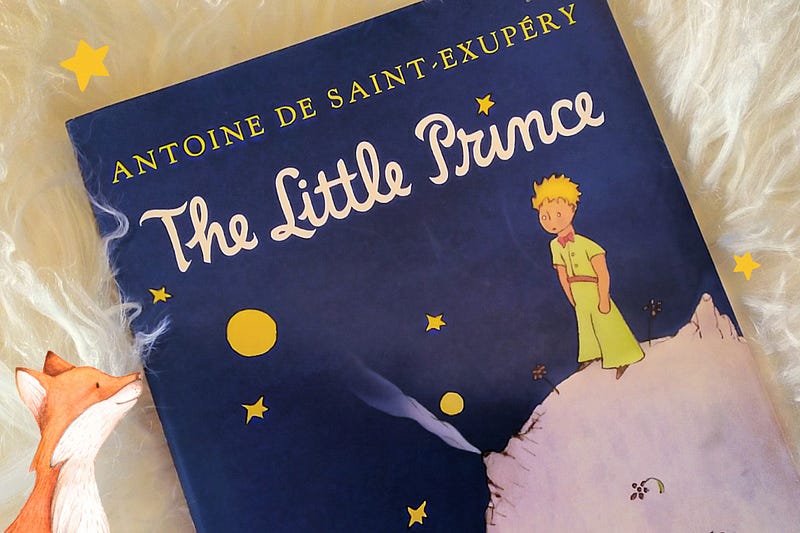
In France, they say you should read The Little Prince at two different ages. As a child, certainly, but you won’t understand it until you’re over forty.
It was 1944, and after delivering the final manuscript to his publisher, Antoine de Saint-Exupery stuffed the handwritten original and his hand drawn illustrations into a bread bag and gave them to a dear friend.
I want to give you something magnificent, he said, but this is all I have.
It’s a charming story of a man whose airplane fell out of the sky.
After giving the originals to his friend, Saint-Exupery got into a P-38 reconnaissance plane to assist in the Allied efforts against Germany and promptly fell out of the sky, never to be seen again.
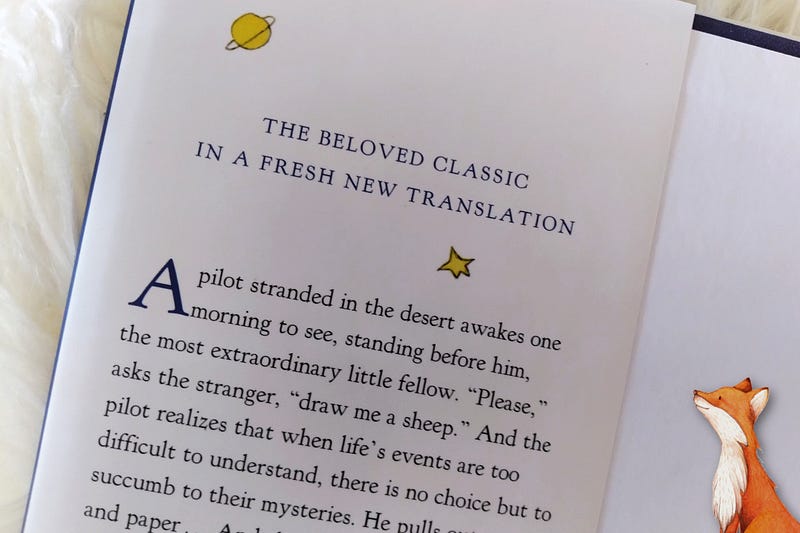
The story is simple, on the surface. The story of a tiny non-human, The Little Prince, struggling to make sense of the world. Adults saying silly things, and a sweet friendship between a boy and a fox.
Simple enough for little children to love and enjoy.
But under the simple story are deeper veins of loneliness, loss, what love really means and a look at our deepest human foibles.
The author would never know his book became one of the most popular books of all time, outselling any single book including Tolkien.
He’d never know his book would be translated into over 505 languages and dialects, making it the second most translated work in publishing history, second only to the Bible.
For years, his disappearance was one of the biggest mysteries in aviation, second only to the disappearance of Amelia Earhart.
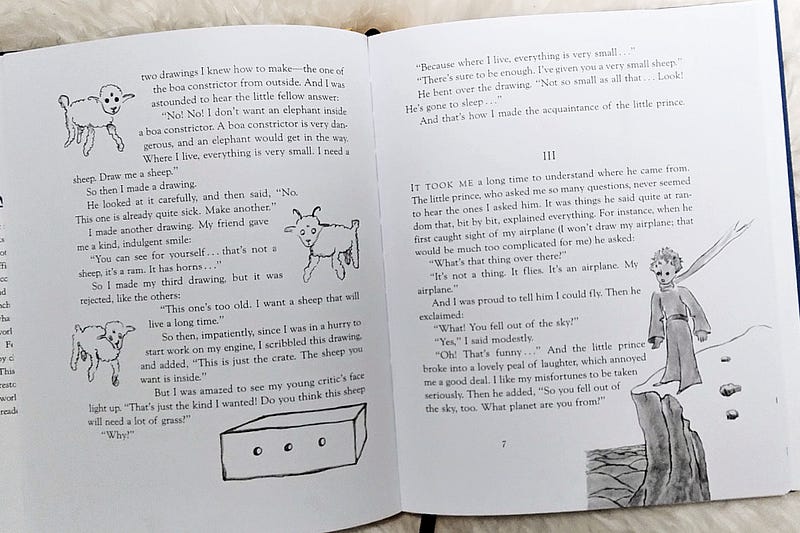
Having fallen out of the sky and landed in a desert, the pilot is trying to fix his plane before his water runs out when he hears a small voice. Please, the voice asks. Can you draw me a sheep?
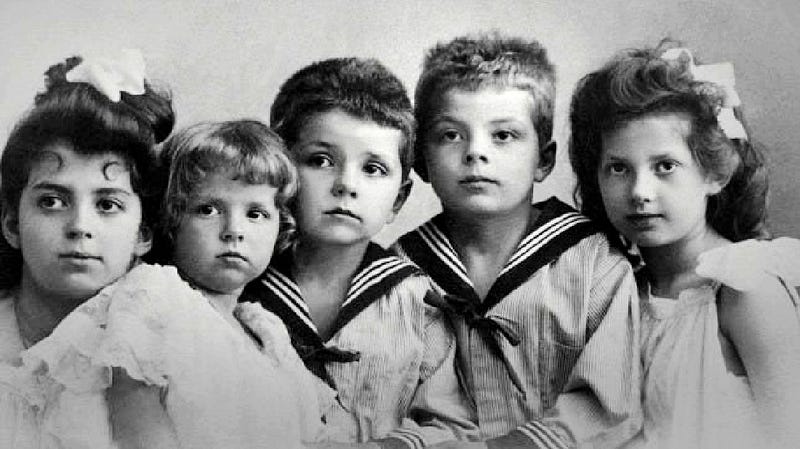
It’s a small boy with tousled blond hair and an inquisitive face and I can’t help but wonder if he modeled the Little Prince after his own childhood.
His mother said he was a vibrant, enthusiastic child, handsome and filled with curiosity, much like the little Prince is portrayed in the story.
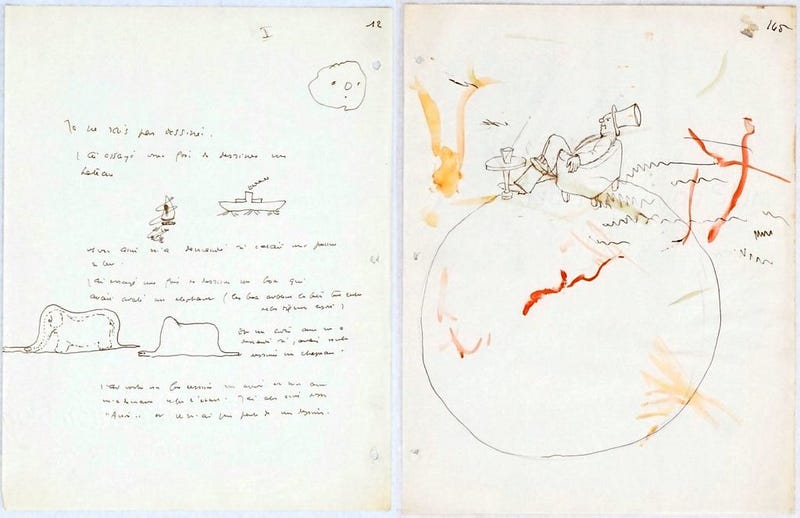
The book begins with the little Prince laughing as the pilot tries to draw a sheep, lamenting his lack of skill. That wasn’t fiction.
Much later, letters to his mother surfaced, asking her opinion on his drawings. He wondered if they were good enough because he so wanted to illustrate his own book but was not certain he had the skill.
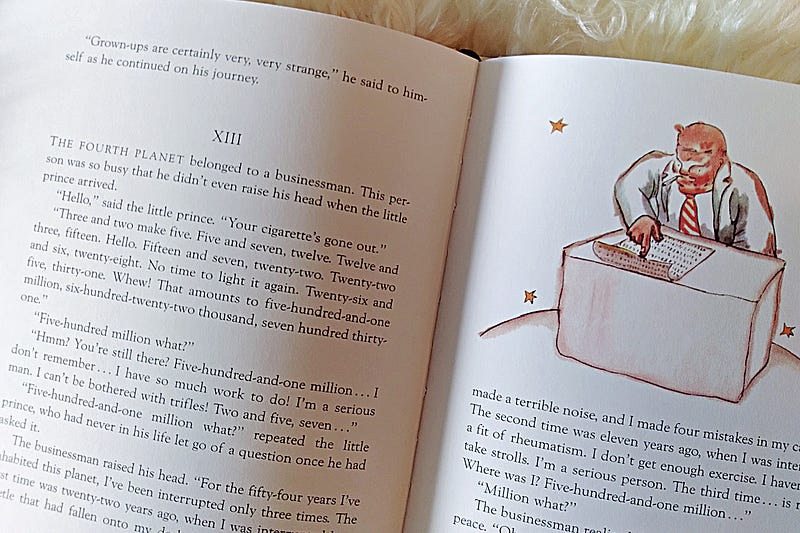
As the pilot works on his plane, the little Prince tells him all the things he’s seen since he left his planet. Mostly, grown-ups who can’t see anything because they’re clouded by their own opinions and perspectives.
The man who can’t stop counting. Busy, busy, busy. The man who just wanted praise, the man who was mired in his own troubles.
The little Prince talks about his home on a tiny planet. He misses the single rose he grew from a seed. He hopes she’s okay. He thinks perhaps he left rashly, and wants to go back home.
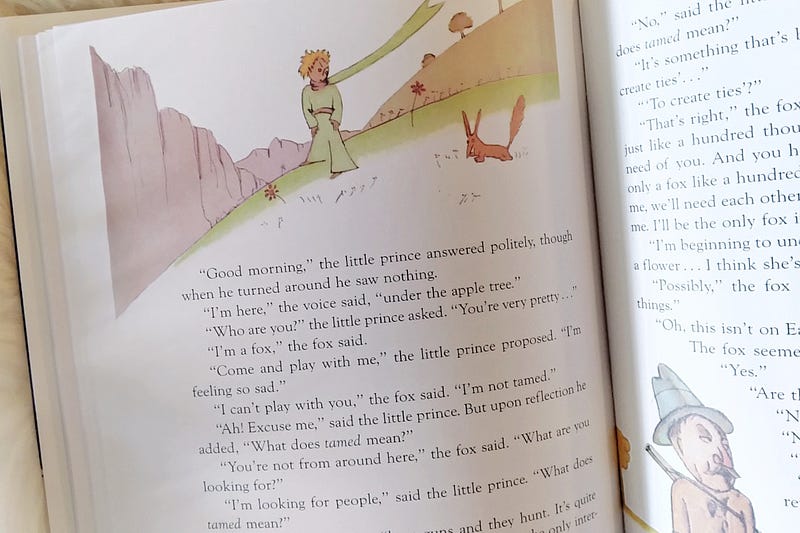
The Little Prince tells the pilot about meeting his friend the fox. You’re just a boy, the fox had said. Like a hundred thousand other boys. And I am just a fox, like a hundred thousand other foxes.
But if you tame me, we become unique in all the world. And if I love you, I will never be able to look at a field of wheat again without thinking of the color of your hair. And if you leave I will weep. And it will be worth it.
In telling the story, the little Prince sees that he never really understood what love meant, before the fox. It wasn’t that he didn’t love. But he didn’t really understand it. Buried under the simple words written for children are profound meanings written for adults.
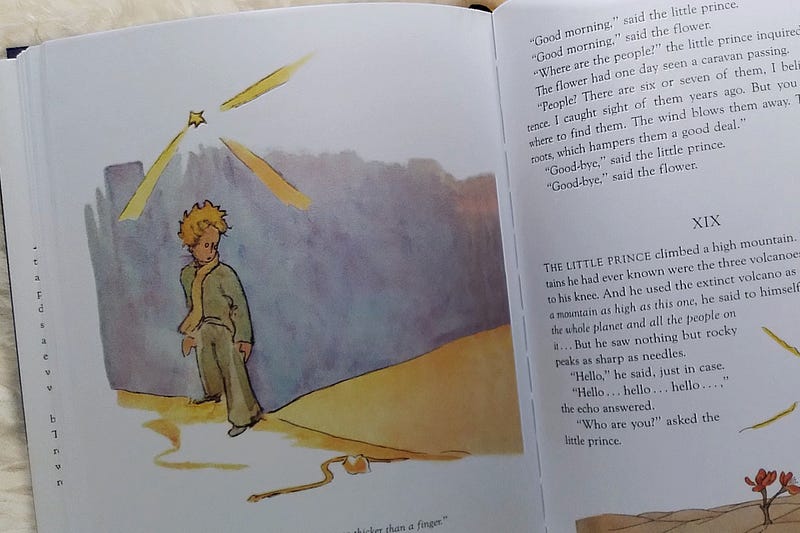
Let’s go see a sunset, the little Prince says one day. But the sun isn’t setting right now, the pilot says. We have to wait for the sun to set.
Oh, the little Prince laughs. He says he must have been thinking of home. Where he lives, you don’t have to wait. The planet is so small, you can just walk over to see a sunset any time.
One day, he said, he watched the sun set forty four times. Sunsets are wonderful when you’re feeling sad, the little Prince says.
On the day of forty four sunsets, were you feeling very sad? the pilot asked, but the Little Prince didn’t answer.
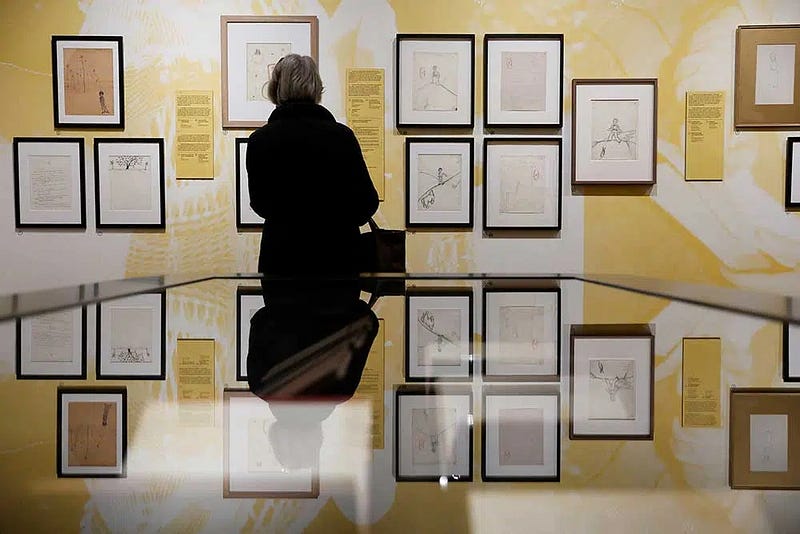
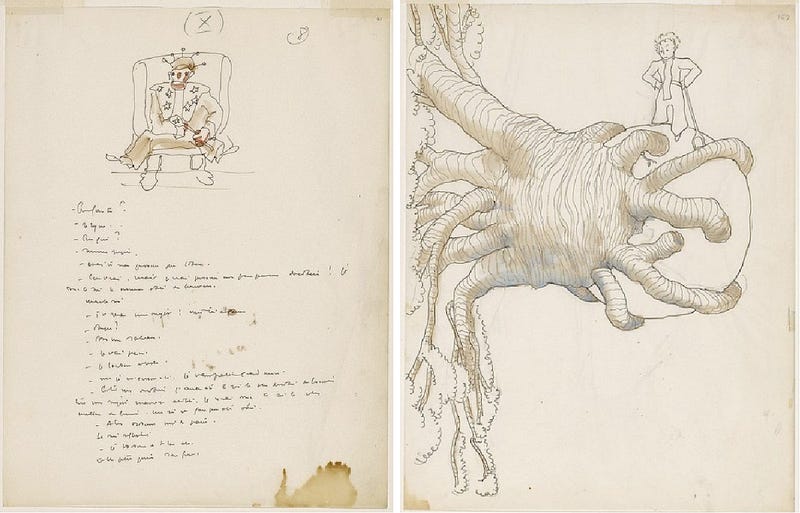
Last year, The Paris Museum of Decorative Arts displayed the original manuscript of The Little Prince for the first time in his native France, along with the illustrations he’d stuffed in a bread bag and given his friend.
His friend donated the manuscript and illustrations to the Morgan Library & Museum in New York, where he’d lived when he wrote the book.
Every illustration is drawn in pen and ink, with dabs of watercolor and all of them on the finest transparent onionskin airmail paper.
He is known as a writer and an aviator, but here we also discover him as an illustrator, said Anne Monier Vanryb, curator of the Paris museum.
In 1998, a fisherman in the Mediterranean pulled up his fishing net and in the net was a silver bracelet that said Saint-Exupéry. The search began.
It took years but they finally found a bits of an aircraft where the bracelet had been found. More years to track down proof it was his plane.
In 2006, an 86 year old German man came forward. He was 22 then, he said. Flying a German bomber when he saw a plane flying French colors. It was doing evasive maneuvers. Odd, evasive loops. So he shot it down.
He didn’t know it was Saint-Exupéry. Or that the little plane was unarmed. He saw enemy colors. Two days later he heard Saint-Exupéry was missing.
He was my hero, the old man said. He’d read everything the author wrote. If I’d known, I wouldn’t have done it, he wept. He lives in desperation, he says. Knowing he shot down his hero. Struggles to bear it.
The exhibition shows dozens and dozens of foreign-language editions of The Little Prince, including the most recent translation, in the Rapa Nui language of Easter Island. They, too, love The Little Prince.
Language may differ, but the heart does not.
I won’t tell you the ending. But I will tell you this.
The last message Robin Williams posted on social media was a birthday message to his daughter Zelda, on her twenty fifth birthday. Eleven days later, when he took his own life she posted one last message to her father.
Here’s what it said:
“You — you alone will have the stars as no one else has them. In one of the stars I shall be living. In one of them I shall be laughing. And so it will be as if all the stars were laughing, when you look at the sky at night. You — only you — will have stars that can laugh.”
It’s from The Little Prince.
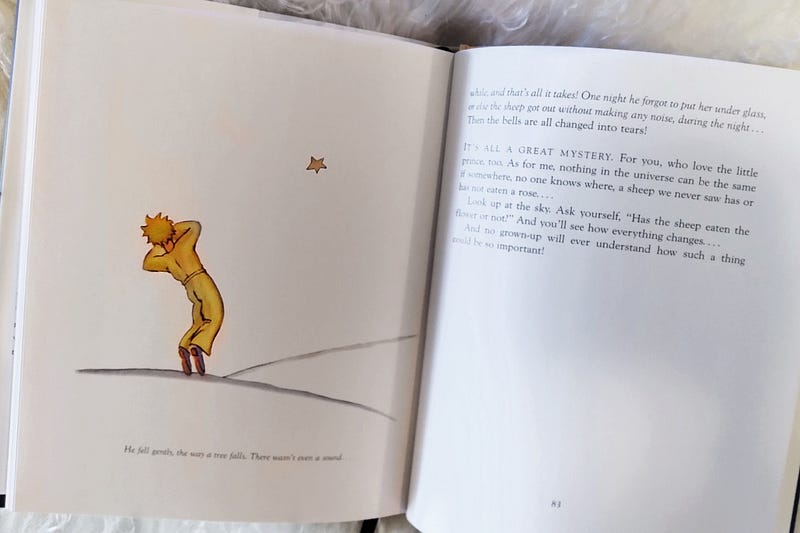
Sometimes, there is no choice but to succumb to the mysteries of life.
That’s what it says on the flap of the book published posthumously, two years after Saint-Exupéry got into his plane and disappeared.
Antoine de Saint-Exupéry was 44 years old when he died. Only months before getting into that plane, he’d written about a little boy who was so very sad one day that he watched the sun go down 44 times.
The mysteries of life, indeed.
I like to think of them up there. Laughing in the stars. The man and the boy he once was. If you’ve not read this as an adult, I think you’ll like it.
“And now here is my secret, a very simple secret: It is only with the heart that one can see rightly; what is essential is invisible to the eye.” ―Antoine de Saint-Exupéry