
A Band of Maniacs You Really Need to Know
A Plethora of Pop Writing Challenge
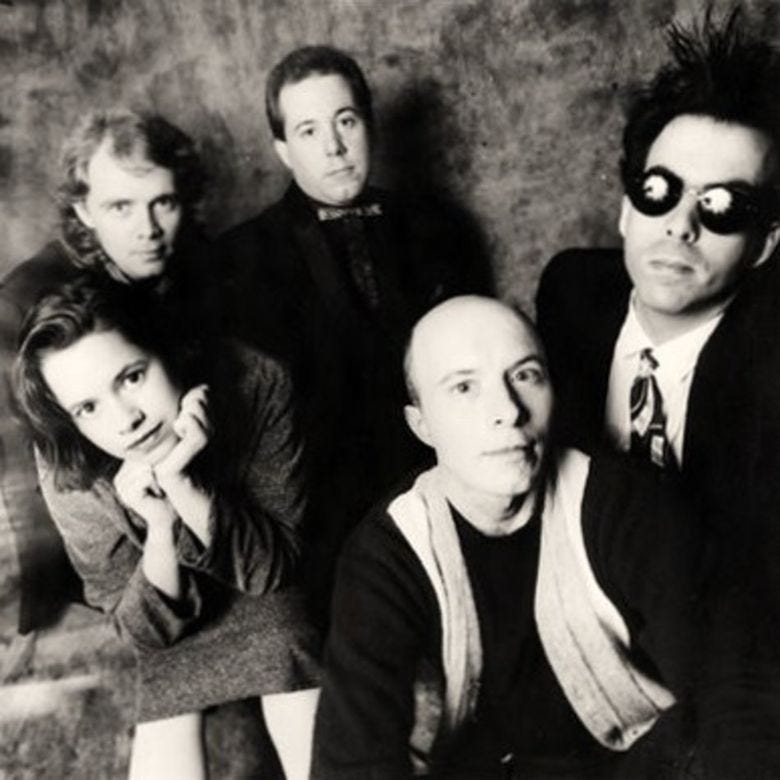
When Plethora of Pop editor and Monkees uber-fan Buddy Gott issued his February writing prompt, “The Shed a Little Light Music Challenge,” my first response was, of course, Springsteen-centered. After that, I wanted to bring attention to the 1987 10,000 Maniacs album, In My Tribe, but that one got bumped down the list by the Gin Blossoms’ New Miserable Experience. As I should have expected, several hardcore fans of both 10,000 Maniacs and Natalie Merchant took umbrage with this.
Normally the mini-outrage would have slid off me like water off a duck, but this time I let it trouble me. I was simply going to be done with the prompt after two stories, but considering the fact that over the past 30-plus years I have probably played New Miserable Experience and In My Tribe an equal number of times (it’s in the hundreds, at least), it would be wrong to leave the Maniacs out. So wrong, in fact, that I am deviating slightly from the prompt and bringing attention to the band itself rather than just one album (great as that album is).
Though unknown to many younger listeners today, if you came of age in the 1980s or early 1990s, the simple mention of the band’s name likely triggers some type of memory. For an all too brief period, they were one of the biggest things around, even playing one of President Bill Clinton’s inaugural balls in 1993. The fact that they released cover versions of Springsteen’s “Because the Night” and Morrissey’s “Everyday is Like Sunday” during their 1987 to 1993 heyday only solidifies them in my personal pantheon. There are numerous excellent covers of Bruce songs; pulling off a great cover of Morrissey is a different story, but lead singer Natalie Merchant nails it.
The band was made up of Merchant, Robert Buck on guitar, Steve Gustafson on bass, Dennis Drew on keyboards, and Jerome Augustyniak on drums. They were a tight unit by 1987, having toured for 6 years at that point, but it is Merchant’s instantly recognizable voice that is the band’s signature; how she never achieved mega-stardom either with the Maniacs or in her later solo career is something I’ll never understand.
Their breakout third album, In My Tribe, is one of the best (and most underrated) albums of the 1980s. On this album, which has not one single throwaway song (how many records can you say that about?), Merchant and the band tackle everything from child abuse on “What’s the Matter Here?” to the military on “Gun Shy” to illiteracy on “Cherry Tree” to corporate greed on “A Campfire Song;” amazingly every one of these is a tune you can dance to.
One thing to note if you’re buying the album for the first time. The original vinyl release included a cover of the Cat Stevens song “Peace Train,” but this was removed from CD and cassette releases starting in 1989 after Stevens (who had converted to Islam) supported the call for the assassination of writer Salman Rushdie over his novel, The Satanic Verses. Separate the art from artist and find a copy that has “Peace Train.”
You will see in the video below that Natalie Merchant’s other signature feature back in the ’80s, besides that angelic voice, was a complete inability to stand still for five seconds. She must have given her elementary school teacher hell and would certainly give any whirling dervish a run for their money.
Nearly as good as In My Tribe is the 1992 release Our Time in Eden. Tracks like “These Are Days” and “Candy Everybody Wants” are the best known but the entire album is excellent, a return to form after the very-good-but-not-great Blind Man’s Zoo album in 1989. Our Time in Eden will always be special to me because it came out while I was in the Army and was, even more than Born to Run or The River, the album that calmed me when things got scary (almost deploying to Somalia at the time the events in Black Hawk Down happened) and when they got sad (realizing my then-girlfriend didn’t really care if I got deployed to Somalia). You can’t ask for much more than that from any album.
Merchant’s final album with the Maniacs was the huge MTV Unplugged release in 1993. It reached #13 on the Billboard album charts and went triple-platinum, unusual for a live album in the 1990s. While not on the same level as Nirvana or Pearl Jam’s Unplugged appearances, it remains one of the best from an outstanding series. Because I am me, I can’t resist posting the Unplugged version of the earlier mentioned Because the Night:
In late 1993, and at the height of their popularity, Natalie Merchant left the band after 12 years, saying she didn’t want art by committee anymore. Given that she was not only already the face and voice of the band but also wrote most of the songs as well, this desire to step out on her own surprised many. However, she had a successful solo career, releasing nine albums since 1995, most notably the stellar Tigerlily and Ophelia.
10,000 Maniacs have continued as a band since Merchant’s departure, releasing four albums between 1997 and 2015, but none reached the level of success they had with her. When your frontman (or frontwoman) is an icon, they simply cannot be swapped out like batteries; much like Van Halen in 1985, the guys in 10,000 Maniacs never grasped this.
It would have been great if the band could have stayed together, even for just a few more albums. As good as Merchant’s solo work is, the spin the rest of the Maniacs would have put on the songs would have been nice to hear (I feel the same way about Morrissey’s post-Smiths catalogue; ah, what might have been). But in the end, Vision was right in Avengers: Age of Ultron when he said: “A thing isn’t beautiful because it lasts.” Those four albums between 1987 and 1993 were beautiful indeed, and while the band did not last, the music will.
If you enjoyed this story, you can support my writing directly by leaving a tip below using the small (and kind of weird) hand icon (you tip waiters and bartenders, so why not writers?).


