
A Bad-Good Day
The unheeded lives of animals
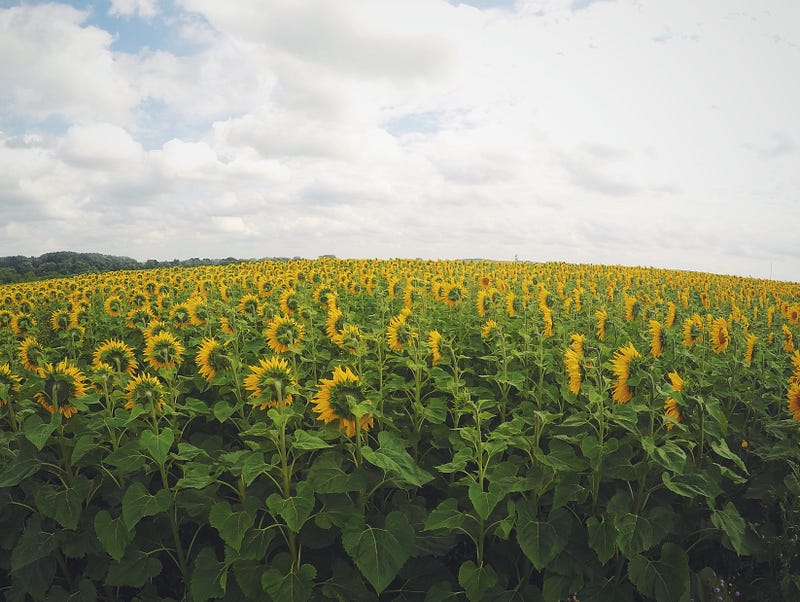
The sunflowers stood close in ordered rows on a short undulation of roadside hill. The greater lee side was hidden from view, and the flowers’ heads turned from the sunset as if awaiting their just and certain death.
It was sad and sweet to all who looked, though not all knew why or to ask why, or that it was sad and sweet, the way it felt to see it.
Death comes to all, also flowers, in the cruelest, most unbeautiful way, when their withered stalks may snap in a breath of dust and their faces have been stripped of a ringing rainfall of seed-tight husks.
The small amber feline crouched, nosed a bristly stem, and recoiled briefly before settling into a pouncing crouch again, tail flicking time because the mouse hadn’t moved.
Fur-plumped and kittenish and a stone-hearted killer, she’d been away from the farmhouse for weeks. And on this night, returned to it again with her latest haul, perhaps weary, perhaps just sated.
Before bed, the lady of the house regaled her family with the now well-told story: the cat had returned — finally — and proudly laid a field mouse on the pillow where her human had been sleeping, its body whole and serene and untouched, as if merely dreaming.
Resigned — used, even — to the cat’s prodigious kills, of which many must have sustained her on her sporadic disappearances, the woman had, she said, transferred the body by its tail to the cat’s bowl, having been through several night-time episodes of half-eaten heads and hollowed-out corpora and severed tails and slender, downy, pink-cushioned feet being left in the bedding; or else, the live-action crunch of late-night feasting on the dead.
But the next morning her visiting daughter came down the stairs and stood at the front door, a mouse in her hands. Calmly, almost domesticatedly, it seemed to be looking for an escape route, peering out between her thumbs and slinking out and onto the back of a hand.
“Is that the mouse?” he asked.
“Yes,” she laughed.
“It won’t bite? I was bitten once.”
“No.”
“What are you doing with it?”
She told him. Both had heard the previous night’s story. Then she changed her mind and turned back to go inside. The mouse needed water. And cheese!
“Do field mice even eat cheese?” he asked.
“That’s how they’re caught,” she said. “Why is that funny?”
Indeed.
“And anyway, we don’t catch things, not in a way that can kill them,” she bristled.
“I taught you that,” he said. “If I’m to be remembered for anything, I’d like it to be for that. If anything. And for you to handle the music.”
“I will,” she said.
Her mom reappeared, and the story resumed: Morning had come and the mouse now lay next to the bowl, she said, its ears flat against its head, petrified, on its side and very faintly breathing.
“Come on, Sully,” she’d said, “just eat it already.” Shocked at the mouse’s hours of suffering and anxious to “let nature run its course”, as one said at such times.
But Sully was majestically uninterested, bored with the banality of murder.
“So now Daughter’s releasing it,” she said.
Why was it funny?
He shrugged and asked to see it. The eye was damaged or, at any rate swam in a thin line of blood in the socket around it. Its foot dragged. Shocked? Hurt?
Everyone made silent calculations.
Her mother brought a box.
Good to go! said one.
His daughter left the house with the box.
“Leave it in the field,” called her mom.
“Not the field,” he said. “Raptors.”
“The grass then,” said her mom.
“Not the grass. Too short. Down by the river.”
The granite blocks, rough-hewn, from a situation and endeavour long before, had somehow manifested there in a purposeful row, perhaps demarcating farmland and roadside once, but now reclaimed by wilderness.
The mouse sat up, held its hands together, licked them, and wiped them in turn on its face and ears. Dropped down on all fours again and was gone in a bramble thicket.


