A 5-Step Framework to Convince Almost Anybody Like Top Strategy Consultants Do
A step-by-step guide to effective communication with examples for anyone

How do you explain things to your colleagues? How do you convince your superiors? How do you persuade clients?
In school, I never learned how to communicate well. A lot of times I had good ideas but I couldn’t convince. It felt like banging my head against a wall.
Your idea is worthless if you can’t package and sell it.
I made the typical mistakes: I always explained how I got to my idea. People got distracted before I had finished.
In university, I got lucky:
For a semester, I had a class on effective communication run by a senior partner at a famous management consulting company.
I knew I had found gold. I started applying it in my family, with friends, and later at work as a consultant and team lead.
The more I practiced, the more attention and engagement I got from listeners. I started looking more senior at work and winning over people.
Communication became one of my main levers for success.
So what to do? How do I explain complex issues without losing my listeners?
The answer is the Pyramid Principle used by large consulting firms and beyond.
The Secret Pyramid Principle Explained
People who are looking for information aren’t like readers of crime novels. They don’t enjoy identifying with the protagonist or revel in waiting to find out whodunit.
Journalists learn: Don’t bury the lead. The most important part of the story has to be upfront.
As US President Harry Truman said famously:
“Give me a one-handed economist! All my economists say ‘On the one hand…on the other hand’.“
Don’t bury your core message in adventurous twists and turns. Don’t talk about your clever analyses and conversations.
Instead, start with the core message and structure the details behind it.
Why is structure so important?
Because the mind speaks in pictures. And, people can better understand and remember ideas if they’re organized around a logical structure.
People create visual images to accompany their inner speech even when they are prompted to use verbal thinking.
Think of stars. For millennia people have seen nearby stars as outlines of figures instead of just points of light. These patterns make it easier to memorize constellations.
The same is true for ideas.
To better understand other people’s thoughts we have to see how they are connected in a recognizable structure.
This is why Barbara Minto created the Pyramid Principle — a top-down communication structure.
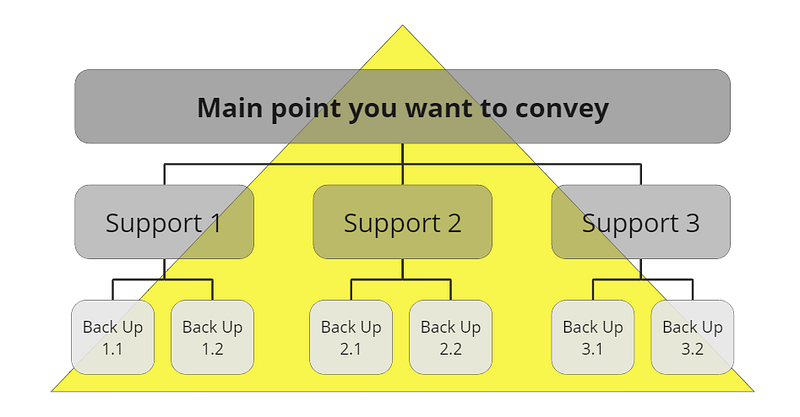
Big consulting firms use it as their standard communication tool to quickly communicate complex issues.
The core elements are:
- Lead with the answer: Make your main point right away
- Support the answer with facts at a high level
- Back up facts with detailed explanations, data, and analysis
You can use it for large presentations or short and simple explanations.
Think of constructing a house.
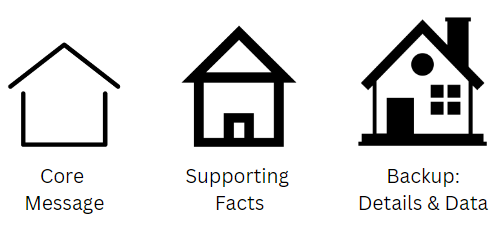
Once you have a basic structure, people will recognize that it will be a house even when all the details are missing.
In communication, the pyramid principle gives you this basic structure.
Depending on your audience and timeframe, you can add as many details as needed.
From Chaos to Clarity With the Pyramid Principle — An Example
Imagine your client had asked you: What will be the cost of Project A?
You’ve had a day to gather information, and now you have to give your answer.
Without the Pyramid Principle, it could look like this:
We have to build a team of 4–5 people that costs 1000 each, but potentially, we can renegotiate to a lower fee. We have talked to Bob, who mentioned that we have to consider five days for planning. Lisa indicated that the project delivery will be 50 days. But we have to consider potential delays because of technical issues.
So, we may be at around 200–300k if we decide to offshore some colleagues. If we use another infrastructure we can save up to 20%, too.
What do you think of this answer?
The client is probably more confused than before. But this type of communication is typical.
Here is an alternative using the Pyramid Principle:
Lead: The cost will be around 260k and consists of 2 main factors.
Support 1: Factor 1 is the build: We use a team of 5 people, each costing 800 a day for a total of 60 days which makes 240k.
Support 2: Factor 2 is infrastructure, where we have costs of 20k.
Backup 1.1: We can negotiate a fee of $800/Person.
Backup 1.2: The duration of the planning is 5 days.
Backup 1.3: The delivery duration is 50 days with 5 days of buffer.
Backup 2.1: For infrastructure, we have options A and B. A is better and costs us $20.
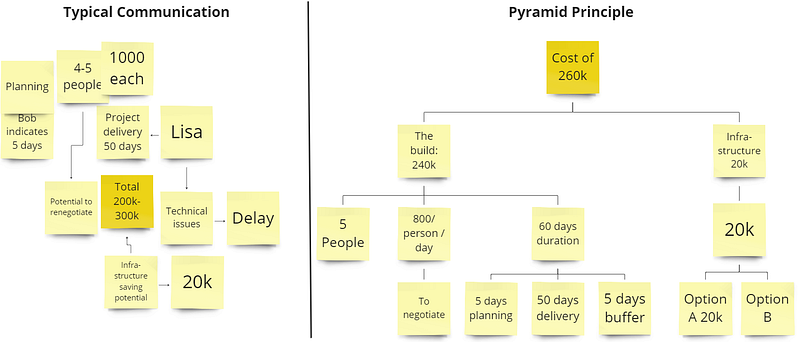
This second explanation saves the listener the work of organizing the information.
How Do You Create a Good Pyramid Communication Step-by-Step?
Let’s create an effective communication with another example.
Imagine we are advising a successful startup in the US. They offer a unique platform for business and life coaching. To grow their business, they want to expand internationally.
They want to know an answer to the following question:
For our international expansion, should we collaborate with the company ‘CoachNow’ to build a sister coaching platform in the UK?
Step 1: Problem breakdown
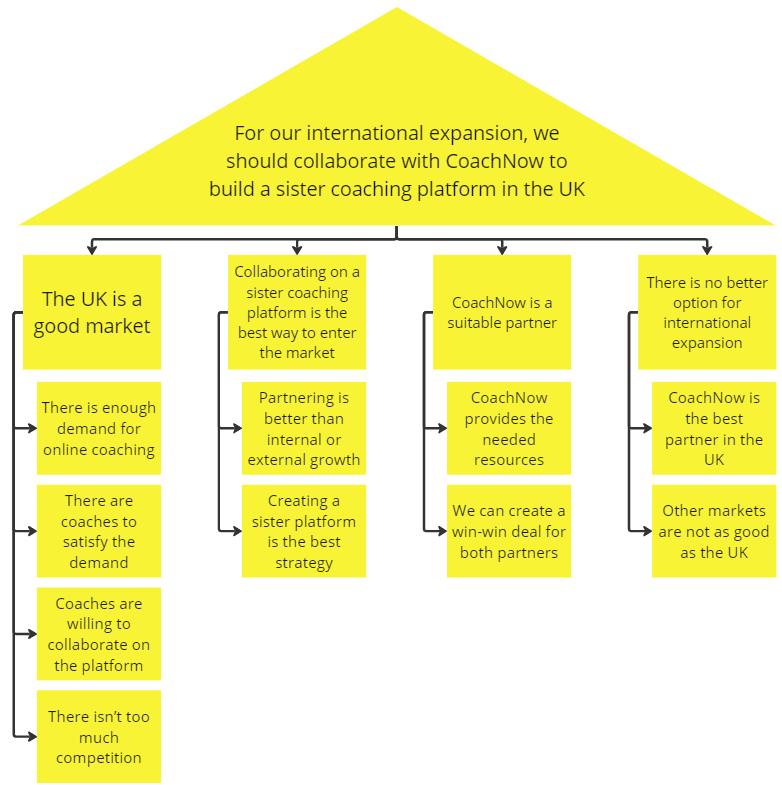
To answer this question we can dissect it into several hypotheses that we confirm or reject.
TL;DR:
- Strategy consultants solve problems by breaking them down into smaller chunks of questions or hypotheses
- They analyze each hypothesis to either reject or confirm it
- If they confirm all hypotheses, then the proposed solution is valid.
For example, for our core question, the following hypotheses have to be true:
- The UK is a good market
- Collaborating on a sister platform is the best way to enter the market
- CoachNow is a suitable partner
- There is no better option for international expansion
I explained these consulting style analyses in more detail here.
Once we confirm all the hypotheses we can conclude final answer. Now, we have to convince the client.
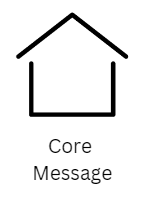
Step 2: Define the Main Message
Based on our analysis, we create the following main message:
We recommend partnering with the company ‘CoachNow’ to drive our international expansion.
Step 3: Group Supporting Arguments
Now that we have the core message defined, we have to support it. We use the same breakdown that we used for answering the question:
- Sub-group 1: The UK is a good market
- Sub-group 2: Collaborating on a sister coaching platform is the best way to enter the market
- Sub-group 3: ‘CoachNow’ is a suitable partner
- Sub-group 4: There is no better option for expansion

Step 4: Provide Evidence and Details
Think of any facts that you provided in the previous step. Which one are your listeners likely to challenge?
Provide evidence and details for those.
For example, for sub-group 1, we share the following evidence:
- Statistics on coaching inquiries in Google
- Results of survey among coaches
- Results of the competitor analysis
For sub-group 2, we provide examples of other successful market expansions.
And, for sub-group 3 we can show a company profile and testimonials for CoachNow.

Step 5: Summarize and Conclude:
At the end of the communication, we wrap it up briefly:
We recommend collaborating with ‘CoachNow’ on a coaching platform to enter the UK coaching market because of 3 reasons:
- The UK is the best-fit market for our expansion strategy
- Collaborating is the most promising way to enter a new market
- ‘CoachNow’ is a strong and trustworthy partner
- There is no better option for international expansion
With this, we have the entire communication pyramid constructed. It follows the logical breakdown structure of the problem.
We can use it in formal presentations with all the details or as a high-level 30-second explanation.
Key Takeaways
If there is one thing I want you to take away, it’s this:
Address questions and problems in a structured way. This is not only the best way to solve it. It’s also the blueprint for your communication. A communication that is clear and easy to follow for your audience.
To get there, follow these steps:
- Break the question or topic down into components and answer them individually
- Define the main message
- Group supporting arguments
- Provide evidence and details
- Summarize and conclude
Note that this article also followed a pyramid principle:
After a short intro, I first shared the key message: What is the pyramid principle? Then I supported the key message by showcasing an example. After that, I explained in detail how to create the pyramid. And finally, I’m summarizing the key points.
You can use the pyramid principle for large and detailed presentations as well as for short elevator pitches.
You can use it in business or at your friend’s pool party.
It’s suitable whenever your listeners are looking for information instead of a story.
You can always choose the needed level of detail once the structure is in place.
What are you explaining today?
Join us for valuable insights on problem-solving with AI at Lead & Succeed!