
Four Ways to Look At Happiness
An essay about what happiness, and the word ‘sand’, means to me
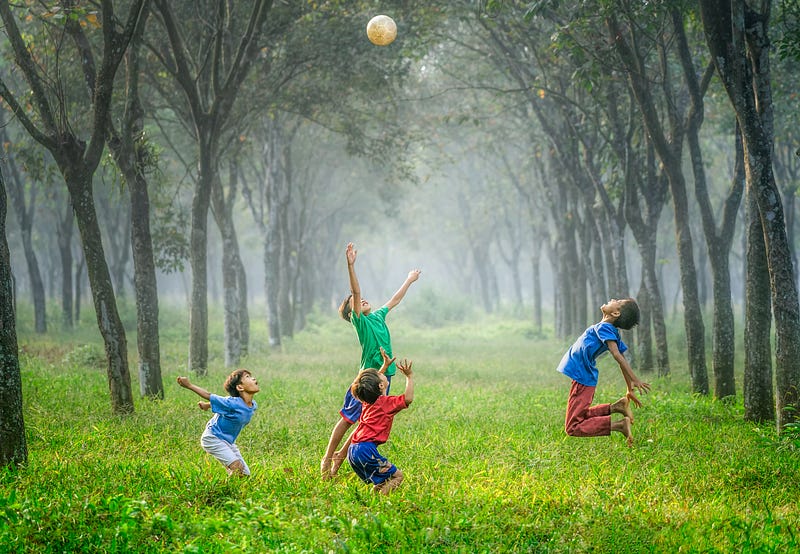
There are 171,476 words in the Oxford English Dictionary.
So many words to choose from, but the word sand is the one that comes to mind whenever I rekindle the early memories of my childhood.
I was born in a country that lies at the heart of Africa, sitting comfortably on the equator. In the summers, there was barely any wind and the sun was always roasting. In the winters (if you could even call it that), the rain never stopped. It was the kind of rain that never drizzled down — oh no, it thundered down.
Looking back, we didn’t have a lot. We survived on the bare necessities.
And, of course, there was no change for lego blocks or toy soldiers, so as a five-year-old kid, I had to be creative and resourceful with how I killed the time.
I remember spending so many hours sitting outside on the sand-stained concrete of our front yard, stacking dusty pebbles on top of each other. One by one.
Whenever the wind blew and collapsed my stone tower, I would collect all the fallen pebbles and begin stacking again. My tiny hands were always covered in grains of sand.
And that’s why the word sand echoes quietly in my mind whenever I think of my early childhood.
The clocks have turned, sixteen years have passed, and I can now candidly tell you that, today, the act of stacking pebbles on top of each other sits right at the bottom of my List of Fun Ways to Kill Time.
But, of course, that’s to be expected.
Most of what we adults consider boring have the power to kindle the powerful curiosity of children.
Playing in the sand was what kindled the curiosity of my five years old self.
Most of my childhood is a blur, but those moments I spent joyfully stacking towers of pebbles in the sand are still vivid in my memories today.
It’s those kinds of moments that perfectly capture what innocent bliss means to me.
The wisdom of children
The moral of the story is that happiness is what you make of it.
There is no universal understanding of happiness; happiness itself lies in the eye of the beholder.
When I was a child, we were scrounging for pennies, but I was still able to create some fond memories despite the situation we were in.
That’s because when I was a kid, the sky wasn’t the limit to my happiness.
Being able to play in the sand, without a care in the world, was the limit.
It seems the older I got, the higher that limit went.
I’ve lost a lot of the playfulness and carefree spirit I had as a child.
In this piece, I want to reconnect with that carefree spirit.
I want to understand happiness as I understood it at the age of five.
I want to dig deeper into the question ‘What is the meaning of happiness to me?’
And I want to explore my personal insights on happiness with you. Not as a professional, self-help guru or a life coach — but as a fellow human being, sailing through the currents of Life.
I’ve broken this piece into four parts — each part exploring the different aspects of what happiness means to me.
I hope you find something meaningful in these words.
I. The Art of Letting Go
I recently dawned upon the realisation that I overwork my mind too much.
On some days, thoughts turn and crash and rush across my mind at 1000 miles per hour.
Overthinking is a symptom a lot of us introverts have in common.
My busy, industrious attitude can sometimes drive me into burn-outs.
That needs to stop.
Sometimes, I feel like I’m in a tough game of tug of war, pulling the ropes of my career, relationships and health.
What I need to learn is the art of letting go.
There are many things outside of my control. All I can do is work on the things that are in my control, and let go of the rest.
I think a good ounce of happiness comes when we let go of the rope and accept the natural flow of things.
It reminds me of a prayer that I saw while reading Ryan Holiday’s The Daily Stoic book.
The prayer goes:
“God grant me the serenity to accept the things I cannot change;
courage to change the things I can; and wisdom to know the difference.”
That’s one prayer that I need to pray more.
II. An Ode to the Moments
Happiness doesn’t always have to be picture-perfect.
Joy can hide in the simplest moments.
At the end of the day, life itself is a long sequence of moments. Drinking a lovely cup of ice coffee, catching up with an old friend, waking up to the smile of a special someone.
We can consciously choose to be more aware of these little moments, and to appreciate the role they play in the stories of our lives — no matter how small their role may be.
Most of the best moments in my life, so far, were unplanned. They were not Caribbean Cruise getaways or breathtaking hikes across the Himalayas.
Some of the best moments in my life were simple:
Moments I spent relaxing with my friends in the park, without a care about tomorrow or yesterday. Only the present.
Moments I spent celebrating Christmases, birthdays, Easter holidays celebrating with my family.
Moments when I thought I was falling in love.
Moments I spent stacking towers of pebbles on the sand.
I think we would uncover more happiness if we simply allowed the little beautiful moments in our lives to matter more.
III. The Paths of Life
“Where do you see yourself in five years?”
I’ve always found it hard to transparently answer this interview question.
The short answer is “I don’t know.”
I have a rough idea of where I’ll be, yes, I have no surefire way of knowing.
So far, my life has not panned out how I initially thought it would.
If you were to ask me at the age of 16 “Where do you see yourself in five years?” I would’ve told you that I see myself working as a machinist.
I would’ve never thought that today, I’d be working at a digital marketing agency.
But life always seems to have a plan of its own.
And sometimes, the plans life has in store for us are better than we expect.
I think to find happiness in life, we need to keep our minds open to the different paths we can take.
IV. Counting blessings
And then there was one:
Gratitude.
Too much of something is always bad, but I don’t think that rule can really apply to gratitude.
You can never have too much gratitude.
Gratitude is the arch enemy of wanting more. I need to steer myself closer towards an attitude of gratitude.
Wanting more is fine until wanting becomes the only thing we do. Until our chances of happiness hinge on whether or not we can tick every box on our wishlist.
I think happiness not as much about what we have as it about how we think.
Perhaps, if we learnt how to count our blessings, we’d be able to see more light in our lives.
A.


