
I Walked 23k Steps/Day for 5 Weeks — Here’s What Happened
A comprehensive overview of my journey, lessons learned, best practices, and if it was worth it
Walk more.
That’s my #1 advice for anyone trying to improve their health and fitness.
If you want to lose weight, walk more. If you want to improve your cardiovascular health, walk more. If you want to be able to eat more, walk more.
Walk. Walk. Walk.
That’s been my mantra for many years. Years in which I’ve religiously taken 10k steps daily — even if this is an arbitrary number born of a Japanese marketing campaign.
Walking is my preferred form of cardio, as it strengthens your heart and legs, helps you burn more calories — allowing you to eat more — and lifts your mood. Research from Harvard shows that walking helps cater to depression, anxiety, stress, and other mental health issues, going as far as stalling the use of antidepressant drugs.
Incredible.
Still… Does this mean that walking more is always a worthwhile goal?
This question prompted me to increase my daily steps for four weeks, from 10k to 20k on average. As life is unexpected, I didn’t want to have a rigid daily goal. Instead, I simply ensured my average step count surpassed 20k. And wouldn’t you know it? I made it to 23k steps for five weeks.
From June 19th to July 23rd, I walked double my usual amount.
In this post, I’ll share my experience week-by-week, offer helpful tips for anyone hoping to walk more, and unveil my results. Most importantly, I’ll answer the question that inspired this challenge: Is it worth it?
Part I: Walking an Average of 23k Steps per Day
I didn’t know what I was getting into when the challenge started.
Yes, I’ve been walking 10k steps daily for many years. Walking for an hour and a half throughout the day has become second nature to me.
But three hours and a half?
Damn.
Already on day 1, I became acquainted with the main obstacle — and con — of walking more than 20k steps daily: It’s incredibly time-consuming. Almost four hours a day is a part-time job.
So yeah… Here’s the week-by-week detail of how I handled my new job.
Week 1:
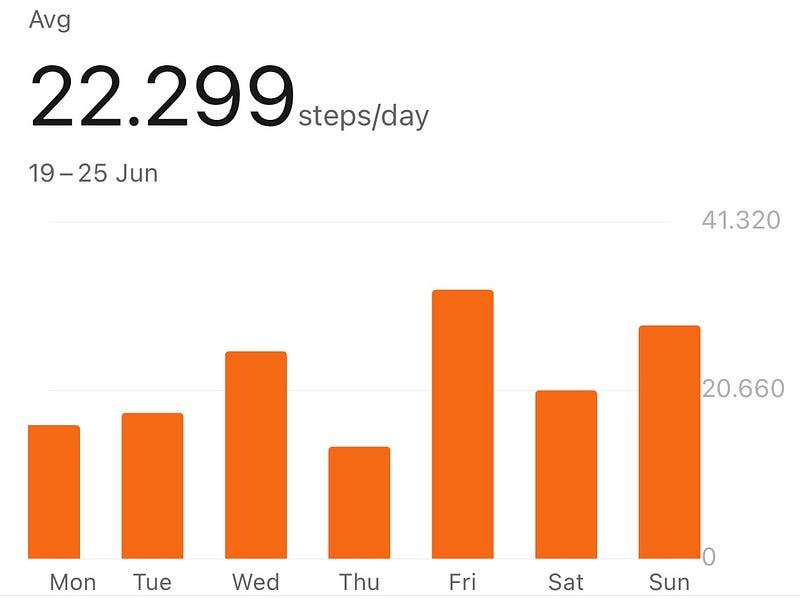
Week one was the most grueling.
Though I secured the average, I fell short of my goal on three days because my feet were killing me.
Not that I expected anything else. This is why every health and fitness influencer worth their salt will recommend you increase your daily step count progressively.
However, as this was a one-month challenge, I decided to go all in.
To prevent pain, I split the steps into many walking sessions. I walked before and after every meal, walked whenever I had a spare moment (even if just 5 minutes), and walked everywhere (even in my living room).
Then, to ease the remaining pain and prepare my feet for the next day, I immersed them in freezing water for ten to fifteen minutes. Though jarring at first, it’s actually pleasant.
Other things I did to avoid/ease pain were:
- Stretching. I did 3 yoga sun salutations after waking up and 3 more after I was done with my steps.
- Wearing comfortable shoes. On the first day, I wore sandals to walk outside and slippers to walk in my living room — and immediately regretted it. From day two onward, I wore comfortable sneakers that made the process easier.
By the end of the week, I was beginning to find my stride (pun intended).
Week 2:
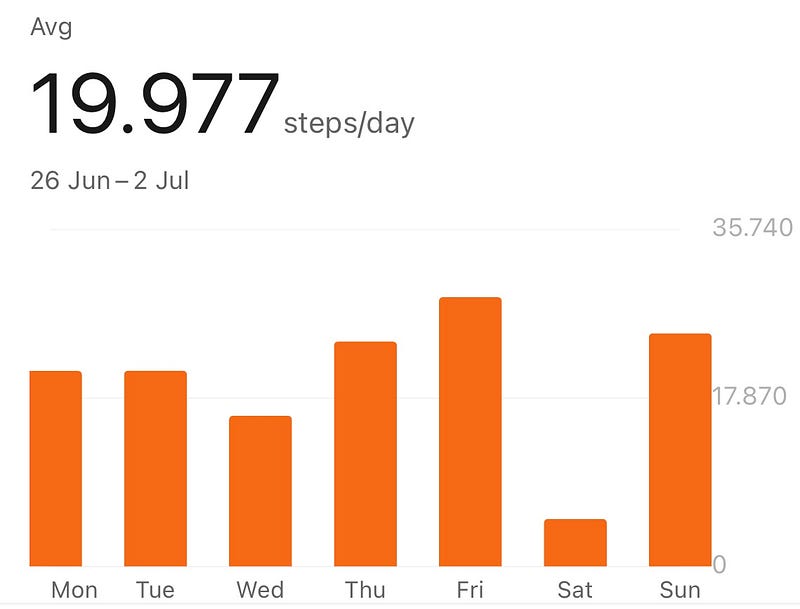
Week 2 was more manageable.
I easily achieved my goal on most days except Saturday (I had a long event and had no time for walking). But even with that “misstep” (I’m killing it today), my weekly average was almost 20k.
Success.
That said, I still came face-to-face with another obstacle of walking so much: It can be boring as hell.
Fortunately, this is something I know how to deal with thanks to my years of 10k daily steps:
- If I want to meet up with friends, we either walk around the block or go trekking.
- If I want to read or watch something on my phone, I pace around my living room while consuming whatever I want. This also applies when calling someone.
Though the second point may sound weird and extreme, it can be anyone’s secret weapon for drastically increasing their step count.
Mastering the art of “read-walking,” “watch-walking,” or “podcast-walking” is what allowed me to enjoy the many living-room walks I had to fit in to achieve the 20k step goal.
In these five weeks alone, I’ve read 8 books and listened to many of Andrew Huberman’s excellent podcasts thanks to all the walking.
Week 3:
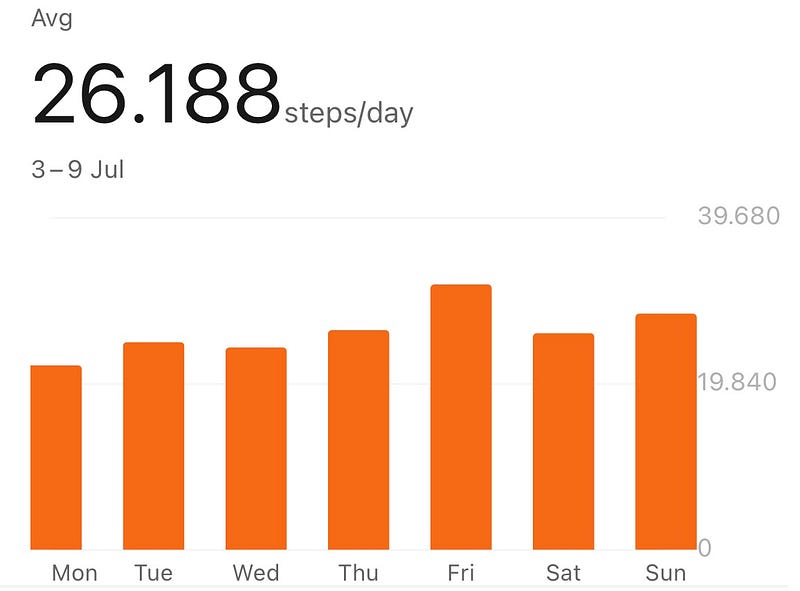
Week 3 was… I have no words to describe it.
Intense. Interesting. Wow — yes. That’s it.
Week 3 was wow.
I never thought I could fit that many steps during a regular workweek. On holidays, yes. Sightseeing can quickly increase your total step count. But having done this on a weekday was surprising even to me.
Two things made this possible.
On the one hand, I had fewer classes than usual (I’m a private English teacher), so I devoted every spare minute to read-walking in my living room. Thankfully my husband is already used to it and no longer thinks I’m weird.
On the other hand, we went to the Pyrenees — the mountain range close to Barcelona — on Friday evening, where we spent the next two weeks (my husband and I can work remotely). This meant that on the weekends, we walked a lot in nature.
Still… wow.
Who knew you could walk so much on a random workweek?
Week 4:
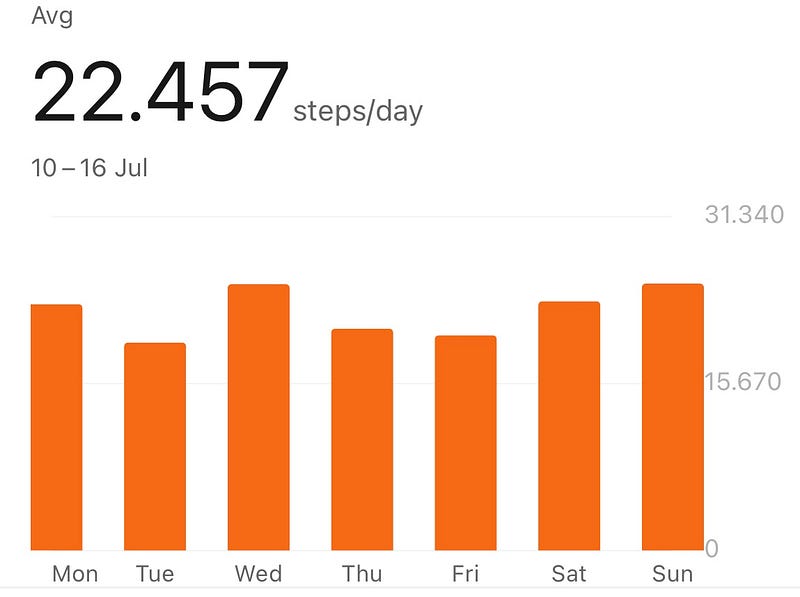
We were in the Pyrenees for the entirety of week 4, which made getting the 20k steps effortless.
Every day after work, we went for a walk in nature. This was not only great for achieving my goal but was also deeply relaxing.
One of the reported benefits of walking more is an increase in quality sleep, which I experienced this week. However, maybe it had more to do with spending many hours in nature (also linked to improved sleep) rather than walking — or perhaps it’s a combination of both.
Either way, it’s clear that walking in nature — whether 20k steps or way less — can reduce your stress levels and improve your sleep.
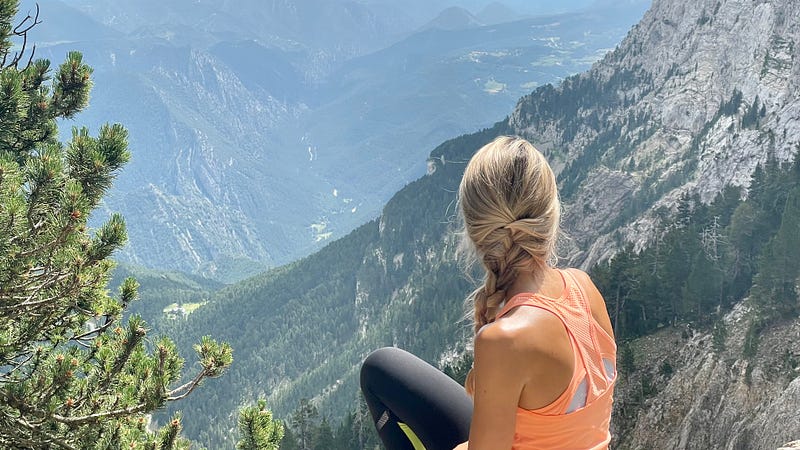
Here’s a picture of the beautiful hike we did on Sunday:
Week 5:
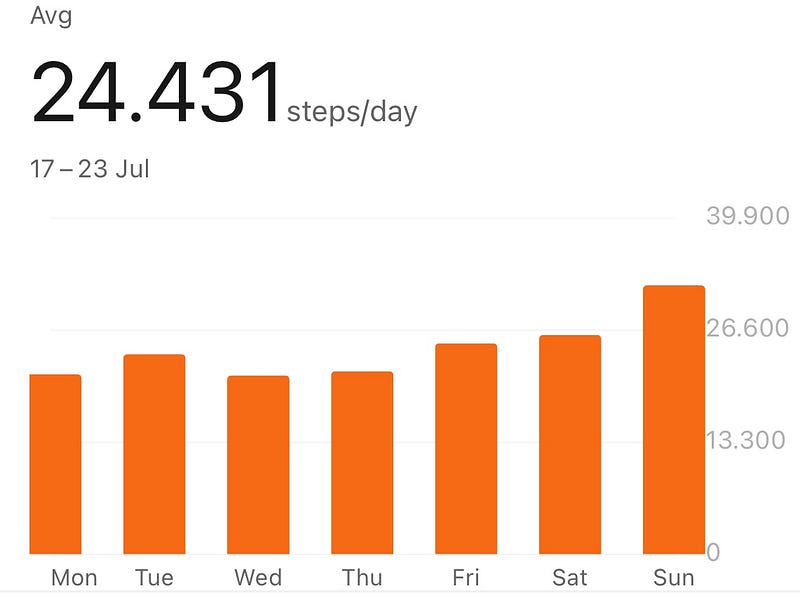
Week 5 was a bonus.
I hadn’t planned to continue the challenge, but since I was still in the Pyrenees, I decided to go for it. And as you can see, I crushed it.
Thanks to weeks 2 and 5, I went above and beyond my original goal. Instead of 20k, the average of the five weeks was 23k steps daily.
And boy… I felt them.
Though at the beginning of the challenge my hunger was more or less the same as before, my appetite increased as the weeks progressed. And since my goal wasn’t to lose weight, I let my body guide me.
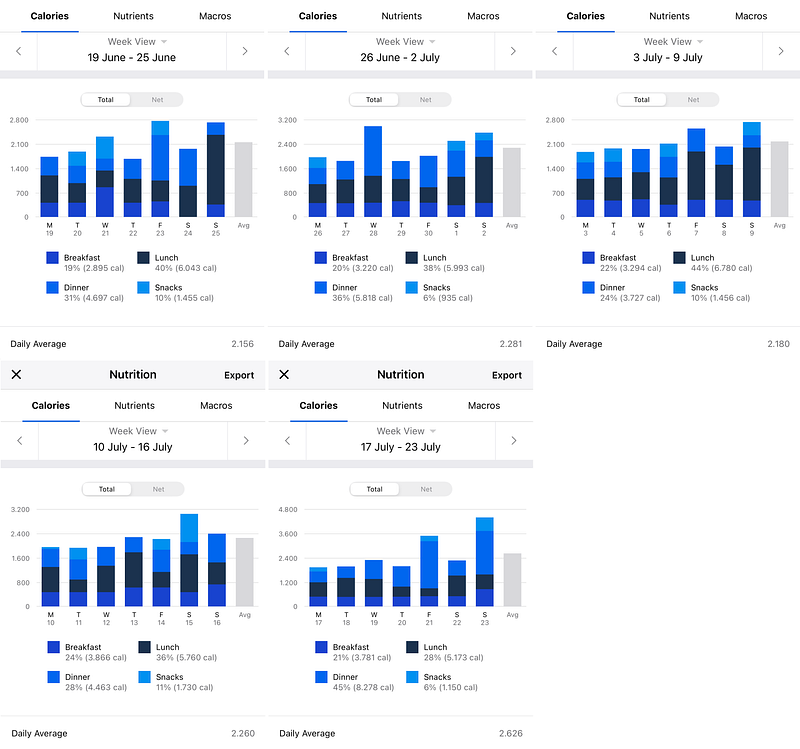
As you can see, I ate more as the challenge went on. By week 5, I’d increased my average daily calorie intake by 400 calories.
Still, though I followed my instincts and ate more, I was mindful of what I ate. If you’ve read my previous post on what I do to maintain a lean physique, you’ll know I ensure all my meals have plenty of protein, healthy fats, and fiber.
This was especially true during this challenge. As I was increasing my activity level, I wanted to give my body enough fuel to withstand it.
Now, of course there was also plenty of ice cream (it’s summer), but 85% of my meals were nutritious hunger-crushing combos (HCC): a combination of protein, fiber-rich veggies, complex carbs, and healthy fats.
On my last day, though, I went all out. Tiramisu, chocolate croissants, cheese fondue, Magnum ice cream, Iberian ham sandwiches — I was celebrating.
The challenge had ended. It was now time to review the results.
PART II: The Results
According to Mayo Clinic, regular brisk walking can help you:
- Lose body fat and maintain a healthy weight.
- Prevent or manage health conditions like heart disease and high blood pressure.
- Improve your cardiovascular fitness.
- Strengthen your bones and muscles.
- Improve your muscle endurance.
- Increase your energy levels.
- Improve your mood, cognition, memory, and sleep.
- Improve your balance and coordination.
- Strengthen your immune system.
- Reduce stress and tension.
Based on these research-backed benefits, let’s review what I got:
Fat loss, weight loss, and muscle gain
Here’s how I looked before and after the challenge:
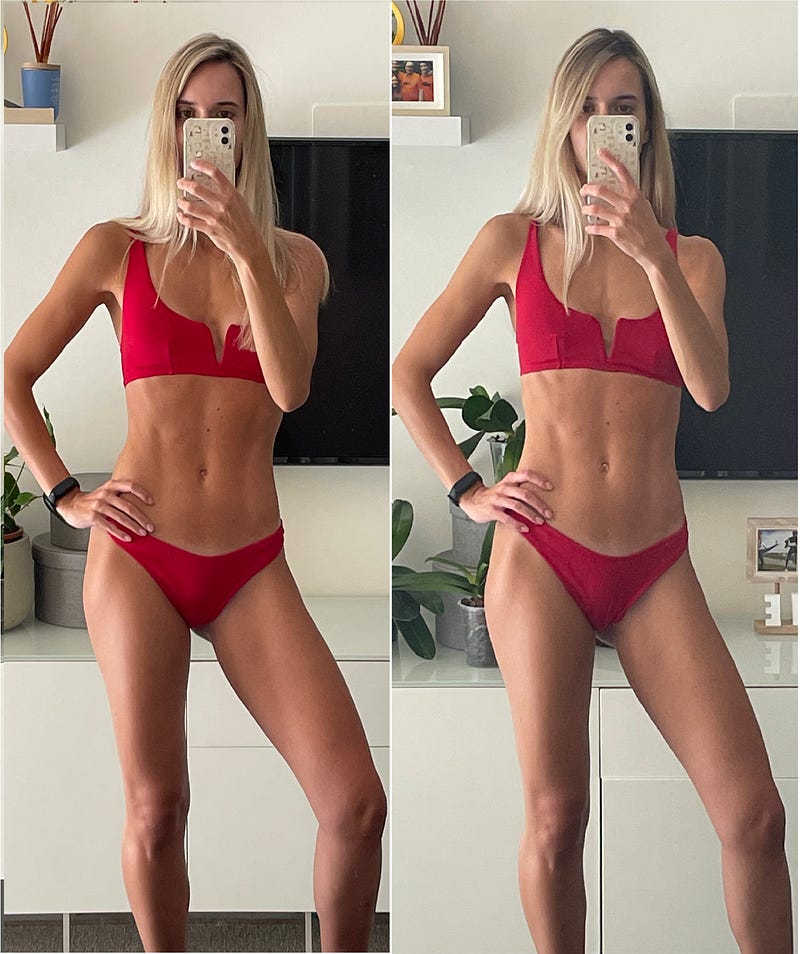
As you can see, very little has changed. Though it’s almost impossible to notice in the pictures above, my arms, glutes, and abs are slightly more defined. How do I know this?
Because of the measurements I got at the gym.
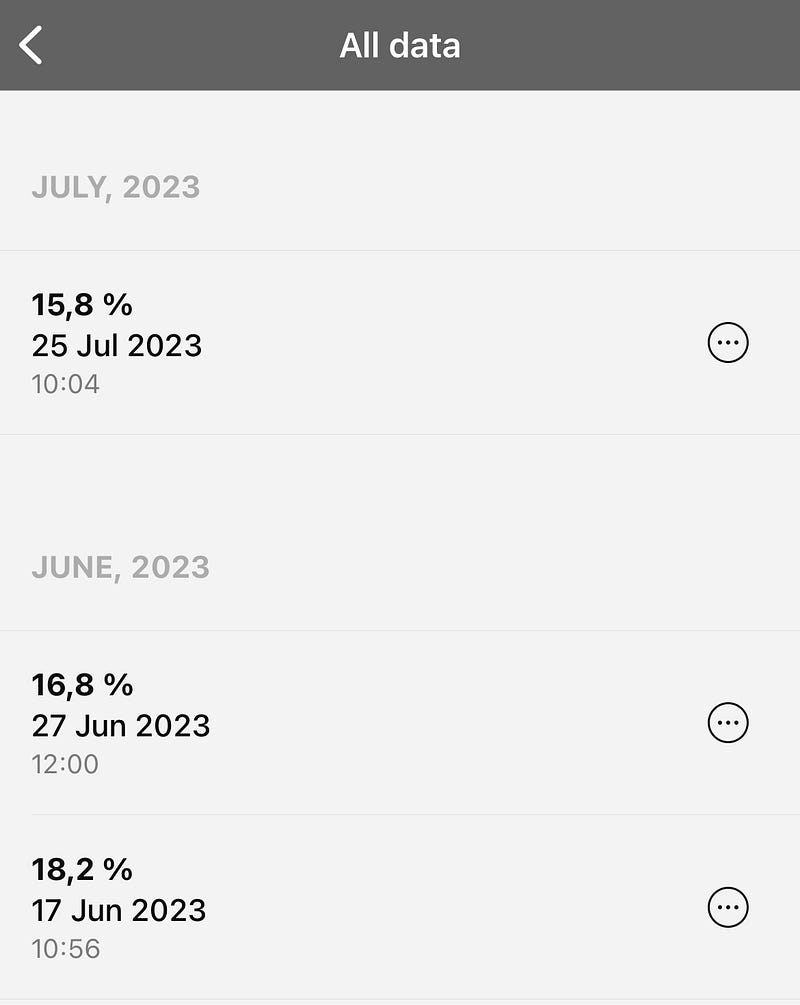
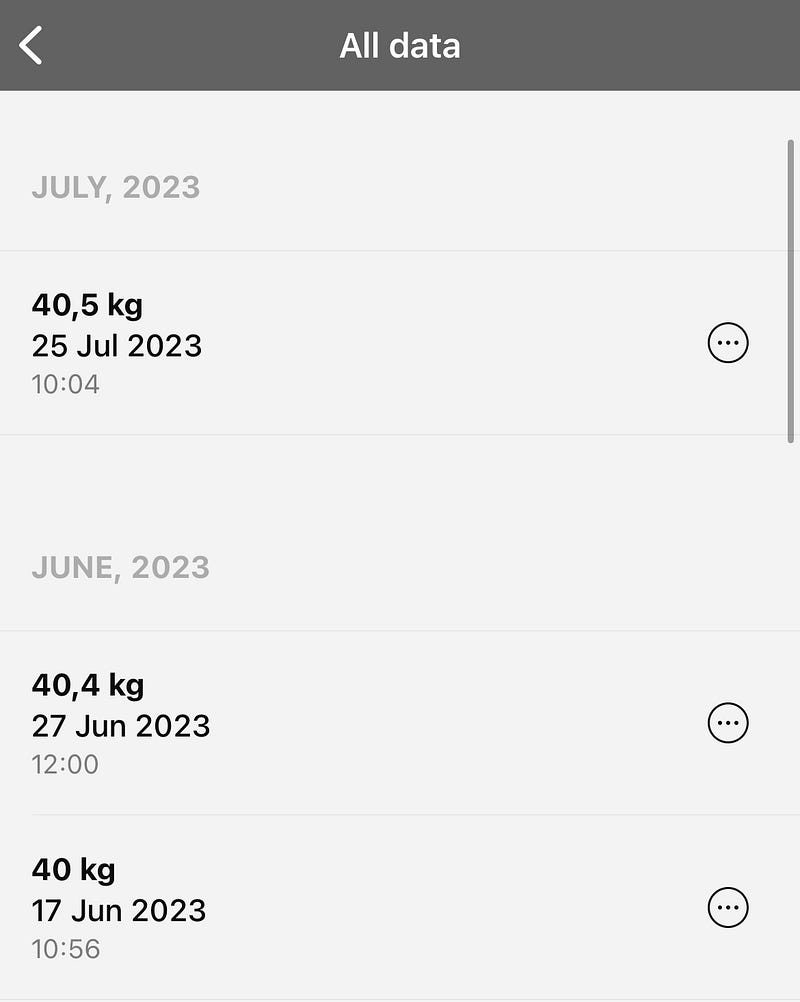
Despite increasing my calorie intake, I lost around 2% body fat and increased my muscle mass by 0,5 kg (1,1 pounds). This translates into more definition. However, the changes are hard to notice as I’m already lean.
One important thing to note is that I maintained my resistance training routine throughout the challenge (3 times per week). Each session lasts around 60 minutes and consists of a warm-up, 7 exercises (4 lower body that prioritize the glutes and 3 upper body), a short abs circuit, and stretching.
However, I didn’t add more weight or reps throughout these 5 weeks, which means the increased muscle mass likely came from walking those extra steps.
So… yes, I lost weight — fat, to be precise — and strengthened my muscles. And the results would’ve probably been more pronounced had I kept my calorie intake closer to my typical values.
However, as I mentioned before, my goal wasn’t to lose weight. I’m just pointing out that walking can be a great way to lose fat and gain muscle.
Other results
Here are the other results I saw:
- Improved cardiovascular fitness. Though I have no data to corroborate my claim, I’ve noticed that returning to 10k steps per day has been effortless. What was challenging for me before now seems like nothing, a sign my cardiovascular fitness must’ve improved.
- Increased energy levels. The energy you feel after a long walk is exhilarating, which was especially useful after lunch. As I always walked after my meals during the challenge, I barely felt the afternoon dip in energy most of us experience.
- Improved mood and sleep. As I mentioned before, walking — specifically in nature — relaxed me and deepened my sleep.
- Improved digestion. Though Mayo Clinic didn’t include this point, I’d like to mention it as it’s something that’s also science-backed. Walking after every meal made my digestion lighter, even when consuming extremely fatty meals.
- Increased knowledge. As I mentioned before, I read many books and listened to many podcasts while walking in my living room. In these five weeks, I’ve learned a lot about Stoicism (I read all of Ryan Holiday’s excellent books) and many ways to improve your health and fitness thanks to Andrew Huberman.
Overall, walking these many steps has helped me feel stronger, smarter, and happier while allowing me to eat more. It’s been a fun part-time job.
PART III: Was It Worth It?
After this challenge, I’m more convinced than ever that walking is the secret weapon for improved health and fitness.
It works for body recomposition (losing fat while gaining muscle), boosts your mood, improves your sleep, and, combined with reading, can help you learn many new things.
However, having a 20k-step daily goal is absurd. Unless you have loads of spare time or you’re training for a marathon, I wouldn’t recommend it.
Moreover, these many steps — and even 10k steps, for that matter — aren’t even necessary to reap the science-backed benefits related to walking. A recent study involving over 2,000 middle-aged adults who had to wear a step-counting fitness device between 2005 and 2016 showed that the optimal number of steps per day is 7k.
At that point, the risk of death was between 50% and 70% lower from all causes compared to people who barely walked. Anything more wasn’t associated with additional benefits.
So… though of course walking 10k or 20k steps daily will help you burn more calories and strengthen your heart and legs, it’s unnecessary to experience extraordinary health. 7k steps will suffice, which you can do following these tips:
- Increase your number of steps progressively.
- If your feet hurt, immerse them in cold water and massage them afterward.
- Wear comfortable shoes. Here you can find 7 tips to find the perfect shoe.
- Walk everywhere and whenever you can. Park far from the entrance of your job. Walk around the office when waiting for a meeting (pretend you’re going somewhere). Add a short walk around the block after every meal. Note: Research has shown this helps us reduce the blood sugar spikes we get after eating something sweet.
- Give “read-walking,” “watch-walking,” or “podcast-walking” a try.
- Ask your friends out for a walk, or call a loved one while on a walk.
- Eat properly. Ensure 85% of your meals are nutritionally on point (lean protein like tofu or chicken breast in a quarter of your plate, complex carbohydrates like quinoa or sweet potato in the other quarter, fiber-rich veggies in the other half, and a sprinkle of healthy fats such as olive oil or nut butter in top.
- Hydrate. Take a water bottle with you and keep reminders on your phone to drink every few minutes.
Now, a 7,000-step goal is as helpful as a 2,000-one if that’s all you can commit to. What matters is that you make a more conscious effort to walk throughout the day. This will keep your energy expenditure high while improving your health.
And even then, if you hate tracking, simply vow to walk more.
That’s all it takes.


