We Might Be Alone in the Milky Way
And it is a really great thing!
According to British writer Arthur Clarke, “Two possibilities exist: either we are alone in the Universe or we are not. Both are equally terrifying.”
Back in the fifties, physicist Enrico Fermi estimated that it would take a technologically advanced civilization a pinch of cosmic time to colonize the entire Milky Way, even without faster-than-light travel capability. Then, during lunch at Los Alamos National Laboratory, Fermi brought this idea to some of his colleagues. According to them, the conversation ended with the famous question that would haunt scientists for years to come: “But where is everybody?”
Unfortunately, Fermi died of cancer a few years later without the opportunity to publish a paper on the subject. Regardless, his argument was so jarring that the question outlived him and became known as the Fermi paradox. The debate still rages today, books of objections and explanations have been published, but the question remains unanswered.
“In 1974, astronomer Michael Hart published the first paper building on Fermi’s argument. Hart proposed that if an alien civilization had evolved in our galaxy, it would have developed interstellar travel and colonized its neighboring stars. These colonies would, in turn, launch colonizing expeditions to their neighboring stars, and so on, occupying the entire Milky Way within two million years.” -Excerpt from my book K3+
The cosmic obstacle curse
Planets are the incubators of life. We know that the development of single-celled organisms comes first — from organic compounds on the surface or delivered by comets and asteroids. Increasing complexity will result in complex multicellular life. Although Evolution is not trying to make big brains, certain selective pressures might eventually lead to the rise of intelligence — and perhaps beings capable of advanced technology. Yet, there is a time limit for a civilization to become spacefaring before the next extinction event.
It is conceivable that, somewhere along these great filters, life in our cosmic neighborhood is being stopped before mastering space. We can identify them because they’re in our past, but we can’t tell what filters lie ahead. This apparent absence of aliens, often referred to as the great silence, compels us to look deeper into the history of life on Earth.
A series of fortunate events
Our world is about 4.5 billion years old. The fossil record shows that life started almost immediately after the planet formed. However, it took over five times longer for a freak accident that cleared the path for multicellular life to occur.
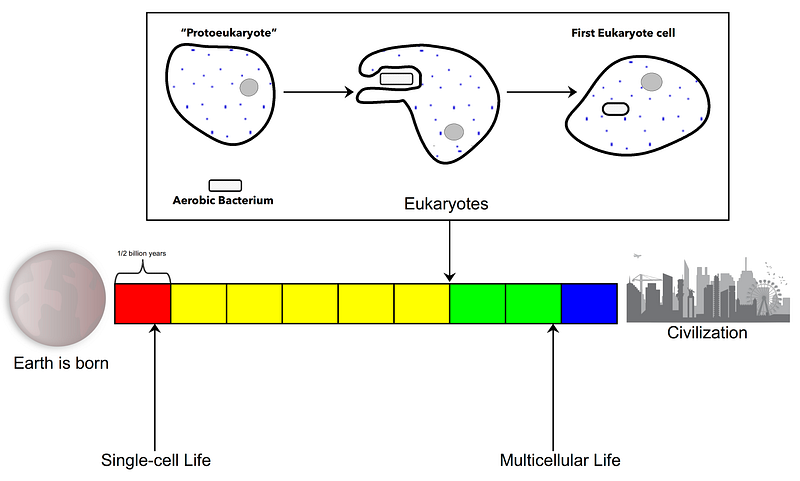
Humans, dogs, cats, trees, and all other lifeforms you can see without a microscope, are made of Eukaryotic cells. Scientists agree that a less complex type of cell must have tried to ingest a bacterium but was unable to digest it. The stalemate led to the first Eukaryote, which became so successful, it spread throughout the planet.
However, it took almost another billion years of evolution for the mighty Eukaryotes to learn to organize and form the first multicellular organisms, just 600 million years ago. Based on the timeframes, it could be argued this was the most significant milestone for life on Earth. We owe the existence of our civilization to that miraculous event, 1.5 billion years ago.
Fast-forward to sixty five million years ago, another miraculous accident occurred. The killer asteroid that crashed into the Yucatán Peninsula was just the right size to kill most of the dinosaurs, but not all life on our world. This event allowed a brand-new species to get out from their underground burrows, and take over planet Earth: the mammals. Had the asteroid been a different size, or struck at a different time, the story of life on our world would be quite different.
If an alien civilization anywhere in the Milky Way got annihilated by an AI of their own creation, we wouldn’t be having this conversation.
Can civilizations spark somewhere else?
We hear there’s a billion trillion stars in the universe. Could our mind-boggling quest towards a technologically advanced civilization, be replicated on planets around any of them?
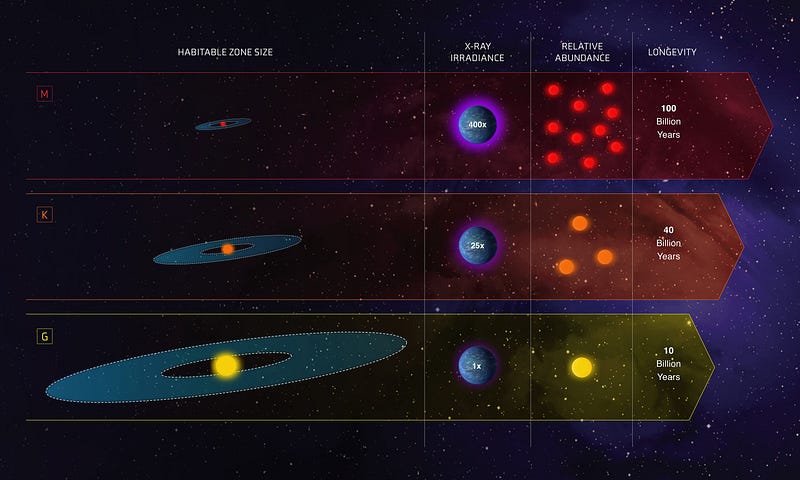
Contrary to what we learned in school, the sun is very atypical — only 3.5 percent of all stars are like it. It has recently been argued that the Sun appears exceptionally tame compared to other Yellow Dwarfs, which makes it even more rare.
Over 70 percent of all stars are Red Dwarfs, which live much longer than the sun. Recent studies, however, place much doubt on rocky worlds around their habitable zones being able to develop strong enough magnetic fields, capable of protecting them against the ferocious radiation erupting from these flare-stars. Without a magnetic field, planet atmospheres will be stripped away — just like it happened on Mars.
But even if Yellow Dwarfs are the only ones with that perfect equilibrium of energy and stability, to allow civilizations to spark on planets around them, these stars are short-lived. Within a billion years, our Sun’s energy output will increase by 10 percent, which will be nothing less than catastrophic to Earth’s biosphere. A civilization must rise fast enough to avoid being wiped out before their star enters its Red Giant phase, which invariably incinerates all worlds in its habitable zone.
Do civilizations have an expiration date?
It’s easy for us to argue that civilizations might be short-lived, as we have observed throughout human history. But even a nuclear war won’t exterminate every single human being — far from it. The survivors will then be able to restart civilization after a few centuries and, hopefully, be wise enough to avoid repeating the experience.
A runaway AI has the potential to wipe out humankind but, just as the Homo sapiens “displaced” the Neanderthal and other hominids, the AI would continue to thrive and soon go on to colonize the galaxy. If an alien civilization anywhere in the Milky Way got annihilated by an AI of their own creation, we wouldn’t be having this conversation.
Some cosmic phenomena, like a close-by supernova, a black hole, or a gamma-ray burst, would be able to completely destroy humanity. However, all civilizations in the galaxy would have to suffer this fate, to prevent a single one of them from expanding throughout their cosmic neighborhood. But in a few centuries we might have the technology to survive some of these cosmic disasters.
So where are the aliens?
We don’t know what we don’t know. But we can speculate that other intelligent beings will be able to figure out math and extrapolate the laws of physics. Even if they interpret them differently, their technology has to follow a path similar to ours. It’s inevitable they’ll undergo a stone age until discovering metals, followed by increasingly efficient ways to put energy to work — leading to what we recognize as advanced technology.
Stars are gargantuan fusion generators releasing vast amounts of free energy, the low-hanging fruit for a civilization to reach critical mass to escape their home planet — and conquer their cosmic backyard.
There are certain signs we expect to recognize from an alien civilization expanding throughout its region of space, such as megastructures that will dim the stars out as they continue to harvest more and more power from them. Although our detection threshold currently spans hundreds of millions of light-years, we haven’t identified any such technosignatures yet. All we see around us is raw wilderness.
If the Fermi Paradox doesn’t impact you at an existential level, you haven’t spent sleepless nights trying to fathom its implications.
Although Earth is our only example, it seems that life evolves soon after a habitable planet is formed. Nevertheless, it’s possible most life in the universe is unicellular, or multicellular organisms that hardly ever achieve advanced technology — before getting incinerated when their sun becomes a red giant.
Consider the hundreds of uncontacted indigenous tribes that still exist around the world. These members of the human species have not developed advanced technology. Our big-brained Neanderthal cousins had knowledge of fire, and even used pottery to boil food, but didn’t develop advanced technology in nearly a half million years. Therefore it’s possible that big brains don’t lead to advanced civilizations 100 percent of the time.
One could argue that technology doesn’t become extinct. Something like the wheel cannot be uninvented, because knowledge of it will spread to other tribes like wildfire — just by seeing it in action. Therefore we can speculate that it might have been invented only once. The same can be said about every single milestone that led to our thriving civilization.
As I discuss in a separate article, humanity has already reached the technological level to begin colonizing the solar system and, within centuries, our neighboring stars. Given another million years, a blink-of-an-eye in cosmic time, we’ll be masters of our galaxy and immune to extinction. With the universe being close to fourteen billion years old, and the Milky Way being nearly as ancient, could this not have happened before on one of the other six billion Earth-like planets?
If the Fermi Paradox doesn’t impact you at an existential level, you haven’t spent sleepless nights trying to fathom its implications. Nevertheless, isn’t being alone a more attractive proposition than being one of many — just another pebble on one of the many shores of this vast cosmic ocean?
And if so, is it not our destiny, our duty, and even our birthright, to spread throughout the cosmos, colonize it, and make it our playground — like a species of gods?
Want to learn more about the Fermi Paradox?
My new dystopian novel K3+ is the story of Earth’s demise and humanity’s rise to become an intergalactic empire. From colonizing space to saving humanity, the science-grounded story interweaves cutting-edge technologies and spellbinding fiction.


