
The Answers Are Obvious, The Bosses Don’t Care
If you ask the average executive about their employees’ mental health, they’ll usually say something related to wellness, mindfulness, or “self care.” If pushed further, said executive will refer to the HR department, or perhaps to some sort of nebulous internal program to “help employees deal with the stress of a challenging world.”
The reason that they do this is because they don’t really know what’s happening in their company, but they also don’t really care, because if they did, they’d realize that you can’t use therapy to beat a shitty job.
Dave Whiteside, Director of Insights at YMCA WorkWell, shared some of his research around how companies could support their employees’ mental health, and the findings are incredible. Apparently, the biggest thing affecting workers’ mental health is…their work? What? Am I reading this right? You’re saying that the stress of work can be reduced by work being less stressful? NO!
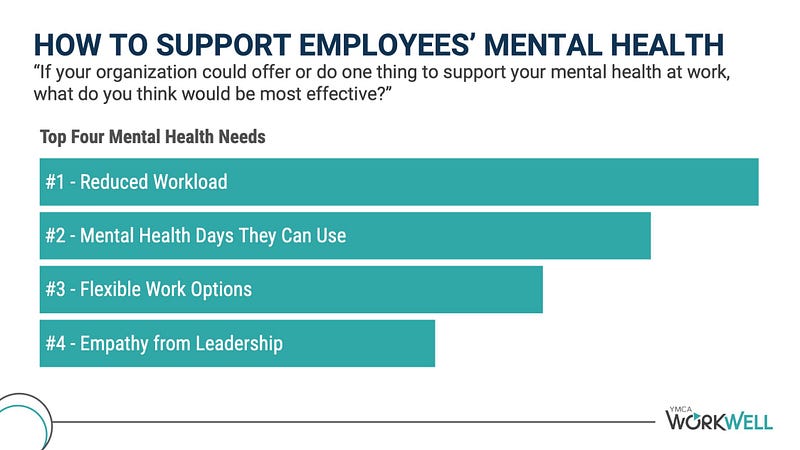
I am, of course, being quite sarcastic.
In every single job where I’ve felt that I had any kind of mental health issue, it’s come down to a combination of lacking any meaningful support and working in a toxic environment. While bad situations from your personal life can bleed into your professional one, the inverse is far more likely — you spend hours at work, surrounded by people you work with, doing work until you’re allowed to leave work.
Many executives want to make this situation as complex as humanely possible, because it obfuscates their role — and thus their responsibility — in what actually causes these problems. If you make “mental health” a monolith, you turn it into something that becomes an ‘initiative’ that the company must ‘consider and ‘organize themselves around.’ Once something is an initiative, it’s “everybody’s role to get involved,” and thus solutions no longer have any responsibilities to the problem itself — because “the hard work must be done to make this part of our company culture,” meaning that your company now has “wellness Wednesdays” and you get access to a company app with guided meditations.
The reality is that the biggest mental health problem you face at work is your job. You cannot therapy your way out of bad colleagues, bad management, having too much work, having too little time to complete tasks, a lack of resources, or bad work conditions. Talking to someone about your problems may make you feel better, but therapy does not deal with external problems. And while you can change your perception of whatever situation you’re in, when things suck, they suck. They’re bad. Working with assholes is terrible. Working for assholes is terrible. Too much work is not something you can Mind Master Yourself Out Of.
It’s also extremely condescending to suggest you can.
The things that an organization has to do to significantly improve the mental health of their workers is make their lives easier. This may seem straightforward, but oftentimes requires tough decisions like firing toxic managers and making clear-set guidelines about what behavior is acceptable (or unacceptable). It also requires a level of organizational introspection and empathy that doesn’t exist unless you’re extremely intentional in building it from day one.
So the next time an executive mentions “wellness” or “mental health,” ask them what they’re specifically doing about it.
And if they say anything about apps, scream at them until they cry.


