
When Coal Was New, Americans Hated It
A lesson for solar energy: People’s objections to a new energy source are often aesthetic
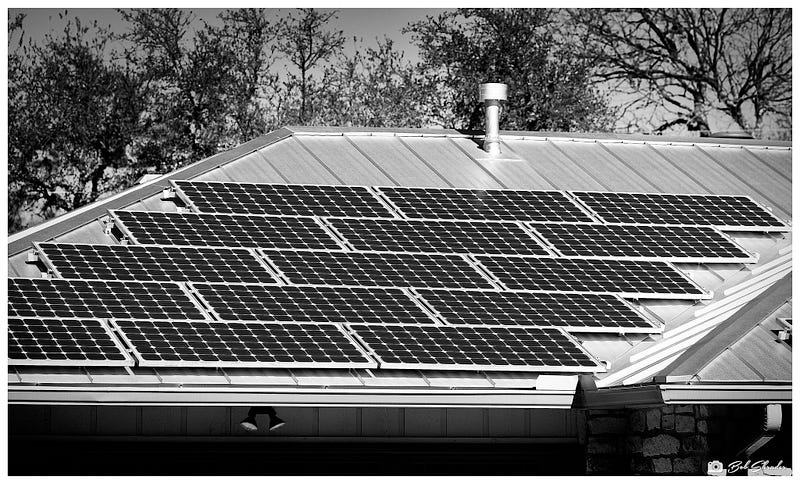
When I first got solar panels on my Brooklyn roof, I set them as far back as possible from the street.
Why? I didn’t want them to be too visible.
I was worried neighbors would think they looked terrible.
As it happens, nobody said anything to me. True, a relative of one of my neighbors, visiting from out of town, declared the panels were a “monstrosity” and said I’d bought into “a scam.” But nobody else objected, at least not to my face.
Statistically speaking, though, I was right worry that people would find them ugly — because the truth is, many do. One of the biggest objections to widespread renewable energy is its aesthetics.
People are fine with renewables in general! As recent surveys find, the majority of Americans want the country to build more solar and more wind.
The problem tends to be when it’s suddenly in their face. They wake up to find an historic house across the street now sports a solar panel, or a big turbine appears on a distant hill. Or maybe a developer builds a big array in a nearby field. They’re happy to have solar and wind somewhere — just not where they can see it
This turns out to be a surprisingly common problem that, in some towns, is really slowing down the adoption of solar. Some community associations and municipal boards are setting rules that ban homeowners from having any panels visible from the street. Meanwhile, residents of rural towns are fighting developers who want to build nearby solar fields. Again, most of these folks aren’t against renewables; they want them to exist. They just find them too ugly to look at.
One might think this is a new problem, right? That there’s something unique about renewables that makes so many find them ugly?
Nope. It turns out Americans have a long history of this. Back in the 19th century, they had equal aesthetic dislike of the newfangled fuel of the day:
Coal.
I just published a new column in Smithsonian magazine about this fascinating bit of history. You can read the whole thing here (and while you’re at it, hey, subscribe to the mag here for $12 a year).
But the gist of it is:
In very early America, nobody yet used coal. Homes were heated with wood, because trees were plentiful and cheap. So Americans built their homes with big fireplaces in the kitchen, and sometimes in drawing rooms too.
But by the mid to late 1700s, they’d cut down so many trees that — in the bigger towns and cities — easy wood was getting harder to come by. Wood prices were spiking. “Wood, our common Fewel, which within these 100 Years might be had at every Man’s Door, must now be fetch’d near 100 Miles to some towns,” wrote Benjamin Franklin in 1744, “and makes a very considerable Article in the Expence of Families”. The country needed a new energy source.
Coal fit the bill. It was plentiful; tons of it had been discovered under Pennsylvania. So coal companies set about trying to convince American families to stop burning wood and start burning coal. Interestingly, the big market was households. In the early 1800s, the steam engine and railroad hadn’t yet arrived, so there was no industrial demand for coal. To sell coal, coal companies had to get individual homeowners to embrace it, one by one.
The thing is, people hated coal.
Specifically, they hated its aesthetics.
Americans were used to clustering around a cheery, open wood-fire. They loved seeing those flames!
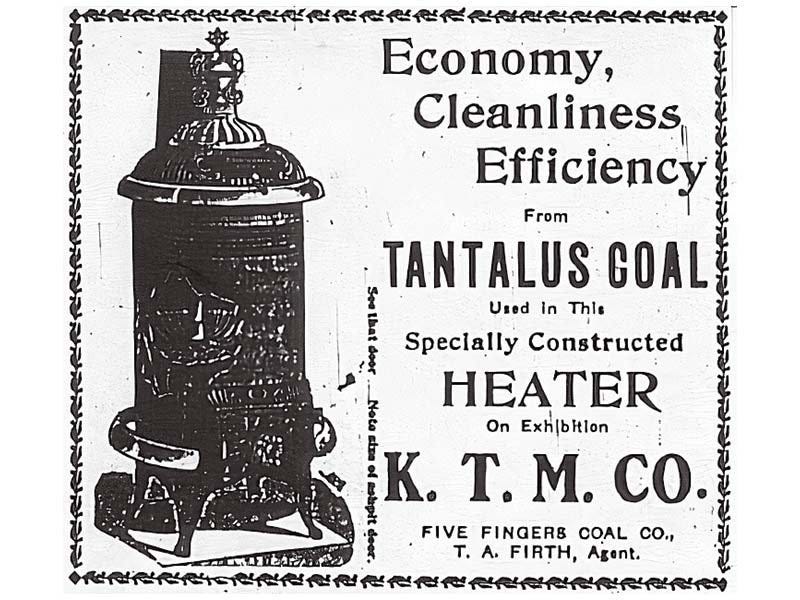
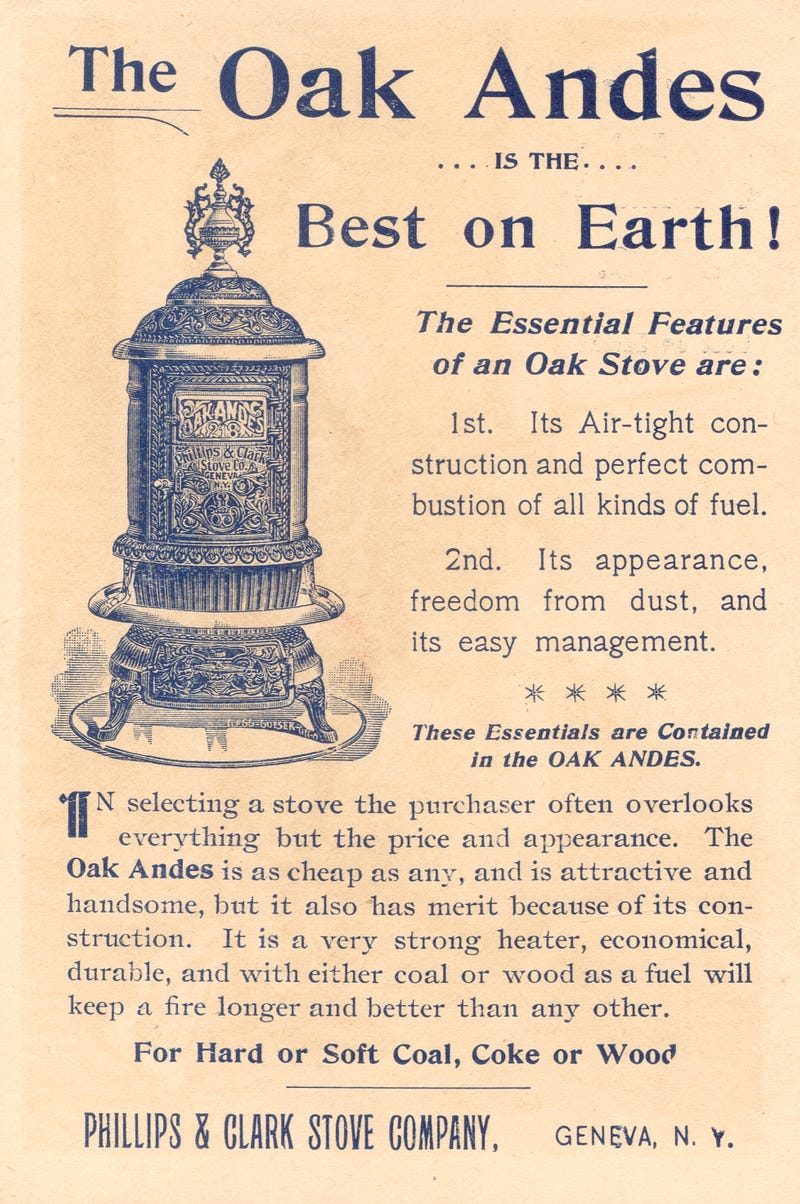
But when you used coal, in contrast, you burned it in a closed metal stove. you couldn’t see the flames. That totally enraged Americans.
No less than Harriet Beecher Stowe wrote ferocious essays attacking coal. As I write in Smithsonian:
In an 1864 essay, Harriet Beecher Stowe fulminated: “Would our Revolutionary fathers have gone barefooted and bleeding over snows to defend air-tight stoves and cooking-ranges? I trow [believe] not.”
The author Nathaniel Hawthorne wrote an entire book in 1843 called Fire Worship where he argued that if Americans started using coal stoves, society would fall apart because families and friends wouldn’t hang out convivially around an open hearth:
“Social intercourse cannot long continue what it has been, now that we have subtracted from it so important…an element as firelight,” Hawthorne fretted. “While a man was true to the fireside, so long would he be true to country and law.”
And food! Food cooked with a coal stove tasted … different. And if you mess with the flavor of people’s food, they really get pissed, as Carolyn Howard King, a resident of Salem Massachusetts discovered: She never forgot the “contemptuous expression on my father’s face the first time a turkey baked in a range was placed before him.”
On and on the cultural objections went. Benjamin Franklin complained that people in coal-stove-warmed houses were “oblig’d to breathe the same unchang’d Air … mix’d with the Breath and Perspiration from one another’s Bodies which is very disagreeable.” You name it, people blamed coal stoves for causing it.
Eventually, coal won out. But it took decades and decades. To get people to finally start using it, stove-makers had to design better-looking stoves that were easier to use, and coal promoters had to heavily subsidize coal for homeowners (much as governments subsidize residential solar these days). But mostly, people just got used to the aesthetics of coal stoves.
So the lesson is, as I say:
Studying early objections to coal can prepare us for road bumps ahead: It shows that transitions to new fuels can be messy and fractious.
Cultural objections are as big, or bigger, than technological ones.
(If you enjoyed this little history lesson, hit that “clap” button — which can sustain 50 such blows per reader!)
Clive Thompson publishes on Medium three times a week; follow him here to get each post in your email — and if you’re not a Medium member, you can join here!
Clive is a contributing writer for the New York Times Magazine, a columnist for Wired and Smithsonian magazines, and a regular contributor to Mother Jones. He’s the author of Coders: The Making of a New Tribe and the Remaking of the World, and Smarter Than You Think: How Technology is Changing our Minds for the Better. He’s @pomeranian99 on Twitter and Instagram.