
Armie Hammer’s S&M Evangelical Story
As he speaks of being sexually abused by a pastor, let’s look at the movie star’s religion
Armie Hammer grew up Evangelical Christian. In a new interview, he says he was sexually abused by a youth pastor — leading to his interest in ‘BDSM’, i.e. S&M.
I’m going over his life, trying understand this difficult Evangelical story.
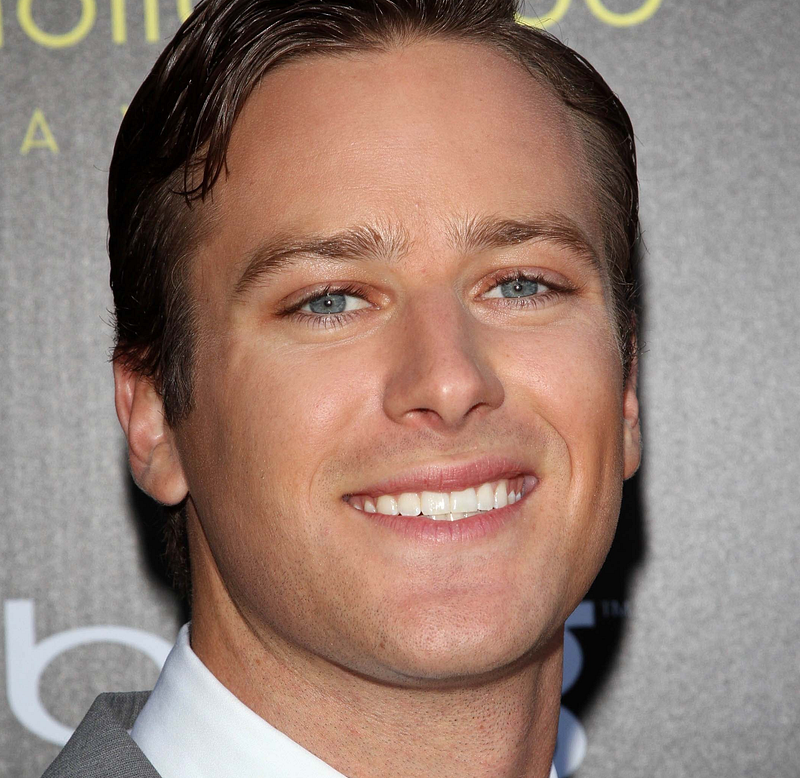
He was born in 1986 in Santa Monica.
His father’s side are ethnically Jewish, but his father, Michael Hammer, had gotten together with an Evangelical woman from Tulsa, Oklahoma.
Dru Ann Mobley was on the Pentecostal side, often aligned with Oral Roberts and his university in Tulsa. They married in a Methodist church.
Outwardly they seemed devout. Were they? The Hammer family had a long history of masquerading as Christian. Armie’s grandfather and namesake, Armand Hammer, had identified as Protestant for years, which biographers see as a means of evading anti-Semitic prejudice.
Armand’s former mistress was quoted in his obituary: “Believe me, Armand Hammer never believed in anything but himself.”
Was it the same with his son?
Michael’s sister, Casey Hammer, thought so. She later wrote of her brother and his Evangelical wife:
“They were the type of wealthy people who steal and cheat but feel that as long as they go to the church on Sunday and tithe lots of money, they were absolved of all sins. They talked incessantly about God and had holier than thou attitude.”
To look at the family, it seems a cauldron of religious hypocrisy—which Armie rejected. He never identified as Evangelical. He’s called himself “half-Jewish” — without always being clear what the other half was.
They were rich, but it wasn’t so apparent.
His mother was strict with money, he recalls. He attended Calvary Christian School for junior high. Then he went on to Los Angeles Baptist High School, which he’d recall for its strict rules — like students not being allowed to watch movies, or kiss.
He adds a new piece in a interview with James Kirchick in Air Mail. At age 13, which was around 1999, a youth pastor at his church took an interest in him — and then was getting sexual. The relationship lasted a year.
Armie told his godmother, who confirms the account. But all he told his parents is that the pastor made him uncomfortable. “This is a man of God,” he recalls them saying. “How dare you say these kinds of things?”
Armie started acting out.
Back in a 2011 interview he’d recalled in his time in high school, “doing things that were so stupid and not even in my character, because I felt caged.” His last stunt was in the 11th grade, when he took lighter fluid, squirted his name outside the school — and lit it up.
He was expelled. Instead of finding a new high school, he oped to just drop out. His parents were deeply dismayed. His father wanted to see him go to Columbia University. But Armie had a vague idea of being an actor, and got an agent. His parents just saw him as a ‘slacker’.
He was handsome, and had a charisma onscreen, but was hard to place. Maybe he was the rich, elite gentleman with simmering conflicts? In late 2007, he was cast at Batman in George Miller’s Justice League: Mortal.
The movie was scrapped. But then he was cast as the young Billy Graham in the 2008 bio-pic Billy: the Early Years. And so Evangelicalism gave Armie his start in movies.
The Graham movie was a bizarre production.
It was intended to be ultra-religiously devout. Two directors walked off the job, then Robbie Benson was hired. “They wanted to make a movie about someone whose face could be chiseled into a mountain,” he told the L.A. Times.
That wasn’t a great strategy for a Hollywood movie, but the production charged forward. A reviewer noted a problem with the resulting ‘Billy Graham’:
“He’s never sad, never angry, never commits a wrong he can’t take back, never faces a dark night of the soul.”
The religion was trying to re-write its horrific history.
In the movie, Billy has Black friends and frequently mixes with Black characters with ease, when he was actively racist. It shows evangelists’ rallies as desegregated, which is absurd.
The love story with Ruth Bell Graham is inert, when it was a horror show. The movie supplied images of Graham as a devoted father, as when he attends his wife’s childbirth. In fact, the real Billy was away.
But Armie conjures a bright, earnest charm, and seems truly sweet and appealing. Interviewed by Christianity Today he said he wanted viewers to “feel an overall sense of goodness and love. So much of that is in this story — Billy Graham’s love for humanity, God’s love for us.”
Even Evangelicals didn’t want to see it, and Billy: The Early Years was a bomb, losing millions of dollars. Only years later would a reviewer, Matthew Jacobs, point out that it revolves around an oddly close but conflicted relationship between Billy and his friend Chuck Templeton.
I watch the movie and agree. It’s a closeted gay love story.
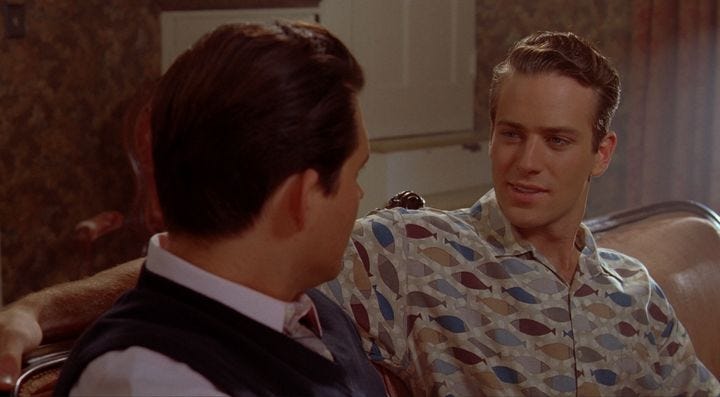
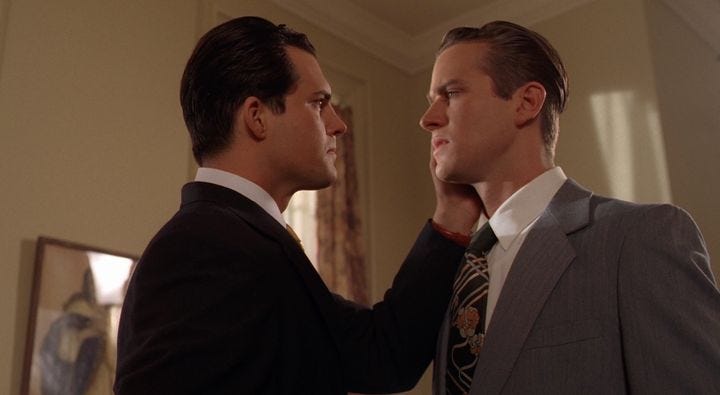
Armie Hammer’s appeal continued to be difficult to place.
He could play the “handsome rich guy,” but was more noticed in roles in which he was paired with another man, as could be vaguely ‘queer’. As J. Edgar Hoover’s partner in J. Edgar, he kissed Leonardo di Caprio. The world wanted to see him perform vague homoerotic dreams.
He played opposite Johnny Depp in The Lone Ranger, and Henry Cavill in The Man from U.N.C.L.E., and was openly sexual with Timothée Chalamet in Call Me by Your Name. It was skittish and fleeing. Onscreen, he remains undefinable and strange.
Armie mentioned in an interview for Call Me by Your Name that his religious mother wouldn’t be seeing it.
He’d married, and had two children.
But the deepest story of Armie Hammer’s life seems to be the affairs with a series of women, heavy on fantasy and BDSM. He connects this mode, now, to his time with the youth pastor. He tells Air Mail:
“What that did for me was it introduced sexuality into my life in a way that it was completely out of my control,” he says. “I was powerless in the situation. I had no agency in the situation. My interests then went to: I want to have control in the situation, sexually.”
In taking up BDSM, it would seem he’d wanted to experience control—the control he’d been deprived of when he was 13.
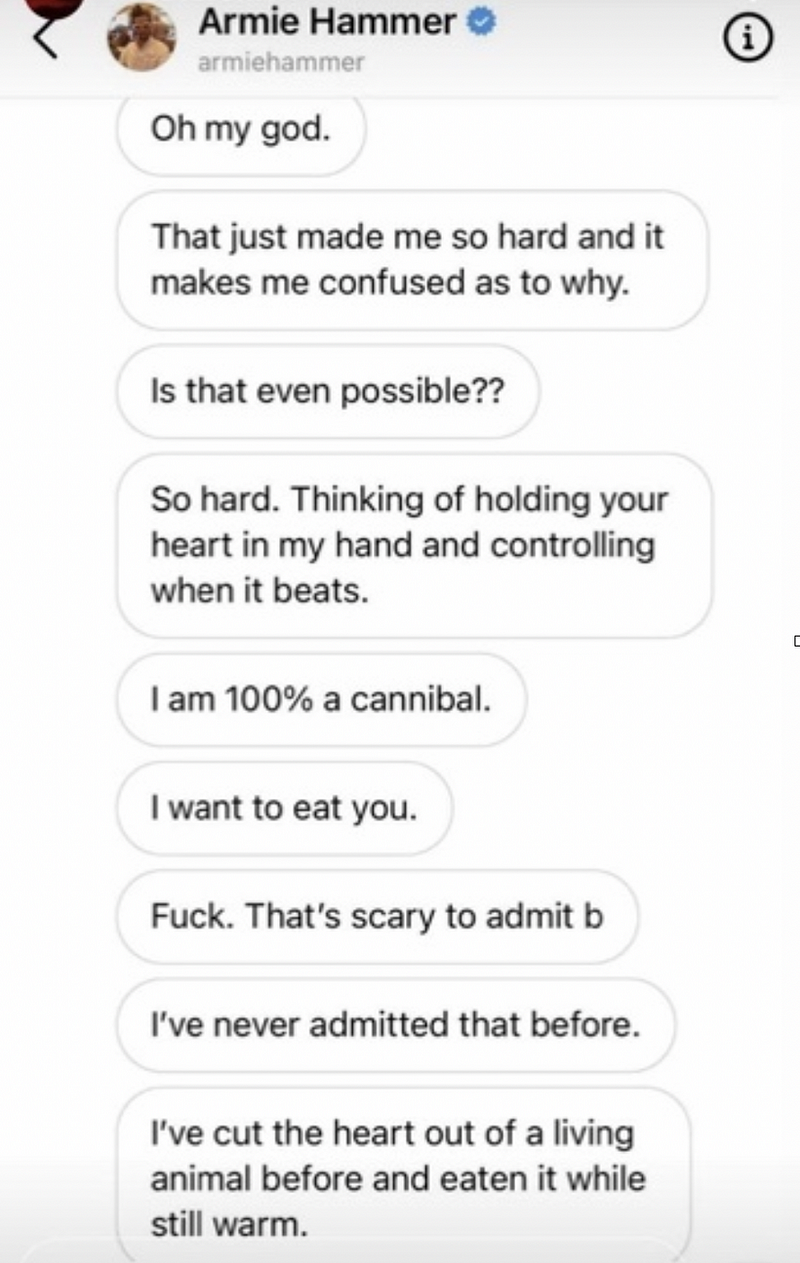
Armie turned into the ‘dom’. The tabloid press obtained DMs and text messages where he seemed to be a sexual predator, and a cannibal by disposition—even a serial killer.
The Air Mail profile is a remarkable piece of journalism—a credit to Kirchick, a gay historian, for going deeply into the sources and exposing much of the talk as overheated and often just false. The controversy was fueled by malevolent young women who’d aggressively pursued Armie.
As aggressively, and deceptively, they’d worked to tear him down.
Their conversions by text message and DM were clearly fantasy talk between lovers.
Armie’s comments seemed outré, but the women were concealing their own messages to him. When the full context is seen, they were just as outrageous, wild and strange. One woman later claimed to have been raped, but also had denied it, never filed a police report—and also, she kept pursuing him.
Reading the messages that led to him being “disgraced,” defamed, and impoverished, it’s clearly chatter between lovers that had no business being made public. The most notable theme is Armie’s continuously spiritual talk.
“I will own you. That’s my soul. My brain. My spirit. My body.”
Even in inviting them to be sex slaves, it seems a spiritual contract.
“In return you will be worshipped, fed and fucked”
The themes of cannibalism that creep into his dialogue, as James Kirchick reminds, are a regular feature of fetish dialogue and would not suggest an interest in consuming human remains.
I think of Jesus’ talk in John 6:
“Whoever eats my flesh and drinks my blood has eternal life…”

His mother said he had “demons.”
A girlfriend recalled Dru Ann telling her that Armie had “demonic behaviors,” and that “the devil was trying to take him.”
Then there’s Armie’s famously deleted Tweet:
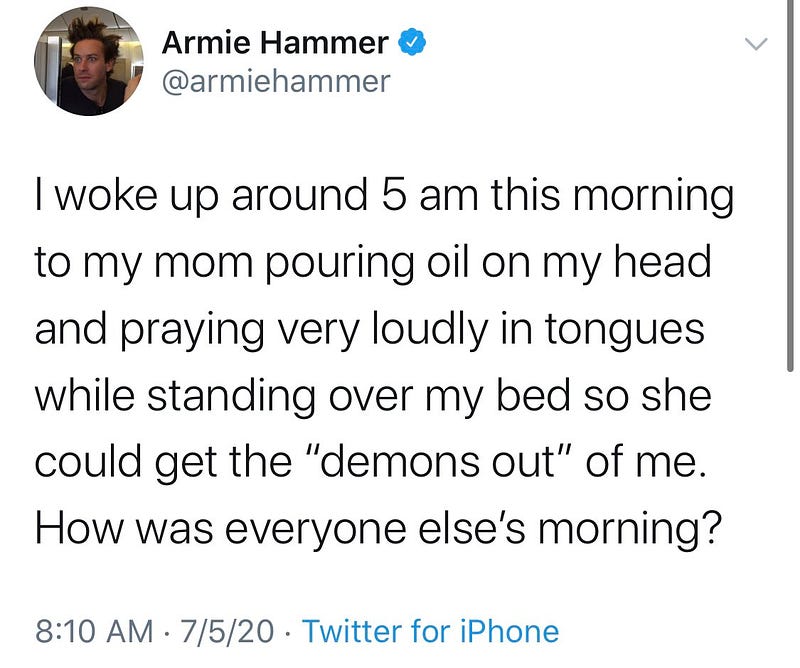
The “demons” talk is all Oral Roberts-style fantasy—the language of a people who have no way to speak about sex, childhood trauma or its effects. Dru Ann’s only public statement has been a letter to Vanity Fair in which she claims Armie and his father as Christians.
Because keeping up the religious identification is all they care about.
“Every family has ‘something,’ but what I know is these Jewish Hammer men you tore apart in your article have all come to know Jesus as their Messiah. I believe that is why I was placed in that family.”
Armie doesn’t call himself Christian, but frames his life as a spiritual journey.
“I’m now grateful for everything that’s happened to me,” he tells Air Mail, since “pain is the touchstone of spiritual progress.” He doesn’t seek recriminations against anyone.
He dismisses cancel culture—that bonfire, he says, in which guilty people throw in guilty people as “sacrifices to protect themselves.”
I suddenly realize the role he was perfect for. The serenity and agitation. The darkness and light. The engagements to women and men. He was Jesus. 🔶