
Recent Shifts in the Electoral College Map
As many of us have heard throughout recent weeks, President Trump’s campaign has floundered in recent weeks under the stress of a severe economic recession, the perceived failure of the federal government’s COVID-19 response, and the extraordinary protests seen in the wake of George Floyd’s death at the hands of Minneapolis police. Throughout the year, breaking news stories have more often than not created opportunities for presumptive Democratic nominee Joe Biden to pick up states Hillary Clinton lost in the 2016 election.
Public polling data as well as the results of elections held since 2016 show a nation undergoing rapid political change. This development portends a future in which the traditional battleground state map is scrambled, as the two major political parties reshape their respective coalitions.
Want to read this story later? Save it in Journal.
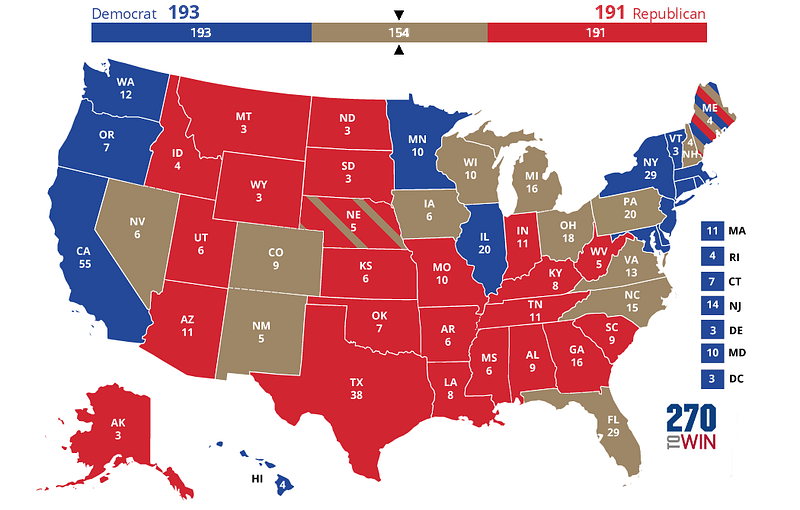
This map has essentially remained unchanged since George W. Bush’s election in 2000. There are some issues which immediately come to mind when looking at this map as a starting point.
- A generic Democrat should be able to safely carry Nevada, Colorado, and New Mexico.
The Southwestern United States were once a foundational block for Republican strength nationally. An example which comes to mind is the 1976 electoral college map, from Jimmy Carter’s Election.
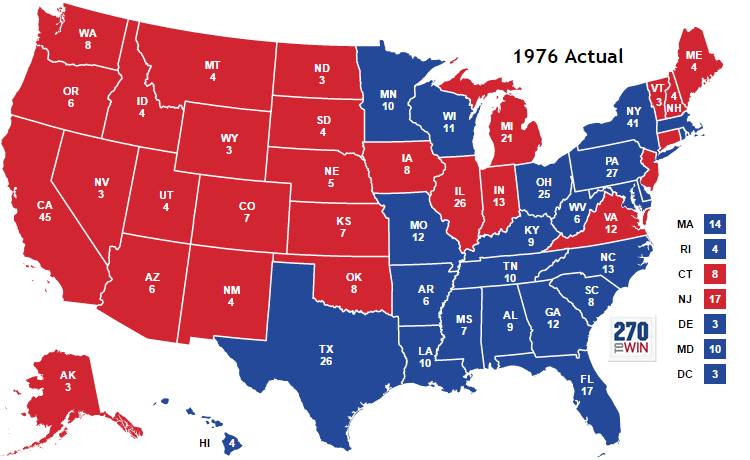
California was essentially the canary in the coal mine for Republicans in the Southwest. Until 1992, Republicans could largely count on California to deliver electoral votes; Presidents Nixon and Reagan both hailed from California politics. As time moved on, however, the state continued to grow in population and diversify.
While 1994’s Proposition 187 is largely credited by some scholars to be the death knell of the national GOP in the Golden State, the truth is more complex. Nevertheless, the fact of the matter is that California has become one of the most solidly Democratic states in the nation, on the backs of minority populations and affluent, liberal whites. Orange County, the centerpiece of Republican politics for decades, has fallen to the Democratic party as the state GOP has been relegated to third-party status.
Colorado and Nevada have both experienced rapid population growth alongside California. While New Mexico has not experienced a similar population boom, all three have seen the diversification of their electorates, shifting them into the Democratic column.
2. Arizona is now, for all intents and purposes, a swing state.
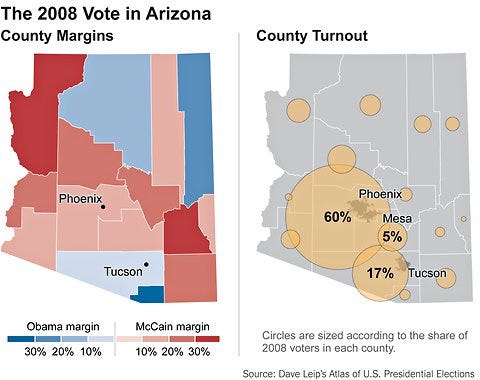
The easiest way to think about Arizona is to think of Colorado about 15–20 years ago. Arizona is in the midst of a large population surge and has continued to diversify its electorate. Due to the Republican party’s stated hostility towards minority groups… a bit of a problem ensues.
Arizona is dominated by Maricopa County, which houses the city of Phoenix. As national politics become ever-more dominated by an urban-rural divide, Arizona will continue its trek left. Much of this shift has to do with affluent and college-educated whites switching their political allegiance to the Democratic Party as well.
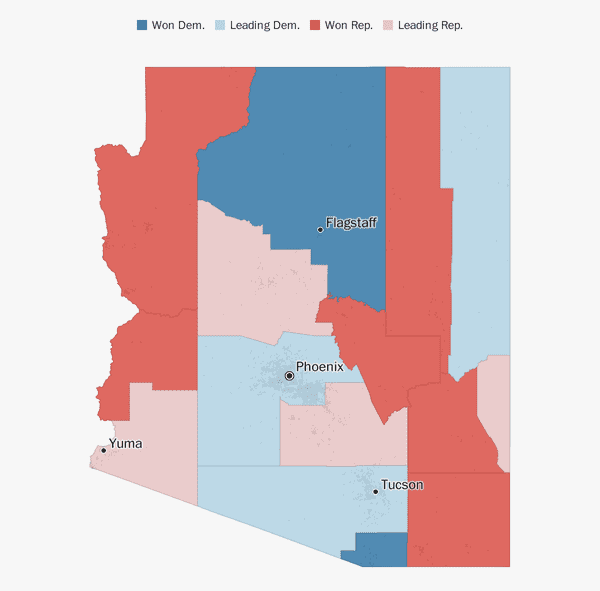
Personally, for the state from which Barry Goldwater, the founder of modern conservatism, comes from, I would advise that more state Republican leaders act more like Governor Ducey or the late Senator John McCain. Arizona has a history of electing people who are not beholden to their party on all issues, and current Senator McSally will continue to have issues inasmuch as she ties herself to the President.
3. Texas and Georgia are slowly becoming more competitive.
Similar to how Arizona is similar to Colorado, which bears semblance to California, Texas and Georgia are trending left. Once again, this has to do with rapid population growth caused by internal and international migration. The aforementioned suburban flight from the GOP has created ample opportunity for the Democrats to improve on their standing from previous elections.
I would like to add that it would not be intelligent for the Democrats to seriously contest these states at the presidential level in the 2020 election. Joe Biden is polling at around 10 points ahead of the President, and the map (purely from polling) currently looks like this:
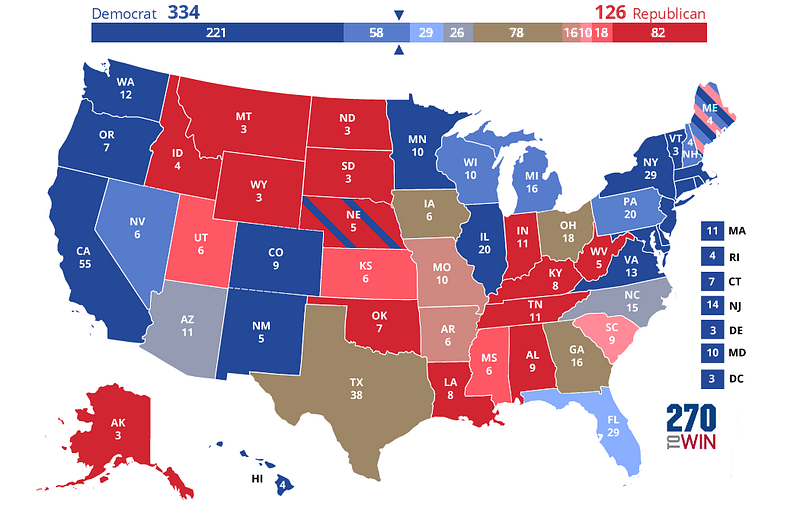
The race is likely going to tighten between now and November, meaning Georgia and Texas are almost certain to drift back into the GOP column. The Republican party will need to fight to keep these states in the future, and the Democrats will likely need to spend money to take advantage of the potential for gubernatorial elections, federal House and Senate elections, and state legislative elections.
Texas is the Republican California, the key to their national success. The Democrats should continue to fight for long-term gains while accepting a likely loss in the 2020 Presidential election.
4. A generic Republican should expect to carry Ohio and Iowa.
The same changes making the Democrats increasingly competitive in the Southwest give the Republicans increased chances in the industrial Midwest.
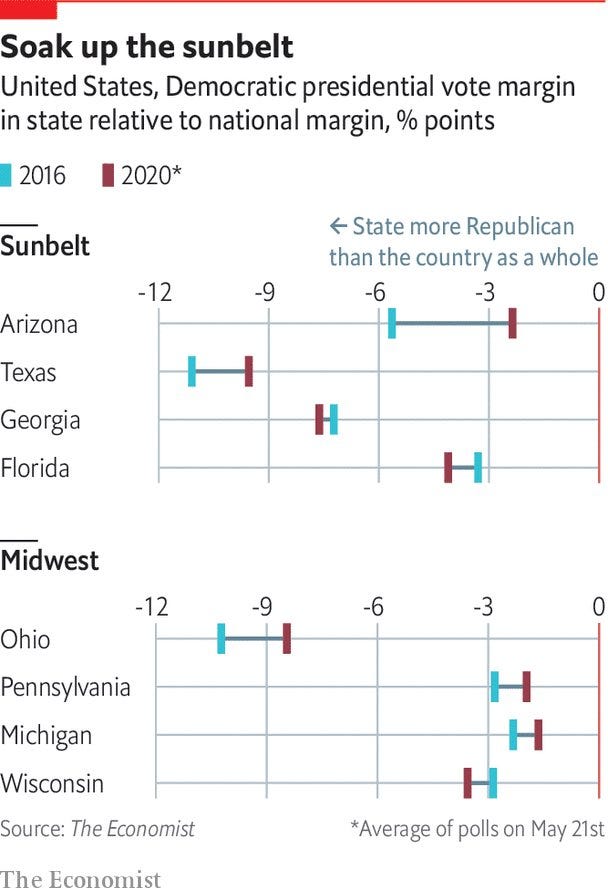
Ohio is nearly as Republican as Texas nowadays. Unlike Texas, the long-term trend has been to the right. It’s folly for the Biden campaign to invest significantly in Ohio, and the returns would be worse than potential in Texas — i.e. taking the State House is possible in Texas but completely impossible in Ohio.
In a way, Missouri’s transition from swing state to Republican bastion presaged Ohio’s movement right. Similarly, West Virginia is now one of the most Republican states in the nation at the presidential level. Appalachia has been trending to the right as the Southwest has trended left.
Ohio can also be tied into the rest of the Upper Midwest, which has been trending to the right. As the states age and lose population, the states will likely continue to become more Republican.
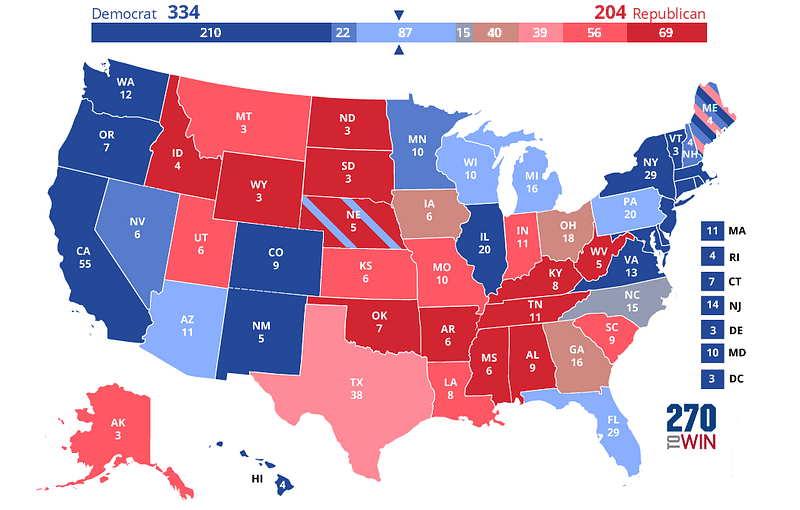
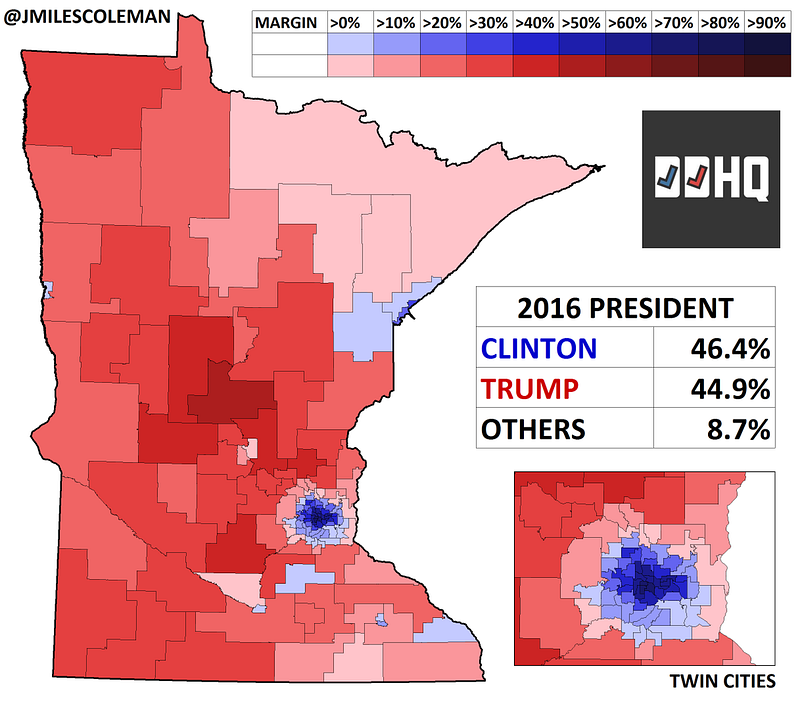
5. Minnesota is no longer as safely Democratic as it once was.
Minnesota, in all likelihood, is likely to go for Biden this year. After all, it has the longest-running streak of any state for the Democratic Party.
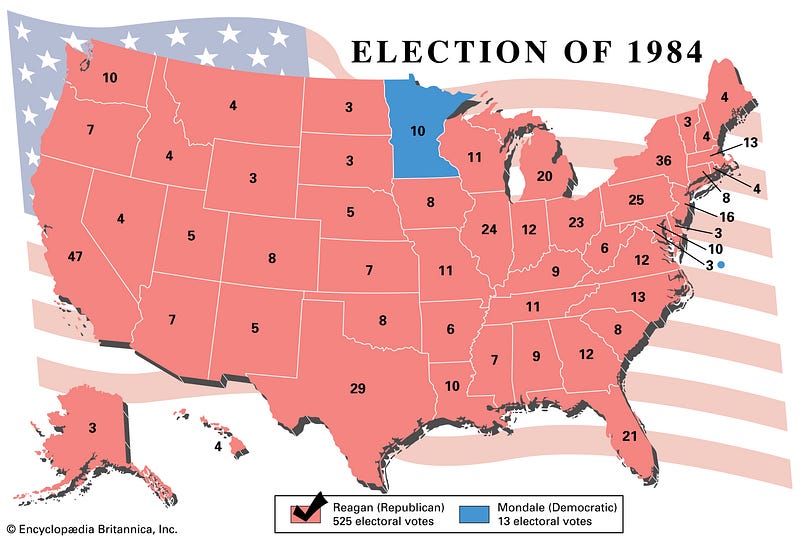
Similar to Michigan, Pennsylvania, and especially Wisconsin, Minnesota has slowly trended to the right over the last several decades. The 2016 Presidential election was the closest since at least 2000 in the state, going to Clinton by about a point and a half. This is an important Republican pickup opportunity in the long-term, similar to Texas for the Democrats.
6. The Midwestern “blue wall” is dead.
Wisconsin, Pennsylvania, and Michigan, each to a greater extent than the previous, have trended rightward throughout the last decade. Similar to how California’s shift presaged Colorado’s leftward tilt, these states presage Minnesota’s likely status as a swing state in the near future. National elections have increasingly become a competition between the parties to see which area flips first: the Sun Belt or the Rust Belt.
These are three states the Biden and Trump campaigns are going to fight the most for in November, as they are the most likely to be the “tipping point.” Wisconsin in particular has moved right throughout the last several years, since the election of Scott Walker. In the near future, it is likely to become the first state in the Industrial Midwest which is consistently solidly Republican.
7. It can be safely assumed Virginia will vote for the Democrats.
See Colorado, but on the East Coast.
P.S. On an unrelated note, McConnell is certain to win in Kentucky.
📝 Save this story in Journal.
🌎 Wake up every Sunday morning to the week’s most noteworthy stories in Society waiting in your inbox. Read the Noteworthy in Society newsletter.


