
A Special Kind of Stress Is Turning Your Hair Gray
There’s a scientific reason why so many people are graying right now
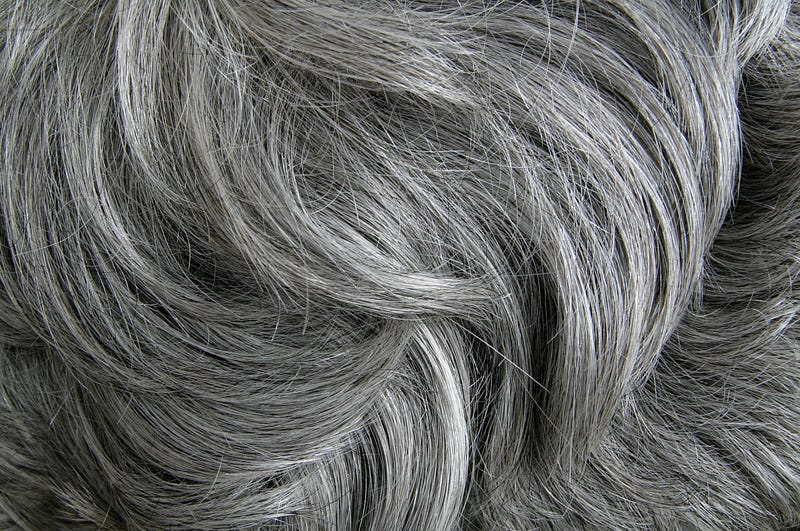
A few months into quarantine, Amy Cannon noticed more gray hairs than usual. “I distinctly remember looking up from washing my hands one day and thinking ‘Oh, wow,’” says the 32-year-old writing professor. “The sprinkling of grays was more pronounced, and especially visible at my part.”
The fast onset of gray hairs — which some are experiencing for the first time ever — has become a widespread anecdotal trend amid lockdown. And while it’s hard to prove the pandemic is definitely causing more salt-and-pepper dos, science does point to a probable culprit: stress.
Stress has long been to blame for any uptick in gray hairs, pandemic or not. And for Cannon at least, this explanation makes sense. “I’ve joked about quarantine insomnia, but it’s true,” she says. “I’ve skipped menstrual cycles from the stress and stopped sleeping from the anxiety.”
Stress manifests itself in the body in a number of ways; stress acne and chronic inflammation are among the most common stress-induced effects. But how exactly stress impacts hair color — or, more accurately, the lack thereof — is less understood.
It helps to know how the graying process works, stress aside. Gray hair is a normal part of aging, particularly after age 30 (any grays that appear before then are considered premature graying). The more precise timing of when someone starts to gray is largely dictated by genetics. “Each hair follicle has pigment cells, which are called melanocytes, and over time, there’s this programmed cell death,” says Shilpi Khetarpal, MD, a dermatologist at the Cleveland Clinic in Cleveland, Ohio. Those melanocytes die off, which in turn shrinks the amount of pigment in hair, lightening strands and turning them gray.
“Despite expert consensus that stress and graying are linked, the actual biological mechanism that ties stress and graying is hard to pin down.”
It’s pretty straightforward — or would be, were genetics the only piece of the puzzle. “Everything’s really a combination of your genetics and your environment,” says Khetarpal. “So, if you’re smoking, if you’re exposed to pollution, sun, and other environmental triggers, [or] if you’re exposing your body to external stressors, that can certainly accelerate the process.”
Factors like these can move up the timeline of graying onset. People may begin to see either their first grays or more robust graying just six to eight weeks after the start of a significant stressor. Considering that, it makes all the more sense that people are only now, a few months into lockdown, seeing a rise in grays. The upshot: Even if your genes were programmed for you to start going gray at 35, you could begin to see gray hairs sooner if you’re feeling especially frazzled.
Despite expert consensus that stress and graying are linked, the actual biological mechanism that ties stress and graying is hard to pin down. Some researchers surmise that cortisol, the stress hormone that contributes to breakouts, impacts the melanocytes at the base of hair follicles, while others theorize that the activity of free radicals — unstable molecules that ultimately damage cells — caused by inflammation impacts follicle health.
A new study published in Nature offers another theory. The study suggests that stress doesn’t harm melanocytes or the hair follicles, but rather it damages the stem cells that produce new melanocytes. When activated by stress, the sympathetic nervous system (which manages the body’s automatic response to dangerous situations) causes dormant melanocyte stem cells — cells waiting to be called into action to produce hair pigment — to wake up, divide, and die.
Even more surprising is the researchers’ conclusion that it’s not cortisol to blame for this stem cell die-off, but another stress hormone called noradrenaline, also known as norepinephrine. “It’s what we think of as the fight-or-flight response,” explains Khetarpal, who was not involved with the study. “It’s the key to this stress-induced graying.”
The distinction between cortisol and noradrenaline is important here, as they’re linked to different types of stress. As Khetarpal explains, the body releases noradrenaline when it’s under acute stress — when there’s some immediate emotional or physical threat present, or traumatic event unfolding (like, say, a global pandemic). Noradrenaline can speed up the heart rate, make palms sweaty, and, apparently, cause graying. It’s safe to say that the pandemic—with jobs impacted, routines upended, and near-constant anxiety of the potentially fatal coronavirus—could indeed be the source of acute stress. Cortisol, on the other hand, tends to rise more gradually with chronic stress. The good news there is that everyday work stress likely won’t cause hair to turn gray.
Unfortunately, once stress-induced graying takes hold, the effect is permanent. “We have not yet found a way to turn the stem cells back on,” says Khetarpal. “Once these things happen, that individual follicle is going to be gray or white indefinitely.” Short of coloring it, there’s not much that can be done to restore the pigment once the hair has gone gray.
That being said, it’s possible to interrupt the stress-graying cycle, keeping in mind that you can only control so much — as not everyone will have the same biochemical response to acute stress. Stress-reduction methods are a good place to start, according to Kheterpal. “I encourage yoga, meditation, and other techniques to reduce stress,” she says. “It can stop further damage or slow it down.”
She also points to an overall healthy lifestyle, including a balanced diet and physical activity, to help counteract the effects of noradrenaline. “There are different neurotransmitters elevated when exercising that can also help,” she explains. In fact, research in the journal Brain Sciences finds that exercise may suppress the release of noradrenaline in the face of uncontrollable stress — and in light of the previous study, that’s a pretty compelling reason to go for a walk.
The other option? Acceptance. “To be honest, I’ve always appreciated people who go gray, so it wasn’t an existential crisis or anything,” says Cannon, recalling the discovery of her new grays. “[It’s] just surprising to me how quickly I feel like it came on.” As with so many things these days, at least we’re all in this together.


