
Biggest change to the Internet is happening and people don’t know?
The biggest change to the Internet is not the big news about Google’s reorganization as Alphabet (as big as Google is and probably’ll get bigger).
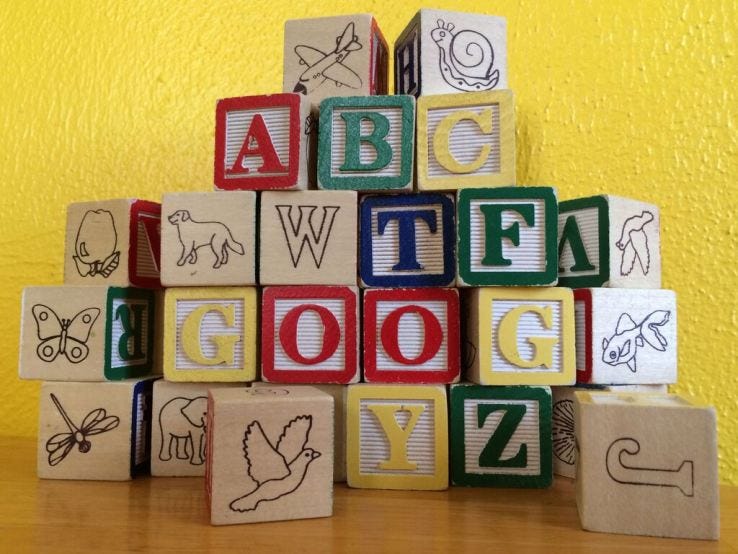
The biggest change in the history of the Internet is the exponential increase of domain extensions — from 7 before 1985 (.COM, .NET, .ORG, .GOV, .EDU, .MIL, .INT) to now more than 1,000, including .XYZ (thanks to Alphabet’s use of abc.xyz), .CLUB, .GURU, .LINK, and many more! (Plus, it ought to be noted that since 1985, the Internet also got 2-letter country code domain names, first with .US, .UK, .IL, and some became popular outside of its country of origin, like .ME, .CO, and .TV).
What difference does a domain name make?
Domain names are so taken for granted, with millions and millions of people using the Internet through search engines and mobile apps. It’s easy to forget that practically every Internet destination needs a domain name, whether it’s the link of a search engine result or a typed-in direct navigation. Consider these 2 situations:
When was the last time you went to a website with an IP address? And if you did, can you remember a sequence of numbers like 192.168.12.34?
What’s easier to say and share: “get the app by searching for keyword so-and-so in the App Store or Google Play for Android” or “get the app at vine.co”?
Internet History in the Making
What’s this historical change that’s happening like a covert operation?
Actually it wasn’t covert at all; it’s all been a very transparent process on the Internet, but primarily only those in the domain industry paid attention.
This Internet expansion, known in the domain industry as the new gTLD (generic top-level domain) program, was launched in 2012 by ICANN (Internet Corporation for Assigned Names and Numbers) with goals to enhance consumer choice and to enable innovation. This program was described as “the biggest change to the Internet since its inception.”
Does the world really need more domain extensions? The same kind of question was asked of television.
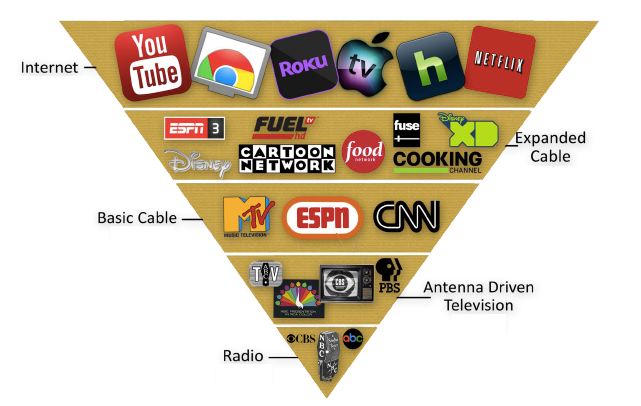
I’m old enough to remember a day when there was only 3 television channels: ABC, CBS, and NBC. Now we have so many channels on cable — CNN, ESPN, Discovery, HBO, Comedy Central, Bravo, Food Network, A&E — and videos on Internet streaming — Netflix, Hulu, YouTube. Countless many.
How do people deal with so many choices? On first glance, it might seem overwhelming, but over time, people like having choices and more choices.
ABC tells you it’s a television channel; Food Network tells you what it is plain and simple. The domain cc.com only tells you it’s a website; the domain comedy.club tells you what it is clearly and simply.
The future of the Internet is here today
We are just beginning to see new domain names that are meaningful and self-evident: coffee.club, ikea.today, toureiffel.paris, lily.camera, republic.bike, disqus.club, home.barclays, movement.builders, open.church, start.wiki, yellow.ventures, abc.xyz.
These newly-available domain endings come in all kinds of useful categories — .BIKE, .CLOTHING, .BLOG, .TECH, .APP. There are world-class cities — .NYC, .LONDON, .PARIS, .SYDNEY. There are languages — .我爱你, .موقع, .みんな, .онлайн. There are professions — .DOCTOR, .LAWYER, .REALTOR. There are religions — .CHURCH, .BIBLE, .ISLAM, .CATHOLIC, .HALAL, .MORMON.
And one more thing.
There are the biggest brands. 50% of Interbrand’s Top 100 Global Brands applied for new gTLDs, like .BMW, .GOOGLE, .IBM, .KPMG, .BARCLAYS, .MARRIOTT, .YOUTUBE, .CANON, .SAMSUNG, .NIKE and many more.
When these big brands launch their top-level domains, people will see them in all kinds of communcations, marketing and advertising. That’s when people will know that the Internet has become a whole new world.
[disclosure: DJ Chuang works with the .BIBLE TLD Registry]