
90% of Webinars Feel Icky to Me
Here’s another way to make money from online courses without wasting people’s time

I get it. Webinars are the sh*t.
They let hosts connect with fans, and they have a higher conversion than most sales funnels. FOMO is here to stay.
When they’re done well, I have no qualms. Many entrepreneurs deliver genuine value through webinars. Here’s my gripe, though:
90% of the ones I attend teach f*ck all.
One I went to last month is a prime example. I turned up, notepad in hand, along with hundreds of others.
It quickly became clear the ‘free webinar’ was a pitch for their paid membership. I ducked out after twenty minutes. It’s only because the host emailed a replay of the webinar that I was able to pick it apart.
They dragged out their story for thirty minutes, rambled on for ten, and pitched in the remaining twenty.
Icky.
The worse thing is, I like this entrepreneur! I’ve followed them for years and enjoy their work.
I’d be lying if I said their webinar hadn’t put me off.
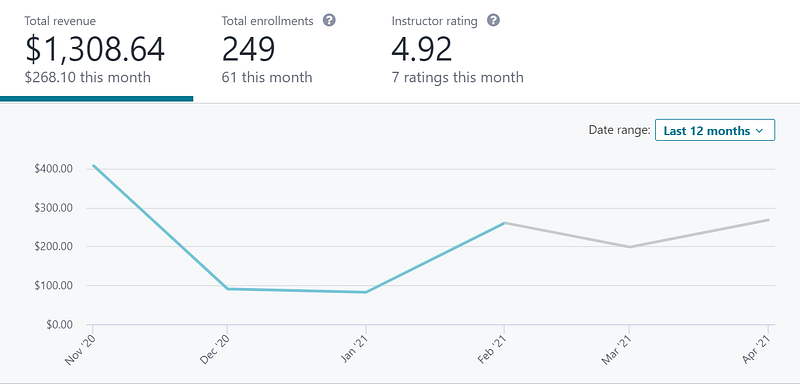
But here’s the good news: It doesn’t have to be like this. I’ve been able to make over $1,300 from four online courses since November 2020 without using webinars. How?
Udemy.com
Granted, it’s not perfect. My courses sell for a fraction of the price compared to if I self-hosted them. It’s also a drop in the ocean compared to what other creators are making.
However, I don’t have to feel guilty about wasting people’s time because I don’t have to market the courses. Udemy takes care of this. They promote my courses, leverage their audience, and deliver passive income every single month.
If webinars make you uncomfortable too, here’s another way to make money from online courses without feeling icky.
1. Identify gaps in the market for things you could teach on Udemy
When selling courses on Udemy or similar marketplaces, topic choice is vital. You have to think about what people will pay for, and what will enough people pay for?
Many instructors create courses without looking at the competition. They’ll think about what they could teach, jump behind a camera, and start filming.
It’s possible to get lucky. There’s also a chance you could spend days making a course that no one ever sees.
Given that you’ll make around $3 per sale on Udemy, and that it could take 50 hours to make a course, you need to make it worthwhile. You also need to consider topics that are less competitive.
Searching for existing courses on your topic is a useful exercise. How yours could be different? Could it be shorter or more detailed? Could it look more professional? Could it target a different audience?
If you can’t find a gap in the market, you may have to choose another topic.
2. Start searching keywords on Udemy
It’s a good idea to assess which keyword or keywords you could realistically rank for on Udemy.
For example, prior to my outsourcing course, the top-ranking course for the keyword ‘outsource to a virtual assistant’ had 19 ratings from 1,742 students. The content also seemed a little fluffy. I knew I could do better.
The best way to find keywords is to do a search on Udemy. I wrote down a list of potential keywords and searched for as many variations as I could think of. Here’s a sample:
- outsource to a virtual assistant
- outsource to a va
- outsource
- remote virtual assistant
- freelance virtual assistant
The key is to find keywords that give you an opportunity to make money but aren’t overly competitive.
A good starting point is to look at keywords that have less than 1,000 results. Next, see which of the courses have less than 30 reviews to rank in position one. This way, when you target a keyword, your course is likely to appear at the top of the search results — if not the very top.
3. Choose your primary keyword and plan your course
Once you’ve identified which keyword you want to target, it’s time to plan your course.
I wrote down a list of topics and split them into five sections. Each section has an introduction to tell students what to expect, and these intros are around two minutes long. The teaching videos are between five and ten minutes.
I’d recommend courses last between two to three hours. If they’re shorter than this, there’s probably not enough material. Too much longer and students may feel overwhelmed. If this is an issue, you can always break the content down into multiple courses.
It’s also important to make sure your course focuses on the primary keyword you want to target. Here are places to include it:
- At the beginning of the course title
- In the course subtitle
- Many times throughout the course description
- Say it in the videos themselves
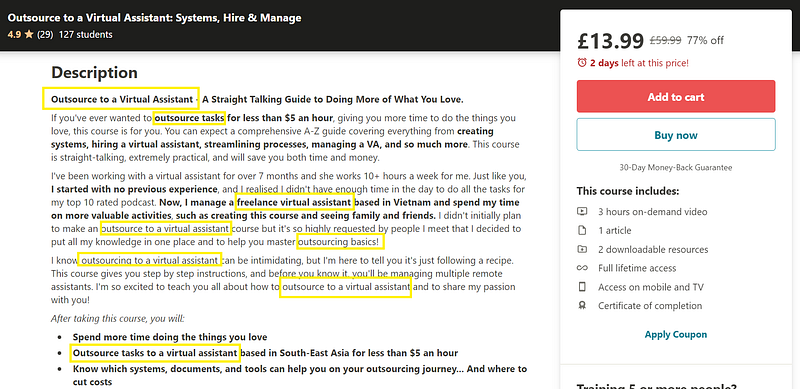
In my course description, I’ve included the keyword ‘outsource to a virtual assistant’ multiple times, as well as variations of this, including ‘outsource tasks’ and ‘outsourcing to a virtual assistant’. It sounds natural and I’ve been careful not to mention it too many times.
5. Make a compelling thumbnail and preview video
According to YouTube, thumbnails and titles act like billboards. They help viewers decide which videos to watch.
The same is true for Udemy courses.
There are a few thumbnail rules when it comes to Udemy. Generally, they’re not allowed to include text, and it’s best to include a human face. These are seen as being more compelling for people to click on.
If in doubt, keep it simple. A picture of you and a few icons can look clean and professional. Canva has a great background removal tool you can use when you sign up for a pro account.
With the promotion video, I recommend keeping it under two minutes. It should also answer the following:
- What’s your course about?
- Why should people listen to you? (What’s your experience/expertise?)
- What can students expect to learn by taking your course?
- What makes your course different?
- What will be the benefits to students of taking your course?
6. Get those reviews in early
Getting the ball rolling on reviews is really important for Udemy SEO. Once it’s high in the rankings, the quality of your course should start generating these in the coming months and years.
On a spreadsheet, I had three columns:
- People in my network who I thought might be interested in my course
- Which platform I messaged them on
- The date I messaged them (so I could follow up a week later)
The message said something like,
“Hey [NAME], hope you’re well! I think you might be interested in this course I’ve created, and using my exclusive discount code, you can get it today for £9.99. If you like what you see, it would be great to see you there!”
If you haven’t got many people in your network who you think would be interested, here are a few ways to promote it:
- Create a podcast and interview people who you think might be interested in your course. Here’s the kicker, though: Don’t mention your course. Once you’ve developed a connection, reach out a few months later to tell them about it.
- Guest on other podcasts. Bring value to the episode and mention your course at the end as a call to action.
- Line up the launch in relevant Facebook groups. By being an active member of relevant Facebook groups, you can tease your course before its release and tell people about it when it’s in the wild.
Takeaways
I’ve barely mentioned my courses on social media, and so far, sales have far exceeded my expectations. There’s no greater feeling than making money whilst you sleep!
Working during lunch breaks and in the evenings isn’t fun, and there’s no such thing as money for nothing. However, push through the resistance and the rewards can be high.
The best thing is, you don’t have to promote your courses through webinars. In fact, you don’t have to promote them at all. Course marketplaces like Udemy and Skillshare can do this for you.
If you do decide to use webinars, all power to you. My only suggestion would be this: Please don’t waste time.
Your fans will thank you for it.
Want to write full-time? Sign up for my newsletter and get my FREE 14-page Google Doc about becoming a full-time writer!


