
9 Ways to Keep Going When You Seriously Want to Give Up
3 mindsets, 3 resources, and 3 strategies to help you get back on track today.
I’ll be honest with you. I write this for selfish reasons.
For the last few months, I’ve struggled tremendously to keep going. That applies to many things — meditating, journaling, exercising, reading — but most of all, writing. Ever since I went all-in on freelance writing two months ago, it’s been a roller coaster with ups and downs.
Now, the point has come where I hit rock bottom.
Things I’ve been telling myself lately:
- “I’m not good enough at writing to make it.”
- “I should probably quit.”
- “Nobody wants to hear what I have to say.”
- “What the hell am I doing here?”
- And a lot more negative thoughts I can’t even put into words.
And yet, I decided not to quit.
Instead, I went down the rabbit hole. I wanted to find out how to keep going because I absolutely love writing. I love being creative. And I don’t want to give up. I write this article to remind myself that — inevitably — there will be times when being a creator sucks. But also as a reminder that there’s a bright, fulfilling side.
There are ways to stay optimistic.
Here are three ideas, three resources, and three strategies that always help get me back on track. I hope they serve you the same purpose. May they brighten the dark and scary path of creativity. And may they help you get unstuck.
Consistency Is a Myth
If you have ever consumed advice about productivity or creative work, you’ve probably encountered something along these lines:
- Stay consistent.
- Put in the reps.
- Do a little bit of work every day.
In theory, I agree. It’s good advice. When investing a little bit of work every day, we get closer to our goals in small but consistent steps. As a result, we compound our efforts and outsmart the competition by playing the long game.
There is just one problem with this advice.
It’s incredibly unrealistic to stay consistent over long periods of time. Inevitably, life will get in the way. Maybe you move to a different apartment. Maybe you meet a special person you want to spend more time with. Maybe a family member needs your support. Maybe you overwork yourself. Maybe you get sick.
Life is far too unpredictable to stay consistent and “put in the work” every single day. That is to say if you’re an oxygen-breathing, fleshy human being and not some productivity output-wired cyborg.
Human work is irrational, messy, and anything but straightforward.
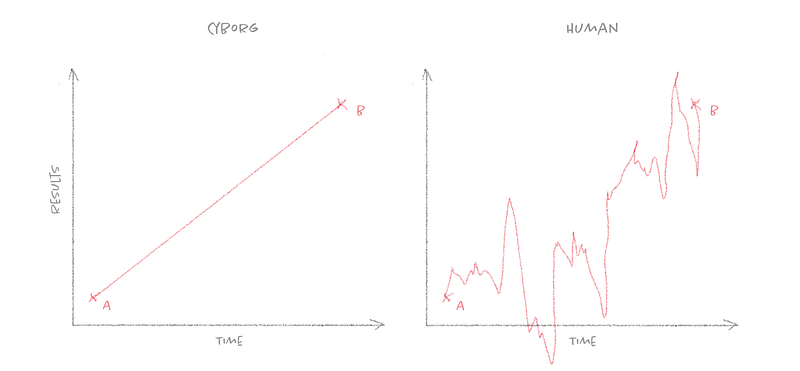
The solution? Be compassionate with yourself. You deserve a break when nothing seems to work.
Next, think macro, not micro. Don’t plan your creative output every single day. Think about what you want to achieve in a week or even a month. And whenever you see the slightest opportunity to create, strike like a ninja at night.
Double down on your inspiration.
Consistency and routine often create immense pressure to function like a machine at the push of a button. But you’re not a machine. You don’t have to function every day. Just like me and everyone else you know, you’re a flawed human being.
You deserve to mix it up.
The Mindsets That Cured My Impostor Syndrome
Do you want to hear the story of a real impostor?
When Frank Abagnale Jr. was 15 years old, he started to con people. He devised his first schemes for (unethically) obtaining money. At age 16, he stole his first car. While still in his teens and early 20s, Abagnale impersonated airline pilots, assistant attorney generals, hospital physicians.
Oh, and not to mention, he forged checks worth around $2.5 million.
You might know Abagnale’s story from the Spielberg movie Catch Me If You Can. But heck, even the story told in the film might be a scam. Recently, there has been more and more evidence that Abagnale’s life story is nowhere near the truth.
And you — an honest, modest, clever creative —you think you’re an impostor?
If you still silently raised your hand, that’s completely normal.
In fact, it’s the very nature of impostor syndrome to feel like a fraud when you’re actually honest and well-accomplished. Ironically, chances are that Abagnale never struggled with impostor syndrome. True impostors don’t feel like impostors.
Thus, impostor syndrome isn’t a sign of weakness or failure.
It’s a sign you’re making progress.
The minds of others work the same as ours
Another idea that completely changed my perspective on impostor syndrome (and many other things in life) comes from The School of Life. In an article, they propose:
“The solution to the impostor syndrome lies in making a crucial leap of faith, the leap that others’ minds work in basically much the same way as do ours.”
What does that mean? Everyone’s mind is speckled with invisible insecurities, doubts, fears, and anxieties. We’re always so quick to assume that other people live carefree lives. In reality, however, everyone has issues. Everyone has insecurities, hopes, and anxieties. Everyone farts. Everyone spills drinks. Everyone forgets appointments.
Especially ‘successful’ people.
A 2014 survey found that the №1 fear of CEOs and top managers is, in fact, being found incompetent (aka impostor syndrome). So — whenever I feel like an impostor, I just think to myself, “Huh, this is what it’s like to be a CEO.”
This thought is so weirdly amusing, bizarre, and motivational that I just hit publish and move on with my day. And so, I keep on writing, feeling a little less like a hyper-anxious maniac.
It’s great. You should try it.
3 Resources to Help You Get Unstuck
Consuming something other people created is literally one of the best ways to feed your brain with creative thoughts. That’s particularly true when other creatives have created something creative about being creative.
Funky, right?
These three resources have helped me when I’ve struggled the most. It’s not because they suddenly solved my writer’s block or any of my doubts. It’s more that they reminded me of the beautifully harsh reality of being a creator.
The Steal Like an Artist Trilogy
by Austin Kleon
This ingenious trilogy includes Steal Like an Artist, Show Your Work, and Keep Going. I highly recommend getting the paperback versions because Austin’s work is half art, half writing. The books are incredibly easy to digest, fun to flip through, and packed with actionable advice.
My favorite ideas from the trilogy:
- “Teach what you know.”
- “Don’t wait until you know who you are to get started.”
- “Build a bliss station.” (More on that later.)
Keep Going
by The School of Life
This stop-motion animation shows a Lego figure trying to build the Empire State Building. That pretty much says it all, doesn’t it? The video is only 2:34 minutes long but perfectly summarizes the pitfalls and struggles of the creative process. Plus, the comment section is filled with motivational quotes, heartwarming words, and encouraging advice.
What I Do When I Feel Like Giving Up
by James Clear
You know that it’s hard to keep going when a world-famous habit expert writes about giving up. For years and years, James has published a new article every Monday and Thursday on his website. But with this piece, he really struggled. How beautifully ironic.
I love this article because (in my humble opinion) it’s not even that good. You can tell the article was excruciating for him to write. It’s not the lessons he shares in the article that are inspiring.
It’s the fact the article exists.
3 Strategies to Help You Gain Momentum Today
These are the things that always help me gain momentum. It’s like an emergency toolkit — a safety net that catches me when reminders and mindsets aren’t enough, and I just need action.
Try them out and make them your own, even if it’s just for the sake of experimenting.
Build your bliss station
A bliss station is a creative zone that blocks out all external stimuli so you can focus on your work. For instance, that weird thing many people call a “routine” is a bliss station. But the trigger doesn’t have to be a strict schedule. It could also be a particular space, smell, taste, song, thought, movement, etc. For bonus points, combine the stimuli.
My bliss station is a shabby coffee shop. I always order a hot chocolate with overflowing whipped cream on it. After I gobbled that down, I get in the flow. I’ve tried certain schedules, playlists, and even scented candles. But it’s the coffee shop and the hot chocolate that finally did the trick for me.
Find what works for you. Build your own bliss station.
Take a philosophical walk
It sounds overly simple but taking a walk is one of the best things you can do to foster original, out-of-the-box, creative thinking.
Friedrich Nietzsche put it best:
“Only thoughts reached by walking have value”
To get the most out of your walk, make it solitary (no phones allowed), take your time (at least 30 minutes), have a journal ready to jot down thoughts, and escape from the hustle-bustle of everyday life into nature. (You can find a more in-depth analysis of philosophical walking in this post.)
There is an inutterable clarity in getting away from your desk and letting your crippled thoughts flutter free like a young dove learning to fly.
Bring back the joy
The creative struggle is highly situational and subjective.
I’ve spent countless hours in despair over writing blog posts. But strangely, when it comes to my newsletter my creative juices never fail to start flowing. Sure, sometimes I feel less inspired and productive. But I always get the job done.
I found the same effect when I scribble in my diary, describe a scenery, or write down a memory to the best of my recollection.
Why? Because there’s nothing at stake, and I expect nothing in return. It’s a gift. I create for the sake of creating.
So whatever you do, find that initial spark that made you start out in the first place. Do something just for fun. Don’t take creating so seriously, and bring back the joy.
Do you have to do this, or do you get to do this? It’s all a matter of perspective.
Just Keep Going
I wanted to save this story until last because it completely changed how I think about consistency.
Recently I sat down in the park to meditate for the first time in months because I was so frustrated over my writing. Around the time I got done, a 30-something stranger approached me. “Hey, I just saw you meditating,” he said with an ear-to-ear smile. “That’s so great. For how long have you been doing this?”
Oh no, I thought. He knows. He knows I don’t have the grit to stay consistent. “Well, err, I don’t know,” I tried to formulate a non-embarrassing answer, “I started two years ago but did it on and off. Unfortunately, I — ”
“Ah, ah, ah,” he raised his index finger like Socrates always does in ancient paintings, “Not unfortunately. Fortunately, you found the time today to sit down in this park and meditate. That’s all that counts, isn’t it?”
My mind was blown.
The most simple and practical advice to keep going? Well — keep showing up. It doesn’t matter what you did or didn’t do in the past. What counts is what you do from this day forward.
Yes, you will struggle. But just ask yourself:
- Have you ever been proud of something you already knew how to achieve?
- Have you ever felt fulfilled by something literally anyone could have done?
- Have you ever been truly satisfied with a 10-minute straightforward task?
Of course not. The struggle is part of the journey — just like there wouldn’t be daylight without darkness, life without death, and happiness without sorrow.
Everything worth building takes time, patience, and a dose of pain. So, if whatever you’re currently working on really means something to you, you already know what to do.
Just. Keep. Going.
If you enjoyed this, subscribe to my free newsletter on intentionality and fulfillment and get your happiness cheat sheet as a thank you gift.