
9 Reasons Many Top Entrepreneurs Are College Dropouts
Maybe formal education had little to offer them
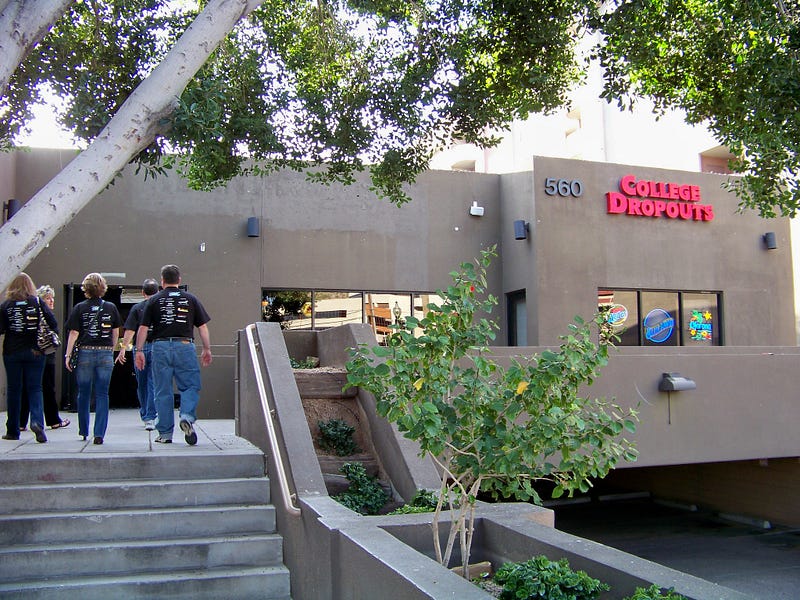
Dropout list:
- Steve Jobs, Apple co-founder.
- Bill Gates, Microsoft Corporation co-founder.
- Mark Zuckerberg, Facebook, Inc. co-founder & CEO.
- Larry Ellison, Oracle Corporation co-founder & CTO.
- Jack Dorsey, Twitter co-founder & CEO.
- Michael Dell, Dell Technologies founder & CEO.
- Jan Koum, WhatsApp co-founder.
- Oprah Winfrey.
- Travis Kalanick, Uber co-founder & CEO.
- Dustin Moskovitz, Facebook, Inc. & Asana (workflow management software) co-founder.
- Julian Assange, WikiLeaks founder.
- Thomas Peterffy, Interactive Brokers founder.
- François-Henri Pinault, CEO of luxury fashion group Kering.
- Sheldon Adelson, Las Vegas Sands Corporation founder & CEO.
- David Karp, Tumblr founder & former CEO.
- Sir Richard Branson, Virgin Group founder.
This list is by no means exhaustive.
We know billionaire dropouts are far from being the norm. Most billionaire entrepreneurs in Forbes 400 have completed some kind of academic studies, but it’s not a mere coincidence that as many as 11.2% of them are college dropouts, including two of the four richest people in America (Bill Gates & Mark Zuckerberg). Another 5.7% of Forbes billionaires are high school graduates but never went to college. The reasons behind this vary, but they include financial issues, trade-offs, and even lack of motivation.
Some entrepreneurs say college was a turning point in their lives, others state that formal education was just for fun, a few of them regret having dropped out, and some say it was a mere waste of time. Times have changed, but it appears college is not always perceived as added value by the most creative, revolutionary, restless minds.
This is not a recommendation to drop out of school, especially not just because “you feel like it”, or “because Bill Gates was also a dropout and made a killing.” Formal education will probably improve your job prospects and your expected wage. But maybe you have other plans. Other dreams. You might reach a point in your life where you realize you don’t need a degree. I’ll provide some examples later on.
Why would formal education fail to retain curious minds?
1 — Formal education is a rather inflexible environment.
Academia is an institution that evolves at a quite slow pace. But many of the discouraged college dropouts enjoy constant change and challenge. A formal education setting is not an environment in constant motion. Its speed of progress may not be up to the demands of some of the most ambitious minds.
2 — Formal education rarely fosters imagination.
Imagination heavily affects the ability to materialize a consummated idea out of thin air. To create something from nothing. Academia often displays a steady, step-by-step kind of growth. College still gives room for improvement/evolutionary innovation, but it’s not necessarily the best place to encourage disruptive innovation, which usually stems from young startups or outsiders. Disruption totally twists reality. It skips 1, 2, 3, or 10 evolutionary steps. College might provide useful — and sometimes essential — guidance, but it often takes you down the most traveled and well-known path. It’s not precisely famous for exploring uncharted territories. Maybe Doctorate levels are more stimulating, but definitely not Undergraduate (or even Graduate) levels.
3 — Formal education is a system. It’s full of rules, boundaries, and guidelines.
College has a formal structure that might limit natural flow or associations between seemingly unconnected ideas. It demands the discipline to follow a predetermined curriculum and stay within the scope of the program. Projects tend to have requirements you need to comply with. Free associations might be discouraged or restricted. The good thing is that college can provide useful guidance, but this could also result in a limiting factor at times.
4 — Formal education is a one-size-fits-all system.
There’s a curriculum, a rhythm, a routine, and everyone must adapt to them. There’s not much room for individualities or eccentricities.
5 — Visionaries are often seen as dreamers in a formal educational setting.
A few professors and classmates often spot the bold thinkers with outstanding ideas and encourage them to make things happen. However, many of the most creative minds I’ve met left school because they felt “it was not the place for them” and they found it to be too uninspiring. Most of them have now founded their own companies or online endeavors from scratch. Many have developed several apps too.
6 — College is not designed to make you an entrepreneur.
Academia focuses on providing you all the tools you need to become a brilliant lecturer, employee, researcher, analyst, executive, academic writer, or even scientist, but not necessarily the best business leader, agent of change, artist, or entrepreneur. Research shows that start-ups play a huge role in hiring talents. And start-ups = entrepreneurs.
7 — Lines of research tend to be predetermined.
Academia encourages you to follow current trends of research, building upon previous work. Units and modules behave like LEGO blocks. This might not be the case with every institution, though. In Uruguay, many of the formal education programs often have lists of research subjects you need to choose from for your research projects.
8 — University has a lot of busywork & filler credits.
Entrepreneurs hate to waste time. They don’t enjoy being distracted from their purpose. Not a single minute is to waste. Every task they embark on gets them closer to their goals. But formal education is full of worthless content. Entrepreneurs are willing to learn whatever interests them, anything that has the power to change them and make them better. They choose the content they want to consume. They may get easily discouraged by material that doesn’t make them better people/better leaders.
9 — The hours of study can be devoted to something they find more productive.
Each hour counts as if it was the last one.
In short, it’s a tradeoff.
They trade:
- Time devoted to studying for time devoted to personal pursuits and growth
- A rigid structure for freedom
- Adapting for disrupting
- Understanding for transcending
- Discipline for lack of limits
- Linear thinking for imagination/visualization
- Steady growth for transformation
- Slow-paced evolution for revolution
- A predictable path for a once-in-a-lifetime opportunity
- Certainty for adventure
- Money spent to pursue a degree for money spent to build an empire
Many great entrepreneurs (Jeff Bezos, Elon Musk, to name a few) surely hold a degree. And, while at college, you get to meet brilliant classmates and professors who might inspire you. Still, many prominent creatives and innovators have chosen the less-traveled path. And there’s a reason for it. Not everyone enjoys being forced to fit.
I think it’s fair to assume many role models would have probably gotten right where they are regardless of their qualifications, assuming their drive, experience, interests, stamina, support, and motivation remained the same.
It’s what I call the “D&D” factor — dreams and drive — what makes all the difference. With this ingredient, you’ll get far regardless of a college degree (unless you want to pursue a very technical career). Without it, dropping out of college just to try your luck might be tricky. But then again, not even a degree might save you from a lack of “D&D”. I see indifferent, professional people every single day. It shows in their eyes.
“It’s fair to ask why some dropouts like Walt Disney, Duke Ellington, Will Rogers, and Thomas Edison did so well without the benefits of higher education. Fair as well to ask why institutions of higher learning fail to retain creative greats… exceptionally creative and intelligent people certainly find the rigors of the classroom tedious, but creative people tend to go through whatever it takes to follow their passions… geniuses drop out of school with a dream, a plan, and the passion to see it through in spite of any obstacle. Without all of these ingredients, dropping out is a hard way to go.” — Peter Lloyd, author, “The Good, the Bad, and the Dropouts”, at ideaCONNECTION
I’ve met many smart people, with or without qualifications, who kept on learning and improving indefinitely. But I’ve also met several people with impressive qualifications that never impressed me much, to be honest.
The most incompetent people I’ve met include both professionals and people with no credentials. The same goes for the most competent ones. But it’s not always easy to spot them. Most selection processes lack the flexibility to do so. It takes much more than just an HR Analyst position and HR qualifications to spot raw talent. It takes a keen eye paired with great instincts to discover real genius.
Many of the most creative people I’ve met have decided to take the entrepreneur route, not only because they enjoy it but also because they couldn't stand selection processes or corporate rules. They felt caged.
The reason why college fails to retain these wild spirits is also the reason why inflexible selection processes can’t hook them in, and why stagnated corporate rules push them away.
Elon Musk says college is mostly for fun, and not for learning.
“I don’t consider going to college evidence of exceptional ability. In fact, ideally you dropped out.” — Musk said
Steve Jobs mentions the “passion” factor, the “D&D” — dreams and drive, remember.
“If you really look at the ones that ended up, you know, being ‘successful’ in the eyes of society and the ones that didn’t, oftentimes, the ones who were successful loved what they did, so they could persevere when it got really tough.” — Steve Jobs, D5 Conference career advice
Bill Gates fondly remembers his college days,
“I loved college. It was so exciting to have conversations with lots of really smart people my age and to learn from great professors.” — said Bill Gates
It’s important, though, to keep in mind that school might teach you valuable skills that will stay with you forever:
- focus
- discipline
- teamwork
- networking (maybe not the skills themselves, but an academic setting might introduce you to interesting people)
- academic writing and argumentative skills
Besides, some of my entrepreneurial ex-classmates have met their start-up co-founders and associates right in college.
Takeaway
Going to college is an exceptional experience if that’s what you feel you want, and if it’ll be an enriching path that helps you get from A to B. But it’s not always essential. It’s not written in stone you’ll get nowhere if you don’t get a degree. That might happen if you don’t have “D&D”, though.
In some fields, a lack of qualifications could complicate things (or even make your goals unattainable), but in other fields, we can all be self-taught and, just like Edgar Allan Poe once said, “nothing is unattainable if you really want it.” You can become a Math expert if you work on it. If languages are your passion, find a career that matches it. If you want to build a company, there’s no need to go to school, although college might provide useful tools.
I’ve met one tremendously successful guy who has amassed a nice fortune before he turned 30. Guess what? He’s a college dropout. He was studying Business Administration, but Football was his longtime passion — the reason he woke up every morning. So he applied for an analyst position at an online bookmaker. They hired him, and since his job was merely watching every single football match he could, he was passionate about it. He was so good, the company founder offered him a partnership. He made thousands, and he’s now the company’s COO and a major stakeholder. As you can see, there’re alternative routes to success, but it requires drive….and dreams.
It appears that not having a passion might be worse than not having a degree. Your passion might call for a degree — take medicine, for instance. Qualifications should follow your passion, not the other way around. Your dreams might kick start a career, with or without higher education. But a degree just for the sake of it won’t take you far either. It might keep you financially safe, but it can make you deeply miserable.
Depending on your needs and goals, college could be any of these:
- a must-have
- nice to have
- interesting
- not essential
- a total waste of time.
College is never good or bad per se. It just depends on you. School is what YOU make of it.
“American academia is good at producing writers, literary critics and historians. It is also good at producing professionals with degrees. But we don’t have a shortage of lawyers and professors. America has a shortage of job creators. And the people who create jobs aren’t traditional professionals, but start-up entrepreneurs.” — Michael Ellsberg (author of “The Education of Millionaires: It’s Not What You Think and It’s Not Too Late”), Will Dropouts Save America?, The New York Times
It appears we might or might not need more dropouts. What we do need is to encourage people to follow their dreams. I can’t think of a single person I’ve met who regrets having followed their dreams. But I can think of many who regret not having done so — including myself, more than once.
It’s better to follow your calling — even if that means dropping out of school — than ignoring it to pursue a degree. But dreams and college are not mutually exclusive. Actually, they might be great complements.
“I have never let school interfere with my education.” — Mark Twain
That’s the whole point. Will college enrich, complement, or interfere with your goals? Or maybe it just doesn’t add any value at all. That’s something only you can tell. Be honest with yourself!
Follow where your D&D takes you. You can’t go wrong.


