
9 Quick Journaling Habits That Actually Help Me Focus and Get Things Done
This was my key to writing more articles and getting stuff done at work
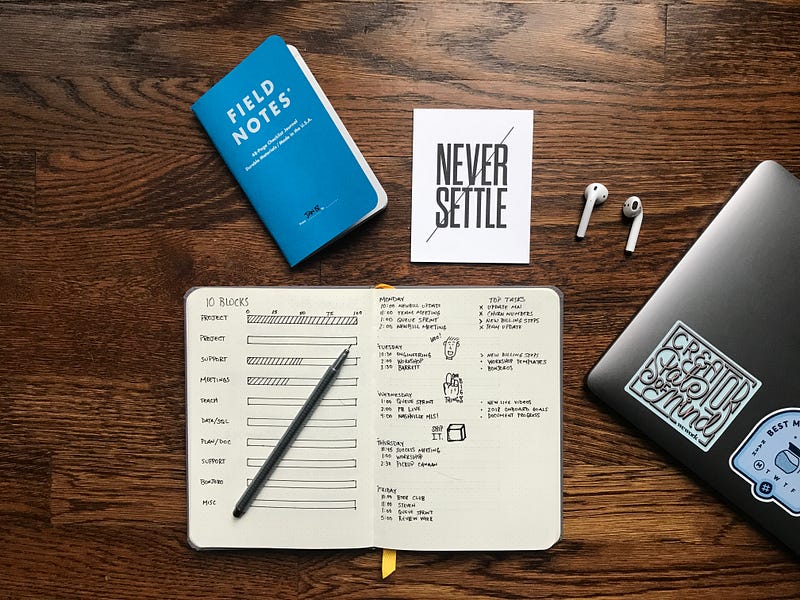
I have six years’ worth of journals stacked up in my closet.
I know…
I’m a maniac.
Why did I get into journaling?
Honestly, I don’t remember.
I knew some seriously successful people journaled, which was good enough for me. Either it was a coincidence that Marcus Aurelius, Cheryl Strayed, and Ryan Holiday journaled, or they acknowledged there’s value in putting thoughts on paper.
Now science tells us journaling can improve productivity. Take this Harvard study that found people who journal have a 25% increase in brain performance compared to people who don’t.
From a personal experience, my work performance, both in writing and work, has improved 10-fold since I started journaling.
- I hit project deadlines with nearly 100% accuracy.
- Journaling minimizes my habit of procrastination.
- It flexes my creative muscles and helps me develop new articles and business ideas.
- Finally, I’m less stressed about work.
I use these 9 journaling habits to help my productivity.
Why do they work?
Simply put, I juggle a lot of information each day, so I forget things. Writing them down helps me prioritize and reduces the stress of remembering all the details.
1.) Your “Daily Log” AKA your Bullet Journal.
I took this from the Bullet Journal Method.
Here’s how it works. You give all your tasks, events, and notes a specific symbol and record it in your journal in a bulleted list.
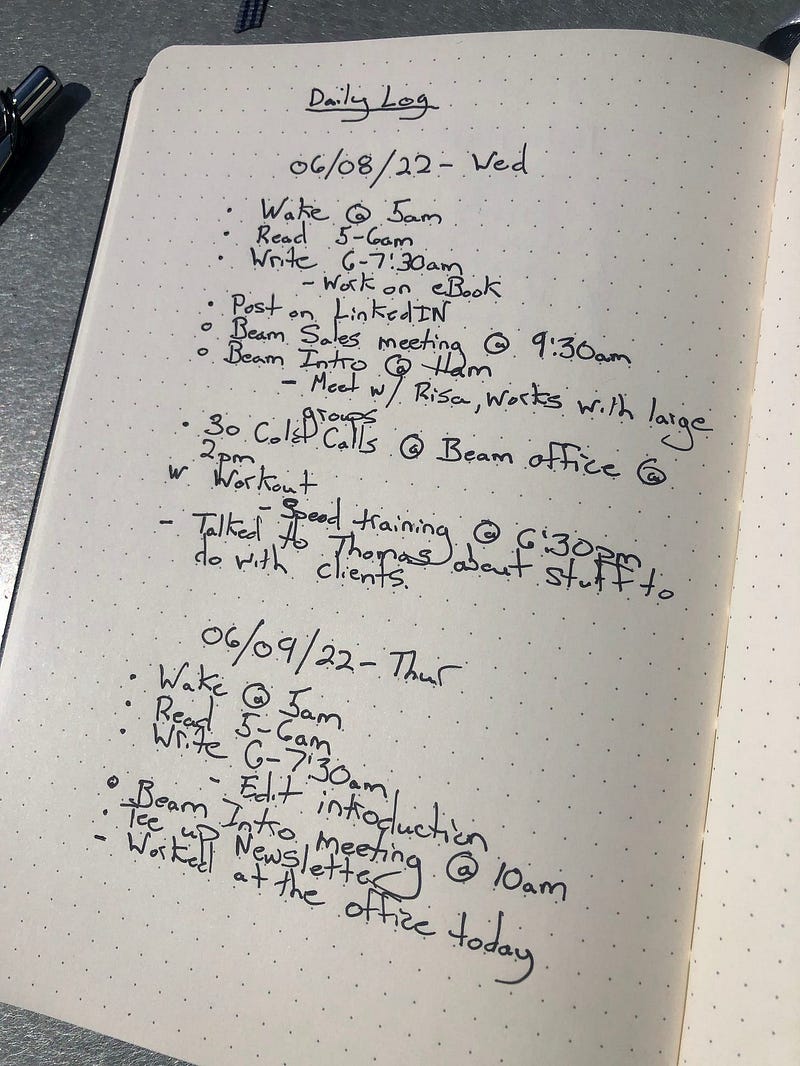
Think of it as an accounting record of all the essential things you do in a day. It prevents all the “must-dos” and meetings and social activities from getting jumbled in your head, where they will likely overwhelm you.
2.) Create boundaries around your “Highlight of the Day.”
The key to productivity is picking out the most essential thing to you, scheduling time to do it, and then placing hard boundaries around it.
My mom used to ask me after school, “What was the highlight of your day?” I thought that was a clever question, so now I call my essential thing my highlight.
Your highlight can change depending on what you’ve deemed essential. It could be going to that yoga class, a work project, or buying flowers for your partner. Anything that you know is important, but you also tend to procrastinate.
I write a big fat H next to the task in my daily log and block time in my work calendar to do it.
3.) Journal your favorite quotes about procrastination.
I have a section in my journal dedicated to motivating quotes — gentle nudges that pull me in the right direction.
You might think it’s not a big deal, but these nudges could mean the difference between doing the damn thing and flipping on Netflix.
Here’s one in my journal right now, which your more than welcome to use as your own:
“To procrastinate is to be entitled. It is arrogant. It assumes there will be a later. It assumes you’ll have the discipline to get to it later (despite not having the discipline now).”
- Ryan Holiday
4.) Journal at coffee shops
I asked my girlfriend the other day if she thought a guy journaling alone at a coffee shop was creepy.
She said so long as you’re not staring at anyone while you’re doing it then it’s fine.
I get my best journaling done when I’m out of my apartment and in a fresh environment. For whatever reason, new environments heighten my senses, they energize me and get the creative juices flowing.
The next time you’re in a coffee shop, bring a journal and hang out for a while.
5.) Your “Daily Headlines” are your creativity funnel
Two things I’ve noticed about creativity since I started writing online 3 years ago.
- Eureka moments are a lie. You must practice thinking creativity and work at it’s a muscle.
- Creativity is a numbers game. Come up with 50 ideas, and maybe one or two are useable.
Each morning, I write ten new article ideas for my newsletter. I’m a writer, so my ideas revolve around writing. If you’re not a writer, I suggest business ideas, travel ideas, or cooking recipes.
6.) Jot down a “Might-Do” list if you feeling lost
Use this habit when you’re lost and can’t figure out what’s essential that day.
A might-do list is exactly what it sounds like. Write down everything you “could do” today. Once those things are out of your head, you can review the list and decide what’s reasonable for you to do.
I stole this tactic from former Google developer John Zeratsky. In his productivity book “Make Time,” he advises that when you’re trying to figure out what to do ask yourself, “Is this urgent? Does it give me satisfaction? Does it give me joy?”
Hopefully this narrows things down for you.
7.) Determine your 12 Rules for Life
This habit comes from Jordan Peterson’s book by the same name.
Look, I don’t always agree with the dude, but I’ll admit that’s it’s a catchy title.
I might be on to something here. Think about it, we respond well to rules in society: show up on time, don’t run red lights, pay your taxes, why wouldn’t you make boundaries for yourself too?
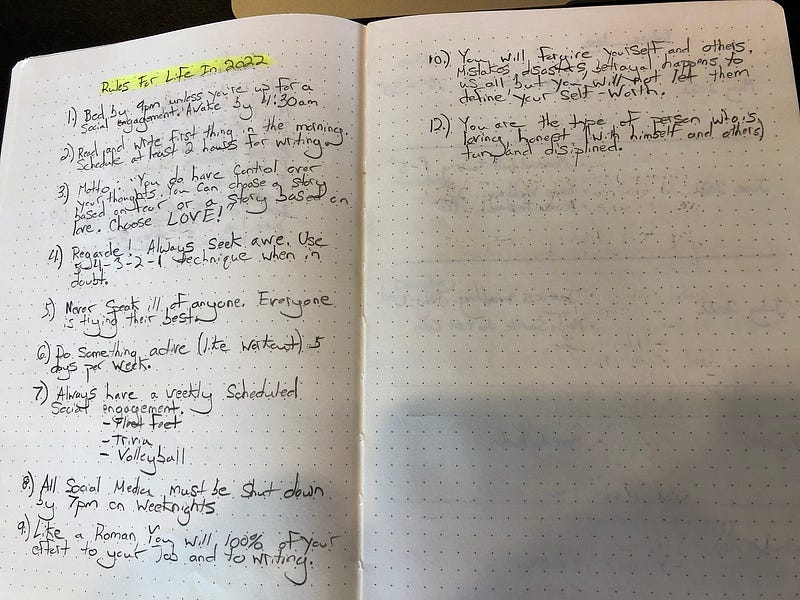
Your rules are your ten commandments. They’re tattooed in your journal. You see them every day like a prized boxer seeing a picture of their opponent in the bathroom mirror.
8.) Plan tomorrow’s adventure today
I procrastinate making decisions more than anything.
For example, I’m planning a movie night for my friends. It took me weeks to finally send the group text, find showtimes, and buy the tickets. We do this because it’s usually not the action that takes the most toll but the decision itself.
Each of us only has so much willpower for so many decisions. Reach our limit and procrastination takes hold.
So save yourself from the loss of internal cabin pressure and eliminate the number of decisions by putting together a plan of action ahead of time.
I call it planning tomorrow’s adventure today.
It’s cheesy, but it’s easy to remember. All you do is create your daily log and highlight the day or the night before, so all you have to do when you wake up is run the program.
9.) Kickstart your big hairy goal with this Tim Ferris journaling strategy
Here’s another trick I learned from master skill developer Tim Ferris. He calls it the Big Hairy Goal. It’s a simple way to kickstart a big project or goal you want to hit.
Start with the end in mind: What do you want to accomplish? Write it down at the top of a page in your journal.
Next, draw 5 boxes stacked on top of each other. In the top box, write 5 years. In the next box, write 4 months, then 3 weeks, 2 days, and 1 hour.
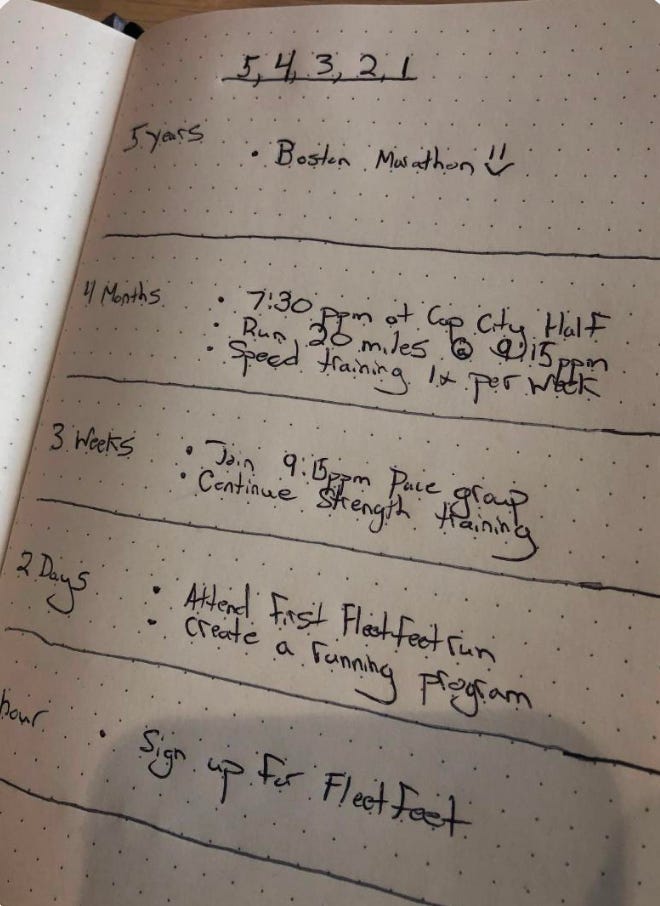
What does your goal look like in 5 years? Write it down. Now, break it down into smaller actionable chunks that are doable in 4 months. Repeat for 3 weeks and 2 days.
Finally, write down something you can do right now that brings you a small step closer to your big hairy goal.
For example, if you want to run a marathon, you could write, “Sign up for a run club.”
Summary
Again, here are the 9 quick journaling habits that help me focus and get things done.
- Daily log.
- The highlight of the day.
- Journal quotes about procrastination.
- Journal at coffee shops.
- Write your daily headlines to get the creative juices flowing.
- Jot down a “might-do” list.
- Determine your 12 Rules for Life.
- Plan tomorrow’s adventure today.
- Kickstart your big hairy goal with this Tim Ferris strategy.
Good luck and happy journaling.