
9 Must-Read Python Books in 2021
Which book would you recommend someone to read?
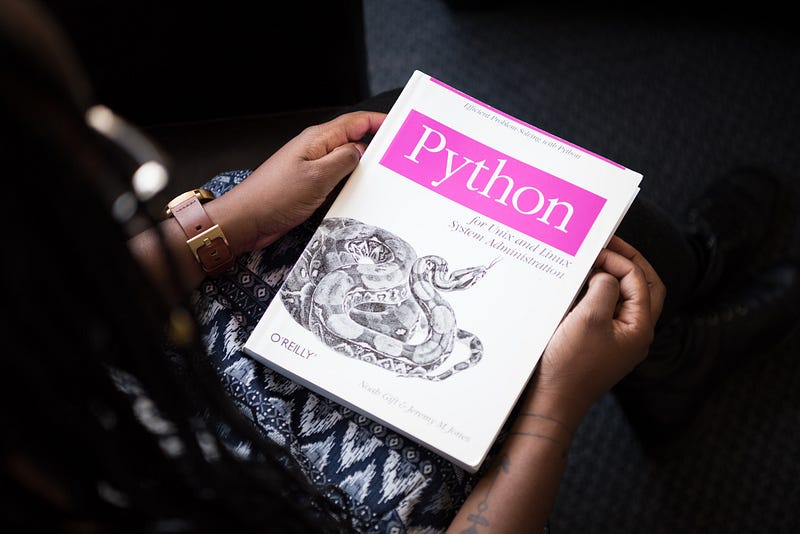
“The joy of coding Python should be in seeing short, concise, readable classes that express a lot of action in a small amount of clear code — not in reams of trivial code that bores the reader to death.”
— Guido van Rossum
Python’s popularity and all-around nature make it the perfect programming language for a diverse range of projects. Moreover, this popularity and wide adoption by the corporations has led to a sharp demand in the industry for skilled Python developers.
Today, there are literally tons of resources, such as books, YouTube channels, podcasts, GitHub repos, online courses, and websites that extensively cover a variety of topics in Python.
Python Books
Just take it slow, and do not hurt your brain.
The internet is filled with loads of convenient mediums to learn everything about Python. Although we discussed the more widely adopted mediums earlier, books still remain an all-time hot favorite among learners. The thing that makes books so much popular among Python learners is that they allow the reader to absorb and practice the content at their own time and pace.
Stick with us while we uncover a handful of more well-known Python books for learners of all skill levels in the list below.
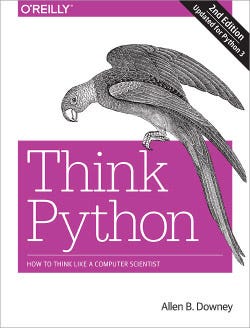
1. Think Python
- Author: Allen B. Downey
- Publisher: O’Reilly
- Difficulty Level: Beginner
“For all live births, the mean pregnancy length is 38.6 weeks, the standard deviation is 2.7 weeks, which means we should expect deviations of 2–3 weeks to be common.”
— Allen B. Downey
“Think Python” is undoubtedly one of the best books out there to get into the basics of Python programming. The book offers beginners an excellent entry point into the world of Python by taking on a more gradual approach to teaching the topics.
The latest edition of the book updates all the included code examples with their Python 3 counterpart to offer learners the most up-to-date learning experience. The book also comes with a number of exercises, case studies, and detailed explanations about the topics. Some key highlights of “Think Python” are listed below:
● Offers beginners the know-how to jump into learning Python right from their browser.
● Provides a clear definition of the concepts in Python.
● Emphasis on debugging to teach the readers to quickly find, resolve, and avoid bugs.
2. Python Programming: An Introduction to Computer Science
- Author: John M. Zelle
- Publisher: Franklin, Beedle
- Difficulty Level: Beginner
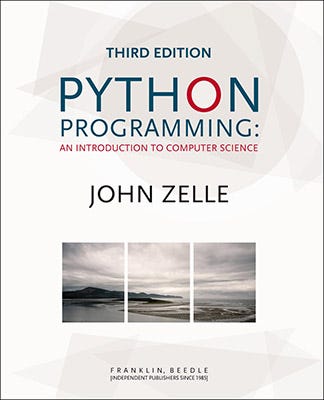
Thanks to the ease and simplicity of Python, it can be an awesome first programming language for beginners. Similarly, “Python Programming: An Introduction to Computer Science” has been written with a singular goal of making the fundamentals of Python as easy as possible for beginners.
The author targeted this book to be used as a college-level textbook, and for that, the author has taken more of a traditional approach to teaching Python by focussing on problem-solving, program design, and programming as core skills. So, if you are a college student and want to learn Python, we recommend giving this book a try. Key highlights of this book are listed below:
● Focus on using an easy-to-use graphics package to encourage the use of such GUI packages
● Loads of interesting examples and end-of-chapter exercises
● Focus on helping the reader master the fundamentals without overwhelming them with the entirety of Python topics
3. Django for Beginners: Build Websites with Python and Django
- Author: William S. Vincent
- Publisher: WelcomeToCode
- Difficulty Level: Beginner
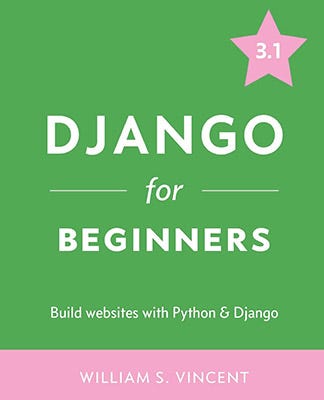
Django has become one of the most popular web application development frameworks among modern developers. Built with Python, Django has proven itself capable enough to offer virtually everything needed for building stunning web applications without diving into core Python.
Starting with a simple Hello World, “Django for Beginners: Build Websites with Python and Django” flawlessly delivers the gradual approach to teaching you how you can build full-scale Django applications. The book also focuses on teaching you the best practices for maintaining security, customizing the look and feel, and effective testing of your app.
Apart from the Hello World app, the rest of the apps covered in this book include the following:
● A Pages app
● A Message Board app
● A Blog app
● A Newspaper app
4. Python Pocket Reference: Python in Your Pocket
- Author: Mark Lutz
- Publisher: O’Reilly
- Difficulty Level: Intermediate
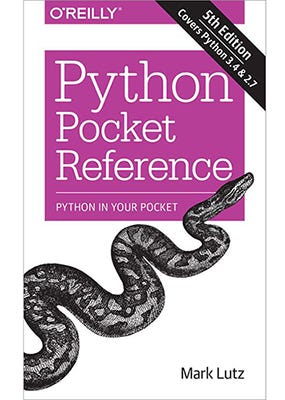
“In the Python way of thinking, explicit is better than implicit, and simple is better than complex.” ― Mark Lutz
“Python Pocket Reference: Python in Your Pocket” is not really a full-on Python learning resource but instead offers instant references to developers on a host of Python topics. The author has intended this book to be used as a companion to other more fuller Python books that offer tutorials, code examples, and other learning materials.
The latest edition of the book covers all the need-to-know content from Python 3.4 and 2.7 while also covering the difference between the two versions. Mark’s pocket reference is targeted towards developers with some experience with Python programming. The book covers several topics, such as:
● Commonly used standard library modules and extensions
● Syntax for statements for creating and processing objects
● Object-oriented programming tools
● Built-in object types, like numbers, dictionaries, and more
● Special operator overloading methods
5. Python Machine Learning: Machine Learning and Deep Learning With Python, scikit-Learn, and TensorFlow 2
- Author: Sebastian Raschka & Vahid Mirjalili
- Publisher: Packt Publishing
- Difficulty Level: Intermediate
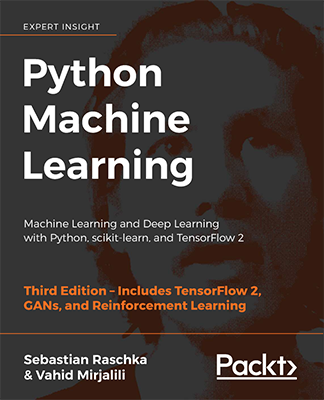
Thanks to Python, the popularity of Machine Learning has skyrocketed in recent years. “Python Machine Learning: Machine Learning and Deep Learning with Python, scikit-learn, and TensorFlow 2” is aimed towards both Python developers and data scientists packing the foundational knowledge of the programming language, who are eager to create impressive Machine Learning and Deep Learning-powered smart solutions. If you’re either one of these, this book will be the perfect fit for you.
When it comes to the contents of this book, apart from the necessary introduction, the third edition provides plenty of coverage on Machine Learning topics, such as:
● Training simple ML algorithms
● Classifiers with the Scikit-learn package
● Steps on building good datasets
● Embedding Machine Learning models to applications
6. Deep Learning with Python
- Author: François Chollet
- Publisher: Manning Publications
- Difficulty Level: Intermediate
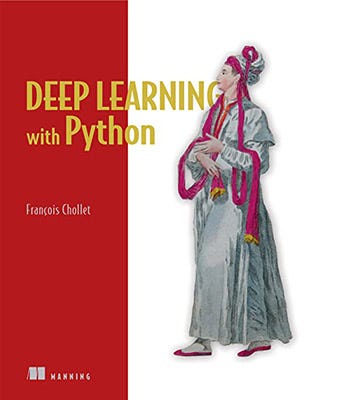
“Deep Learning with Python” is an excellent book that simplifies the intricacies of Deep Learning using Python. The author of this book is none other than the creator of the famed Deep Learning Python API called Keras. François’ book uses Keras as the bridge between the world of Deep Learning and Python to gradually build your understanding of the subject with intuitive explanations and practical examples.
The book has been split into parts, covering most of the introductory stuff about Machine Learning and Neural Networks and the practical application of Deep Learning for real-world challenges and tasks, such as:
● Computer Vision
● Text and sequences
● Best practices
● Generative Deep Learning
7. Python in a Nutshell: A Desktop Quick Reference
- Author: Alex Martelli, Anna Ravenscroft & Steve Holden
- Publisher: O’Reilly
- Difficulty Level: Intermediate
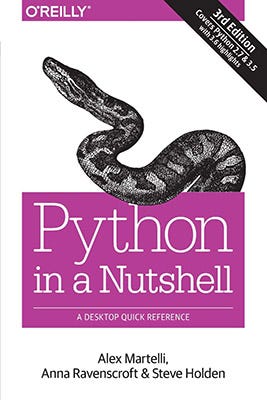
No matter if you have worked with Python in the past or you’re a veteran developer looking to pick up Python, you’ll find “Python in a Nutshell: A Desktop Quick Reference” exceptionally useful. The book covers a range of widely used topics from the world of Python and serves as a quick reference for the Python programming language.
The authors of the book have split it into five parts covering everything from the basics to the core features as well as the more advanced ones. A brief explanation about those five parts is below:
● Part I: Covers the introduction and explanation about the Python interpreter
● Part II: Covers the core python language and its built-in topics
● Part III: Covers the Python library and extension modules
● Part IV: Covers network and web programming with Python
● Part V: Covers extending Python programs, it’s distribution and migration from v2 to v3
8. Programming Python: Powerful Object-Oriented Programming
- Author: Mark Lutz
- Publisher: O’Reilly
- Difficulty Level: Intermediate
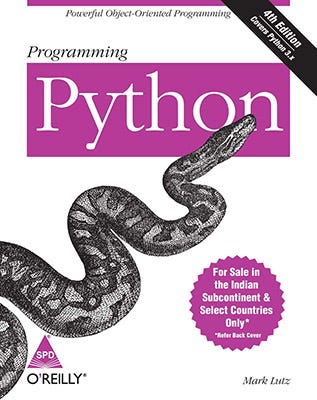
Let’s say you’ve understood the introductory topics in Python with great clarity, but what next?
The most obvious thing to do next is to test out your newfound knowledge by developing a simple yet practical Python application.
If domain-specific examples are what you’re looking for, we can’t recommend Lutz’s book “Programming Python: Powerful Object-Oriented Programming” enough. The book is perfect for intermediate Python developers and covers in-depth tutorials for some of the widely used applications from a diverse range of topics listed below:
● A brief and quick introduction to Python
● System programming with system tools and files and directories
● GUI programming with Tkinter
● Internet programming with client- and server-side scripting, network scripting, and an email client
9. Natural Language Processing with Python: Analyzing Text with the Natural Language Toolkit
- Author: Steven Bird, Ewan Klein & Edward Loper
- Publisher: O’Reilly
- Difficulty Level: Advanced
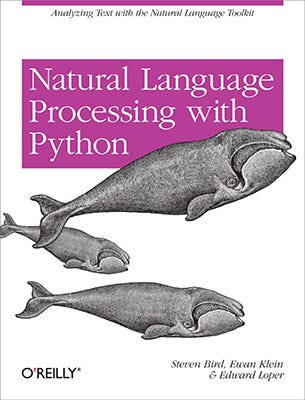
Natural Language Processing has become a vital element for modern devices as they play a key role in offering smart features like predictive text, handwriting recognition, human-friendly language translation, and more. The book “Natural Language Processing with Python: Analyzing Text with the Natural Language Toolkit” contains sufficient learning resources for those taking their first steps into the world of programming or those new to Python.
This book would be more suitable for developers with a strong grasp of Python fundamentals as it is filled with hundreds of detailed examples and exercises. It uses the Python library NLTK to teach topics, such as:
● Introduction to NLP
● Accessing text and lexical resources
● Processing raw text
● Categorizing and tagging words
● Text classification
Conclusion
Learning Python can open a slew of lucrative opportunities for you. If you are eager to snag one of the most trending and high-paying job profiles of the century, we recommend getting a solid understanding of the concepts in Python. The books we covered in this article do an exceptional job explaining even the most intricate Python topics in a reader-friendly manner.
Did we cover all your favorite books on our list? We would love to hear your thoughts.
Thanks for reading!


