avatarJosh Spilker

Free AI web copilot to create summaries, insights and extended knowledge, download it at here

2806

Abstract

id="f376" class="link-block"> <a href="https://www.port.ac.uk/student-life/help-and-advice/study-skills/research-reading-referencing-and-citation/helpful-abbreviations-for-speedy-note-taking"> <div> <div> <h2>Helpful abbreviations for speedy note-taking and note-making</h2> <div><h3>Explore our top tips for abbreviations for notes and download our help sheet. Find out more.</h3></div> <div><p>www.port.ac.uk</p></div> </div> <div> <div style="background-image: url(https://miro.readmedium.com/v2/resize:fit:320/0*k7taMA7AL1TD5ZUZ)"></div> </div> </div> </a> </div><h1 id="9923">3. Develop your own method</h1><p id="a04e">Familiarize yourself with established note-taking techniques, but don’t be afraid to deviate from them. Popular ones include the <a href="https://lsc.cornell.edu/how-to-study/taking-notes/cornell-note-taking-system/">Cornell method</a>, mind mapping, or outlines. Choose a method that complements what you’re doing along with your personal learning style.</p> <figure id="2e06"> <div> <div> <img class="ratio" src="http://placehold.it/16x9"> <iframe class="" src="https://cdn.embedly.com/widgets/media.html?src=https%3A%2F%2Fwww.youtube.com%2Fembed%2FnX-xshA_0m8%3Ffeature%3Doembed&amp;display_name=YouTube&amp;url=https%3A%2F%2Fwww.youtube.com%2Fwatch%3Fv%3DnX-xshA_0m8&amp;image=https%3A%2F%2Fi.ytimg.com%2Fvi%2FnX-xshA_0m8%2Fhqdefault.jpg&amp;key=a19fcc184b9711e1b4764040d3dc5c07&amp;type=text%2Fhtml&amp;schema=youtube" allowfullscreen="" frameborder="0" height="480" width="854"> </div> </div> </figure></iframe></div></div></figure><h1 id="db3e">4. Highlight key concepts</h1><p id="75b0">Emphasize essential ideas, dates, or terms by using color coding, asterisks, underlining, or boxing ideas.</p><p id="539a">On the debate team, we used arrows to conduct key ideas, or circles to indicate when something wasn’t addressed or stood out to us.</p><p id="8e52">It’s simple and seems obvious but it was a system we could agree on and immediately knew what it meant.</p><p id="a3a4">If your highlights are too hard to decode, then they won’t do you any good.</p><p id="e3bd">The visual helps in easier revision and immediate understanding. You may want to use highlighters or different pens. However, I find all this extra stuff to be a distraction and prefer a pen.</p><h1 id="fda3">5. Review your notes regularly (and throw them out when you’re done)</h1><p id="1b4d">Notes should be reviewed periodically. Otherwise, what are you doing? Revisit your notes soon after taking them to reinforce the informa

Options

tion or to expand on any points if needed.</p><p id="2dfe">Also, don’t be afraid to throw them away if their usefulness is gone.</p><h1 id="89b9">6. Visuals help you remember</h1><p id="bb3a">Make a diagram or a drawing. This can sometimes convey information more effectively than words alone. <a href="https://austinkleon.com/visual-note-taking/">Austin Kleon</a> is really good at this. He <a href="https://austinkleon.com/2010/02/22/tedxaustin-on-sticky-notes/">draws cartoons</a> to help him capture notes from certain events.</p><p id="00a0"><a href="https://austinkleon.com/visual-note-taking/"><b>Austin’s drawing from a talk by actor Jeffrey Tambor:</b></a></p><figure id="c389"><img src="https://cdn-images-1.readmedium.com/v2/resize:fit:800/1*mMYWd1JnGwNtYqyNiXpSPQ.jpeg"><figcaption></figcaption></figure><h1 id="6001">7. Leave white space</h1><p id="6104">Don’t cram everything together. Leave room in your notes to add in more details later, annotate, or for summaries. White space makes notes easier to navigate and less overwhelming.</p><h1 id="a458">8. Use all your senses</h1><p id="c05c">Read your notes aloud. Draw like above. Make a chart. Maybe create a voice file. This will help you remember them, especially if you’re taking a test or exam.</p><h1 id="f5e6">9. Organize and store your notes so you can find them again</h1><p id="96ae">Regularly compile and organize your notes in digital folders or physical notebooks. Clearly date your notes, the location, and who was talking or the book title. <a href="https://joshspilker.medium.com/all-the-note-taking-is-out-of-control-a316f20aaedb">All the note-taking tools</a> are completely out of control, so do what works for you. I use a mix of Google Keep and Notion, but nothing is dogmatic.</p><p id="65fd">Remember, note-taking is a skill, and like any skill, it improves with practice and adaptation to what suits you best.</p><p id="b56d">Experiment! And see what works for you.</p><p id="f69c"><i>Try this <a href="https://joshspilker.gumroad.com/l/itqjq">quick note-taking template and cheat sheet</a> for free and get <a href="http://joshspilker.substack.com/">my newsletter </a>every Saturday.</i></p><div id="65c9" class="link-block"> <a href="https://medium.com/@joshspilker"> <div> <div> <h2>Josh Spilker - Medium</h2> <div><h3>Read writing from Josh Spilker on Medium. Writer and marketer. Newsletter every week: https://joshspilker.substack.com…</h3></div> <div><p>medium.com</p></div> </div> <div> <div style="background-image: url(https://miro.readmedium.com/v2/resize:fit:320/0*Y3KIYkW8PNooNQog)"></div> </div> </div> </a> </div></article></body>

9 Irrefutable Laws of Note-Taking

You won’t be able to argue with these.

Photo by Scott Graham on Unsplash

We spread our papers and notebooks across the study table at the downtown library.

A short guy, not much older than me, cleared his throat and began to instruct us on how to take notes:

  • “This is what a primary source is…”
  • “This is what secondary sources are…”
  • “Don’t use articles beyond this date…”

This wasn’t my first reporting job.

This wasn’t an introductory comp class. This wasn’t even high school.

It was the middle school debate team.

And we weren’t even getting graded for it. It was for fun.

We’d meet regularly at the library, then haul our research notes in large crates, make speeches using that info, and then take live notes during the debate competitions.

That was a hardcore introduction to taking notes and it’s a skill I’ve honed over the years.

With that background, along with my own personal experiences, here are 9 irrefutable laws about notetaking.

Want more from your notes? Get my quick note-taking template and cheat sheet for free.

1. Listen and read with a purpose

Know what you’re going to do with your notes and why you’re taking notes. Before jotting anything down, think through the information. By understanding the context, you can determine which pieces of information are most important to note down.

You shouldn’t necessarily write down everything from a lecture or in a meeting unless you know your next step. Not sure? Then jot down what sounds interesting at the time, and then go back and review your later, circling or annotating the key points that stick with you.

2. Use shortcuts (like abbreviations or symbols)

Shortcuts can speed up the note-taking process. Develop a personal system of abbreviations and symbols to represent common words or concepts but remember what they represent. For instance:

  • The “@” symbol is for “at” or “around.”
  • An arrow connects two concepts together.
  • Removing vowels helps you write it faster: “management” becomes “mngt”

Here’s a full list that may help you:

3. Develop your own method

Familiarize yourself with established note-taking techniques, but don’t be afraid to deviate from them. Popular ones include the Cornell method, mind mapping, or outlines. Choose a method that complements what you’re doing along with your personal learning style.

4. Highlight key concepts

Emphasize essential ideas, dates, or terms by using color coding, asterisks, underlining, or boxing ideas.

On the debate team, we used arrows to conduct key ideas, or circles to indicate when something wasn’t addressed or stood out to us.

It’s simple and seems obvious but it was a system we could agree on and immediately knew what it meant.

If your highlights are too hard to decode, then they won’t do you any good.

The visual helps in easier revision and immediate understanding. You may want to use highlighters or different pens. However, I find all this extra stuff to be a distraction and prefer a pen.

5. Review your notes regularly (and throw them out when you’re done)

Notes should be reviewed periodically. Otherwise, what are you doing? Revisit your notes soon after taking them to reinforce the information or to expand on any points if needed.

Also, don’t be afraid to throw them away if their usefulness is gone.

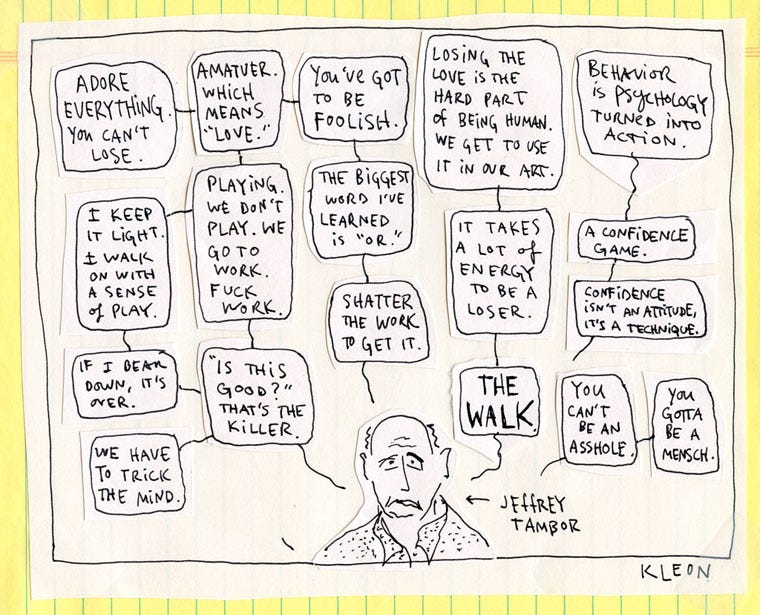
6. Visuals help you remember

Make a diagram or a drawing. This can sometimes convey information more effectively than words alone. Austin Kleon is really good at this. He draws cartoons to help him capture notes from certain events.

Austin’s drawing from a talk by actor Jeffrey Tambor:
7. Leave white space

Don’t cram everything together. Leave room in your notes to add in more details later, annotate, or for summaries. White space makes notes easier to navigate and less overwhelming.

8. Use all your senses

Read your notes aloud. Draw like above. Make a chart. Maybe create a voice file. This will help you remember them, especially if you’re taking a test or exam.

9. Organize and store your notes so you can find them again

Regularly compile and organize your notes in digital folders or physical notebooks. Clearly date your notes, the location, and who was talking or the book title. All the note-taking tools are completely out of control, so do what works for you. I use a mix of Google Keep and Notion, but nothing is dogmatic.

Remember, note-taking is a skill, and like any skill, it improves with practice and adaptation to what suits you best.

Experiment! And see what works for you.

Try this quick note-taking template and cheat sheet for free and get my newsletter every Saturday.

Notes
Notetaking
Self Improvement
Productivity
Productivity Hacks
Recommended from ReadMedium